Page 2 of 5
1 2 3 4 5
bluetooth low energy Archives - Page 2 of 5 - BLE App Developers
BLE App Developers Navbar

Tag: bluetooth low energy

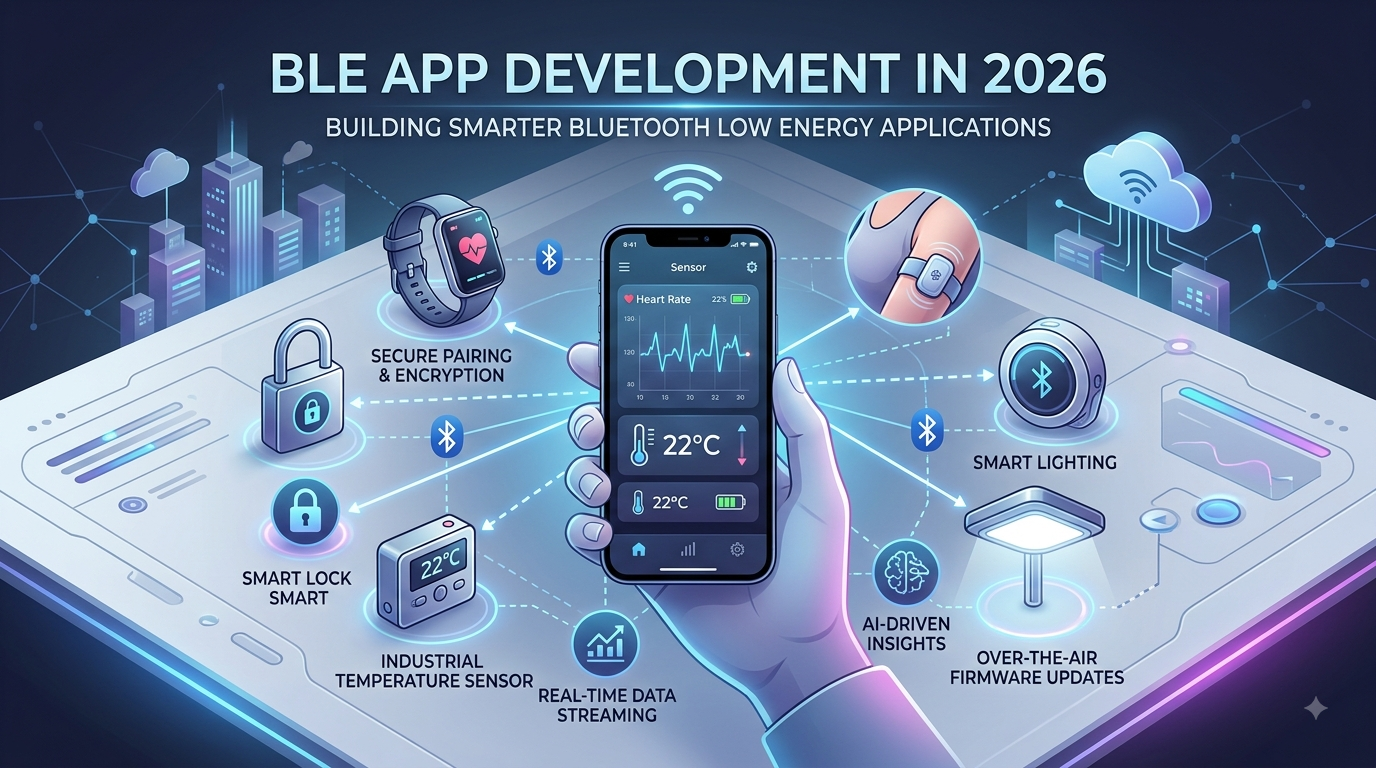
  • BLE App Development in 2026: Building Secure and Scalable Bluetooth Low Energy Applications

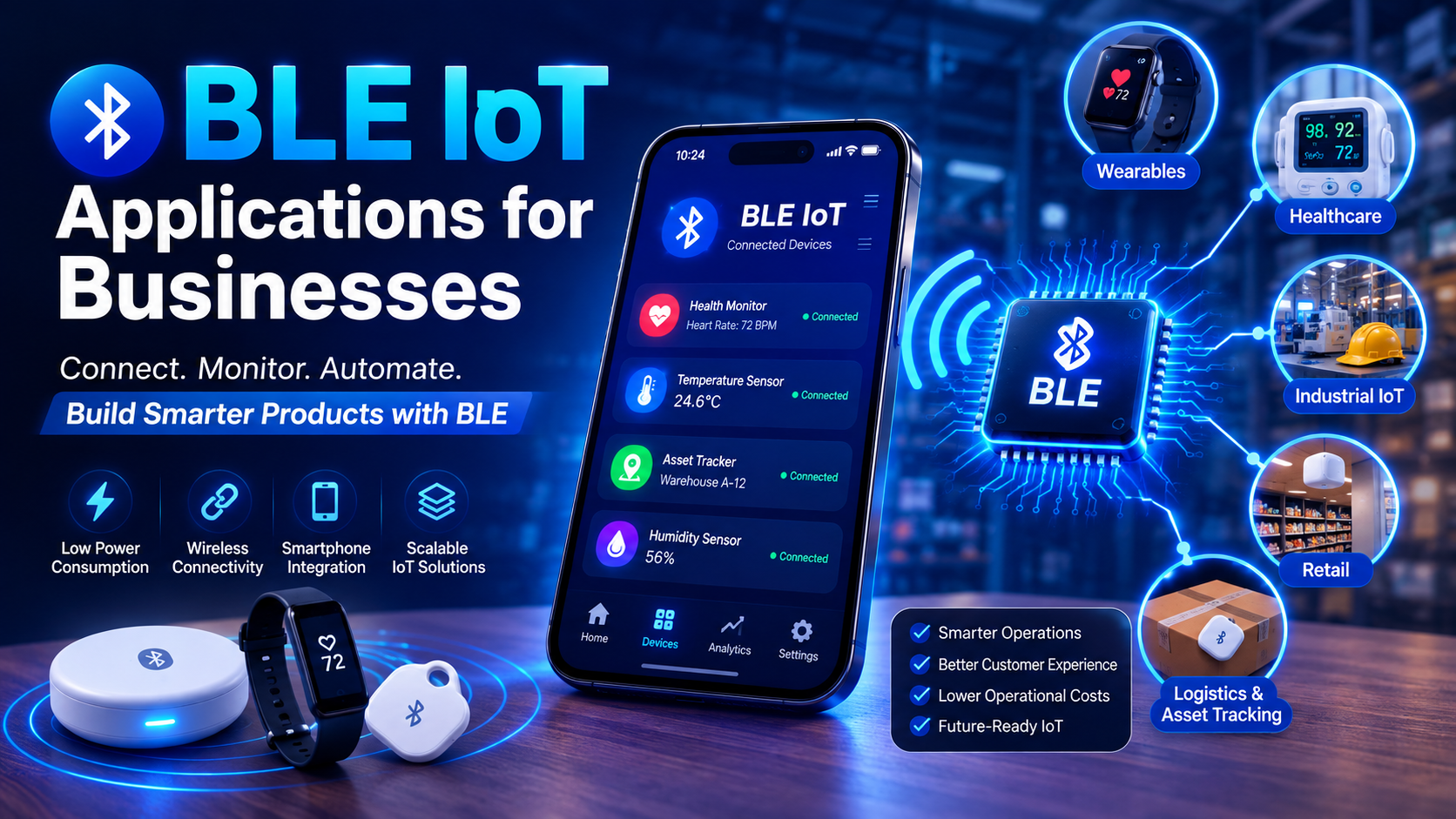
    Bluetooth Low Energy (BLE) has become an important connectivity technology for modern mobile applications, IoT products, wearables, healthcare devices, smart home products, industrial equipment, and connected consumer products.

    Unlike traditional Bluetooth, BLE is designed for applications where devices need to communicate while maintaining relatively low power consumption.

    This makes BLE particularly useful for battery-powered products that need to exchange information with smartphones, tablets, gateways, or other connected systems.

    However, successful BLE app development involves much more than connecting a mobile phone to a Bluetooth device.

    A production-ready BLE application may require device discovery, pairing, GATT communication, background connectivity, firmware integration, data synchronization, cloud APIs, security, device management, and a carefully designed mobile user experience.

    What Is BLE App Development?

    BLE app development is the process of creating mobile or software applications that communicate with Bluetooth Low Energy devices.

    A BLE application can communicate with:

    • Sensors
    • Fitness trackers
    • Smartwatches
    • Medical devices
    • Industrial equipment
    • Beacons
    • Smart locks
    • Wearable devices
    • Smart home products
    • Asset trackers
    • Connected consumer electronics

    A typical BLE ecosystem may look like:

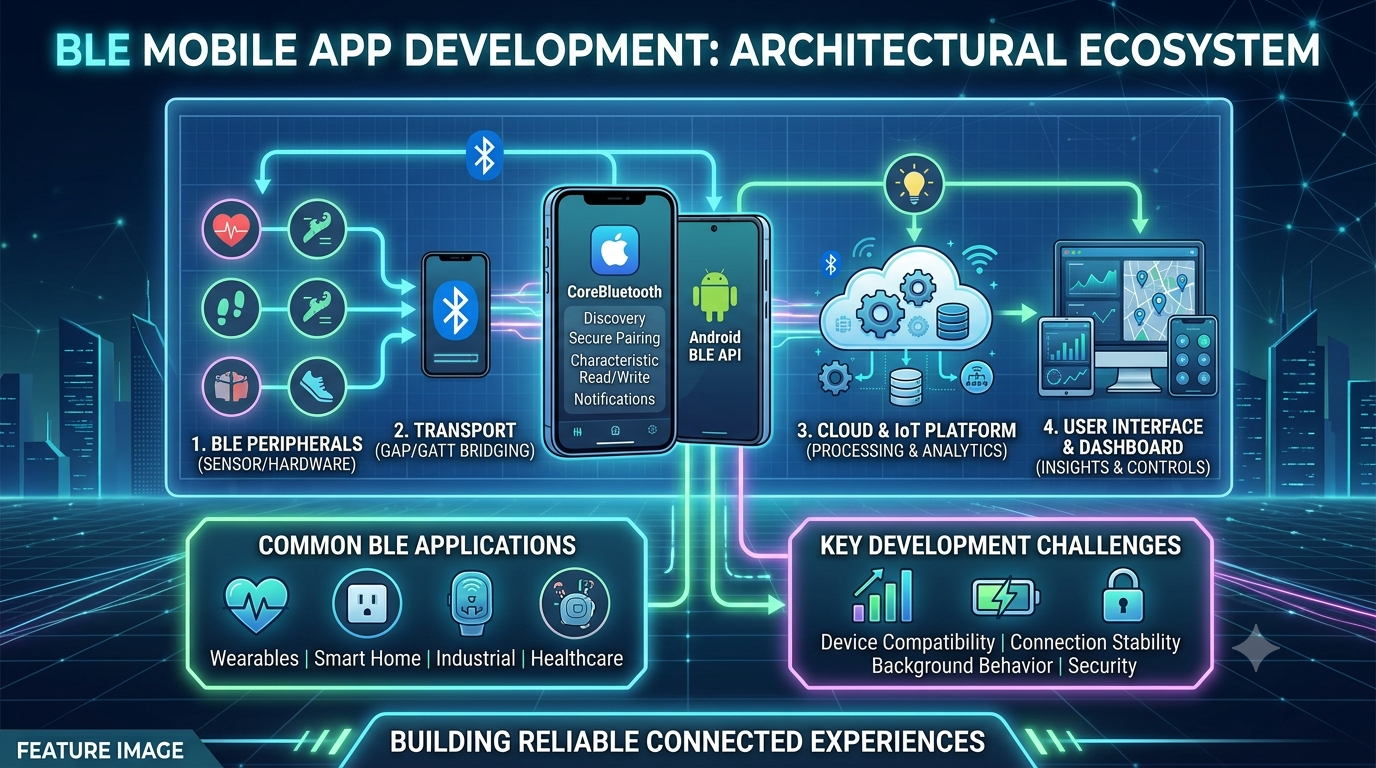
    BLE Device → Bluetooth Connection → Mobile Application → Backend API → Cloud Platform

    Depending on the product, the mobile application may also control the BLE device.

    For example:

    Mobile App → BLE Command → Connected Device → Sensor Data → Mobile App

    This two-way communication allows applications to monitor and control connected products.

    How Does Bluetooth Low Energy Work?

    BLE uses a client-server communication model based around the Generic Attribute Profile (GATT).

    A BLE device typically exposes services and characteristics.

    BLE Services

    A service groups related functionality.

    For example, a smart fitness device might provide:

    • Heart-rate service
    • Battery service
    • Device information service
    • Activity service

    BLE Characteristics

    Characteristics contain data or provide a way to interact with a BLE device.

    A characteristic can be used to:

    • Read data
    • Write data
    • Receive notifications
    • Receive indications

    For example:

    Service → Temperature Characteristic → Sensor Reading

    The mobile application can discover the available services and characteristics and then communicate with the device according to its BLE protocol.

    BLE App Development for iOS and Android

    BLE applications are commonly developed for both major mobile platforms.

    BLE App Development for iOS

    iOS applications can use Apple’s Core Bluetooth framework to communicate with BLE peripherals.

    Typical functionality includes:

    • Scanning for BLE devices
    • Connecting to peripherals
    • Discovering services
    • Discovering characteristics
    • Reading characteristics
    • Writing values
    • Receiving notifications
    • Managing connection states

    The application must also account for Apple’s permissions and background execution rules.

    BLE App Development for Android

    Android provides Bluetooth APIs for BLE communication.

    An Android BLE application may need to handle:

    • Bluetooth permissions
    • Device scanning
    • GATT connections
    • Service discovery
    • Characteristic reads
    • Characteristic writes
    • Notifications
    • Connection management

    Android versions and device manufacturers can introduce differences that should be considered during testing.

    BLE Device Integration

    One of the most important parts of BLE application development is understanding the device’s communication protocol.

    The mobile application needs to know:

    • Device advertising behavior
    • Service UUIDs
    • Characteristic UUIDs
    • Data formats
    • Commands
    • Response formats
    • Notification behavior
    • Connection requirements
    • Authentication mechanisms

    For a custom BLE product, the firmware and mobile application should be designed together whenever possible.

    This helps ensure that the hardware, firmware, and mobile application use a consistent communication protocol.

    BLE GATT Architecture

    GATT provides the structure through which BLE devices expose their data and functionality.

    A simplified architecture is:

    BLE Peripheral

    → Service

    → Characteristic

    → Descriptor

    The mobile application acts as a GATT client and communicates with the BLE peripheral.

    For example:

    Device Information Service

    • Manufacturer Name
    • Model Number
    • Firmware Version

    Battery Service

    • Battery Level

    Custom Service

    • Device Status
    • Configuration
    • Sensor Data
    • Control Commands

    Custom BLE services are particularly useful when developing proprietary connected products.

    BLE Data Communication

    BLE applications may use several communication operations.

    Read

    The application requests information from a characteristic.

    Example:

    App → Read Battery Level → BLE Device → 85%

    Write

    The application sends a value or command to the BLE device.

    Example:

    App → Write Command → BLE Device → Change Operating Mode

    Notify

    The BLE device sends updated information to the application when the value changes.

    Example:

    Temperature Changes → BLE Device → Notification → Mobile App

    Indicate

    Indications provide a mechanism for acknowledged updates between the BLE device and client.

    The communication method should be selected according to the application’s requirements.

    BLE App Development for IoT

    BLE is frequently used as part of larger IoT architectures.

    For example:

    BLE Sensors → Mobile App/Gateway → Cloud → Web Dashboard

    BLE can provide short-range communication while the gateway or smartphone provides internet connectivity.

    This architecture can be useful for:

    • Industrial sensors
    • Smart buildings
    • Asset tracking
    • Healthcare devices
    • Wearables
    • Retail systems
    • Connected equipment

    BLE can therefore serve as the local connectivity layer within a broader IoT platform.

    BLE Gateway Development

    A gateway can connect BLE devices to cloud infrastructure.

    For example:

    Multiple BLE Sensors → Gateway → Internet → Cloud Platform

    The gateway can:

    • Scan for BLE devices
    • Connect to multiple peripherals
    • Collect sensor data
    • Process information locally
    • Authenticate devices
    • Forward data to APIs
    • Store data temporarily during connectivity problems

    This can be particularly useful in industrial and commercial environments where many BLE devices need centralized monitoring.

    BLE and Mobile Applications

    The mobile application can provide a user-friendly interface for connected hardware.

    A BLE application may allow users to:

    • Discover devices
    • Connect devices
    • Configure settings
    • Monitor sensor data
    • Control hardware
    • Update device configuration
    • View historical information
    • Receive alerts
    • Manage multiple devices

    For consumer products, the mobile app may become the primary interface between the customer and the physical product.

    BLE Firmware Integration

    A BLE mobile application cannot work independently of the device firmware.

    The firmware determines:

    • BLE advertising
    • Services
    • Characteristics
    • Data formats
    • Commands
    • Connection behavior
    • Security mechanisms
    • Power management

    The mobile application must implement the corresponding communication protocol.

    For example:

    Mobile App Command

    SET_MODE:01

    ↓

    BLE Characteristic

    ↓

    Firmware

    ↓

    Device Changes Operating Mode

    A clearly documented BLE protocol can make development and long-term maintenance easier.

    BLE Security

    Security should be considered from the beginning of BLE application development.

    Depending on the product, security measures may include:

    • Device authentication
    • Secure pairing
    • Encrypted communication
    • Application authentication
    • Access control
    • Secure firmware updates
    • Secure cloud APIs
    • Device identity management

    Developers should also consider what happens if an unauthorized device attempts to connect.

    For products controlling physical equipment, weak BLE security could potentially allow unauthorized commands to reach the device.

    BLE Background Connectivity

    Some applications need to communicate with BLE devices while the application is not actively visible.

    Examples include:

    • Fitness trackers
    • Healthcare devices
    • Smart home products
    • Location systems
    • Background sensor monitoring

    Background BLE behavior differs between operating systems and depends on platform policies.

    Therefore, background connectivity should be treated as an architectural requirement rather than something added at the end of development.

    BLE and Cloud Integration

    BLE applications can connect local devices with cloud platforms.

    A typical architecture can be:

    BLE Device → Mobile App → REST API → Cloud Database → Web Dashboard

    The cloud platform can provide:

    • User accounts
    • Device management
    • Data storage
    • Analytics
    • Notifications
    • Remote configuration
    • Device history
    • Reporting

    This allows businesses to turn a local BLE product into a connected software ecosystem.

    BLE App Development Use Cases

    BLE technology can support applications across many industries.

    Healthcare

    BLE can connect:

    • Wearable health devices
    • Patient monitoring devices
    • Fitness equipment
    • Medical sensors
    • Connected diagnostic products

    Healthcare applications require careful consideration of privacy, security, reliability, and regulatory requirements.

    Fitness and Wearables

    BLE is widely suited to battery-powered wearable products.

    Applications can include:

    • Fitness trackers
    • Smartwatches
    • Heart-rate devices
    • Cycling sensors
    • Sports equipment
    • Activity monitors

    Smart Home

    BLE can support device configuration and local communication for:

    • Smart locks
    • Sensors
    • Lighting products
    • Home appliances
    • Security devices

    Industrial IoT

    Industrial BLE applications can connect:

    • Equipment sensors
    • Machine-monitoring devices
    • Asset trackers
    • Environmental sensors
    • Maintenance tools

    Retail

    BLE can support:

    • Beacons
    • Asset tracking
    • Inventory systems
    • Smart retail devices
    • Customer engagement systems

    Automotive

    BLE applications can be used for certain connected vehicle and accessory experiences, depending on the product architecture.

    Common BLE Development Challenges

    BLE development can present challenges that are not usually found in conventional mobile applications.

    Device Compatibility

    Different phones and operating-system versions can behave differently.

    Testing should therefore include multiple devices.

    Connection Reliability

    BLE connections can be affected by:

    • Distance
    • Interference
    • Device state
    • Radio environment
    • Operating-system restrictions
    • Power management

    The application should gracefully handle connection failures and reconnection attempts.

    Data Synchronization

    Applications need a strategy for handling data when a BLE connection is interrupted.

    For example:

    Device Offline → Local Data Storage → Reconnection → Data Synchronization

    Battery Consumption

    Continuous scanning or communication can consume significant battery power.

    Developers should optimize:

    • Scan intervals
    • Connection intervals
    • Data frequency
    • Notifications
    • Background operations

    Firmware Compatibility

    A mobile application may need to communicate with multiple firmware versions.

    Version management and backward compatibility should therefore be considered.

    BLE Firmware Over-the-Air Updates

    Connected products may require firmware updates after deployment.

    A BLE application can sometimes act as the communication channel for firmware updates.

    A simplified process is:

    Firmware File → Mobile App → BLE Transfer → Device → Firmware Verification → Update

    Firmware update systems need careful design because interrupted or invalid updates can affect device availability.

    For production systems, developers should consider:

    • Update authentication
    • Firmware integrity
    • Version management
    • Recovery mechanisms
    • Interrupted transfers
    • Rollback strategies

    BLE App Development Process

    A structured development process can reduce technical risks.

    Step 1: Define the Product

    Identify:

    • Device type
    • Target users
    • Mobile platforms
    • Required BLE functions
    • Data requirements
    • Cloud requirements

    Step 2: Define the BLE Protocol

    Document:

    • Services
    • Characteristics
    • UUIDs
    • Commands
    • Data formats
    • Error responses
    • Authentication

    Step 3: Develop a Proof of Concept

    Test the fundamental communication between the mobile application and BLE device.

    Step 4: Develop the Mobile Application

    Implement:

    • Scanning
    • Pairing/connection
    • Service discovery
    • Data communication
    • Device control
    • Error handling

    Step 5: Integrate Cloud Services

    Add backend APIs, user accounts, data storage, analytics, and dashboards where required.

    Step 6: Test Real Devices

    Test across:

    • iOS devices
    • Android devices
    • BLE hardware versions
    • Different operating-system versions
    • Different physical environments

    Step 7: Launch and Maintain

    Continue supporting:

    • OS updates
    • Firmware updates
    • Security improvements
    • Bug fixes
    • Device compatibility
    • Backend improvements

    How to Choose a BLE App Development Company

    Businesses planning a connected product should evaluate the development team’s experience across both software and hardware communication.

    Consider the following areas.

    BLE Experience

    Ask whether the team has worked with real BLE devices and custom GATT protocols.

    Mobile Development

    Check experience with both iOS and Android BLE applications if cross-platform support is required.

    Firmware Knowledge

    For custom hardware, firmware knowledge can make integration significantly easier.

    IoT Experience

    If the BLE product will connect to cloud infrastructure, look for experience with IoT platforms, gateways, APIs, and device management.

    Security

    Ask how the development team handles BLE authentication, secure communication, APIs, and device security.

    Testing

    BLE products need testing on real hardware rather than only simulators.

    Long-Term Support

    Connected products may require ongoing firmware, mobile application, backend, and security updates.

    Future of BLE App Development

    BLE is becoming part of increasingly sophisticated connected-product ecosystems.

    Future BLE applications may combine:

    • BLE
    • Edge computing
    • IoT cloud platforms
    • AI analytics
    • Digital twins
    • Wearable technology
    • Smart sensors
    • Real-time monitoring
    • Device automation

    Instead of using BLE simply to transfer data between two devices, businesses can use BLE as one layer within a larger connected ecosystem.

    For example:

    BLE Sensor → Mobile/Gateway → Cloud → AI Analytics → Automated Action

    This architecture can transform raw device data into useful business intelligence.

    Conclusion

    BLE app development is an important part of the modern connected-device ecosystem.

    A successful BLE application requires more than Bluetooth connectivity. Developers need to consider GATT architecture, device protocols, mobile operating systems, firmware, sec
  • BLE App Development in 2026: How to Build Bluetooth Low Energy Apps for iOS and Android

    Bluetooth Low Energy (BLE) has become an important technology for connecting smartphones with smart devices, sensors, wearables, medical equipment, industrial products, and connected consumer electronics.

    Unlike traditional Bluetooth applications that often focus on continuous data transfer, BLE is designed for efficient, low-power communication. This makes it particularly useful for battery-powered devices that need to communicate with mobile applications.

    In 2026, businesses are using BLE app development to create connected products across healthcare, fitness, industrial IoT, smart homes, retail, logistics, automotive, and consumer electronics.

    A modern BLE application can do much more than simply connect to a Bluetooth device. It can discover devices, establish secure connections, exchange data, configure hardware, synchronize information with the cloud, support OTA updates, and provide real-time device monitoring.

    What Is BLE App Development?

    BLE app development is the process of creating mobile applications that communicate with Bluetooth Low Energy devices.

    A BLE mobile application can interact with:

    • BLE sensors
    • Wearables
    • Smartwatches
    • Medical devices
    • Fitness equipment
    • Industrial equipment
    • IoT devices
    • Beacons
    • Smart-home products
    • Connected consumer electronics

    A typical architecture is:

    BLE Device → Mobile Application → Cloud Platform → Business Dashboard

    The mobile application acts as a communication layer between the physical device and software ecosystem.

    How Does a BLE App Work?

    A BLE application generally follows a sequence of steps.

    1. Device Discovery

    The application scans for nearby BLE devices.

    The scan may identify devices based on:

    • Device name
    • MAC-related identifiers where applicable
    • Service UUID
    • Manufacturer data
    • Signal strength

    2. Device Connection

    After identifying the correct peripheral, the application establishes a BLE connection.

    3. Service Discovery

    The application discovers the services and characteristics exposed by the BLE device.

    4. Data Exchange

    The app can perform operations such as:

    • Read
    • Write
    • Notify
    • Subscribe
    • Configure
    • Control

    5. Cloud Synchronization

    If required, the application can send device data to a backend or cloud platform.

    This creates an architecture such as:

    BLE Device → iOS/Android App → API → Cloud → Dashboard

    Why Businesses Choose BLE for Mobile Applications

    BLE offers several advantages for connected products.

    Low Power Consumption

    BLE is designed for low-power communication, making it suitable for battery-operated devices.

    Smartphone Compatibility

    BLE is supported by modern smartphones, making mobile devices practical gateways for many connected products.

    Short-Range Communication

    BLE is useful when devices need to communicate within a local area.

    Flexible Data Exchange

    Custom BLE services and characteristics can be designed around the specific communication requirements of a product.

    IoT Integration

    BLE applications can connect physical devices to cloud platforms and larger IoT ecosystems.

    BLE App Development for iOS

    Apple devices provide BLE functionality through the Core Bluetooth framework.

    A BLE application for iPhone or iPad can perform tasks such as:

    • Scan for peripherals
    • Connect to devices
    • Discover services
    • Discover characteristics
    • Read values
    • Write values
    • Subscribe to notifications
    • Monitor connection status
    • Manage device interactions

    However, iOS BLE applications need to follow Apple’s platform requirements, including appropriate Bluetooth permissions and background-execution rules.

    iOS BLE App Architecture

    A typical architecture can be:

    BLE Peripheral → Core Bluetooth → iOS App → Backend API → Cloud

    For example, a wearable could send sensor readings to an iPhone, and the application could synchronize selected information with a cloud platform.

    BLE App Development for Android

    Android also provides APIs for BLE communication.

    An Android BLE application can support:

    • Device scanning
    • Connection management
    • Service discovery
    • Characteristic reads
    • Characteristic writes
    • Notifications
    • Device configuration
    • Data synchronization

    Android development requires careful handling of Bluetooth permissions and differences between supported Android versions and devices.

    Android BLE App Architecture

    A typical architecture is:

    BLE Device → Android App → REST/API Layer → Cloud Platform

    For businesses supporting both major mobile platforms, testing should be performed across representative iOS and Android devices.

    Key Features of a BLE Mobile App

    1. BLE Device Scanning

    The app searches for nearby devices and identifies compatible peripherals.

    The application can filter devices using service information or manufacturer-specific advertising data.

    2. Automatic Device Connection

    The application can reconnect to previously configured devices when appropriate.

    This can improve the user experience for products that are frequently used with the same smartphone.

    3. GATT Service Integration

    BLE applications commonly communicate through the Generic Attribute Profile (GATT).

    A custom device may expose services such as:

    Device Service

    • Battery Characteristic
    • Status Characteristic
    • Temperature Characteristic
    • Configuration Characteristic
    • Command Characteristic

    The mobile application can interact with these characteristics according to the product’s communication protocol.

    4. Real-Time Notifications

    BLE notifications allow a peripheral to send updated information to the application without requiring the application to repeatedly request the same value.

    This is useful for:

    • Sensor monitoring
    • Fitness devices
    • Wearables
    • Medical equipment
    • Industrial devices

    5. Device Configuration

    A mobile application can provide an interface for configuring connected hardware.

    For example, users may be able to change:

    • Device settings
    • Sampling frequency
    • Thresholds
    • Operating modes
    • User preferences

    6. Firmware Updates

    BLE applications can also support Over-the-Air (OTA) firmware updates.

    A typical workflow is:

    Firmware File → Mobile App → BLE → Device → Firmware Verification → Update

    OTA functionality should be designed with appropriate integrity checks, authentication, interruption handling, and recovery mechanisms.

    7. Cloud Integration

    A BLE app can connect local device data with a cloud platform.

    For example:

    BLE Sensor → Mobile App → API → Cloud Database → Analytics Dashboard

    This allows businesses to monitor devices beyond the local Bluetooth connection.

    BLE Apps for IoT

    BLE and IoT frequently work together.

    A smartphone can serve as a temporary gateway between BLE devices and internet services.

    For example:

    BLE Sensor

    ↓

    Mobile Application

    ↓

    Wi-Fi/5G

    ↓

    Cloud Platform

    ↓

    Business Dashboard

    For larger deployments, a dedicated BLE gateway may replace the smartphone.

    BLE App Development for Wearables

    Wearable technology is one of the major BLE application categories.

    BLE apps can connect with:

    • Fitness trackers
    • Smartwatches
    • Health monitors
    • Sports equipment
    • Industrial wearables
    • Smart accessories

    Applications can display real-time information, synchronize historical data, configure device settings, and transfer information to cloud platforms.

    BLE Healthcare App Development

    BLE can support communication between mobile applications and various connected healthcare devices.

    Potential applications include:

    • Health monitoring
    • Fitness tracking
    • Connected medical equipment
    • Patient monitoring
    • Wellness devices
    • Rehabilitation equipment

    Healthcare applications require careful consideration of data privacy, security, reliability, and applicable regulatory requirements.

    BLE Industrial Applications

    Industrial businesses can use BLE apps to communicate with equipment and sensors.

    Examples include:

    • Machine monitoring
    • Equipment configuration
    • Sensor readings
    • Asset tracking
    • Maintenance applications
    • Field-service tools
    • Industrial diagnostics

    A technician could use a mobile BLE application to connect to equipment, retrieve diagnostic information, modify authorized settings, and synchronize the results with a central system.

    BLE App Security

    Security should be incorporated into the BLE application architecture from the beginning.

    Important areas include:

    Secure Pairing

    The appropriate BLE pairing and authentication approach should be selected based on the product’s security requirements.

    Encryption

    BLE provides security mechanisms for protecting communication when configured appropriately.

    Application Authentication

    The mobile application should authenticate users where required.

    API Security

    When BLE data is transferred to a cloud platform, APIs should use appropriate authentication and authorization mechanisms.

    Device Authorization

    A system should determine which users are allowed to access which devices.

    For example:

    User A → Device A

    User B → Device B

    Administrator → Authorized Device Group

    This is especially important for enterprise IoT deployments.

    BLE App Development Challenges

    BLE applications can be more complex than standard mobile applications because the software interacts with physical hardware.

    Common challenges include:

    Connection Reliability

    Connections can be affected by distance, interference, device state, operating-system behavior, and hardware differences.

    Background Operation

    iOS and Android impose platform-specific restrictions on background Bluetooth behavior.

    Device Compatibility

    Different smartphones can behave differently with Bluetooth hardware and operating-system versions.

    Battery Optimization

    Both the BLE peripheral and mobile application need to manage power efficiently.

    Data Synchronization

    The application needs to handle cases where a device temporarily loses connection.

    Firmware Compatibility

    Mobile applications and device firmware must remain compatible as products evolve.

    BLE App Development Process

    Step 1: Define the Product

    The first step is understanding:

    • What device will the app connect to?
    • What data will be exchanged?
    • How frequently will communication occur?
    • Is cloud connectivity required?
    • Is OTA firmware updating required?
    • Will the application support iOS, Android, or both?

    Step 2: Define the BLE Protocol

    The development team defines:

    • Services
    • Characteristics
    • UUIDs
    • Data formats
    • Commands
    • Notifications
    • Error responses
    • Security requirements

    Step 3: Design the Mobile UX

    The interface should make device connectivity easy for users.

    Typical screens can include:

    • Device discovery
    • Device pairing
    • Connection status
    • Device dashboard
    • Settings
    • Sensor data
    • Firmware updates
    • User account

    Step 4: Develop the BLE Layer

    Developers implement:

    • Scanning
    • Connection
    • Service discovery
    • Characteristic operations
    • Notifications
    • Reconnection
    • Error handling

    Step 5: Integrate the Backend

    If cloud functionality is required, the app can connect with backend APIs for:

    • User accounts
    • Device registration
    • Data synchronization
    • Analytics
    • Notifications
    • Device management

    Step 6: Implement Security

    Security measures should be integrated across:

    • BLE communication
    • Mobile application
    • APIs
    • Cloud infrastructure
    • Device authentication

    Step 7: Test With Real Hardware

    BLE applications should be tested with actual devices.

    Testing can include:

    • Connection range
    • Reconnection
    • Interference
    • Battery consumption
    • Background behavior
    • Multiple devices
    • Firmware compatibility
    • iOS devices
    • Android devices

    BLE App Development Cost

    The cost of developing a BLE mobile application depends on the complexity of the connected product.

    Major factors include:

    • iOS development
    • Android development
    • BLE protocol complexity
    • Custom GATT services
    • Hardware integration
    • Firmware development
    • Cloud backend
    • Admin dashboard
    • OTA updates
    • Security requirements
    • Third-party integrations
    • Testing requirements

    A simple BLE control application can be considerably less complex than an enterprise application connected to hundreds or thousands of devices.

    Why Choose a BLE App Development Company?

    BLE projects require knowledge across both software and hardware ecosystems.

    A development team may need expertise in:

    • iOS BLE development
    • Android BLE development
    • Bluetooth Low Energy
    • GATT
    • Embedded systems
    • Firmware
    • IoT
    • Cloud APIs
    • Security
    • OTA updates

    A BLE-focused development partner can help businesses connect their physical products with mobile and cloud applications.

    BLEAppDeveloper for Custom BLE Applications

    BLEAppDeveloper focuses on custom Bluetooth Low Energy application development for businesses building connected products.

    Services can include:

    • BLE iOS app development
    • BLE Android app development
    • Cross-platform BLE applications
    • Custom GATT integration
    • BLE device integration
    • IoT application development
    • BLE gateway integration
    • Firmware communication
    • OTA update functionality
    • Cloud integration
    • BLE application testing

    The development approach can be tailored to the requirements of the hardware, communication protocol, mobile platform, and backend architecture.

    Frequently Asked Questions

    What is a BLE app?

    A BLE app is a mobile application designed to communicate with Bluetooth Low Energy devices such as sensors, wearables, medical devices, and IoT products.

    Can BLE apps work on both iOS and Android?

    Yes. BLE applications can be developed for both iOS and Android using their respective Bluetooth APIs and platform capabilities.

    Can a BLE app connect to multiple devices?

    Yes, depending on the application’s architecture, hardware capabilities, operating-system behavior, and communication requirements.

    Can BLE apps connect to the cloud?

    Yes. A mobile application can receive information from BLE devices and send selected data to cloud services through an internet connection.

    Can BLE apps update device firmware?

    Yes. BLE can be used as a communication channel for OTA firmware updates when the hardware and firmware architecture support it.

    How much does BLE app development cost?

    The cost depends on the BLE protocol, hardware, number of platforms, backend requirements, security, OTA functionality, and overall application complexity.

    How long does it take to build a BLE app?

    Development time varies according to the scope. A basic BLE application can be developed faster than a complete product involving custom hardware, firmware, cloud services, analytics, and OTA updates.

    Conclusion

    BLE app development is becoming an important part of connected-product development.

    From wearables and healthcare devices to industrial equipment, smart-home products, sensors, and IoT systems, BLE allows mobile applications to communicate efficiently with physical devices.

    A successful BLE application requires more than implementing a Bluetooth connection. Developers need to consider GATT architecture, device discovery, connection management, security, mobile-platform behavior, firmware compatibility, cloud integration, testing, and long-term scalability.

    Businesses planning a connected product can use a specialized BLE app development company to build the mobile application and integrate it with the underlying hardware, firmware, IoT platform, and cloud infrastructure.

    BLEAppDeveloper helps businesses develop custom BLE applications for iOS, Android, IoT, wearables, sensors, and connected products.

  • Mobile Architecture for Hardware Integration: The Guide for BLE App Developers

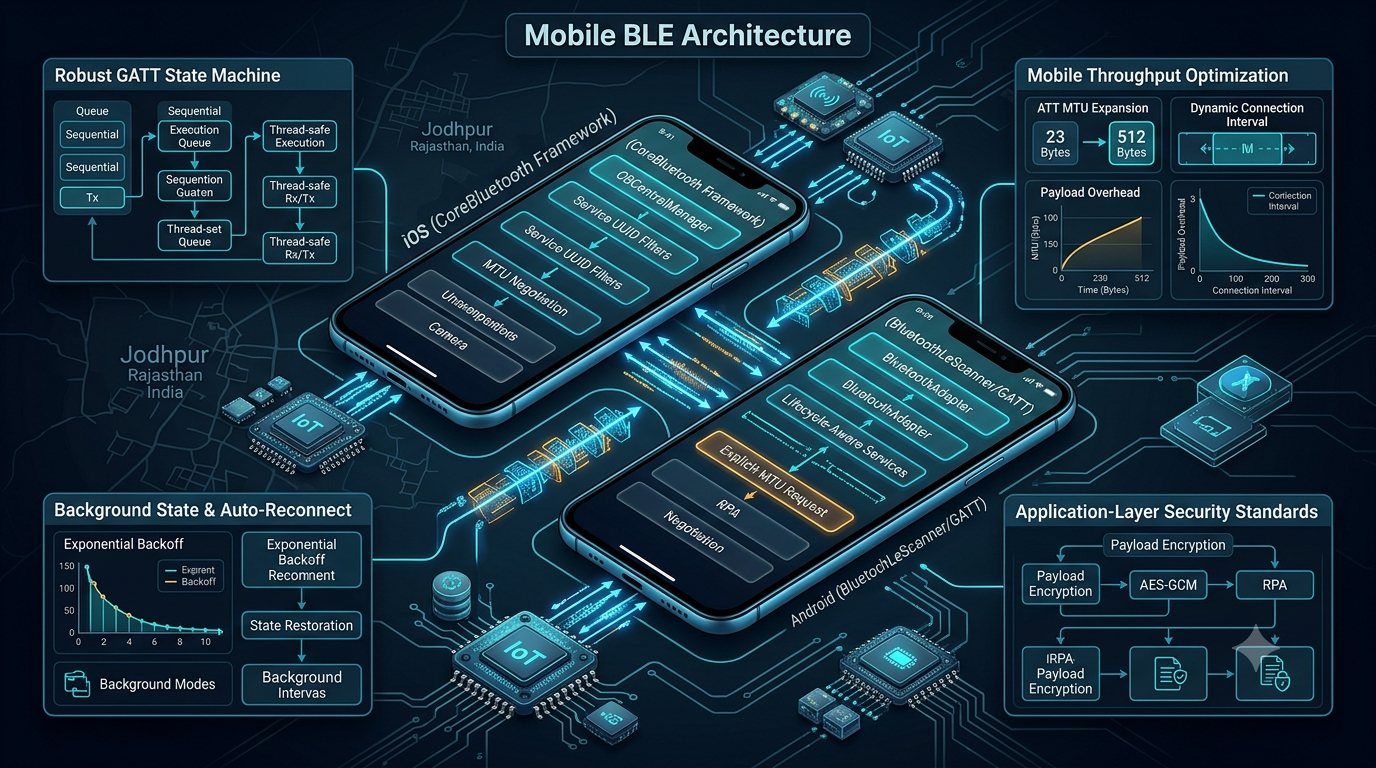
    Integrating physical hardware peripherals with native mobile applications requires bridging two radically different execution environments: the constrained, deterministic world of embedded microcontrollers and the high-level, lifecycle-managed environment of iOS and Android OS.

    For the modern BLE App Developer (bleappdeveloper), delivering resilient connected-product experiences demands mastering GATT state machines, throughput negotiation, OS background execution modes, and fault-tolerant reconnection logic.

    The Cross-Platform BLE Engineering Framework

    Mobile OS vendors enforce strict abstraction layers over Bluetooth radios. Building production apps requires handling distinct stack behaviors between Apple CoreBluetooth and Android BluetoothLeScanner/GATT drivers.

    Engineering DomainiOS (CoreBluetooth)Android (Android.Bluetooth)Production Best Practice
    Central State LifecycleCBCentralManager state restoration keys.BluetoothAdapter & lifecycle-aware foreground services.Handle OS-level state changes gracefully without losing background subscriptions.
    Device DiscoveryService UUID filtering via scanForPeripherals.ScanFilter with ScanSettings.SCAN_MODE_LOW_LATENCY.Always filter by target Service UUIDs to preserve mobile battery and radio performance.
    MTU & ThroughputAuto-negotiates max MTU (up to 185–512 bytes).Explicit request via gatt.requestMtu(512).Right-size ATT MTU immediately post-connection to maximize data packet payload size.
    Connection ParametersMinimum interval constrained to ~15ms by iOS.Supports short intervals down to 7.5ms.Dynamically adjust connection intervals: low latency for data transfers, high interval for idle.
    Permissions FrameworkNSBluetoothAlwaysUsageDescription.BLUETOOTH_SCAN, BLUETOOTH_CONNECT, fine location.Request runtime permissions with clear fallback UI states when Bluetooth is disabled.

    Core Engineering Patterns for BLE Mobile Apps

    1. Robust GATT Connection State Machine

    A common failure point in mobile-BLE applications is assuming a linear connection flow. Peripheral connections drop due to radio interference, range variations, or unexpected OS thread suspension.

    • Sequential Execution Queues: Native BLE stacks do not support concurrent operations. Implement thread-safe queues (e.g., ReactiveX, Kotlin Coroutines, or Swift Actor patterns) to ensure GATT operations (read, write, notify) run sequentially.
    • Service & Characteristic Discovery Caching: Avoid redundant service discovery calls on re-connection. Cache GATT characteristic handles to reduce connection setup time and save battery power.
    • Indication vs. Notification Strategy: Favor NOTIFY over INDICATE for continuous telemetry streams to avoid waiting for application-layer acknowledgments over the air, reserving INDICATE strictly for critical state changes.
    ┌─────────────────────────────────────────────────────────────┐
    │                 GATT STATE MACHINE EXECUTION                │
    ├─────────────────────────────────────────────────────────────┤
    │ Disconnected ──> Scanning (UUID Filtered)                   │
    │                       │                                     │
    │                       ▼                                     │
    │ Connecting ──> MTU Negotiation (Request 512 Bytes)          │
    │                       │                                     │
    │                       ▼                                     │
    │ Discover Services ──> Subscribe to Notifications (CCC)      │
    │                       │                                     │
    │                       ▼                                     │
    │ Connected State <─── Ready for Data Queue (Rx/Tx)           │
    └─────────────────────────────────────────────────────────────┘
    

    2. Mobile Throughput Optimization

    Achieving maximum throughput (e.g., during Over-the-Air firmware updates or high-frequency sensor streams) requires tuning three key parameters:

    • ATT MTU Expansion: Default BLE ATT MTU is only 23 bytes (leaving 20 bytes for actual payload). Expanding the MTU to 512 bytes reduces packet framing overhead by up to 80%.
    • Connection Interval Negotiation: Requesting a 15ms connection interval increases packet bursts per second from the central device.
    • Write Without Response (WRITE_NO_RESPONSE): Offload high-volume data pushes to unacknowledged write commands, handling packet integrity checks at the application protocol layer instead of waiting for a GATT layer ACK every cycle.

    3. Background Execution & Auto-Reconnection Strategy

    Mobile operating systems aggressively kill background apps or suspend radio polling to extend smartphone battery life.

    • iOS Background Modes: Declare bluetooth-central background execution modes and supply restoration identifiers (CBCentralManagerOptionRestoreIdentifierKey) so iOS can re-instantiate your manager state upon background event triggers.
    • Android Foreground Services: Wrap active BLE sessions in a persistent Android Foreground Service bound to an active OS notification to protect the connection thread from memory management kills.
    • Exponential Backoff Reconnection: Implement auto-reconnect loops that scale attempt intervals exponentially (1s,2s,4s,8s,16s…) to prevent radio saturation when the physical hardware is out of range.

    Application-Layer Security Standards

    Wireless security cannot rely solely on basic BLE pairing or “Just Works” passkeys. Modern BLE mobile architectures enforce multi-layered security:

    • App-Layer Payload Encryption: Encrypt sensitive telemetry payloads with AES-GCM or ChaCha20-Poly1305 at the application layer before writing data to GATT characteristics.
    • Challenge-Response Authentication: Exchange ephemeral session tokens over secure channels upon initial connection before unlocking control characteristics.
    • Resolvable Private Addresses (RPA): Enforce MAC address rotation on the peripheral hardware to protect user privacy against physical location tracking.

    Modern Development Pipelines for BLE Mobile Systems

    Building reliable BLE applications requires pairing clean native mobile code with physical hardware testing pipelines. By combining structured GATT queues, dynamic connection parameter tuning, robust background state restoration, and robust encryption, BLE app developers build seamless mobile-to-hardware ecosystems that perform predictably in real-world environments.

  • BLE App Development in 2026: How Bluetooth Apps Are Connecting Smart Devices

    Bluetooth Low Energy has become an important technology for modern connected products.

    From smartwatches and fitness trackers to healthcare devices, industrial sensors, smart home products, and retail technology, BLE allows mobile applications to communicate with nearby devices without relying on traditional wired connections.

    As businesses continue building connected products, BLE app development is becoming an important part of the product development strategy.

    What Is BLE App Development?

    BLE app development involves creating mobile applications that communicate with Bluetooth Low Energy devices.

    A BLE-enabled mobile app can:

    • Discover nearby BLE devices
    • Establish secure connections
    • Read sensor data
    • Write information to devices
    • Monitor device status
    • Send commands
    • Configure connected hardware
    • Synchronize data with cloud platforms

    A typical BLE application ecosystem may include:

    BLE Hardware → Mobile App → Cloud Platform → Web Dashboard

    This combination allows physical products to interact with software and cloud-based services.

    Why BLE Is Important for Mobile Applications

    Traditional Bluetooth and BLE are not exactly the same.

    BLE is designed around efficient, low-power communication, making it particularly suitable for devices that need to operate for extended periods on batteries.

    For mobile application developers, BLE can enable communication with compact devices without requiring users to connect cables or use complicated interfaces.

    This creates opportunities for businesses developing:

    • Wearables
    • Smart sensors
    • Fitness devices
    • Medical and wellness products
    • IoT devices
    • Industrial equipment
    • Smart home products

    1. BLE Apps for Wearable Devices

    Wearables are one of the most common BLE application categories.

    A smartwatch, fitness tracker, or other wearable can collect information from sensors and communicate it to a smartphone application.

    The mobile app can then display the information in an easy-to-understand interface.

    Possible features include:

    • Activity tracking
    • Device configuration
    • Sensor monitoring
    • Notifications
    • Data synchronization
    • Battery monitoring

    BLE allows the wearable and smartphone to communicate efficiently without requiring a constant wired connection.

    2. Healthcare and Medical Applications

    BLE technology is also being used in connected healthcare and wellness products.

    A BLE-enabled device can collect information and transfer it to a mobile application for visualization or further processing.

    Potential applications include:

    • Connected health monitors
    • Wellness devices
    • Patient monitoring
    • Temperature sensors
    • Fitness equipment
    • Rehabilitation devices

    Healthcare applications require additional attention to security, privacy, reliability, and applicable regulatory requirements.

    3. BLE Apps for IoT Products

    Many IoT products need a simple way for users to configure or control devices.

    A mobile BLE application can act as the bridge between the user and the hardware.

    For example, during initial setup, an app could:

    Scan → Discover Device → Connect → Configure → Verify → Sync

    After configuration, the device may communicate with a gateway or cloud platform for ongoing monitoring.

    This makes BLE mobile apps particularly useful during device provisioning and local control.

    4. Industrial BLE Applications

    Industrial businesses are increasingly connecting machines, tools, sensors, and other equipment.

    BLE apps can provide technicians and employees with direct access to nearby devices.

    For example, a technician could use a mobile application to:

    • Discover equipment
    • Read sensor values
    • Configure settings
    • Check device status
    • Troubleshoot equipment
    • Update certain device parameters

    This can reduce the need for dedicated hardware interfaces in some applications.

    5. Smart Home Applications

    Smart home products require simple user experiences.

    A mobile application can use BLE to communicate with smart locks, sensors, lighting devices, and other connected products.

    For example, a smart-device app might allow users to:

    • Add new devices
    • Configure devices
    • Monitor status
    • Change settings
    • Control connected equipment

    BLE can be especially useful during the device setup process.

    BLE App Development for iOS and Android

    Developing a BLE application requires understanding the Bluetooth frameworks available on each mobile platform.

    iOS BLE Development

    iOS applications commonly use Apple’s Core Bluetooth framework to communicate with BLE peripherals.

    Developers need to manage:

    • Bluetooth state
    • Device discovery
    • Services
    • Characteristics
    • Connections
    • Notifications
    • Read/write operations
    • Permissions

    Android BLE Development

    Android provides APIs that allow applications to scan for and communicate with BLE devices.

    Developers need to consider differences across Android versions and devices, including permissions, Bluetooth state management, background behavior, and connection handling.

    Native vs Cross-Platform BLE Apps

    Businesses often have to decide whether to build their BLE application using native technologies or a cross-platform framework.

    Native Development

    Native development can provide deeper platform-specific control.

    It may be suitable when the application requires complex Bluetooth functionality or highly optimized platform behavior.

    Cross-Platform Development

    Frameworks such as React Native can help businesses share parts of their application code between iOS and Android.

    This can potentially reduce development effort while maintaining applications for multiple platforms.

    However, BLE functionality still requires careful testing because Bluetooth behavior can vary between operating systems and devices.

    Common BLE App Development Challenges

    BLE development can look simple from the outside, but reliable implementation requires careful engineering.

    Common challenges include:

    Device Compatibility

    Different smartphones and BLE peripherals can behave differently.

    Testing across relevant devices is important.

    Connection Stability

    Applications need to handle unexpected disconnections, reconnection attempts, and changing Bluetooth states.

    Background Operation

    Mobile operating systems place restrictions on background activities, so developers need to design BLE workflows carefully.

    Data Reliability

    Applications must correctly handle notifications, read/write operations, packets, and communication timing.

    Security

    Connected applications should use appropriate authentication, encryption, permissions, and secure communication practices.

    How AI Could Improve BLE Applications

    AI is increasingly being integrated into connected-device ecosystems.

    A BLE application can collect device data and send it to an AI or analytics platform.

    For example:

    BLE Sensors → Mobile App → Cloud → AI Model → Insights

    This could allow applications to identify patterns, detect anomalies, generate recommendations, or automate certain decisions.

    The value of AI doesn’t come from simply adding an AI feature. It comes from turning device data into useful and actionable information.

    Choosing the Right BLE App Development Partner

    If you’re developing a BLE product, mobile development is only one part of the project.

    A successful solution may require expertise in:

    • BLE protocols
    • Mobile application development
    • Firmware
    • Hardware integration
    • Cloud APIs
    • IoT architecture
    • Security
    • Testing
    • Device certification requirements

    Working with a development team that understands both mobile software and connected hardware can help reduce integration problems later in the project.

    The Future of BLE App Development

    BLE applications are evolving from simple device-control apps into complete connected-product platforms.

    Future BLE applications are likely to combine:

    BLE + Mobile Apps + IoT + Cloud + AI + Analytics

    This will create opportunities for businesses to build smarter products that can communicate, collect information, and provide useful insights.

    From wearable technology to industrial IoT, BLE app development will continue to play an important role in the connected-device ecosystem.

    Conclusion

    BLE has created new possibilities for mobile applications by allowing smartphones to communicate with a wide range of low-power connected devices.

    For businesses developing smart products, a well-designed BLE mobile application can provide the interface between users and hardware while also connecting the product to cloud and IoT platforms.

    The key isn’t simply creating an app that connects to Bluetooth.

    The goal is to build a reliable connected experience that makes the hardware more useful, intelligent, and easy to operate.

  • BLE App Development in 2026: How Businesses Are Building Smarter Connected Experiences

    Introduction

    Bluetooth Low Energy (BLE) has become an important technology for businesses developing connected products and mobile applications. From smart wearables and healthcare devices to industrial sensors and connected consumer products, BLE enables devices to communicate efficiently while using very little power.

    As businesses invest in IoT and connected technologies in 2026, BLE app development is becoming more sophisticated. Modern BLE applications are no longer limited to basic device connectivity. They can support real-time data exchange, remote monitoring, device configuration, automation, analytics, and cloud integration.

    For companies planning a connected product, choosing the right BLE application architecture can have a major impact on performance, scalability, and user experience.

    What Is BLE App Development?

    BLE app development involves creating mobile or software applications that communicate with Bluetooth Low Energy-enabled devices.

    A typical BLE ecosystem can include:

    BLE Device → Mobile Application → API/Cloud Platform → Dashboard

    The mobile application acts as an important communication layer between the user and the connected hardware.

    Depending on the product, a BLE application may allow users to:

    • Discover nearby devices
    • Connect and disconnect devices
    • Configure hardware
    • Receive sensor data
    • Control connected equipment
    • Monitor device status
    • Update settings
    • Receive notifications
    • Synchronize information with the cloud

    Why BLE Is Important for Connected Products

    BLE is designed for applications where low power consumption and efficient wireless communication are important.

    Its advantages include:

    • Low energy consumption
    • Wireless connectivity
    • Smartphone compatibility
    • Fast device discovery
    • Compact hardware requirements
    • Flexible communication
    • Support for connected-device ecosystems

    These characteristics make BLE suitable for battery-powered devices that need to communicate with smartphones or gateways.

    Top BLE App Development Use Cases

    1. Wearable Applications

    Fitness trackers, smartwatches, health devices, and other wearables frequently use BLE to communicate with smartphones.

    A mobile application can collect information from the wearable and present it to users through dashboards, reports, and notifications.

    2. Healthcare Applications

    BLE can connect medical and healthcare devices with mobile applications.

    Depending on the device and regulatory requirements, applications can support data collection, device configuration, monitoring, and communication with cloud-based systems.

    Security, privacy, reliability, and applicable regulatory requirements are especially important for healthcare-related products.

    3. Smart Home Applications

    BLE can be used in smart locks, sensors, lighting systems, appliances, and other connected products.

    A mobile application can allow users to discover devices, configure them, and control supported functions.

    4. Industrial Applications

    Industrial companies can use BLE-enabled sensors and devices to collect operational information.

    Applications can provide information about:

    • Equipment status
    • Temperature
    • Movement
    • Location
    • Battery levels
    • Maintenance conditions

    When combined with IoT platforms, this information can be transmitted to centralized systems for analysis.

    5. Asset Tracking

    BLE beacons and tags can help businesses track equipment, inventory, and other assets.

    Mobile applications and gateways can collect BLE signals and connect them with backend platforms for tracking and reporting.

    6. Retail Applications

    Retail businesses can use BLE technology for proximity-based experiences, connected devices, inventory applications, and location-aware services.

    BLE can also work alongside mobile applications to create personalized customer experiences.

    BLE App Development for iOS and Android

    A successful BLE application needs to account for the differences between mobile platforms.

    iOS BLE Development

    iOS applications can use Apple’s Core Bluetooth framework to communicate with supported BLE peripherals.

    Developers need to consider Bluetooth permissions, background behavior, connection management, device discovery, and Apple’s platform requirements.

    Android BLE Development

    Android provides Bluetooth APIs that allow applications to scan for and communicate with BLE devices.

    Android development requires careful handling of permissions, Bluetooth states, scanning behavior, connection lifecycle, and device compatibility.

    Because Android devices vary significantly across manufacturers and operating-system versions, compatibility testing is particularly important.

    BLE Communication Architecture

    Understanding the BLE communication model is essential when designing an application.

    A BLE peripheral typically exposes services containing characteristics. The mobile application can discover these services and interact with supported characteristics.

    Common operations include:

    • Reading characteristic values
    • Writing values
    • Receiving notifications
    • Monitoring device status
    • Managing connections

    The application should also be designed to handle situations such as connection failures, signal interruptions, device unavailability, and unexpected disconnections.

    BLE and IoT Integration

    BLE becomes even more powerful when combined with IoT infrastructure.

    A connected product can use BLE for local communication and cloud infrastructure for centralized data management.

    For example:

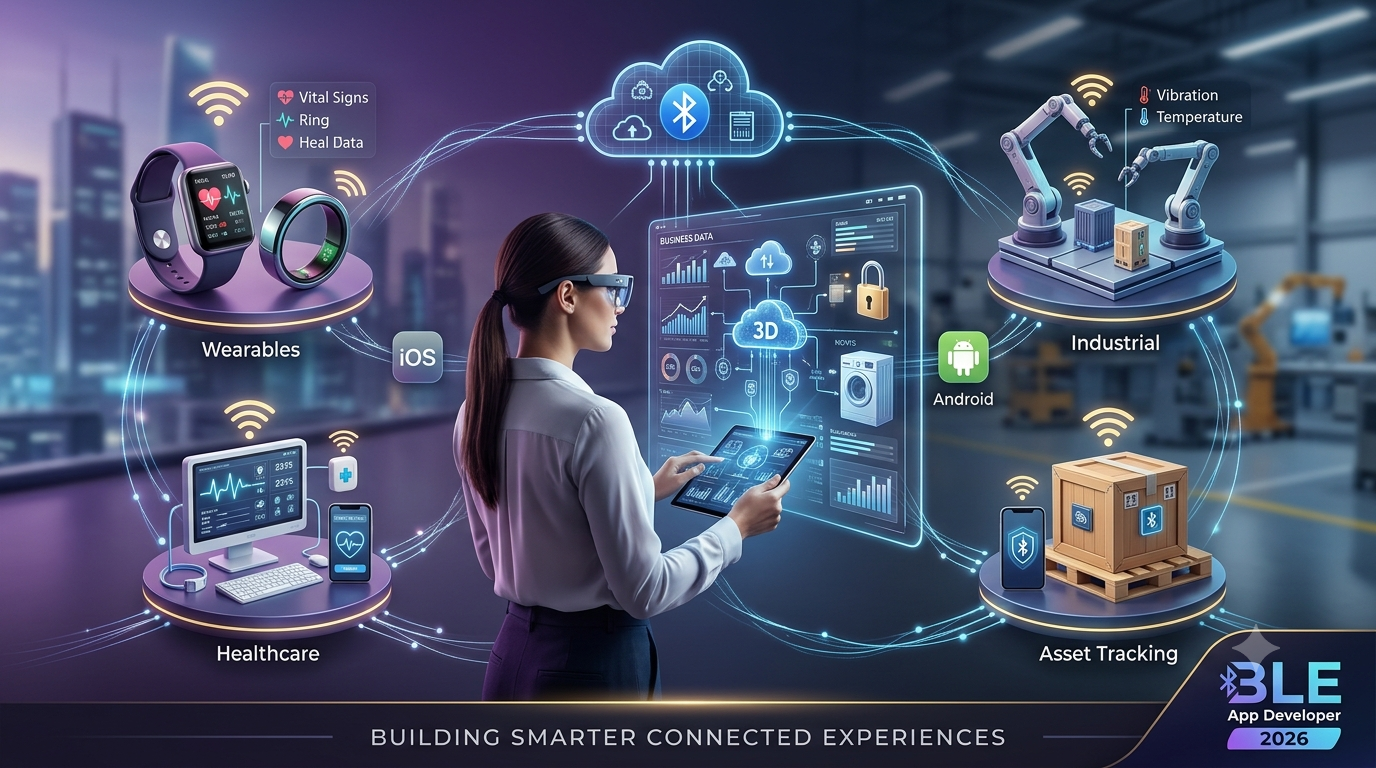
    Sensor → BLE → Smartphone/Gateway → API → Cloud → Analytics Dashboard

    This architecture can enable businesses to collect information from connected devices and make it accessible across different systems.

    Security in BLE App Development

    Security should be considered throughout the development lifecycle.

    Depending on the application, developers may need to address:

    • Secure pairing
    • Device authentication
    • Encrypted communication
    • Access control
    • Secure API communication
    • Data protection
    • Authentication tokens
    • Secure cloud storage
    • Firmware security

    The security architecture should be designed according to the sensitivity of the data and the requirements of the product.

    BLE App Development Challenges

    Although BLE offers significant advantages, developing a reliable BLE application can present several challenges.

    Connection Management

    BLE connections can be interrupted because of distance, interference, device conditions, or operating-system behavior.

    The application should be able to reconnect gracefully and maintain a reliable user experience.

    Device Compatibility

    Different devices may implement BLE specifications differently.

    Testing with actual hardware is therefore an important part of BLE application development.

    Background Operation

    Mobile operating systems impose restrictions on applications operating in the background.

    BLE applications need to be designed carefully when continuous or background communication is required.

    Data Synchronization

    When BLE data needs to be synchronized with cloud platforms, developers must consider connectivity interruptions and duplicate or incomplete data.

    A reliable synchronization strategy can help prevent data inconsistencies.

    BLE App Development Process

    A structured development approach can reduce technical problems and improve product quality.

    Step 1: Understand the Hardware

    The development team should first understand the BLE device, supported services, characteristics, communication protocol, and firmware behavior.

    Step 2: Define the Application Architecture

    The team determines how the mobile application, BLE device, APIs, cloud infrastructure, and other components will communicate.

    Step 3: Design the User Experience

    The application interface should make device discovery, connection, configuration, and monitoring easy for users.

    Step 4: Develop BLE Communication

    Developers implement scanning, pairing, connection management, service discovery, characteristic operations, and notifications.

    Step 5: Integrate APIs and Cloud Services

    If the product requires cloud functionality, BLE data can be synchronized with backend services and databases.

    Step 6: Test With Real Devices

    Testing should be performed with actual hardware across relevant smartphones and operating-system versions.

    Step 7: Deploy and Maintain

    After launch, applications may require updates for new operating-system versions, hardware revisions, security improvements, and additional product features.

    Why Choose BLEAppDeveloper?

    BLEAppDeveloper helps businesses develop applications for BLE-enabled products and connected-device ecosystems.

    Development capabilities can include:

    • BLE mobile application development
    • iOS BLE development
    • Android BLE development
    • BLE device integration
    • IoT application development
    • BLE-to-cloud integration
    • API development
    • Connected product development
    • BLE testing and optimization
    • Custom device control applications

    A development partner with experience across mobile applications, BLE communication, APIs, and IoT can help businesses create a more complete connected-product ecosystem.

    The Future of BLE App Development

    BLE will continue to play an important role in connected technology as businesses combine it with IoT, cloud platforms, edge computing, and artificial intelligence.

    Future BLE applications are likely to focus increasingly on:

    • Intelligent device management
    • Real-time analytics
    • Predictive maintenance
    • Automated workflows
    • Connected healthcare
    • Smart industrial systems
    • Advanced asset tracking
    • AI-powered insights

    The biggest opportunity is not simply connecting a device to a smartphone. It is using that connection to create useful, scalable, and intelligent digital experiences.

    Conclusion

    BLE app development has become an important part of modern connected-product development. From wearables and healthcare devices to industrial equipment and smart consumer products, BLE provides an efficient communication layer between hardware and software.

    However, successful BLE applications require more than Bluetooth integration. They need reliable connection management, platform-specific development, security, device compatibility testing, scalable architecture, and—when required—cloud and IoT integration.

    Businesses planning a connected product in 2026 can use BLE as a foundation for building smarter, more efficient, and more scalable digital experiences.

    BLEAppDeveloper can help transform BLE product concepts into customized mobile and connected-device applications designed around specific business and hardware requirements.

  • BLE App Development in 2026: How Businesses Can Build Smarter Bluetooth Applications

    Bluetooth Low Energy (BLE) has become an important connectivity technology for modern mobile and connected-device applications. From wearable technology and healthcare devices to smart retail, asset tracking, fitness products, and industrial equipment, BLE enables applications to communicate with nearby devices while maintaining efficient power consumption.

    In 2026, BLE app development is evolving beyond basic device connectivity. Businesses are building complete ecosystems where BLE devices, mobile applications, cloud platforms, IoT systems, and AI-powered services work together.

    For companies developing connected products, choosing the right BLE architecture and development approach can have a major impact on performance, reliability, security, and user experience.

    What Is BLE App Development?

    BLE app development involves creating mobile applications that communicate with Bluetooth Low Energy-enabled devices.

    A BLE application can:

    • Discover nearby devices
    • Connect to BLE peripherals
    • Read device data
    • Write commands to devices
    • Subscribe to notifications
    • Monitor sensor information
    • Synchronize data with cloud platforms
    • Control connected hardware

    BLE applications can be developed for platforms such as iOS and Android, with the architecture selected according to the product’s requirements.

    Why BLE Is Important in 2026

    BLE offers several advantages for connected applications.

    Low Power Consumption

    BLE is designed for efficient wireless communication, making it particularly useful for battery-powered devices.

    Smartphone Compatibility

    Modern smartphones support BLE, allowing businesses to create applications that communicate directly with compatible devices.

    Flexible Connectivity

    BLE can support sensors, wearables, trackers, smart devices, medical equipment, and many other connected products.

    Cost Efficiency

    BLE hardware can provide an economical connectivity option for many consumer and business applications.

    Real-Time Communication

    Applications can receive information from BLE devices and respond to device events in real time.

    How a BLE Application Works

    A typical BLE application involves two major components:

    Central: Usually a smartphone or tablet.

    Peripheral: A BLE-enabled device such as a sensor, wearable, tracker, or smart accessory.

    The basic communication process is:

    Scan → Discover Device → Connect → Discover Services → Discover Characteristics → Read/Write Data → Receive Notifications

    For example, a fitness application may connect to a wearable device and receive activity or sensor information through BLE characteristics.

    BLE Services and Characteristics

    BLE communication is generally organized around services and characteristics.

    A service groups related functionality.

    Characteristics contain the actual data or control points exchanged between the application and the device.

    For example, a smart temperature sensor could provide:

    • Device information service
    • Battery service
    • Temperature service
    • Temperature characteristic

    The mobile application communicates with the appropriate characteristics to read information or send commands.

    Understanding this structure is essential for reliable BLE application development.

    Major BLE App Development Use Cases

    1. Wearable Applications

    Wearables are one of the most common BLE use cases.

    BLE can connect smartphones with:

    • Smartwatches
    • Fitness trackers
    • Smart bands
    • Health monitors
    • Sports devices

    Applications can synchronize activity, health, and device information.

    2. Healthcare Applications

    BLE can connect mobile applications with compatible healthcare devices.

    Potential applications include:

    • Blood pressure monitors
    • Glucose-related devices
    • Pulse monitoring
    • Patient monitoring
    • Fitness and wellness devices
    • Connected medical equipment

    Healthcare applications require additional attention to privacy, security, reliability, and applicable regulatory requirements.

    3. Asset Tracking

    BLE-enabled tags can communicate with smartphones or gateways to support asset-monitoring applications.

    Businesses can use BLE for:

    • Equipment tracking
    • Inventory visibility
    • Warehouse monitoring
    • Hospital equipment management
    • Logistics
    • Industrial assets

    4. Smart Retail

    BLE applications can support proximity-based retail experiences.

    Examples include:

    • Beacon-based engagement
    • Indoor navigation
    • Product identification
    • Store analytics
    • Customer notifications
    • Smart checkout experiences

    5. Smart Home Applications

    BLE can be used to connect smartphones with smart devices such as:

    • Locks
    • Sensors
    • Lighting controllers
    • Home accessories
    • Security devices

    The application can allow users to monitor and control connected devices.

    6. Industrial Applications

    BLE can help connect sensors and industrial equipment to mobile applications.

    Potential applications include:

    • Machine monitoring
    • Equipment configuration
    • Sensor data collection
    • Maintenance applications
    • Industrial diagnostics

    BLE App Development for iOS and Android

    Developing a BLE application for iOS and Android requires understanding the differences between the platforms.

    iOS BLE Development

    Apple provides Bluetooth functionality through its Core Bluetooth framework.

    Developers need to consider:

    • Bluetooth permissions
    • Background execution
    • Connection management
    • Service discovery
    • Characteristic handling
    • App lifecycle behavior

    Android BLE Development

    Android provides Bluetooth APIs for discovering and communicating with BLE devices.

    Important considerations include:

    • Bluetooth permissions
    • Android version compatibility
    • Device discovery
    • Runtime permissions
    • Connection management
    • Background behavior

    A cross-platform application can also be developed when the product requirements are suitable for a shared codebase.

    BLE and Mobile App Architecture

    A scalable BLE application should separate Bluetooth communication from the user interface.

    A typical architecture can include:

    BLE Layer → Communication Layer → Business Logic → Application UI → Cloud/API Layer

    This separation can make the application easier to test, maintain, and expand.

    For example, the BLE communication layer can handle device connections while the business logic determines how the collected information should be processed.

    BLE and IoT Integration

    BLE applications can become part of larger IoT ecosystems.

    A smartphone or BLE gateway can collect information from nearby devices and send it to a cloud platform.

    The architecture may look like:

    BLE Device → Mobile App/Gateway → API → IoT Cloud → Dashboard

    This enables businesses to manage connected devices remotely and analyze information collected from multiple locations.

    BLE + AI: The Next Step

    Artificial Intelligence can add intelligence to BLE-connected applications.

    For example, a BLE-enabled industrial sensor may continuously collect equipment data.

    The application can transmit that data to a cloud platform where AI analyzes it to identify unusual patterns.

    AI-powered BLE applications can support:

    • Predictive maintenance
    • Anomaly detection
    • Intelligent recommendations
    • Automated alerts
    • User behavior analysis
    • Predictive analytics

    The combination of BLE + IoT + AI can transform a simple connected device into a more intelligent business solution.

    BLE App Security

    Security should be considered from the beginning of development.

    Important security measures can include:

    • Secure device pairing
    • Authentication
    • Encryption
    • Secure APIs
    • Access control
    • Secure cloud communication
    • Protection of sensitive device data
    • Secure firmware-update mechanisms

    Applications handling health, financial, personal, or business-sensitive data may require additional security and compliance controls.

    Common BLE Development Challenges

    Device Compatibility

    BLE implementations can differ between devices and manufacturers.

    Testing with actual target hardware is essential.

    Connection Drops

    BLE connections can be interrupted because of distance, interference, device state, or operating-system behavior.

    Applications should implement reliable reconnection strategies.

    Background Restrictions

    Mobile operating systems can restrict background activity.

    Developers need to design BLE communication according to platform-specific limitations.

    Battery Consumption

    Poorly optimized scanning and communication can increase battery usage.

    BLE operations should be carefully optimized.

    Hardware Variations

    Different firmware versions and BLE chipsets can behave differently.

    A structured testing strategy is therefore important.

    How to Build a Successful BLE Application

    Step 1: Define the Product Requirements

    Identify what the application needs to do and which BLE devices it needs to support.

    Step 2: Understand the BLE Specification

    Document:

    • Services
    • Characteristics
    • UUIDs
    • Data formats
    • Commands
    • Notification behavior

    Step 3: Select the Development Approach

    Choose between native iOS/Android development or an appropriate cross-platform approach.

    Step 4: Build the BLE Communication Layer

    Implement:

    • Scanning
    • Connection
    • Service discovery
    • Characteristic operations
    • Notifications
    • Reconnection

    Step 5: Build the Application

    Create the user interface and business logic around the BLE functionality.

    Step 6: Integrate Cloud Services

    If required, connect the application with APIs, databases, analytics, and IoT platforms.

    Step 7: Test With Real Hardware

    Testing should cover different devices, operating-system versions, connection distances, battery conditions, and real-world environments.

    Benefits of Working With an Experienced BLE App Development Team

    BLE development combines mobile development with wireless communication and hardware integration.

    An experienced team can help businesses with:

    • BLE architecture
    • Mobile app development
    • Hardware integration
    • IoT connectivity
    • Cloud integration
    • API development
    • Security
    • Cross-platform development
    • Testing and optimization

    This can reduce development risks and help create a more reliable connected product.

    Why Choose BLE App Developer?

    BLE App Developer focuses on creating applications and connected solutions involving Bluetooth Low Energy, mobile applications, IoT, and smart devices.

    Businesses can use BLE development expertise to build solutions for:

    • Wearables
    • Healthcare
    • Fitness
    • Retail
    • Asset tracking
    • Smart home
    • Industrial applications
    • Consumer electronics
    • IoT products

    A complete BLE development strategy can cover the mobile application, device communication, backend services, cloud integration, and ongoing product improvements.

    Future of BLE App Development

    BLE is likely to remain an important connectivity technology as businesses continue developing connected products.

    The future will increasingly involve applications that combine:

    BLE + IoT + AI + Cloud + Mobile

    This combination can enable applications that not only connect devices but also collect information, analyze data, automate actions, and deliver intelligent user experiences.

    As connected-device adoption grows, businesses will need BLE applications that are secure, scalable, battery-efficient, and capable of working across increasingly complex ecosystems.

    Conclusion

    BLE app development has become an important part of the connected technology ecosystem in 2026.

    From wearable technology and healthcare to industrial IoT and smart retail, BLE allows businesses to create applications that communicate efficiently with nearby devices.

    However, successful BLE development requires more than establishing a Bluetooth connection. Device compatibility, architecture, security, battery optimization, platform limitations, cloud integration, and real-world testing all need to be considered.

    BLE App Developer helps businesses turn connected-device ideas into reliable BLE mobile applications and scalable IoT solutions.

    Suggested SEO Keywords

    Primary Keywords:
    BLE app development, BLE app developer, Bluetooth Low Energy app development, BLE development

    Secondary Keywords:
    BLE mobile app development, Bluetooth app development, BLE iOS development, BLE Android development, BLE IoT development, BLE integration, Bluetooth Low Energy developers, wearable app development, connected device app development

    Suggested Meta Title

    BLE App Development in 2026 | Bluetooth Low Energy Solutions

    Suggested Meta Description

    Learn how BLE app development is transforming wearables, healthcare, IoT, retail, and smart devices in 2026. Explore BLE architecture, benefits, security, challenges, and development best practices.

  • BLE App Development in 2026: Building Smarter Bluetooth-Connected Applications

    Bluetooth Low Energy (BLE) has become one of the most practical technologies for connecting smartphones, wearables, sensors, medical devices, industrial equipment, and smart products.

    In 2026, businesses are increasingly looking beyond basic Bluetooth connectivity. They want BLE applications that can securely communicate with devices, collect real-time data, automate workflows, and deliver reliable user experiences.

    This is making BLE app development an important part of modern IoT and connected-device strategies.

    What Is BLE App Development?

    BLE app development involves creating mobile or web applications that communicate with Bluetooth Low Energy devices.

    Unlike traditional Bluetooth applications, BLE is optimized for devices that need to transmit small amounts of data while consuming very little power.

    A typical BLE ecosystem can include:

    BLE Device → Bluetooth Connection → Mobile App → Cloud Platform → Analytics Dashboard

    This architecture can support everything from wearable devices and fitness trackers to industrial sensors and smart-home products.

    Why BLE App Development Matters in 2026

    BLE has several characteristics that make it attractive for connected applications:

    • Low power consumption
    • Wireless communication
    • Smartphone compatibility
    • Fast device discovery
    • Support for multiple device types
    • Cost-effective hardware integration
    • Secure communication capabilities
    • Suitability for IoT applications

    Modern smartphones already provide built-in Bluetooth capabilities, allowing businesses to develop applications that communicate directly with compatible BLE hardware.

    Top BLE App Development Use Cases

    1. Wearable Applications

    Fitness bands, smartwatches, health trackers, and other wearable devices commonly use BLE to communicate with smartphones.

    A BLE mobile application can collect information such as:

    • Activity data
    • Heart-rate readings
    • Sleep information
    • Steps
    • Device status
    • Battery levels

    The application can then visualize the collected information through dashboards and reports.

    2. Healthcare and Medical Devices

    BLE is increasingly useful for connected healthcare devices where low-power wireless communication is important.

    Applications can connect with compatible devices such as:

    • Digital thermometers
    • Glucose monitoring devices
    • Blood-pressure monitors
    • Fitness and wellness sensors
    • Patient monitoring equipment

    Healthcare applications require particularly careful attention to security, privacy, reliability, and applicable regulations.

    3. Smart Home Applications

    BLE can help mobile applications communicate with smart devices around the home.

    Potential applications include:

    • Smart locks
    • Sensors
    • Lighting controls
    • Temperature devices
    • Smart appliances
    • Security equipment

    A mobile app can discover nearby devices, establish a connection, exchange data, and allow users to control compatible hardware.

    4. Industrial IoT

    BLE is also useful in industrial environments.

    Businesses can connect mobile applications with sensors and equipment to monitor:

    • Temperature
    • Humidity
    • Machine status
    • Equipment performance
    • Asset movement
    • Maintenance conditions

    BLE applications can provide technicians with real-time information without requiring wired connections.

    5. Asset Tracking

    BLE beacons and tags can help businesses track assets and identify their approximate location.

    Possible applications include:

    • Warehouse tracking
    • Equipment monitoring
    • Retail asset management
    • Hospital equipment tracking
    • Logistics operations

    BLE-based tracking can help organizations improve visibility across physical environments.

    How BLE Communication Works

    BLE communication generally revolves around GATT (Generic Attribute Profile).

    A BLE device can expose services containing characteristics. The mobile application communicates with those characteristics to read, write, or receive data.

    A simplified workflow looks like this:

    1. Scan for nearby BLE devices.
    2. Identify the required device.
    3. Establish a connection.
    4. Discover available services.
    5. Discover characteristics.
    6. Subscribe to notifications where required.
    7. Read or write data.
    8. Process the received information.
    9. Disconnect or maintain the connection according to the application’s requirements.

    Understanding this architecture is essential when developing reliable BLE applications.

    BLE App Development for iOS and Android

    A major advantage of BLE is its availability across modern mobile platforms.

    iOS BLE Development

    Apple provides Core Bluetooth APIs for applications that communicate with BLE peripherals.

    Developers need to consider:

    • Bluetooth permissions
    • Device discovery
    • Service discovery
    • Characteristic management
    • Connection handling
    • Background behavior
    • Power consumption
    • iOS version compatibility

    Android BLE Development

    Android provides Bluetooth APIs for discovering and communicating with BLE devices.

    Important considerations include:

    • Runtime permissions
    • Scanning behavior
    • GATT connections
    • Service discovery
    • Notifications
    • Background restrictions
    • Device compatibility

    Because Android devices vary significantly between manufacturers, testing across multiple devices is especially important.

    Cross-Platform BLE Development

    Businesses that want applications for both iOS and Android can consider cross-platform technologies.

    Frameworks such as React Native and Flutter can reduce duplicated application development, although BLE functionality still requires careful handling of native Bluetooth behavior.

    A practical architecture may use:

    Cross-Platform UI + Native BLE Layer + Cloud Backend

    This can provide development efficiency while maintaining appropriate access to platform-specific Bluetooth functionality.

    Security in BLE Applications

    Security should be considered from the beginning of a BLE application project.

    Depending on the use case, developers may need to implement:

    • Secure pairing
    • Authentication
    • Encryption
    • Device authorization
    • Secure data transmission
    • Access controls
    • Secure API communication
    • Protection against unauthorized devices

    For sensitive applications, simply establishing a Bluetooth connection is not enough. The application should verify that the connected device is trusted and authorized.

    Common BLE Development Challenges

    BLE development can look simple at first, but real-world projects often introduce technical challenges.

    Device Compatibility

    Different BLE devices can implement services and characteristics differently.

    Thorough testing is therefore essential.

    Connection Stability

    Applications need to handle:

    • Connection drops
    • Reconnection
    • Signal interference
    • Device movement
    • Bluetooth being disabled
    • Application backgrounding

    Background Operation

    Mobile operating systems impose restrictions on background Bluetooth activity.

    Applications requiring continuous or periodic communication need architecture designed around these platform limitations.

    Data Synchronization

    When a BLE device collects data while the phone is disconnected, developers may need a reliable synchronization mechanism when the connection returns.

    Battery Consumption

    Although BLE is designed for low-power communication, inefficient scanning and communication patterns can still consume significant battery power.

    BLE + Cloud Integration

    BLE applications become significantly more powerful when connected to cloud platforms.

    A typical architecture can look like:

    BLE Sensor → Mobile Application → API → Cloud Database → Analytics Dashboard

    This allows businesses to store and analyze device data over time.

    Cloud integration can support:

    • Remote monitoring
    • Historical data
    • User accounts
    • Device management
    • Notifications
    • Analytics
    • Automated reports
    • Multi-device synchronization

    BLE and IoT: A Powerful Combination

    BLE is often used as the local connectivity layer within larger IoT systems.

    For example:

    Sensor → BLE → Smartphone/Gateway → Internet → Cloud → Business Dashboard

    The BLE device doesn’t necessarily need direct internet connectivity. The smartphone or gateway can act as a bridge between the physical device and cloud infrastructure.

    This approach can reduce hardware complexity while still enabling connected-device functionality.

    AI and BLE Applications in 2026

    The combination of BLE-generated data and AI creates new opportunities.

    AI can analyze device information to identify patterns, anomalies, and trends.

    For example, a business could use AI to:

    • Detect unusual sensor readings
    • Predict equipment problems
    • Analyze user activity
    • Identify abnormal device behavior
    • Generate automated insights
    • Improve energy efficiency

    The value comes from combining reliable BLE data collection with intelligent data processing.

    BLE App Development Process

    A professional BLE application project generally follows these stages:

    1. Requirement Analysis

    Define the hardware, users, communication requirements, platforms, and business objectives.

    2. BLE Architecture

    Identify services, characteristics, communication protocols, pairing requirements, and data structures.

    3. UI/UX Design

    Create an interface that makes device setup, connection, monitoring, and control simple for users.

    4. Application Development

    Develop the mobile application and integrate the BLE communication layer.

    5. Backend Integration

    Connect the application with APIs, databases, cloud services, and analytics platforms when required.

    6. Device Testing

    Test with actual BLE hardware rather than relying only on simulators.

    7. Security Testing

    Validate authentication, authorization, communication security, and data protection.

    8. Deployment and Maintenance

    Release the application and continue improving compatibility, performance, and functionality.

    Choosing a BLE App Development Partner

    Businesses should evaluate a development partner based on more than mobile development experience.

    Important factors include:

    • BLE development experience
    • iOS and Android expertise
    • Hardware integration knowledge
    • IoT experience
    • API and cloud development
    • Security practices
    • Testing capabilities
    • Post-launch support

    A development team should understand both the mobile application layer and the physical BLE device.

    The Future of BLE App Development

    BLE will continue to play an important role in connected products because it provides a practical bridge between physical devices and mobile applications.

    As IoT, wearables, smart-home products, healthcare technology, and industrial automation continue to grow, BLE applications are likely to become more intelligent and integrated.

    The future is not simply about connecting a phone to a Bluetooth device. It is about creating an ecosystem where devices collect data, applications interpret it, cloud platforms process it, and businesses use the insights to make better decisions.

    Final Thoughts

    BLE app development provides businesses with a flexible way to connect smartphones with low-power devices and sensors.

    From wearables and healthcare devices to industrial IoT and smart-home products, BLE can support a wide range of connected experiences.

    In 2026, successful BLE applications will focus on more than connectivity. Reliability, security, scalability, cloud integration, user experience, and intelligent data processing will be equally important.

    For businesses building a new connected product, choosing the right BLE architecture and development approach from the beginning can make the difference between a basic Bluetooth application and a scalable IoT solution.

  • BLE App Development in 2026: Building Smarter Bluetooth Low Energy Applications

    Bluetooth Low Energy (BLE) has become an important technology for connecting smartphones, smart devices, sensors, wearables, and IoT products. In 2026, BLE app development is moving beyond basic device pairing toward intelligent, secure, and highly connected applications.

    BLE’s low power requirements make it especially useful for battery-powered devices such as fitness trackers, healthcare sensors, smart locks, industrial sensors, and connected consumer products. Modern mobile platforms also provide built-in BLE support for discovering nearby devices, accessing services, and exchanging data.

    For businesses building connected products, a well-designed BLE application can become the bridge between physical hardware and digital experiences.

    What Is BLE App Development?

    BLE app development involves creating mobile or software applications that communicate with Bluetooth Low Energy-enabled devices.

    A BLE application can:

    • Discover nearby devices
    • Connect and disconnect from devices
    • Read device information
    • Exchange sensor data
    • Send commands to hardware
    • Monitor device status
    • Synchronize data with cloud platforms
    • Provide real-time notifications

    Unlike traditional Bluetooth applications, BLE solutions are optimized for low-power communication and are well suited to devices that need long battery life.

    Why BLE App Development Matters in 2026

    BLE is being used across healthcare, retail, smart homes, fitness, logistics, automotive, and industrial IoT.

    The technology is particularly valuable when businesses need reliable short-range communication without placing a heavy power burden on connected hardware.

    Current Bluetooth industry developments are also expanding possibilities around device ranging and spatial awareness, including Bluetooth Channel Sounding, which is designed to provide more accurate distance awareness between connected devices.

    Key Features of a Modern BLE Application

    1. Device Discovery and Pairing

    A BLE app should be able to scan for compatible devices and establish a reliable connection.

    The application can identify devices based on their advertising information and then connect to the appropriate hardware.

    2. Real-Time Data Communication

    BLE applications can receive information from sensors and connected devices in real time.

    Examples include:

    • Heart-rate data
    • Temperature readings
    • Motion information
    • Battery status
    • Equipment status
    • Location-related information

    This makes BLE particularly useful for monitoring and automation applications.

    3. Secure Device Communication

    Security should be included from the beginning of BLE application development.

    Depending on the use case, developers may need to implement:

    • Secure pairing
    • Authentication
    • Encryption
    • Access control
    • Secure APIs
    • Application-layer protection

    Android documentation specifically notes that applications handling sensitive BLE data should implement application-layer security to protect that information.

    4. Background Connectivity

    Many BLE products need to continue communicating with devices while the user is not actively interacting with the application.

    Developers therefore need to carefully manage:

    • Background execution
    • Connection states
    • Notifications
    • OS restrictions
    • Battery consumption

    The implementation can differ significantly between iOS and Android.

    5. Firmware and OTA Updates

    Some connected products require firmware updates after deployment.

    A BLE application can be designed to support secure over-the-air firmware updates, allowing manufacturers to improve device functionality without requiring customers to physically access the hardware.

    Major BLE App Development Use Cases

    Healthcare and Medical Devices

    BLE is widely suited to low-power health and wellness devices.

    Applications can support:

    • Remote monitoring
    • Fitness tracking
    • Wearable devices
    • Connected medical equipment
    • Patient-related monitoring systems

    For medical applications, developers must also consider the additional security, privacy, regulatory, and reliability requirements of the specific product.

    Smart Wearables

    Smartwatches, fitness trackers, sports sensors, and other wearables rely heavily on efficient wireless communication.

    BLE allows these devices to exchange information with smartphones while conserving battery power.

    Smart Home Applications

    BLE applications can control and monitor connected home devices such as:

    • Smart locks
    • Sensors
    • Lighting
    • Temperature devices
    • Security equipment
    • Connected appliances

    A mobile application can provide users with a central interface for interacting with these devices.

    Industrial IoT

    Industrial businesses can use BLE-enabled sensors to monitor equipment and operational conditions.

    Potential applications include:

    • Asset tracking
    • Equipment monitoring
    • Predictive maintenance
    • Worker safety
    • Environmental monitoring
    • Warehouse operations

    BLE Mesh can also support larger connected environments where many devices need to communicate across an area.

    Retail and Proximity Applications

    BLE beacons and connected devices can support:

    • Indoor navigation
    • Proximity notifications
    • Customer engagement
    • Store analytics
    • Location-aware experiences

    Retail businesses can combine BLE data with mobile applications and analytics platforms to create more personalized experiences.

    Automotive Applications

    BLE can support several automotive experiences, including device connectivity, digital keys, access systems, and personalized interactions.

    Bluetooth’s continued development around ranging and distance awareness could create additional opportunities for secure and context-aware automotive experiences.

    BLE App Development for iOS and Android

    Cross-platform BLE development requires careful consideration because the operating systems handle Bluetooth communication differently.

    iOS BLE Development

    Apple’s Core Bluetooth framework provides the foundation for communicating with BLE peripherals on iOS applications.

    Developers need to consider:

    • Bluetooth permissions
    • Background behavior
    • Connection management
    • Service discovery
    • Data handling
    • App lifecycle

    Android BLE Development

    Android provides APIs that allow applications to discover nearby BLE devices, query services, and exchange information.

    Android development also requires attention to permissions, device fragmentation, background restrictions, and different hardware implementations.

    BLE and IoT Integration

    BLE applications become even more powerful when integrated with IoT platforms.

    A typical architecture can look like:

    BLE Device → Mobile App/Gateway → Cloud Platform → Database → Analytics Dashboard

    This architecture allows businesses to collect device information and transform it into useful operational data.

    Cloud integration can provide:

    • Centralized device management
    • Remote monitoring
    • Data storage
    • Analytics
    • Alerts
    • Reporting
    • Multi-device management

    BLE and AI

    Artificial intelligence is creating new opportunities for BLE applications.

    Instead of simply displaying sensor data, AI can analyze device information to identify patterns and generate useful insights.

    Potential applications include:

    • Predictive maintenance
    • Personalized fitness recommendations
    • Smart alerts
    • Anomaly detection
    • Usage prediction
    • Automated device behavior

    The combination of BLE, IoT, and AI can transform a connected product into an intelligent system.

    BLE App Development Challenges

    Developing a reliable BLE application requires more than implementing basic Bluetooth APIs.

    Common challenges include:

    Device Compatibility

    Different hardware manufacturers can implement BLE services and characteristics differently.

    Connection Reliability

    Real-world environments may introduce interference, signal loss, or unexpected disconnects.

    Battery Optimization

    Poor scanning and connection strategies can unnecessarily consume device or smartphone battery.

    Background Restrictions

    iOS and Android impose different restrictions on background processing and Bluetooth activity.

    Security

    Applications handling sensitive information need appropriate security controls beyond simply establishing a BLE connection.

    Testing

    BLE applications should be tested with different phones, operating-system versions, hardware devices, signal conditions, and connection scenarios.

    BLE App Development Process

    A professional BLE development process generally includes the following stages.

    Step 1: Requirement Analysis

    Define the hardware, communication requirements, target platforms, user workflows, and business objectives.

    Step 2: BLE Architecture

    Identify services, characteristics, communication patterns, device roles, and security requirements.

    Step 3: UI/UX Design

    Create a simple interface for device setup, monitoring, controls, and data visualization.

    Step 4: Mobile Development

    Develop the iOS and/or Android application and integrate the required BLE functionality.

    Step 5: Hardware Integration

    Connect the application with the target BLE hardware and validate communication.

    Step 6: Testing

    Test connectivity, performance, battery usage, security, device compatibility, and real-world scenarios.

    Step 7: Cloud and API Integration

    If required, connect the BLE application to cloud services, databases, analytics, and business systems.

    Step 8: Deployment and Maintenance

    Launch the application and continue improving it through software updates, firmware updates, monitoring, and optimization.

    How to Choose a BLE App Development Partner

    Businesses should evaluate a development partner based on technical BLE experience rather than general mobile development skills alone.

    Important areas include:

    • BLE protocol knowledge
    • iOS and Android experience
    • Hardware integration
    • IoT development
    • Firmware understanding
    • Security
    • Cloud integration
    • BLE testing
    • Post-launch support

    A strong development partner should understand both the mobile application and the physical device ecosystem.

    The Future of BLE App Development

    BLE development is moving toward smarter and more context-aware connected experiences.

    Future applications will increasingly combine:

    • BLE
    • AI
    • IoT
    • Edge computing
    • Cloud platforms
    • Advanced positioning
    • Smart sensors
    • Real-time analytics

    Bluetooth Channel Sounding is one example of how the ecosystem is evolving toward more precise distance awareness, potentially opening new possibilities for location and proximity-based applications.

    Conclusion

    BLE app development is becoming an important part of the connected-device ecosystem in 2026. Its low-power characteristics, mobile compatibility, and broad range of applications make it suitable for everything from wearables and healthcare devices to smart homes, retail systems, and industrial IoT.

    For businesses developing a connected product, the right BLE architecture can improve reliability, battery efficiency, security, and user experience.

    A successful BLE application should therefore be designed as part of the complete product ecosystem—connecting hardware, mobile applications, cloud platforms, and intelligent data services.

    Suggested SEO Keywords: BLE app development, BLE app developer, Bluetooth Low Energy app development, BLE mobile app development, Bluetooth app development, BLE IoT development, BLE software development, BLE application development, iOS BLE development, Android BLE development, custom BLE app development

  • BLE App Developer: When Bluetooth Says “Connected” but Your App Says “Try Again”

    Every BLE app development project begins with one beautiful sentence:

    “We just need a mobile app that connects to our Bluetooth device.”

    Developer:

    “Easy.”

    Then the client continues:

    “It should work on iPhone and Android.”

    Okay.

    “It should connect automatically.”

    Sure.

    “It should work in the background.”

    Hmm.

    “It should show real-time sensor data.”

    Fine.

    “Can users update the device firmware from the app?”

    Okay.

    “Can we also add cloud synchronization?”

    Sure.

    “And maybe AI analytics?”

    …

    Welcome to BLE app development. 😂


    What Is BLE App Development?

    BLE app development involves creating mobile applications that communicate with Bluetooth Low Energy devices.

    A typical architecture looks like:

    BLE Device 📡

    ↓

    Bluetooth Low Energy 🔵

    ↓

    iOS / Android App 📱

    ↓

    Cloud ☁️

    ↓

    Dashboard / Analytics 📊

    The user sees:

    Device Connected ✅

    The developer sees:

    Scanner → Peripheral → GATT → Service → Characteristic → Notification → Reconnection → Background Mode

    😂


    The BLE Connection: A Complicated Relationship

    Developer:

    “Connect to the device.”

    BLE device:

    “No.”

    Developer:

    “Scan again.”

    BLE device:

    “Maybe.”

    Developer:

    “Found you!”

    BLE device:

    “I’m gone.”

    Developer:

    “Reconnect.”

    BLE device:

    “Okay.”

    Developer:

    “Great!”

    BLE device:

    Disconnected.

    😂

    Every BLE developer eventually develops a special relationship with the Bluetooth logs.


    “But Bluetooth Is ON!”

    This is another classic.

    User:

    “My Bluetooth is ON.”

    Developer:

    “Great. Can the app see the device?”

    User:

    “No.”

    Developer:

    “Is the device powered on?”

    User:

    “Yes.”

    Developer:

    “Is it advertising?”

    User:

    “What’s advertising?”

    😂

    BLE troubleshooting can involve checking:

    • Bluetooth state
    • Device power
    • Advertising
    • Permissions
    • Scan results
    • Signal strength
    • Services
    • Characteristics
    • Connection state
    • Firmware compatibility

    Sometimes the solution is simple.

    Sometimes the solution is:

    Restart Bluetooth.

    And somehow…

    It works. 😂


    The Famous “Works on Android”

    Developer:

    “The BLE device works perfectly on Android.”

    Client:

    “Great!”

    Then someone tests on iPhone.

    Nothing.

    😂

    Then the team discovers that iOS and Android handle BLE and background behavior differently.

    A serious BLE app should be tested across supported:

    • iOS versions
    • Android versions
    • Smartphone models
    • Bluetooth chipsets
    • Device firmware versions

    Because:

    One successful test phone does not equal a production-ready BLE application.


    GATT: The BLE Language Everyone Eventually Learns

    If you’re new to BLE development, you’ll quickly hear:

    GATT

    It stands for Generic Attribute Profile.

    BLE devices organize their data through:

    • Services
    • Characteristics
    • Descriptors

    Imagine a device exposing:

    Battery Service

    → Battery Level

    And:

    Temperature Service

    → Temperature Characteristic

    The mobile application communicates with those characteristics to read, write, or receive updates.

    At first:

    “What is a characteristic?”

    After a few BLE projects:

    “Check characteristic UUID 2A6E.”

    😂


    The Mystery UUID

    Every BLE developer has seen something like:

    0000180F-0000-1000-8000-00805F9B34FB

    And thought:

    “Wonderful.”

    😂

    UUIDs identify BLE services and characteristics.

    Standard UUIDs can represent standardized services.

    Custom products may use custom UUIDs.

    The important thing is that the mobile application and BLE firmware agree on the communication structure.

    Otherwise:

    App: “Give me temperature.”

    Device: “Here’s battery percentage.”

    App: “That’s not what I asked.”

    😂


    The BLE Device With No Documentation

    Client:

    “We already have the hardware.”

    Developer:

    “Great. Do you have the BLE protocol?”

    Client:

    “No.”

    “GATT documentation?”

    “No.”

    “SDK?”

    “No.”

    “Firmware source?”

    “No.”

    “Technical documentation?”

    Client:

    “We have a video.”

    Developer:

    😐

    And that’s how a BLE developer becomes a detective.


    The “Simple Sensor App”

    Client:

    “The device only measures temperature.”

    Easy.

    Then:

    “It also measures humidity.”

    Okay.

    “Battery level too.”

    Fine.

    “Can users change the measurement interval?”

    Sure.

    “Can they download the data?”

    Okay.

    “Can they see historical graphs?”

    Yep.

    “Can they share reports?”

    Sure.

    “Can the device update firmware from the app?”

    …

    😂

    The “simple sensor app” has officially become a complete connected-device platform.


    BLE Scanning: The App’s Favorite Hobby

    The app starts scanning.

    Device 1

    Device 2

    Device 3

    Random Headphones

    Smartwatch

    Unknown Device

    Your Neighbor’s Speaker

    😂

    BLE scanning can discover many nearby devices.

    A production application therefore needs sensible filtering and device identification.

    Otherwise the user might see:

    “Select your device.”

    And the list looks like:

    Unknown 1

    Unknown 2

    Unknown 3

    BT Device

    LE-123

    Something-7A

    😂


    Automatic Connection Sounds Great

    Client:

    “Can the app automatically reconnect?”

    Developer:

    “Yes, depending on the device and platform behavior.”

    Client:

    “Perfect.”

    Then the user walks away.

    Bluetooth signal disappears.

    User comes back.

    App:

    Device disconnected.

    User:

    “Why didn’t it reconnect?”

    Developer:

    “Let’s check the connection lifecycle.”

    😂

    Reliable reconnection requires thoughtful handling of:

    • Connection state
    • Timeouts
    • Device availability
    • Background restrictions
    • Retry logic
    • Signal loss
    • App lifecycle

    Background BLE: Where Things Get Serious

    Client:

    “The app should keep receiving data even when the user isn’t looking at it.”

    Developer:

    “Okay.”

    Client:

    “And even if the app isn’t open?”

    Developer:

    😐

    Mobile operating systems place restrictions on background activity.

    BLE applications therefore need platform-specific architecture and testing.

    The lesson:

    “Background BLE” should be a requirement discussed at the beginning—not two days before launch.

    😂


    iOS vs Android: The Eternal Debate

    iOS Developer:

    “It works.”

    Android Developer:

    “It works.”

    QA:

    “It doesn’t work on this phone.”

    Everyone:

    😐

    Mobile BLE applications must account for differences in:

    • Permissions
    • Bluetooth APIs
    • Background execution
    • OS lifecycle
    • Device compatibility
    • Power management

    That’s why real-device testing matters.


    The Battery Problem 🔋

    BLE is designed for low-power communication.

    But that doesn’t mean developers can communicate with a device constantly without considering battery usage.

    Imagine:

    Connect

    → Read

    → Write

    → Notify

    → Scan

    → Reconnect

    → Scan again

    → Send data

    → Repeat

    Battery:

    “I have had enough.”

    😂

    Good BLE application architecture considers:

    • Connection intervals
    • Scan duration
    • Data frequency
    • Notification usage
    • Device sleep modes
    • Synchronization strategy

    “Can We Show Real-Time Data?”

    Client:

    “We need real-time sensor data.”

    Developer:

    “How real-time?”

    Client:

    “Instant.”

    Developer:

    “Every second?”

    Client:

    “Even faster.”

    Developer:

    “Why?”

    Client:

    “Because real-time sounds better.”

    😂

    The correct update frequency depends on the actual business requirement.

    Sometimes:

    1 second

    makes sense.

    Sometimes:

    10 seconds

    is perfectly sufficient.

    Sometimes:

    Once every minute

    is enough.

    More data isn’t automatically better.


    Notifications: The BLE App’s Superpower

    BLE devices can send updates to the mobile app through notifications.

    For example:

    Temperature changes

    ↓

    BLE Notification

    ↓

    Mobile App

    ↓

    UI Updates

    This is useful for:

    • Sensor monitoring
    • Wearables
    • Medical devices
    • Fitness products
    • Industrial equipment
    • Smart products

    Instead of constantly asking:

    “Did the value change?”

    the app can subscribe to updates.

    Much smarter.

    And much less annoying.

    😂


    Firmware Updates From the App

    Then comes the big request:

    “Can the app update the device firmware?”

    Yes—if the hardware and firmware architecture support an appropriate OTA update mechanism.

    But OTA firmware updates can involve:

    • Firmware files
    • BLE transfer
    • Version checking
    • Validation
    • Progress tracking
    • Error handling
    • Recovery
    • Battery requirements

    Because:

    Bricking a device is not an acceptable user experience. 😂


    The BLE Log That Nobody Wants to Read

    When everything works:

    Connected.

    When everything fails:

    Error 133

    Developer:

    “Hmm.”

    😂

    BLE logs can contain connection events, service discovery information, characteristic operations, errors, and state changes.

    A good development process includes proper logging so the team can understand:

    What happened?

    When did it happen?

    Why did it happen?

    What should happen next?


    The “One More Feature” Problem

    BLE project:

    Version 1

    Connect device.

    Version 2

    Add sensor readings.

    Version 3

    Add charts.

    Version 4

    Add cloud sync.

    Version 5

    Add user accounts.

    Version 6

    Add OTA updates.

    Version 7

    Add notifications.

    Version 8

    Add AI.

    Client:

    “Now can we make it a smartwatch?”

    😂

    That’s why good BLE app development starts with a clear product roadmap.


    BLE App + Cloud

    BLE handles local communication.

    But many modern connected applications also need cloud services.

    A typical architecture can be:

    BLE Device

    ↓

    Mobile App

    ↓

    Secure API

    ↓

    Cloud

    ↓

    Database

    ↓

    Dashboard

    This allows users to access information beyond the immediate Bluetooth connection.

    For example:

    Device → App → Cloud

    Then later:

    User logs in → Cloud → Historical Data


    What Happens When Bluetooth Disconnects?

    This is an important question.

    A good BLE app shouldn’t simply crash or lose everything.

    Depending on the product, it may need:

    • Local caching
    • Retry logic
    • Reconnection
    • Synchronization
    • Offline mode
    • Connection-state indicators

    The user should ideally understand:

    “Device disconnected. We’ll sync when it reconnects.”

    Instead of:

    “Something went wrong.”

    😂

  • BLE IoT Applications for Businesses: How Bluetooth Low Energy Is Powering Connected Products

    Bluetooth Low Energy (BLE) has evolved far beyond simple wireless connectivity between smartphones and accessories.

    Today, businesses are using BLE IoT applications to connect sensors, devices, wearables, industrial equipment, healthcare products, retail systems, and smart-building infrastructure.

    The reason is straightforward: BLE offers low power consumption, short-range wireless communication, broad smartphone support, and a flexible foundation for connected-device applications.

    When BLE is combined with cloud platforms, mobile applications, edge computing, and IoT analytics, it can become an important part of a complete connected-product architecture.

    A typical BLE IoT architecture can look like:

    BLE Device → Mobile App / Gateway → Cloud Platform → Database → Analytics / Business System

    This article explores how businesses are using Bluetooth Low Energy for IoT, the most important applications, technical architecture, development considerations, and how to build scalable BLE IoT solutions.


    What Is BLE IoT?

    BLE IoT refers to the use of Bluetooth Low Energy technology to connect physical devices, sensors, and equipment to applications and IoT platforms.

    A BLE-enabled device can collect information such as:

    • Temperature
    • Humidity
    • Motion
    • Proximity
    • Battery status
    • Location-related data
    • Pressure
    • Heart rate
    • Equipment status
    • Environmental measurements

    The device can then communicate this information through BLE.

    Depending on the architecture, the BLE data can be processed by:

    • A smartphone
    • Tablet
    • Dedicated gateway
    • Edge device
    • Embedded controller
    • IoT gateway

    The information can subsequently be transferred to a cloud platform for storage, processing, analytics, automation, or monitoring.


    Why Businesses Are Using BLE for IoT

    BLE is particularly useful when IoT devices need to communicate wirelessly while consuming minimal power.

    Some of the key advantages include:

    Low Power Consumption

    BLE was designed for applications where battery efficiency matters.

    This makes it suitable for sensors, trackers, wearables, and other battery-powered devices.

    Smartphone Compatibility

    Modern smartphones generally support BLE, making a smartphone a practical gateway for many connected-device applications.

    Cost-Effective Hardware

    BLE modules and chipsets are available across a wide range of embedded platforms.

    This makes BLE attractive for startups as well as enterprise IoT deployments.

    Wireless Connectivity

    BLE eliminates the need for physical connections between compatible devices.

    Flexible Communication

    BLE supports different communication patterns depending on the product architecture, including advertising, scanning, connections, services, and characteristics.

    Suitable for Small Data Transfers

    Many IoT sensors transmit relatively small amounts of data.

    BLE can be an effective communication technology for these scenarios.


    How a BLE IoT System Works

    A typical BLE IoT application involves several layers.

    Layer 1: BLE Device

    The physical device contains a BLE-capable chipset and one or more sensors.

    For example:

    Temperature Sensor → BLE Chip → Wireless Advertisement

    The device may periodically broadcast information or establish a connection with another BLE device.

    Layer 2: Mobile Application or Gateway

    A mobile application can scan for nearby BLE devices and communicate with them.

    The application can:

    • Discover devices
    • Connect to devices
    • Read characteristics
    • Write configuration values
    • Subscribe to notifications
    • Monitor signal strength
    • Process sensor data
    • Send data to the cloud

    Alternatively, a dedicated IoT gateway can perform these functions.

    Layer 3: Cloud Backend

    The gateway or mobile application can send data to a backend through Wi-Fi, cellular connectivity, or another internet connection.

    The backend can provide:

    • Data storage
    • Device management
    • Authentication
    • Analytics
    • Alerts
    • Reporting
    • APIs
    • User management

    Layer 4: Business Application

    The final layer transforms IoT data into something useful for the business.

    For example:

    Sensor Data → Analytics → Maintenance Alert

    or:

    BLE Device → Mobile App → Cloud → Customer Dashboard

    This is where BLE IoT becomes a business solution rather than simply a connectivity feature.


    Major BLE IoT Applications for Businesses

    1. Healthcare and Medical Devices

    BLE is widely suited to connected healthcare products where low-power communication and mobile connectivity are important.

    Potential applications include:

    • Patient monitoring
    • Wearable health devices
    • Fitness equipment
    • Blood pressure devices
    • Temperature monitoring
    • Glucose-related devices
    • Medical equipment monitoring

    A BLE-enabled healthcare device can transmit measurements to a mobile application, where authorized information can be displayed and processed.

    A more advanced architecture can connect:

    Medical Device → BLE → Mobile Gateway → Secure Cloud → Healthcare Dashboard

    For healthcare applications, however, security, privacy, regulatory requirements, and data handling need to be considered from the beginning.


    2. Industrial IoT

    BLE can also be used in industrial environments for selected monitoring and asset-management scenarios.

    Industrial BLE IoT applications can include:

    • Equipment monitoring
    • Asset tracking
    • Temperature monitoring
    • Predictive maintenance
    • Worker safety
    • Inventory monitoring
    • Machine-status monitoring
    • Environmental sensing

    For example, a sensor attached to equipment can periodically transmit operating information.

    The gateway collects the data and sends it to an industrial IoT platform.

    The platform can then identify unusual patterns.

    A simplified workflow is:

    BLE Sensor → Gateway → Cloud → Analytics → Maintenance Alert

    This can help businesses move from reactive maintenance toward data-driven maintenance strategies.


    3. Asset Tracking

    Businesses often need to know where equipment, tools, inventory, or other assets are located.

    BLE beacons and tags can provide a relatively practical way to build asset-monitoring systems.

    Potential applications include:

    • Warehouse assets
    • Hospital equipment
    • Industrial tools
    • Retail inventory
    • Office equipment
    • Logistics assets

    BLE-based tracking can use information such as:

    • Device identifier
    • RSSI
    • Gateway location
    • Beacon information
    • Timestamp

    For more sophisticated location systems, BLE can be combined with technologies such as Bluetooth Direction Finding.


    4. Smart Retail

    BLE can create connected retail experiences.

    Retail businesses can use BLE for:

    • Indoor proximity experiences
    • Product information
    • Customer engagement
    • Asset monitoring
    • Inventory-related applications
    • Store analytics
    • Smart shelves

    For example, BLE beacons can transmit identifiers that a compatible application can detect.

    A mobile application can then use that information to trigger an appropriate experience.

    However, businesses should design these systems carefully around user consent and privacy.


    5. Smart Buildings

    BLE IoT technology can support connected-building applications.

    Examples include:

    • Occupancy monitoring
    • Access systems
    • Indoor navigation
    • Environmental monitoring
    • Smart lighting
    • Asset tracking
    • Room management

    A BLE-enabled system could collect information from sensors distributed throughout a building.

    That data can then be combined with other building-management systems.

    For example:

    BLE Sensors + Cloud Platform + Building Management System

    This architecture can provide a more connected view of building operations.


    6. Wearable Technology

    Wearables are one of the natural use cases for BLE.

    Examples include:

    • Smartwatches
    • Fitness trackers
    • Health wearables
    • Industrial wearables
    • Safety devices
    • Location tags
    • Smart accessories

    A mobile application can act as the bridge between the wearable and the cloud.

    For example:

    Wearable → BLE → Smartphone → Internet → Cloud

    The application can synchronize data, configure the device, display information, and send updates back to the wearable.


    7. Logistics and Supply Chain

    BLE IoT can also contribute to logistics operations.

    Potential use cases include:

    • Asset tracking
    • Cold-chain monitoring
    • Warehouse monitoring
    • Temperature tracking
    • Equipment tracking
    • Shipment monitoring

    For example, a BLE temperature sensor attached to a shipment can periodically record environmental conditions.

    A gateway can collect the information and send it to the cloud.

    If the temperature exceeds a defined threshold, the backend can generate an alert.


    8. Smart Agriculture

    BLE sensors can be used in selected agricultural environments.

    Potential applications include:

    • Temperature monitoring
    • Humidity sensing
    • Equipment monitoring
    • Greenhouse monitoring
    • Environmental data collection

    BLE can be particularly useful where sensors need to operate on batteries for extended periods.

    For large outdoor deployments, however, businesses should evaluate BLE alongside technologies such as LoRaWAN, cellular IoT, Wi-Fi, or other connectivity options.

    The correct technology depends on:

    • Range
    • Data volume
    • Power requirements
    • Deployment environment
    • Infrastructure
    • Cost

    9. Hospitality and Smart Hotels

    Hotels can use BLE to create connected guest experiences.

    Applications may include:

    • Mobile room access
    • Indoor navigation
    • Guest services
    • Asset tracking
    • Staff management
    • Smart-room controls

    A smartphone can communicate with BLE-enabled locks or room devices.

    The backend can then manage authentication and access permissions.

    Security is particularly important for applications involving physical access.


    10. Automotive and Mobility Applications

    BLE can also be integrated into automotive and mobility ecosystems.

    Potential applications include:

    • Digital keys
    • Vehicle accessories
    • Driver identification
    • Asset tracking
    • Fleet applications
    • Maintenance devices

    A mobile application can communicate with a BLE-enabled vehicle component or accessory and exchange authorized information.


    BLE Beacons in IoT Applications

    BLE beacons are small devices that periodically broadcast Bluetooth packets.

    They are useful for applications involving proximity and location awareness.

    A typical architecture looks like:

    Beacon → Smartphone → Application → Backend

    Possible applications include:

    • Indoor navigation
    • Retail proximity
    • Museum experiences
    • Asset identification
    • Event management
    • Location-aware applications

    The important distinction is that beacons generally broadcast information rather than functioning like traditional connected BLE peripherals.


    BLE GATT: The Core of Many BLE Applications

    Developers building BLE applications need to understand the Generic Attribute Profile (GATT).

    GATT defines how data is organized and exchanged between BLE devices.

    The basic structure includes:

    Profile → Service → Characteristic → Value

    For example:

    Device

    → Battery Service

    → Battery Level Characteristic

    → Battery Percentage

    Another device could expose a custom service:

    Custom Service

    → Temperature Characteristic

    → Sensor Value

    The mobile application can discover these services and characteristics and then perform operations such as:

    • Read
    • Write
    • Notify
    • Indicate

    Understanding GATT is essential when developing reliable BLE applications.


    BLE Advertising vs BLE Connections

    BLE applications commonly use two different communication approaches.

    Advertising

    A BLE peripheral can periodically broadcast packets without establishing a connection.

    This can be useful for:

    • Beacons
    • Discovery
    • Sensor broadcasts
    • Presence detection

    Connected Communication

    A central device can establish a BLE connection with a peripheral.

    This can enable:

    • Reading characteristics
    • Writing commands
    • Receiving notifications
    • Device configuration
    • Data synchronization

    The correct approach depends on the application’s requirements.


    BLE IoT Mobile App Architecture

    A modern BLE IoT mobile application may use an architecture such as:

    BLE Device

    ↓

    iOS / Android App

    ↓

    BLE Service Layer

    ↓

    Application Logic

    ↓

    Cloud API

    ↓

    IoT Backend

    ↓

    Database + Analytics

    This separation is important because BLE communication should not be tightly coupled to the application’s user interface.

    A well-designed architecture can make the application easier to:

    • Test
    • Maintain
    • Extend
    • Debug
    • Scale

    BLE App Development for iOS and Android

    BLE development behaves differently across mobile platforms.

    iOS BLE Development

    Apple provides the Core Bluetooth framework for Bluetooth Low Energy communication.

    Developers need to consider:

    • Bluetooth permissions
    • Background execution
    • Connection lifecycle
    • Service discovery
    • Notifications
    • State restoration
    • iOS-specific limitations

    Android BLE Development

    Android provides Bluetooth APIs for BLE communication.

    Developers need to consider:

    • Bluetooth permissions
    • Android version differences
    • Scanning behavior
    • Connection lifecycle
    • Background restrictions
    • Manufacturer-specific behavior
    • BLE reliability

    A cross-platform application can share significant application logic, but BLE implementations may still require platform-specific handling.


    BLE IoT Security

    Security should never be treated as an optional feature in BLE IoT development.

    Potential security considerations include:

    Device Authentication

    How does the application know that it is communicating with the correct device?

    Encryption

    Sensitive communication should use appropriate security mechanisms.

    Secure Pairing

    The pairing mechanism should match the application’s security requirements.

    Cloud Authentication

    The backend should authenticate devices and applications before accepting data.

    Access Control

    Not every user should have access to every device.

    Secure Firmware Updates

    Connected devices may require secure OTA firmware-update mechanisms.

    Data Protection

    Sensitive information should be protected during transmission and storage.

    A complete architecture therefore needs security across:

    Device → BLE → Mobile/Gateway → API → Cloud → Database


    BLE IoT Data Pipeline

    A scalable BLE IoT system should consider how sensor data moves through the entire platform.

    For example:

    Sensor

    ↓

    BLE Advertisement / GATT

    ↓

    Mobile App / Gateway

    ↓

    MQTT / HTTPS / API

    ↓

    Cloud Backend

    ↓

    Database

    ↓

    Data Processing

    ↓

    Dashboard / Alert / Automation

    This architecture allows BLE to function as one part of a larger IoT ecosystem.


    BLE + Cloud Integration

    BLE itself is not an internet protocol.

    This distinction is important.

    BLE typically provides local wireless connectivity.

    Cloud connectivity generally comes through another network connection.

    For example:

    BLE Device → Smartphone → Wi-Fi/5G → Cloud

    or:

    BLE Device → IoT Gateway → Ethernet/Wi-Fi/Cellular → Cloud

    This gateway concept is fundamental to many BLE IoT deployments.


    BLE + AI: The Next Step for Intelligent IoT

    BLE can provide the data.

    AI can provide intelligence.

    This creates an interesting architecture:

    BLE Sensors → IoT Platform → AI Models → Insights → Automated Actions

    For example, industrial sensors could provide equipment data.

    AI could analyze historical patterns and identify anomalies.

    The system could then generate:

    “Possible equipment failure detected.”

    This combination can enable:

    • Predictive maintenance
    • Intelligent monitoring
    • Anomaly detection
    • Automated alerts
    • Personalized recommendations
    • Sensor-data classification

    BLE therefore doesn’t need to work alone.

    Its value can increase significantly when combined with cloud computing and AI.


    BLE IoT Development Challenges

    BLE is powerful, but developers need to account for several challenges.

    Device Compatibility

    Different manufacturers may implement BLE specifications differently.

    Testing across real hardware is essential.

    Connection Reliability

    BLE connections can be affected by:

    • Distance
    • Interference
    • Device state
    • Operating-system behavior
    • Power management

    Background Processing

    Mobile operating systems impose restrictions on background execution.

    This can affect BLE applications that need continuous communication.

    Battery Consumption

    Poorly designed scanning or connection strategies can increase power consumption.

    Data Synchronization

    Applications need to handle situations where connectivity is interrupted.

    A robust system should support:

    • Local caching
    • Retry mechanisms
    • Queueing
    • Synchronization
    • Conflict handling

    How to Build a BLE IoT Application

    A practical BLE IoT development process can follow these stages.

    Step 1: Define the Use Case

    Start with the business problem.

    What needs to be connected?

    What information needs to be collected?

    What action will the data enable?

    Step 2: Select the BLE Hardware

    Choose the appropriate:

    • BLE chipset
    • Sensor
    • Antenna
    • Power source
    • Firmware architecture

    Step 3: Define the GATT Architecture

    Design:

    • Services
    • Characteristics
    • Properties
    • Data formats
    • Notifications
    • Commands

    Step 4: Develop Firmware

    The embedded software needs to manage:

    • Sensor readings
    • BLE advertising
    • Connections
    • Data transmission
    • Power management
    • Security

    Step 5: Develop the Mobile Application

    The mobile application can provide:

    • Device discovery
    • Pairing
    • Configuration
    • Data visualization
    • Firmware updates
    • User management

    Step 6: Develop the Backend

    The cloud platform can provide:

    • APIs
    • Authentication
    • Device management
    • Data storage
    • Analytics
    • Notifications

    Step 7: Test With Real Hardware

    BLE applications should not be tested only with simulators.

    Real-device testing is essential.

    Test:

    • Different phones
    • Different OS versions
    • Different BLE peripherals
    • Range
    • Interference
    • Battery behavior
    • Connection recovery
    • Background behavior

    Step 8: Monitor and Scale

    After deployment, monitor:

    • Connection failures
    • Battery performance
    • Device errors
    • API failures
    • Data quality
    • User behavior

    Then improve the platform based on real-world data.


    BLE vs Wi-Fi for IoT

    BLE and Wi-Fi serve different purposes.

    FeatureBLEWi-Fi
    Power consumptionVery lowHigher
    Typical rangeShortLonger
    Data throughputLowerHigher
    Smartphone supportExcellentExcellent
    Battery devicesExcellentLess suitable
    Internet connectionUsually indirectDirect
    Small sensor dataExcellentOften unnecessary
    High-bandwidth dataLimitedBetter

    BLE is often a better choice for small, battery-powered sensors.

    Wi-Fi can be more appropriate for applications requiring high data throughput or direct internet connectivity.

    In some architectures, both technologies work together.


    BLE vs Zigbee vs LoRaWAN

    There is no single best wireless technology for every IoT project.

    BLE

    Best suited for:

    • Wearables
    • Smartphones
    • Short-range sensors
    • Accessories
    • Proximity applications

    Zigbee

    Often useful for:

    • Smart-home networks
    • Mesh networks
    • Low-power connected devices

    LoRaWAN

    Useful for:

    • Long-range sensor networks
    • Agriculture
    • Smart cities
    • Remote monitoring

    The best choice depends on the application’s:

    Range + Power + Data + Cost + Infrastructure

    requirements.


    How Much Does BLE IoT App Development Cost?

    BLE IoT development costs vary significantly.

    The total project cost depends on:

    • Hardware complexity
    • Firmware development
    • BLE protocol requirements
    • Mobile platforms
    • Number of devices
    • Cloud infrastructure
    • IoT backend
    • Security
    • Dashboard requirements
    • AI integration
    • Third-party APIs
    • Testing requirements

    A simple BLE mobile application can be considerably less complex than an enterprise IoT platform involving thousands of connected devices.

    A proper technical discovery process should therefore happen before estimating the complete project.


    BLE IoT Trends Businesses Should Watch

    Several developments are making BLE increasingly useful for connected products.

    Bluetooth Direction Finding

    Direction-finding capabilities can enable more precise positioning applications.

    BLE Audio

    Bluetooth LE Audio expands the potential of Bluetooth Low Energy for audio-related experiences.

    Edge Processing

    More IoT data can be processed closer to the device instead of sending everything to the cloud.

    AI-Powered IoT

    AI can transform BLE sensor data into predictions and automated decisions.

    Connected Products

    BLE is increasingly being incorporated into consumer and industrial products as a standard connectivity layer.


    When Should a Business Choose BLE?

    BLE is a strong candidate when an IoT application requires:

    • Low power consumption
    • Short-range communication
    • Smartphone connectivity
    • Small data transfers
    • Battery-powered devices
    • Wearable integration
    • Sensor connectivity
    • Local device configuration

    BLE may not be ideal when the application requires:

    • Long-distance direct communication
    • High-bandwidth data
    • Continuous high-volume streaming
    • Large-scale outdoor coverage without gateways

    In such cases, BLE can still be part of a hybrid architecture.


    Why Choose a BLE App Development Partner?

    Building a BLE IoT solution requires more than mobile development.

    A successful project may involve:

    Hardware + Firmware + BLE + Mobile + Cloud + IoT + Security + Analytics

    A development team should understand how these layers interact.

    An experienced BLE development partner can help with:

    • BLE mobile app development
    • iOS BLE development
    • Android BLE development
    • BLE firmware integration
    • BLE IoT architecture
    • BLE device integration
    • GATT implementation
    • BLE gateway development
    • Cloud integration
    • IoT dashboards
    • BLE security
    • Device management

    The goal is to create a complete connected ecosystem rather than an isolated BLE feature.


    How BLEAppDeveloper Can Help

    At BLEAppDeveloper, businesses can build custom Bluetooth Low Energy applications designed around their specific connected-product requirements.

    Development capabilities can include:

    • Custom BLE app development
    • iOS BLE applications
    • Android BLE applications
    • Cross-platform BLE applications
    • BLE IoT applications
    • BLE device integration
    • BLE beacon applications
    • BLE wearable applications
    • BLE sensor applications
    • BLE gateway solutions
    • BLE firmware integration
    • Cloud and IoT integration
    • BLE device configuration apps
    • BLE data monitoring applications

    Whether you’re building a wearable, industrial sensor, smart device, healthcare product, or connected consumer product, the BLE architecture should be designed around the actual hardware and business requirements.

    Frequently Asked Questions

    What are BLE IoT applications?

    BLE IoT applications use Bluetooth Low Energy to connect sensors, devices, wearables, equipment, or other physical products with mobile applications, gateways, cloud platforms, or business systems.

    Is BLE good for IoT?

    Yes. BLE is particularly useful for low-power, short-range IoT applications involving sensors, wearables, asset tracking, smart devices, and smartphone connectivity.

    Can BLE connect directly to the cloud?

    BLE itself does not normally provide direct internet connectivity. A smartphone, gateway, or another connected device can act as the bridge between BLE and the cloud.

    Can BLE be used with iOS and Android?

    Yes. BLE is supported on both major mobile platforms. iOS applications can use Core Bluetooth, while Android provides its own BLE APIs.

    What is GATT in BLE?

    GATT, or Generic Attribute Profile, defines how BLE data is organized and exchanged through services and characteristics.

    Can BLE be used for asset tracking?

    Yes. BLE beacons and tags can be used for proximity and asset-monitoring applications. More advanced location requirements can use additional Bluetooth positioning capabilities.

    Can BLE work with AI?

    Yes. BLE can provide sensor and device data to an AI or analytics platform. AI can then be used for anomaly detection, predictive maintenance, classification, personalization, and other intelligent applications.

    How much does BLE app development cost?

    The cost depends on hardware, firmware, mobile platforms, backend requirements, device complexity, security, integrations, and testing. A technical assessment is recommended before preparing a project estimate.

    Is BLE better than Wi-Fi for IoT?

    It depends on the use case. BLE is generally better suited to low-power, short-range, small-data applications, while Wi-Fi is better for higher-bandwidth applications and direct network connectivity.

    Conclusion

    BLE has become an important connectivity technology for modern IoT products.

    Its combination of low power consumption, smartphone compatibility, flexible communication, and relatively low hardware requirements makes it suitable for a wide range of connected-product applications.

    But the real value of BLE doesn’t come from connectivity alone.

    The strongest BLE IoT solutions combine:

    BLE Devices + Mobile Apps + Cloud + IoT Platforms + Analytics + Security

    And increasingly:

    BLE + AI

    For businesses developing connected products, the opportunity is to transform raw sensor data into useful information, automated workflows, and better customer experiences.

    Whether you’re developing a wearable, healthcare device, industrial sensor, smart product, asset-tracking system, or connected consumer application, a well-designed BLE architecture can provide the foundation for a scalable IoT ecosystem.

    Have a BLE or IoT product idea? Start with the hardware, communication requirements, and business workflow—and design the mobile and cloud architecture around them.

    Talk to BLEAppDeveloper about building your custom BLE IoT application.