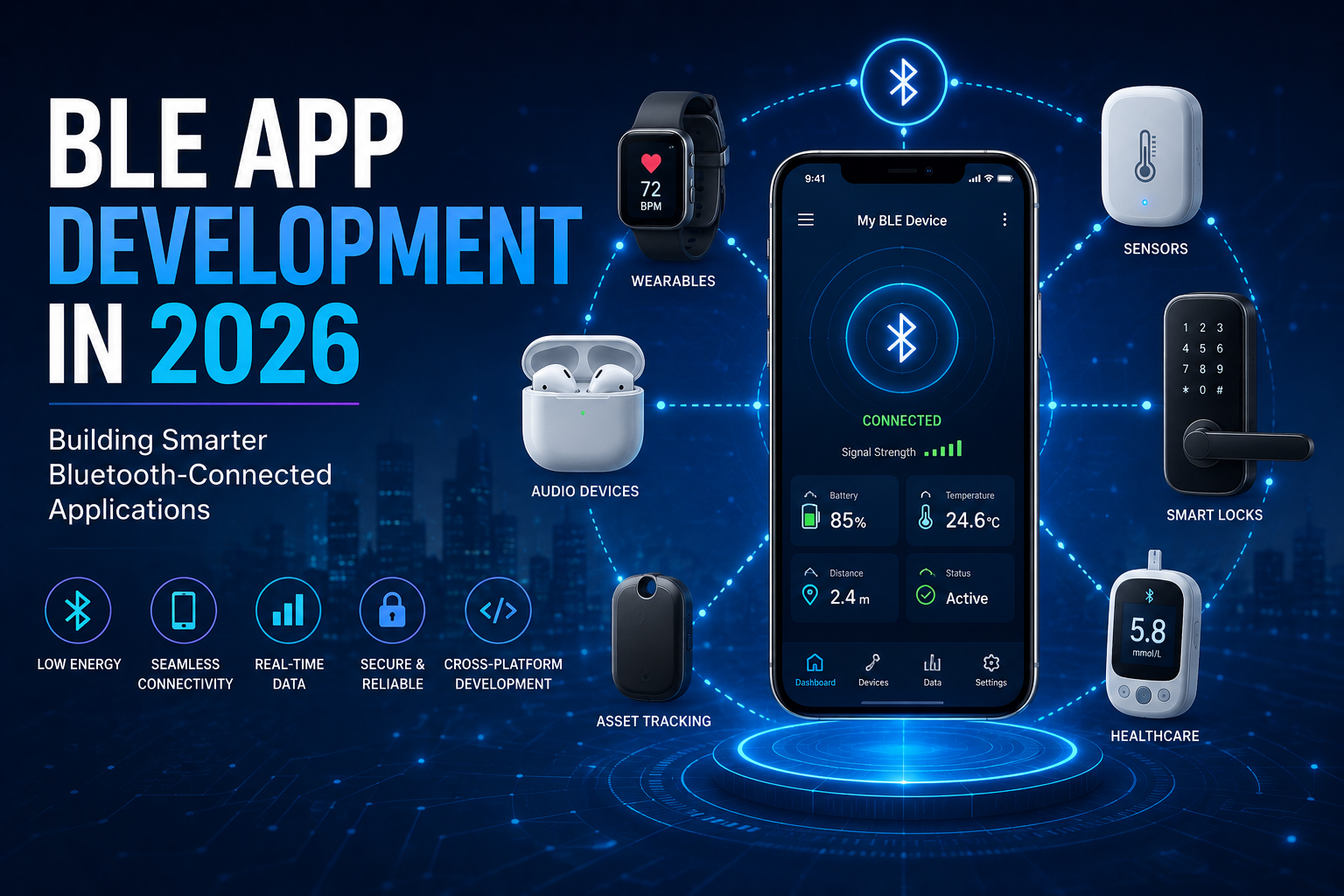
Bluetooth Low Energy (BLE) has become one of the most practical technologies for connecting smartphones, wearables, sensors, medical devices, industrial equipment, and smart products.
In 2026, businesses are increasingly looking beyond basic Bluetooth connectivity. They want BLE applications that can securely communicate with devices, collect real-time data, automate workflows, and deliver reliable user experiences.
This is making BLE app development an important part of modern IoT and connected-device strategies.
What Is BLE App Development?
BLE app development involves creating mobile or web applications that communicate with Bluetooth Low Energy devices.
Unlike traditional Bluetooth applications, BLE is optimized for devices that need to transmit small amounts of data while consuming very little power.
A typical BLE ecosystem can include:
BLE Device → Bluetooth Connection → Mobile App → Cloud Platform → Analytics Dashboard
This architecture can support everything from wearable devices and fitness trackers to industrial sensors and smart-home products.
Why BLE App Development Matters in 2026
BLE has several characteristics that make it attractive for connected applications:
- Low power consumption
- Wireless communication
- Smartphone compatibility
- Fast device discovery
- Support for multiple device types
- Cost-effective hardware integration
- Secure communication capabilities
- Suitability for IoT applications
Modern smartphones already provide built-in Bluetooth capabilities, allowing businesses to develop applications that communicate directly with compatible BLE hardware.
Top BLE App Development Use Cases
1. Wearable Applications
Fitness bands, smartwatches, health trackers, and other wearable devices commonly use BLE to communicate with smartphones.
A BLE mobile application can collect information such as:
- Activity data
- Heart-rate readings
- Sleep information
- Steps
- Device status
- Battery levels
The application can then visualize the collected information through dashboards and reports.
2. Healthcare and Medical Devices
BLE is increasingly useful for connected healthcare devices where low-power wireless communication is important.
Applications can connect with compatible devices such as:
- Digital thermometers
- Glucose monitoring devices
- Blood-pressure monitors
- Fitness and wellness sensors
- Patient monitoring equipment
Healthcare applications require particularly careful attention to security, privacy, reliability, and applicable regulations.
3. Smart Home Applications
BLE can help mobile applications communicate with smart devices around the home.
Potential applications include:
- Smart locks
- Sensors
- Lighting controls
- Temperature devices
- Smart appliances
- Security equipment
A mobile app can discover nearby devices, establish a connection, exchange data, and allow users to control compatible hardware.
4. Industrial IoT
BLE is also useful in industrial environments.
Businesses can connect mobile applications with sensors and equipment to monitor:
- Temperature
- Humidity
- Machine status
- Equipment performance
- Asset movement
- Maintenance conditions
BLE applications can provide technicians with real-time information without requiring wired connections.
5. Asset Tracking
BLE beacons and tags can help businesses track assets and identify their approximate location.
Possible applications include:
- Warehouse tracking
- Equipment monitoring
- Retail asset management
- Hospital equipment tracking
- Logistics operations
BLE-based tracking can help organizations improve visibility across physical environments.
How BLE Communication Works
BLE communication generally revolves around GATT (Generic Attribute Profile).
A BLE device can expose services containing characteristics. The mobile application communicates with those characteristics to read, write, or receive data.
A simplified workflow looks like this:
- Scan for nearby BLE devices.
- Identify the required device.
- Establish a connection.
- Discover available services.
- Discover characteristics.
- Subscribe to notifications where required.
- Read or write data.
- Process the received information.
- Disconnect or maintain the connection according to the application’s requirements.
Understanding this architecture is essential when developing reliable BLE applications.
BLE App Development for iOS and Android
A major advantage of BLE is its availability across modern mobile platforms.
iOS BLE Development
Apple provides Core Bluetooth APIs for applications that communicate with BLE peripherals.
Developers need to consider:
- Bluetooth permissions
- Device discovery
- Service discovery
- Characteristic management
- Connection handling
- Background behavior
- Power consumption
- iOS version compatibility
Android BLE Development
Android provides Bluetooth APIs for discovering and communicating with BLE devices.
Important considerations include:
- Runtime permissions
- Scanning behavior
- GATT connections
- Service discovery
- Notifications
- Background restrictions
- Device compatibility
Because Android devices vary significantly between manufacturers, testing across multiple devices is especially important.
Cross-Platform BLE Development
Businesses that want applications for both iOS and Android can consider cross-platform technologies.
Frameworks such as React Native and Flutter can reduce duplicated application development, although BLE functionality still requires careful handling of native Bluetooth behavior.
A practical architecture may use:
Cross-Platform UI + Native BLE Layer + Cloud Backend
This can provide development efficiency while maintaining appropriate access to platform-specific Bluetooth functionality.
Security in BLE Applications
Security should be considered from the beginning of a BLE application project.
Depending on the use case, developers may need to implement:
- Secure pairing
- Authentication
- Encryption
- Device authorization
- Secure data transmission
- Access controls
- Secure API communication
- Protection against unauthorized devices
For sensitive applications, simply establishing a Bluetooth connection is not enough. The application should verify that the connected device is trusted and authorized.
Common BLE Development Challenges
BLE development can look simple at first, but real-world projects often introduce technical challenges.
Device Compatibility
Different BLE devices can implement services and characteristics differently.
Thorough testing is therefore essential.
Connection Stability
Applications need to handle:
- Connection drops
- Reconnection
- Signal interference
- Device movement
- Bluetooth being disabled
- Application backgrounding
Background Operation
Mobile operating systems impose restrictions on background Bluetooth activity.
Applications requiring continuous or periodic communication need architecture designed around these platform limitations.
Data Synchronization
When a BLE device collects data while the phone is disconnected, developers may need a reliable synchronization mechanism when the connection returns.
Battery Consumption
Although BLE is designed for low-power communication, inefficient scanning and communication patterns can still consume significant battery power.
BLE + Cloud Integration
BLE applications become significantly more powerful when connected to cloud platforms.
A typical architecture can look like:
BLE Sensor → Mobile Application → API → Cloud Database → Analytics Dashboard
This allows businesses to store and analyze device data over time.
Cloud integration can support:
- Remote monitoring
- Historical data
- User accounts
- Device management
- Notifications
- Analytics
- Automated reports
- Multi-device synchronization
BLE and IoT: A Powerful Combination
BLE is often used as the local connectivity layer within larger IoT systems.
For example:
Sensor → BLE → Smartphone/Gateway → Internet → Cloud → Business Dashboard
The BLE device doesn’t necessarily need direct internet connectivity. The smartphone or gateway can act as a bridge between the physical device and cloud infrastructure.
This approach can reduce hardware complexity while still enabling connected-device functionality.
AI and BLE Applications in 2026
The combination of BLE-generated data and AI creates new opportunities.
AI can analyze device information to identify patterns, anomalies, and trends.
For example, a business could use AI to:
- Detect unusual sensor readings
- Predict equipment problems
- Analyze user activity
- Identify abnormal device behavior
- Generate automated insights
- Improve energy efficiency
The value comes from combining reliable BLE data collection with intelligent data processing.
BLE App Development Process
A professional BLE application project generally follows these stages:
1. Requirement Analysis
Define the hardware, users, communication requirements, platforms, and business objectives.
2. BLE Architecture
Identify services, characteristics, communication protocols, pairing requirements, and data structures.
3. UI/UX Design
Create an interface that makes device setup, connection, monitoring, and control simple for users.
4. Application Development
Develop the mobile application and integrate the BLE communication layer.
5. Backend Integration
Connect the application with APIs, databases, cloud services, and analytics platforms when required.
6. Device Testing
Test with actual BLE hardware rather than relying only on simulators.
7. Security Testing
Validate authentication, authorization, communication security, and data protection.
8. Deployment and Maintenance
Release the application and continue improving compatibility, performance, and functionality.
Choosing a BLE App Development Partner
Businesses should evaluate a development partner based on more than mobile development experience.
Important factors include:
- BLE development experience
- iOS and Android expertise
- Hardware integration knowledge
- IoT experience
- API and cloud development
- Security practices
- Testing capabilities
- Post-launch support
A development team should understand both the mobile application layer and the physical BLE device.
The Future of BLE App Development
BLE will continue to play an important role in connected products because it provides a practical bridge between physical devices and mobile applications.
As IoT, wearables, smart-home products, healthcare technology, and industrial automation continue to grow, BLE applications are likely to become more intelligent and integrated.
The future is not simply about connecting a phone to a Bluetooth device. It is about creating an ecosystem where devices collect data, applications interpret it, cloud platforms process it, and businesses use the insights to make better decisions.
Final Thoughts
BLE app development provides businesses with a flexible way to connect smartphones with low-power devices and sensors.
From wearables and healthcare devices to industrial IoT and smart-home products, BLE can support a wide range of connected experiences.
In 2026, successful BLE applications will focus on more than connectivity. Reliability, security, scalability, cloud integration, user experience, and intelligent data processing will be equally important.
For businesses building a new connected product, choosing the right BLE architecture and development approach from the beginning can make the difference between a basic Bluetooth application and a scalable IoT solution.