Page 1 of 3
1 2 3
Bluetooth Devices Archives - BLE App Developers
BLE App Developers Navbar

Category: Bluetooth Devices

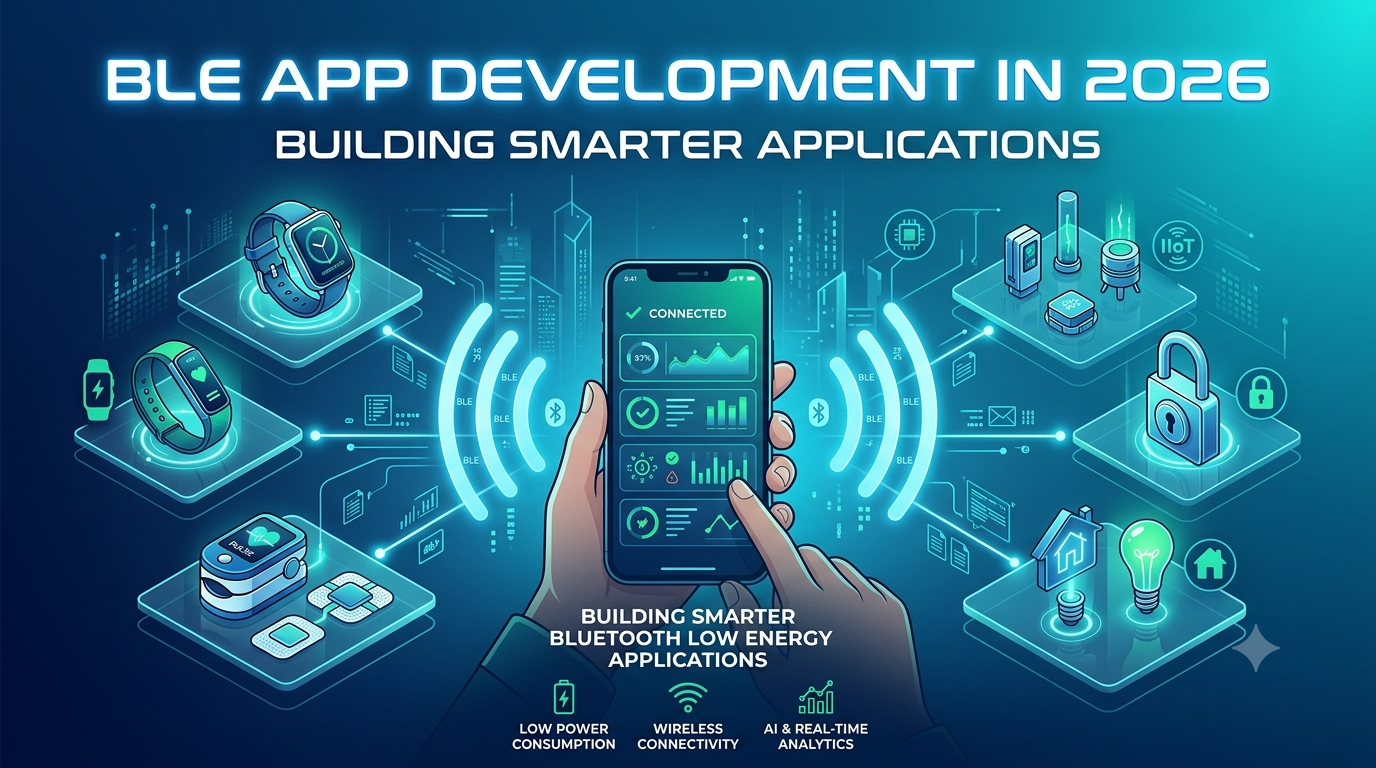
  • BLE App Development Company in 2026: Building Smarter Connected Applications

    Bluetooth Low Energy (BLE) has become a critical connectivity technology for modern connected products. From smart wearables and healthcare devices to industrial sensors, asset trackers, smart home products, and retail solutions, BLE enables devices to communicate efficiently while maintaining low power consumption.

    In 2026, BLE app development is moving beyond simple device connectivity. Businesses are increasingly combining BLE, mobile applications, IoT platforms, cloud services, AI, and real-time analytics to create intelligent connected-device ecosystems.

    For companies planning a connected product, choosing an experienced BLE app development company can make a significant difference in application performance, security, scalability, and user experience.

    What Is BLE App Development?

    BLE app development is the process of building applications that communicate with Bluetooth Low Energy-enabled devices.

    A modern BLE application can:

    • Discover nearby BLE devices
    • Establish and manage connections
    • Read device information
    • Write commands to connected hardware
    • Receive real-time notifications
    • Collect sensor data
    • Monitor device status
    • Configure connected products
    • Synchronize information with cloud platforms
    • Provide real-time alerts and analytics

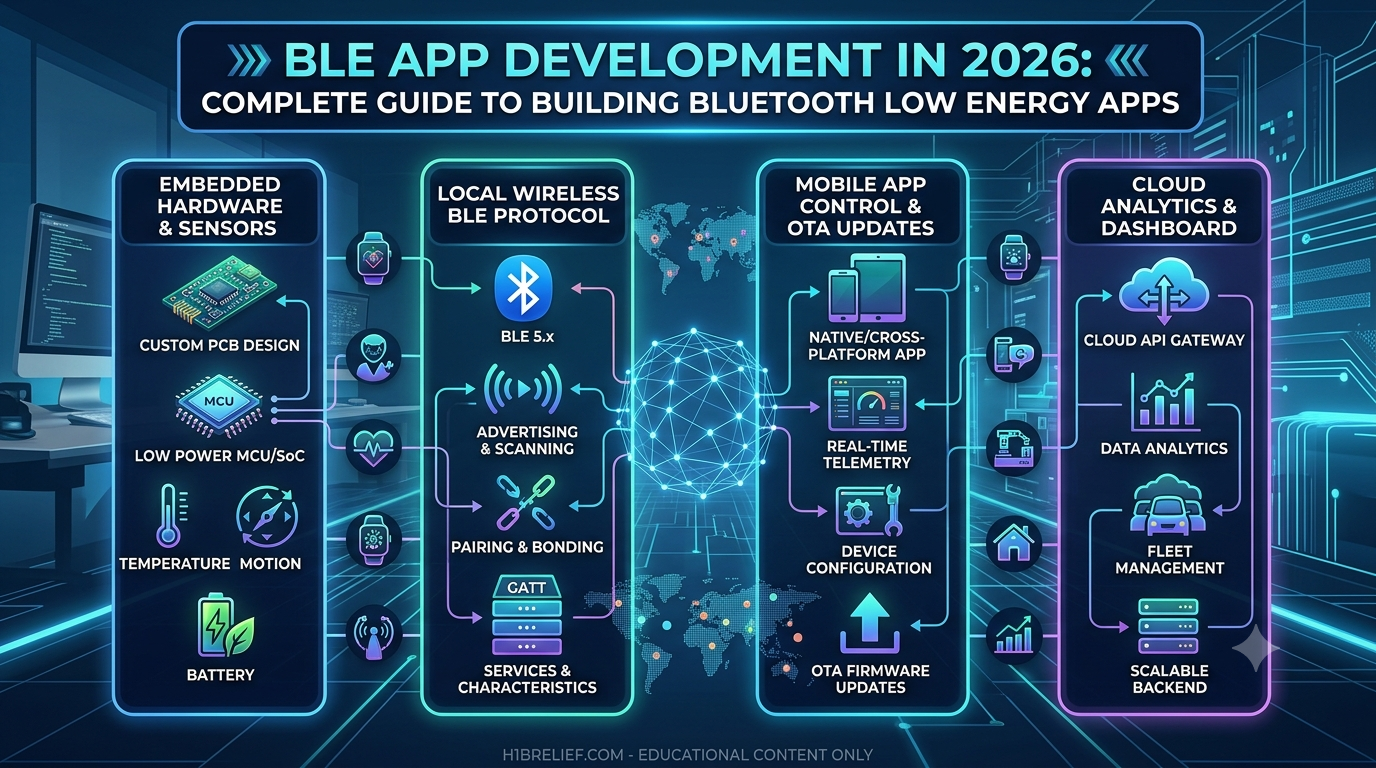
    A complete BLE solution can include hardware, firmware, mobile applications, APIs, cloud infrastructure, databases, and administrative dashboards.

    The architecture depends on the product and its connectivity requirements.

    Why BLE App Development Matters in 2026

    BLE continues to be valuable because it combines wireless connectivity with efficient power usage.

    It is particularly suitable for products that operate on batteries or require frequent communication with smartphones and other nearby devices.

    Some of the major benefits include:

    1. Low Power Consumption

    BLE is designed for efficient wireless communication, making it suitable for battery-powered sensors, wearables, trackers, and smart devices.

    2. Smartphone Connectivity

    BLE support across modern mobile platforms allows businesses to connect physical products directly with iOS and Android applications.

    3. Real-Time Device Communication

    BLE applications can exchange information between mobile devices and connected hardware for monitoring, configuration, and control.

    4. IoT Integration

    BLE devices can connect with mobile gateways and cloud platforms, allowing businesses to create larger IoT ecosystems.

    5. Flexible Use Cases

    BLE can be used across healthcare, fitness, retail, logistics, automotive, industrial automation, smart homes, and consumer electronics.

    How a BLE Application Works

    A typical BLE communication flow looks like:

    Scan → Discover → Connect → Service Discovery → Characteristic Discovery → Read/Write → Notifications

    In many applications, the smartphone acts as the central, while the connected device acts as the peripheral.

    BLE uses the Generic Attribute Profile (GATT) to organize device data into services and characteristics.

    For example, a fitness application could connect to a wearable device, read sensor information, and display activity data in real time.

    Top BLE App Development Trends in 2026

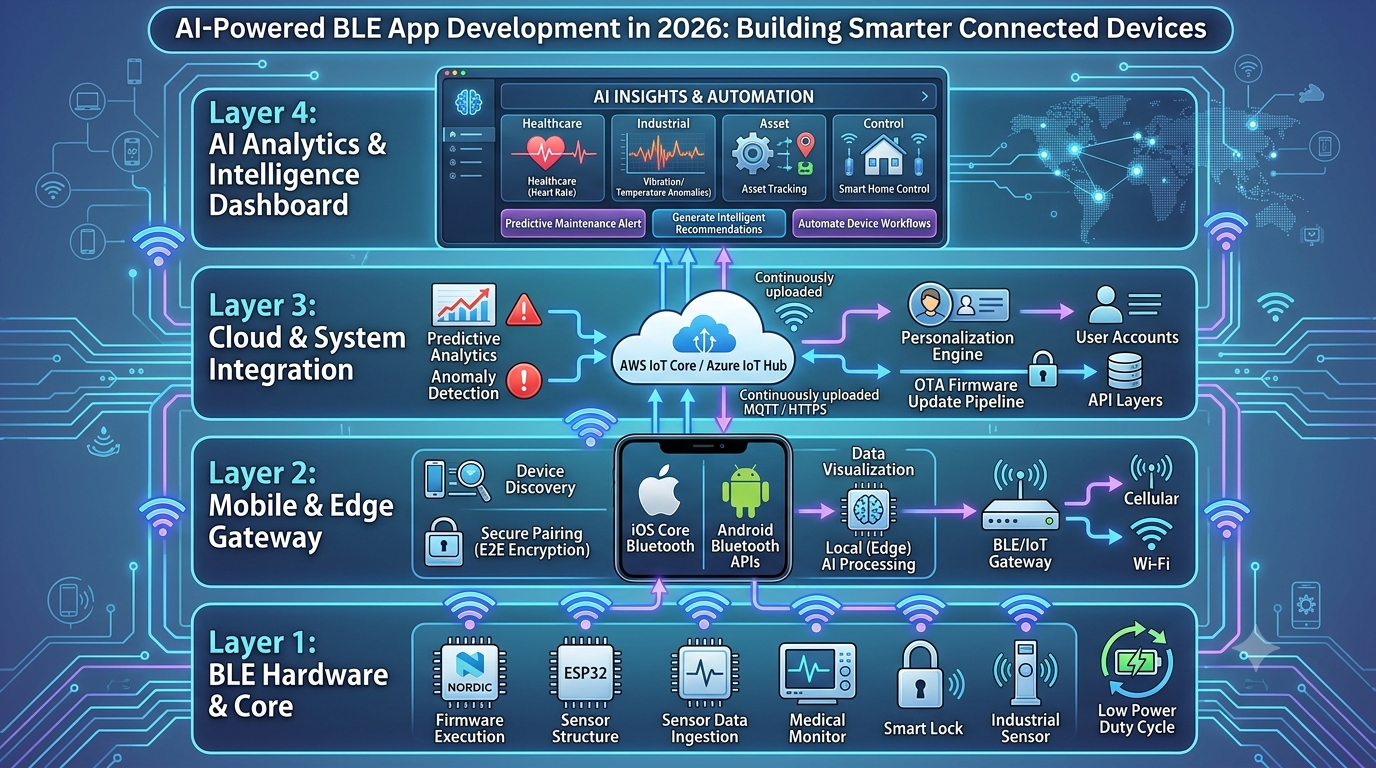
    BLE + AI

    One of the biggest opportunities is combining BLE-generated data with artificial intelligence.

    Instead of simply collecting sensor information, AI can analyze device data and identify patterns.

    For example:

    • Predictive maintenance
    • Personalized fitness recommendations
    • Anomaly detection
    • Smart device automation
    • Predictive healthcare insights
    • Intelligent customer experiences

    This transforms a BLE application from a connectivity tool into an intelligent digital product.

    Bluetooth Channel Sounding

    Bluetooth technology is evolving toward more accurate distance awareness.

    Bluetooth SIG introduced Bluetooth Channel Sounding to enable secure fine-ranging capabilities, creating opportunities for applications that need better distance awareness.

    Potential applications include:

    • Digital keys
    • Asset tracking
    • Indoor navigation
    • Smart access control
    • Device finding
    • Location-aware experiences
    • Industrial applications

    BLE + IoT

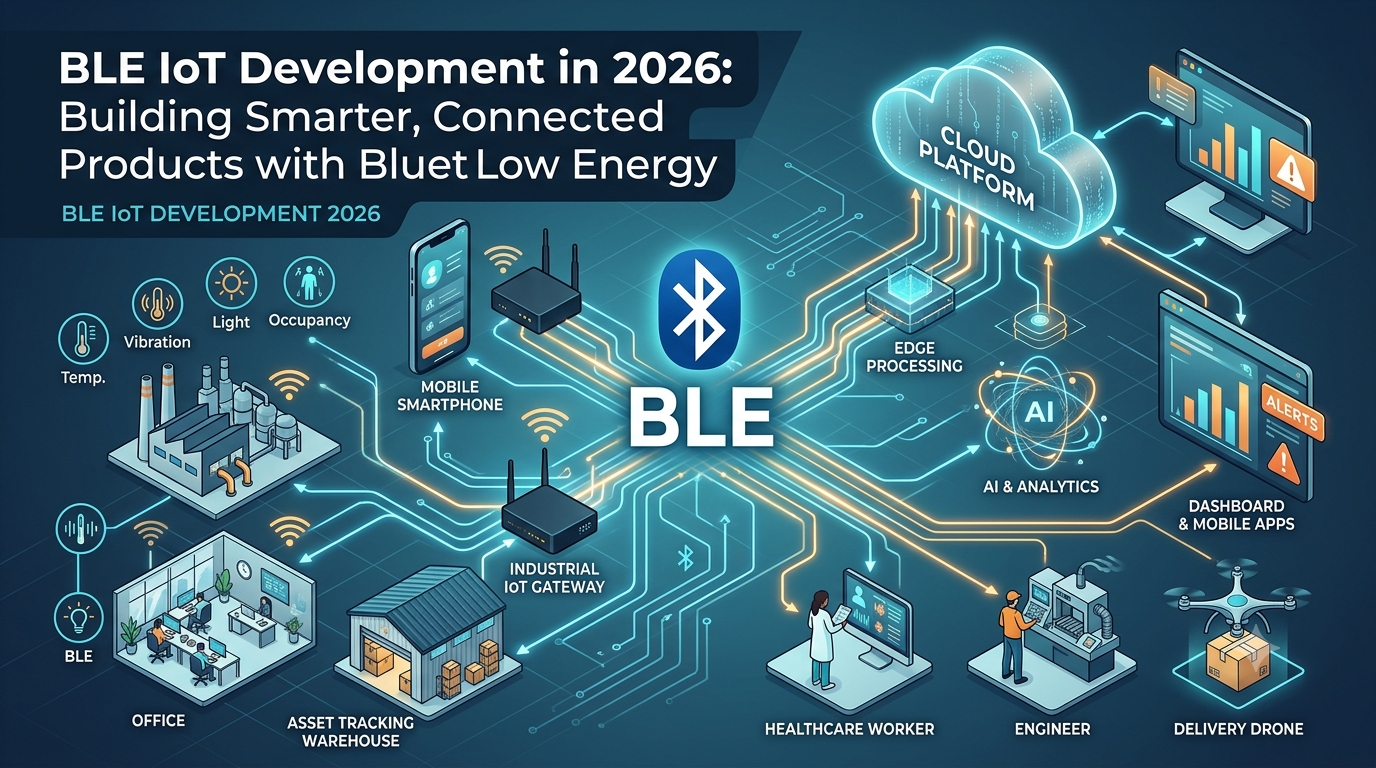
    BLE is increasingly being used as part of complete IoT architectures.

    A typical solution can look like:

    BLE Device → Mobile App/Gateway → Cloud → Database → Analytics → Business Dashboard

    This architecture allows organizations to monitor connected devices and turn device data into actionable business insights.

    BLE for Smart Devices

    Smart locks, wearable devices, connected appliances, fitness equipment, medical sensors, and industrial products can use BLE applications for configuration, monitoring, and control.

    BLE Mesh and Large Device Networks

    BLE-based networking can also support environments containing many connected devices.

    Potential applications include:

    • Warehouses
    • Retail stores
    • Smart buildings
    • Industrial facilities
    • Healthcare environments
    • Smart campuses

    Bluetooth Core 5.4 introduced features such as Periodic Advertising with Responses (PAwR), supporting large-scale one-to-many communication scenarios.

    BLE App Development for Android

    Android BLE application development requires careful handling of scanning, permissions, connections, GATT operations, and device compatibility.

    A BLE Android application can provide:

    • Device discovery
    • BLE pairing and connection
    • Service discovery
    • Characteristic read/write
    • Notifications
    • Device configuration
    • Sensor monitoring
    • Firmware update workflows
    • Real-time data visualization

    Android device fragmentation also means developers need to test applications across different devices and operating-system versions.

    BLE App Development for iOS

    Apple’s Core Bluetooth framework provides the foundation for communicating with BLE peripherals on iOS.

    A typical iOS BLE application may:

    1. Scan for nearby peripherals
    2. Identify available services
    3. Connect to a BLE device
    4. Discover characteristics
    5. Read and write data
    6. Subscribe to notifications
    7. Handle connection changes
    8. Manage application lifecycle behavior

    Background execution and Bluetooth permissions should be considered during architecture and testing.

    Cross-Platform BLE App Development

    Businesses developing both Android and iOS applications can consider cross-platform technologies such as:

    • Flutter
    • React Native
    • Native Android
    • Native iOS

    However, BLE functionality frequently requires platform-specific handling.

    A strong BLE development architecture should therefore balance code reuse with native Bluetooth capabilities.

    Industries Using BLE Applications

    Healthcare

    BLE can connect medical sensors, monitoring equipment, wearable devices, and patient-monitoring products.

    Fitness & Wearables

    Fitness trackers, smartwatches, heart-rate monitors, cycling devices, and other wearable products can use BLE to transfer data to mobile applications.

    Retail

    BLE can support proximity experiences, indoor navigation, electronic shelf applications, customer engagement, and connected retail infrastructure.

    Logistics & Asset Tracking

    BLE-enabled tags and sensors can help businesses monitor assets, equipment, inventory, and movement.

    Automotive

    BLE can support digital keys, vehicle access, device connectivity, and personalized automotive experiences.

    Industrial IoT

    Factories can use BLE-connected sensors for equipment monitoring, environmental monitoring, predictive maintenance, and operational visibility.

    Smart Homes

    BLE applications can control and configure smart locks, sensors, lighting products, appliances, and other connected devices.

    Key Features of a Modern BLE Application

    A business-grade BLE application may include:

    Device Management

    Connect, disconnect, configure, rename, and monitor BLE devices.

    Real-Time Data

    Display sensor and device information immediately inside the application.

    Push Notifications

    Alert users when a device reports a particular event or condition.

    Cloud Integration

    Synchronize device information with cloud platforms and databases.

    Analytics Dashboard

    Convert BLE data into useful business and operational insights.

    Secure Communication

    Protect communication between mobile applications and connected hardware.

    OTA Firmware Updates

    Support firmware-management workflows where the product architecture requires them.

    Multi-Device Support

    Allow users to manage multiple BLE peripherals from a single application.

    BLE App Security

    Security should be considered from the beginning of BLE application development.

    Important areas include:

    • Secure pairing
    • Authentication
    • Encryption
    • Secure data transmission
    • API authentication
    • Access control
    • Secure cloud communication
    • Device authorization
    • Protection against unauthorized commands

    For products handling sensitive business, personal, or healthcare information, BLE security should be combined with application-level and cloud-level security controls.

    BLE App Development Process

    A structured development process helps reduce connectivity problems and improves product reliability.

    Step 1: Product Discovery

    Understand the hardware, target users, business requirements, BLE profile, communication model, and expected data flow.

    Step 2: BLE Architecture

    Define the services, characteristics, communication protocols, connection strategy, and device-management requirements.

    Step 3: UI/UX Design

    Create a simple interface for device discovery, connection, configuration, monitoring, and data visualization.

    Step 4: Mobile Development

    Develop the Android and iOS applications based on the selected architecture.

    Step 5: Hardware & Firmware Integration

    Test communication between the application and actual BLE hardware rather than relying only on simulated environments.

    Step 6: Cloud & API Integration

    Connect the application with APIs, databases, dashboards, analytics platforms, and other business systems when required.

    Step 7: Testing

    Test:

    • Different smartphones
    • Different OS versions
    • Multiple BLE devices
    • Connection interruptions
    • Background behavior
    • Battery consumption
    • Data accuracy
    • Security
    • Network conditions

    Step 8: Deployment & Maintenance

    After launch, continue monitoring performance and releasing application and firmware updates as required.

    How to Choose a BLE App Development Company

    Not every mobile development company has deep BLE expertise.

    When selecting a BLE app development company, businesses should evaluate:

    • BLE protocol experience
    • Android BLE expertise
    • iOS Core Bluetooth experience
    • Hardware integration knowledge
    • Firmware understanding
    • IoT development experience
    • Cloud and API integration
    • BLE security knowledge
    • Testing capabilities
    • Post-launch support

    A good development partner should understand the complete ecosystem—not just the mobile application.

    Why Choose BLEAppDeveloper?

    BLEAppDeveloper focuses on building customized Bluetooth Low Energy applications for connected products and IoT ecosystems.

    Our development approach can support:

    • Custom BLE mobile applications
    • Android BLE development
    • iOS BLE development
    • Bluetooth device integration
    • BLE IoT applications
    • Wearable applications
    • Smart device applications
    • BLE data visualization
    • Cloud and API integration
    • Connected-product development
    • Device monitoring solutions

    The goal is to create BLE applications that are reliable, secure, scalable, and easy for end users to operate.

    The Future of BLE App Development

    BLE development is moving toward intelligent, context-aware, and highly connected experiences.

    Future solutions will increasingly combine:

    BLE + AI + IoT + Cloud + Edge Computing + Real-Time Analytics + Advanced Positioning

    As Bluetooth technology continues to evolve, new capabilities around distance awareness, connected-device networking, and intelligent device interactions can create opportunities across consumer and enterprise markets. Bluetooth SIG’s 2026 industry outlook specifically identifies Channel Sounding and distance-aware experiences as important areas to watch.

    Conclusion

    BLE app development has become an important part of modern connected-product development.

    From wearables and healthcare devices to industrial IoT, smart homes, retail, logistics, and automotive applications, BLE provides businesses with an efficient way to connect physical products with mobile and cloud-based experiences.

    The most successful BLE applications are not built around connectivity alone. They combine reliable BLE communication, intuitive mobile UX, secure architecture, cloud integration, analytics, and intelligent automation.

    If you are planning a connected product, working with an experienced BLE app development company can help turn your hardware concept into a scalable digital ecosystem.

    SEO Details

    SEO Title: BLE App Development Company in 2026 | BLEAppDeveloper

    Meta Description: Build smarter connected products with BLE app development services. Explore Android, iOS, IoT, AI, wearable, and custom Bluetooth Low Energy app development.

    Primary Keyword: BLE App Development Company

    Secondary Keywords: BLE App Developers, BLE App Development Services, Bluetooth Low Energy App Development, Bluetooth App Development Company, BLE IoT Development, BLE Android App Development, BLE iOS App Development

    Suggested URL: /blogs/ble-app-development-company-2026/
  • BLE App Development in 2026: Building Smart Bluetooth Low Energy Applications

    Bluetooth Low Energy (BLE) has become an important connectivity technology for modern applications that need reliable short-range communication with connected devices.

    From wearable technology and healthcare devices to smart locks, industrial sensors, fitness products, asset tracking systems, and IoT solutions, BLE enables mobile applications to communicate with physical devices without requiring traditional wired connections.

    As connected products continue to grow in 2026, businesses are investing in BLE app development to create mobile applications that can discover, connect, control, monitor, and exchange data with BLE-enabled devices.

    What Is BLE App Development?

    BLE app development involves creating mobile applications that communicate with Bluetooth Low Energy devices.

    A BLE application can allow users to:

    • Discover nearby devices
    • Connect to BLE peripherals
    • Read sensor data
    • Send commands
    • Configure devices
    • Monitor device status
    • Receive notifications
    • Synchronize data
    • Manage connected products

    A typical BLE application ecosystem looks like:

    BLE Device → Mobile Application → Backend/Cloud → Dashboard

    The exact architecture depends on the product and its business requirements.

    Why Businesses Are Choosing BLE in 2026

    BLE is particularly useful for connected products that need efficient wireless communication.

    Compared with traditional connectivity approaches, BLE can be attractive for applications where devices need:

    • Low power consumption
    • Short-range communication
    • Smartphone connectivity
    • Compact hardware
    • Battery-powered operation
    • Sensor data transmission

    This makes BLE suitable for a wide range of consumer and enterprise products.

    Top BLE App Development Use Cases

    1. Wearable Applications

    Fitness trackers, smartwatches, health devices, and other wearables frequently communicate with smartphones.

    BLE applications can collect information from wearable devices and display it through mobile dashboards.

    Possible features include:

    • Activity tracking
    • Device monitoring
    • Sensor readings
    • Exercise data
    • Notifications
    • Device configuration

    2. Healthcare Applications

    BLE can connect compatible medical and wellness devices with mobile applications.

    Potential use cases include:

    • Patient monitoring
    • Fitness monitoring
    • Connected thermometers
    • Rehabilitation devices
    • Blood pressure monitoring
    • Wearable health devices

    Healthcare applications require strong attention to security, privacy, reliability, and applicable regulatory requirements.

    3. Smart Home Applications

    BLE can also support smart-home products.

    Examples include:

    • Smart locks
    • Sensors
    • Lighting controls
    • Access systems
    • Smart appliances
    • Security devices

    A mobile application can provide users with a convenient interface for discovering and controlling compatible devices.

    4. Industrial Applications

    Industrial businesses are increasingly adopting connected sensors and equipment.

    BLE applications can support:

    • Equipment monitoring
    • Asset tracking
    • Maintenance workflows
    • Environmental sensors
    • Inventory monitoring
    • Worker safety solutions

    A mobile BLE application can give field workers direct access to connected equipment.

    5. Retail and Proximity Applications

    BLE beacons and connected devices can support proximity-based experiences.

    Businesses can explore applications such as:

    • Indoor navigation
    • Proximity notifications
    • Asset tracking
    • Smart retail
    • Customer engagement
    • Location-aware experiences

    How BLE Communication Works

    A BLE system generally involves two roles:

    Central: Usually a smartphone, tablet, or gateway.

    Peripheral: A BLE-enabled device that provides services and characteristics.

    The mobile application can discover the peripheral and establish a connection.

    After connection, the application can interact with the device through defined BLE services and characteristics.

    For example:

    Mobile App → BLE Characteristic → Device Command

    or:

    BLE Sensor → Characteristic → Mobile App → Data Display

    Understanding this communication model is essential when designing a reliable BLE application.

    Important Features of a BLE Application

    Device Discovery

    Users can scan for nearby BLE devices and identify compatible products.

    Device Pairing

    The application can establish secure communication with supported devices.

    Data Reading

    Applications can retrieve information from BLE characteristics.

    Data Writing

    Apps can send commands or configuration values to compatible devices.

    Notifications

    BLE notifications can allow devices to send updated information to applications without requiring constant polling.

    Device Management

    Users can manage multiple connected devices from one application.

    Firmware Updates

    For compatible products, BLE applications can support appropriate firmware-update workflows.

    Cloud Synchronization

    Device information can be synchronized with a backend or cloud platform for storage and analytics.

    BLE App Development for Android and iOS

    Businesses often need BLE applications across both major mobile platforms.

    Android BLE Development

    Android provides Bluetooth APIs that allow applications to scan for devices, connect to peripherals, discover services, and exchange data.

    Developers need to account for Android permissions, operating-system versions, device manufacturers, background behavior, and connection management.

    iOS BLE Development

    Apple’s Core Bluetooth framework allows iOS applications to communicate with BLE peripherals.

    iOS BLE development requires careful handling of permissions, background operation, connection states, and Apple’s platform-specific requirements.

    A successful BLE application should provide a consistent experience while respecting the technical differences between Android and iOS.

    BLE + IoT: A Powerful Combination

    BLE becomes even more useful when connected to an IoT platform.

    A typical architecture can be:

    BLE Device → Mobile/Gateway → API → Cloud → Analytics

    This allows businesses to collect device data and make it available through centralized systems.

    IoT integration can provide:

    • Device monitoring
    • Data storage
    • Remote analytics
    • User management
    • Notifications
    • Reporting
    • Device lifecycle management

    BLE + AI for Smarter Applications

    Artificial intelligence is creating new opportunities for BLE-enabled products.

    BLE devices can collect data while AI systems analyze that information to identify patterns and generate insights.

    For example:

    BLE Sensor → Data → AI Analysis → Insight → Action

    Potential applications include:

    • Predictive maintenance
    • Anomaly detection
    • Personalized recommendations
    • Device behavior analysis
    • Usage forecasting
    • Intelligent alerts

    AI should be introduced where it provides measurable value to the product or business.

    BLE Application Security

    Security is an important consideration when developing applications that communicate with physical devices.

    A BLE application may need to address:

    • Secure pairing
    • Device authentication
    • Encryption
    • Access control
    • Secure APIs
    • User authentication
    • Data protection
    • Firmware security
    • Secure device updates

    Security should be considered during architecture and development rather than added after the product is completed.

    Challenges in BLE App Development

    BLE development can involve several technical challenges.

    Connection Management

    Wireless connections can be affected by distance, interference, operating-system behavior, and device conditions.

    Battery Optimization

    Frequent scanning and communication can increase battery consumption if not designed carefully.

    Device Compatibility

    Different smartphones and BLE hardware can behave differently.

    Background Operation

    Android and iOS impose platform-specific restrictions around background Bluetooth operations.

    Firmware Compatibility

    Mobile applications need to remain compatible with supported hardware and firmware versions.

    Scalability

    A product designed for a few devices may need a different architecture when supporting thousands or millions of connected devices.

    How to Develop a BLE Application

    A structured development process can help reduce technical problems.

    Step 1: Define the Use Case

    Identify what the BLE device does and what users need to accomplish through the app.

    Step 2: Define BLE Requirements

    Document:

    • Services
    • Characteristics
    • Data formats
    • Commands
    • Connection behavior
    • Security requirements

    Step 3: Select the Technology Stack

    Choose the appropriate native or cross-platform mobile development approach based on the product requirements.

    Step 4: Develop the BLE Layer

    Build device scanning, connection management, service discovery, data exchange, and error handling.

    Step 5: Build the User Interface

    Create a simple interface for device setup, monitoring, configuration, and control.

    Step 6: Integrate the Backend

    Connect the application with APIs, databases, cloud services, and analytics where required.

    Step 7: Test With Real Hardware

    BLE applications should be tested across different:

    • Smartphones
    • OS versions
    • BLE devices
    • Firmware versions
    • Physical environments
    • Connection conditions

    Why Choose Custom BLE App Development?

    Generic Bluetooth applications may be sufficient for basic device testing, but commercial products often require a customized user experience.

    Custom BLE application development can provide control over:

    • Device communication
    • User experience
    • Hardware integration
    • Security
    • Cloud connectivity
    • Analytics
    • Firmware updates
    • Device management
    • Business workflows

    This makes custom development particularly valuable for companies creating their own connected products.

    What Does BLE App Development Cost?

    The cost of a BLE application depends on the complexity of the product.

    Factors that can affect development cost include:

    • Number of platforms
    • BLE communication complexity
    • Number of devices
    • UI/UX requirements
    • Hardware integration
    • Firmware requirements
    • Cloud backend
    • API integrations
    • Security requirements
    • Analytics
    • Admin dashboards
    • Testing requirements

    A simple BLE controller can require significantly less development effort than a complete IoT ecosystem with cloud infrastructure and thousands of connected devices.

    The Future of BLE Applications

    BLE development is moving toward more connected and intelligent applications.

    The combination of:

    BLE + Mobile + IoT + Cloud + AI + Edge Computing

    can create powerful connected-product ecosystems.

    As businesses continue developing smart devices, BLE applications will remain an important interface between users and physical products.

    Final Thoughts

    BLE app development is no longer limited to basic Bluetooth connectivity.

    Modern BLE applications can connect physical devices with mobile apps, cloud platforms, IoT systems, analytics, and AI-powered services.

    For businesses developing wearables, healthcare devices, smart-home products, industrial equipment, asset trackers, or connected consumer products, choosing the right BLE architecture can have a major impact on reliability, security, scalability, and user experience.

    A well-designed BLE application provides more than connectivity—it creates a digital interface for the physical product.

    Looking to build a BLE-powered mobile application?

    BLEAppDeveloper helps businesses develop custom Bluetooth Low Energy applications for Android, iOS, IoT devices, wearables, industrial products, healthcare technology, smart-home solutions, and connected products.

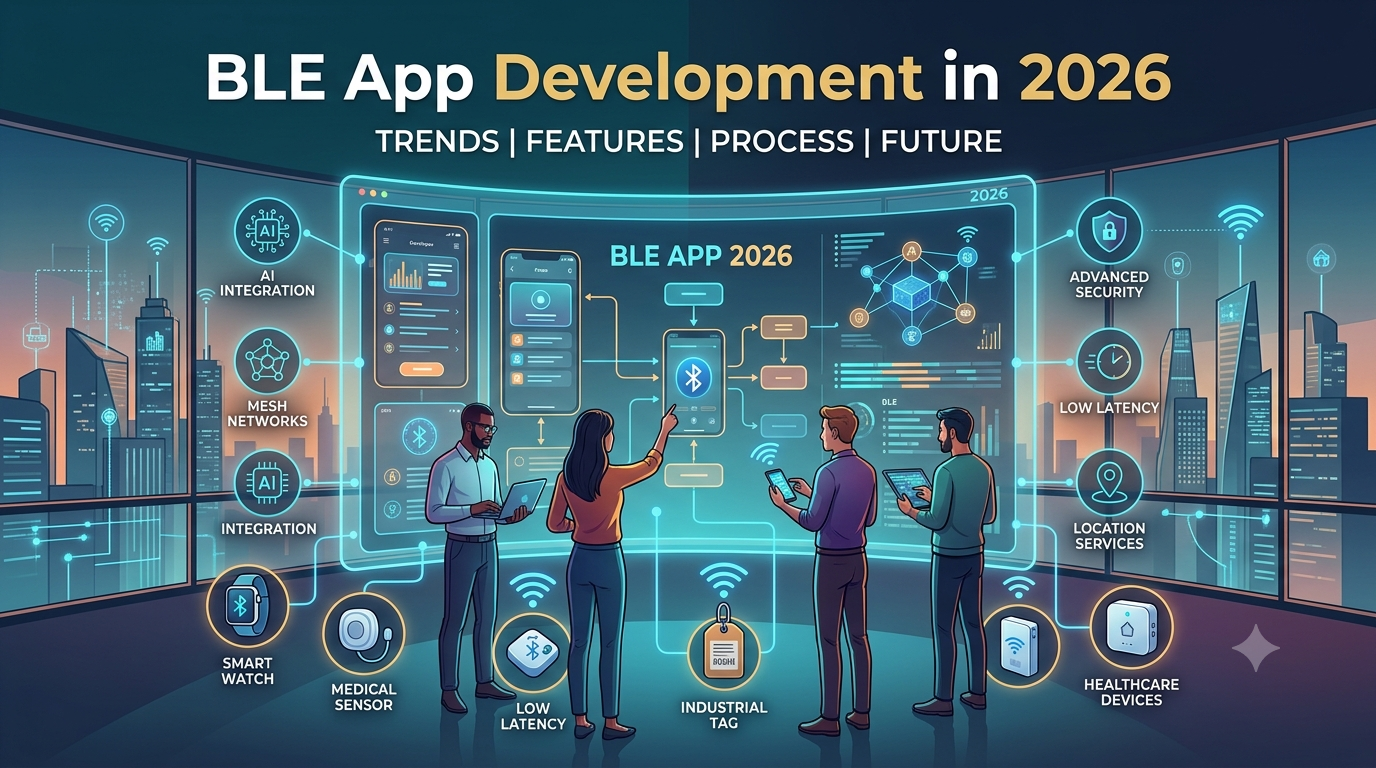
  • BLE App Development in 2026: Trends, Features, Process & Future of Bluetooth Apps

    Bluetooth Low Energy has become an important connectivity technology for modern mobile applications. From smartwatches and fitness trackers to healthcare devices, industrial sensors, smart home products, and asset tracking systems, BLE enables smartphones and connected devices to communicate efficiently.

    In 2026, BLE app development is moving beyond basic device connectivity. Developers are building applications that combine Bluetooth Low Energy, IoT, cloud platforms, AI, real-time analytics, and intelligent automation.

    For businesses developing connected products, a well-designed BLE mobile application can become the bridge between the physical device and the digital ecosystem.

    What Is BLE App Development?

    BLE app development involves creating mobile applications that communicate with Bluetooth Low Energy devices.

    A typical BLE application can:

    • Discover nearby BLE devices
    • Connect and disconnect devices
    • Read sensor data
    • Write commands to devices
    • Monitor device status
    • Configure connected hardware
    • Transfer data
    • Synchronize information with the cloud
    • Display real-time device information

    The application can be developed for Android, iOS, or both platforms depending on the product requirements.

    A typical architecture looks like:

    BLE Device → Mobile App → API/Cloud → Dashboard/Analytics

    Why BLE App Development Is Trending in 2026

    Connected devices are becoming part of everyday life.

    Businesses are developing products that need smartphones to communicate with physical devices without relying on traditional wired connections.

    BLE provides an efficient solution for many of these use cases because it is designed for low-power wireless communication.

    Popular applications include:

    • Wearables
    • Smart healthcare devices
    • Fitness equipment
    • Smart home devices
    • Industrial sensors
    • Asset tracking
    • Retail technology
    • Automotive accessories
    • Consumer electronics

    Top BLE App Development Trends in 2026

    1. AI-Powered BLE Applications

    AI is becoming an important layer in connected-device applications.

    Instead of simply showing sensor readings, BLE apps can use AI and analytics to interpret device data.

    For example:

    BLE Sensor → Mobile App → Cloud → AI → Intelligent Recommendation

    AI-powered BLE applications can support:

    • Predictive insights
    • Anomaly detection
    • Personalized recommendations
    • Device performance analysis
    • User behavior analysis
    • Predictive maintenance
    • Automated alerts

    This moves BLE applications from simple control interfaces toward intelligent applications.

    2. BLE + IoT Integration

    BLE apps are increasingly becoming part of larger IoT ecosystems.

    A mobile app can act as a bridge between BLE hardware and a cloud platform.

    For example:

    BLE Device → Smartphone → Internet → Cloud → Web Dashboard

    This architecture allows businesses to monitor connected devices remotely and analyze their data.

    3. BLE 5.x Development

    Modern BLE development can take advantage of capabilities available across the Bluetooth 5.x family, depending on the hardware and use case.

    Developers can build applications around requirements involving:

    • Range
    • Data throughput
    • Broadcasting
    • Device discovery
    • Reliability
    • Location-related functionality

    Choosing compatible hardware and designing the correct BLE communication architecture is essential for achieving the expected application performance.

    4. BLE Wearable App Development

    Wearables remain one of the most popular BLE application categories.

    BLE apps can connect smartphones with:

    • Smartwatches
    • Fitness bands
    • Health trackers
    • Smart rings
    • Sports devices
    • Specialized wearable sensors

    Applications can collect information such as activity, movement, device status, and other supported sensor measurements.

    5. Healthcare BLE Apps

    BLE is widely useful for connected healthcare and wellness products.

    A healthcare BLE app can communicate with compatible devices and present information to users or authorized systems.

    Potential applications include:

    • Health monitoring
    • Fitness monitoring
    • Rehabilitation
    • Remote device configuration
    • Connected medical equipment
    • Wellness applications

    Healthcare applications require additional attention to security, privacy, reliability, and applicable regulations.

    6. BLE Asset Tracking Apps

    Businesses can use BLE-enabled mobile applications to interact with asset tags and tracking systems.

    For example, an application can help employees:

    • Discover nearby assets
    • Identify devices
    • Configure BLE tags
    • Record asset information
    • Monitor proximity
    • Update asset status

    For larger deployments, the mobile app can communicate with cloud-based asset management systems.

    7. BLE Indoor Positioning

    BLE technology can support location and proximity-based applications.

    Potential use cases include:

    • Indoor navigation
    • Retail proximity
    • Warehouse management
    • Hospital asset tracking
    • Smart buildings
    • Event applications
    • Location-based experiences

    BLE beacons and other Bluetooth-based technologies can help applications understand proximity or approximate device location.

    8. Cross-Platform BLE App Development

    Businesses increasingly want applications for both Android and iOS without unnecessarily maintaining completely separate development projects.

    Depending on the requirements, cross-platform technologies can help reduce development time and simplify application maintenance.

    However, BLE applications require careful handling of:

    • Bluetooth permissions
    • Background behavior
    • Device discovery
    • Connection management
    • OS-specific Bluetooth APIs
    • Battery optimization

    For complex BLE applications, the development approach should be selected based on the hardware and communication requirements rather than simply choosing a framework because it is popular.

    Essential Features of a BLE Mobile App

    A professional BLE application can include:

    Device Discovery

    Scan for nearby Bluetooth Low Energy devices.

    Device Pairing

    Allow users to securely connect supported devices.

    Device Management

    Add, remove, rename, or configure connected devices.

    Data Reading

    Retrieve information from BLE characteristics.

    Data Writing

    Send commands or configuration values to connected devices.

    Real-Time Monitoring

    Display live device and sensor information.

    Notifications

    Alert users when specific conditions occur.

    Cloud Synchronization

    Send device data to a backend or IoT platform.

    Firmware Updates

    Support appropriate device firmware update workflows.

    User Accounts

    Provide authentication and personalized device management.

    Analytics

    Display historical and real-time device data.

    BLE App Development for Android and iOS

    BLE development is different across mobile platforms.

    Android BLE Development

    Android applications can use the platform’s Bluetooth APIs to:

    • Scan devices
    • Connect to peripherals
    • Discover services
    • Read characteristics
    • Write characteristics
    • Subscribe to notifications

    Developers also need to handle modern Android Bluetooth permissions and different device behaviors.

    iOS BLE Development

    iOS applications commonly use Apple’s Core Bluetooth framework for BLE communication.

    Applications can:

    • Discover peripherals
    • Connect to devices
    • Discover services
    • Read characteristics
    • Write data
    • Monitor notifications

    Background execution and Bluetooth behavior need to be carefully considered when designing the application.

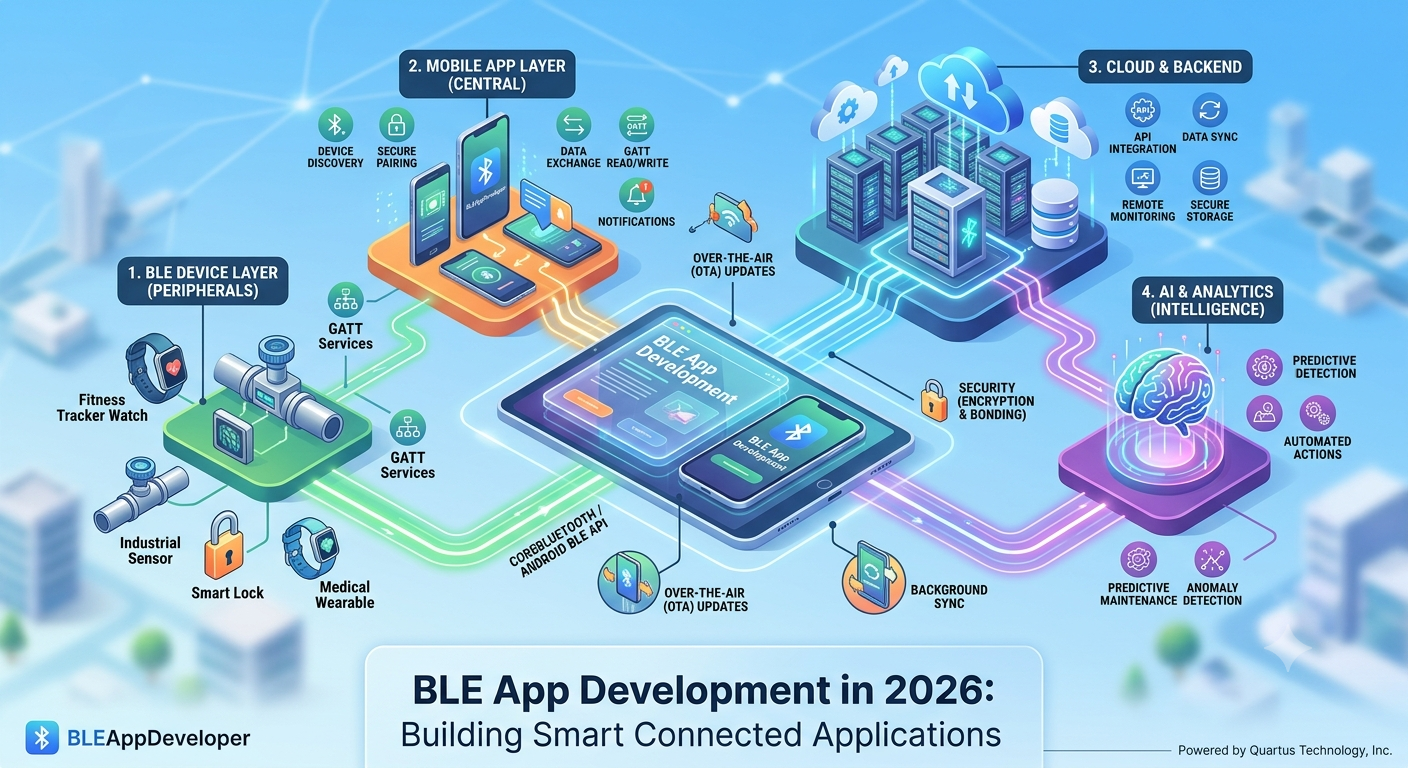
    BLE App Development Architecture

    A scalable BLE application can contain multiple layers.

    Hardware Layer

    BLE sensors, wearables, tags, or connected devices.

    BLE Communication Layer

    Handles scanning, pairing, connections, services, characteristics, notifications, and data transfer.

    Mobile Application Layer

    Provides the user interface and device management functionality.

    Backend Layer

    Handles authentication, APIs, data storage, device information, and business logic.

    Cloud Layer

    Stores and processes connected-device data.

    Analytics & AI Layer

    Analyzes information and generates insights.

    This architecture can be represented as:

    BLE Hardware → Mobile App → API → Cloud → Analytics/AI

    BLE App Security

    Security should be considered throughout BLE app development.

    Important areas include:

    • Secure pairing
    • Authentication
    • Encryption
    • Secure data transfer
    • Device identity
    • API security
    • User authentication
    • Access control
    • Secure firmware updates
    • Cloud security

    Developers should also avoid trusting device data blindly and should validate data received from connected hardware.

    How to Develop a BLE App

    Step 1: Define the Product

    Identify the connected device, target users, supported platforms, and business requirements.

    Step 2: Understand the BLE Protocol

    Define:

    • Services
    • Characteristics
    • UUIDs
    • Read/write operations
    • Notifications
    • Data formats
    • Connection requirements

    Step 3: Design the UX

    Create a simple experience for:

    • Device discovery
    • Pairing
    • Setup
    • Monitoring
    • Configuration
    • Notifications

    Step 4: Develop the BLE Layer

    Implement scanning, connection management, service discovery, data reading, writing, and notifications.

    Step 5: Build the Mobile App

    Develop the Android, iOS, or cross-platform application.

    Step 6: Connect the Backend

    Add APIs, authentication, cloud storage, user management, and analytics where required.

    Step 7: Test With Real Hardware

    BLE applications should be tested with actual devices.

    Testing should cover:

    • Connection reliability
    • Range
    • Reconnection
    • Background behavior
    • Battery consumption
    • Multiple devices
    • Different smartphones
    • Data accuracy

    Step 8: Deploy and Maintain

    After launch, continue improving the application, firmware compatibility, security, and device support.

    Industries Using BLE Apps

    Healthcare

    Connected health and wellness devices.

    Fitness

    Wearables, gym equipment, and sports sensors.

    Retail

    Beacons, proximity marketing, and smart retail solutions.

    Manufacturing

    Equipment monitoring and industrial sensors.

    Logistics

    Asset tracking and warehouse applications.

    Smart Home

    Connected locks, sensors, lighting, and appliances.

    Automotive

    Connected accessories and proximity applications.

    Consumer Electronics

    Smart devices and Bluetooth-enabled products.

    BLE App Development Challenges

    Building a BLE application is different from developing a standard mobile application.

    Common challenges include:

    Device Compatibility

    Different BLE devices can behave differently even when they follow the same standard.

    Connection Stability

    Applications need to handle connection drops and automatic reconnection.

    Background Restrictions

    Android and iOS impose restrictions that can affect BLE behavior in the background.

    Battery Consumption

    Poorly designed scanning and communication can increase battery usage.

    Data Synchronization

    Mobile apps need reliable synchronization between device data and cloud systems.

    Hardware Dependencies

    The mobile application often depends on firmware and hardware behavior.

    This is why BLE development requires coordination between hardware, firmware, mobile, backend, and cloud teams.

    How Much Does BLE App Development Cost?

    The cost of a BLE application depends on the complexity of the product.

    Factors include:

    • Android development
    • iOS development
    • Cross-platform requirements
    • Number of BLE devices
    • BLE protocol complexity
    • UI/UX requirements
    • Backend development
    • Cloud integration
    • AI and analytics
    • Admin dashboard
    • Security requirements
    • Firmware integration
    • Testing requirements

    A simple BLE controller app can be significantly different in scope from a complete IoT platform with multiple devices, cloud services, and analytics.

    Future of BLE App Development

    The future of BLE applications is moving toward intelligent connected experiences.

    The next generation of BLE apps will increasingly combine:

    Bluetooth Low Energy + IoT + AI + Cloud + Edge Computing + Analytics

    Instead of simply connecting to a device, applications will increasingly understand device data and help users make decisions.

    For businesses developing connected products, this creates opportunities to build applications that are not only communication tools but complete digital platforms.

    Build Your BLE Application With BLEAppDeveloper

    A successful BLE application requires more than a Bluetooth connection.

    It requires a well-designed combination of BLE communication, mobile development, hardware integration, backend APIs, cloud services, security, and user experience.

    Whether you are developing a wearable, healthcare device, fitness product, smart home device, industrial sensor, asset tracking solution, or connected consumer product, the right BLE architecture can help turn your hardware into a scalable digital product.

    BLEAppDeveloper helps businesses develop BLE-enabled mobile applications designed to communicate with connected products and IoT ecosystems.

    SEO Keywords

    • BLE app development
    • BLE app development company
    • Bluetooth app development
    • Bluetooth Low Energy app development
    • BLE mobile app development
    • BLE Android app development
    • BLE iOS app development
    • BLE application development
    • Bluetooth application development
    • BLE software development
    • BLE developer
    • BLE developers
    • BLE wearable app development
    • BLE IoT app development
    • BLE healthcare app development
    • BLE asset tracking app
    • BLE device management app
    • BLE firmware integration
    • Bluetooth IoT app development
    • BLE app development services
    • custom BLE app development
    • BLE app development 2026
    • Bluetooth app development company
    • IoT mobile app development

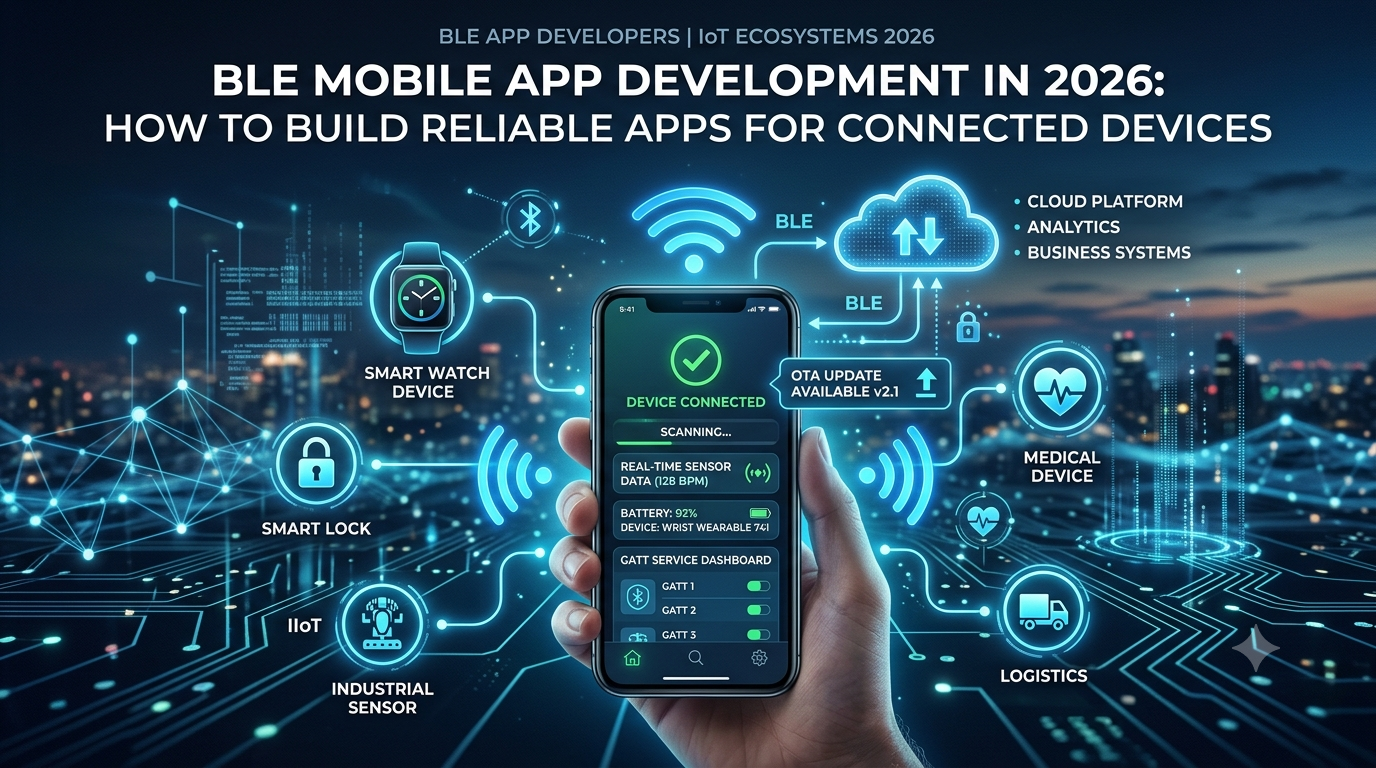
  • BLE Mobile App Development in 2026: How to Build Reliable Apps for Connected Devices

    Bluetooth Low Energy (BLE) has become an important connectivity layer for modern connected products. From smart wearables and healthcare devices to industrial sensors, smart locks, asset trackers, and consumer electronics, BLE allows mobile applications to communicate with nearby hardware while supporting efficient wireless communication.

    In 2026, BLE mobile app development is moving beyond simple device pairing. Businesses are building complete connected ecosystems that combine BLE hardware, mobile applications, cloud platforms, analytics, automation, and firmware updates.

    For companies launching a connected product, the challenge is not simply making an app connect to Bluetooth. The real goal is creating a reliable, secure, scalable, and easy-to-use BLE application.

    What Is BLE Mobile App Development?

    BLE mobile app development is the process of creating mobile applications that communicate with Bluetooth Low Energy-enabled devices.

    A typical BLE ecosystem may include:

    BLE Device → Mobile App → Cloud Platform → Analytics → Business System

    The mobile application can discover nearby devices, establish connections, read and write data, receive notifications, configure hardware, monitor device status, and synchronize information with cloud services.

    Apple provides the Core Bluetooth framework for applications communicating with Bluetooth Low Energy devices, including support for central and peripheral roles.

    Why BLE Apps Are Important in 2026

    Connected products increasingly need a mobile interface that makes hardware useful and manageable for customers.

    BLE applications can help businesses provide:

    • Wireless device configuration
    • Real-time sensor monitoring
    • Device control
    • User authentication
    • Firmware updates
    • Remote diagnostics
    • Data synchronization
    • Push notifications
    • Cloud connectivity
    • Device management

    BLE is particularly useful when a product needs short-range wireless communication and efficient power usage.

    At the same time, the Bluetooth ecosystem continues to evolve. Bluetooth SIG is developing technologies such as Bluetooth High Data Throughput and Channel Sounding, expanding possibilities for future connected-device applications.

    How a BLE Mobile App Works

    A typical BLE application follows a structured communication process:

    1. Device Discovery

    The application scans for nearby BLE peripherals and identifies compatible devices.

    For example, a fitness application may search for a specific wearable based on its advertised information.

    2. Connection

    Once the correct device is identified, the application establishes a BLE connection.

    3. Service Discovery

    The app discovers the device’s available services and characteristics.

    These characteristics define the data that the application can read, write, or subscribe to.

    4. Data Exchange

    The application can then:

    • Read sensor values
    • Send commands
    • Write configuration settings
    • Subscribe to notifications
    • Monitor device status

    5. Cloud Synchronization

    For products requiring centralized data, information collected through BLE can be synchronized with a cloud backend.

    This allows businesses to create dashboards, analytics systems, remote monitoring platforms, and device-management solutions.

    Key Features of a Modern BLE Application

    Device Scanning and Discovery

    A good BLE application should make device discovery simple for users.

    Instead of forcing users through complicated Bluetooth settings, the application can provide a guided connection experience.

    Secure Pairing and Authentication

    Security should be considered from the beginning of development.

    Depending on the product, a BLE solution may require:

    • Secure pairing
    • Authentication
    • Encryption
    • Device authorization
    • User authentication
    • Secure API communication
    • Access control

    Security requirements should be designed according to the product, hardware, operating system, and data being transmitted.

    Real-Time Notifications

    BLE applications can subscribe to characteristic updates so that users receive new device information without repeatedly requesting it.

    This can be useful for:

    • Temperature sensors
    • Fitness devices
    • Industrial equipment
    • Medical monitoring devices
    • Smart locks
    • Asset trackers

    Background Connectivity

    Some connected products need BLE communication even when the user is not actively looking at the application.

    This is one of the more challenging areas of BLE iOS app development and BLE Android app development because mobile operating systems manage background execution and radio usage differently.

    Apple’s current Core Bluetooth documentation includes specific background behavior and, in iOS 26 and later, additional capabilities associated with Live Activities and Bluetooth workflows.

    Therefore, developers should design background connectivity according to the actual product requirements rather than assuming that BLE scanning or communication will behave identically in foreground and background modes.

    BLE Android App Development vs. BLE iOS App Development

    Businesses building a BLE mobile application often need both Android and iOS versions.

    However, the BLE implementation should not simply be copied from one platform to another.

    Android BLE Development

    Android BLE applications need to account for:

    • Bluetooth permissions
    • Device discovery
    • Connection management
    • GATT communication
    • Connection failures
    • Android version differences
    • Battery optimization

    iOS BLE Development

    iOS applications commonly use Apple’s Core Bluetooth framework.

    Developers need to consider:

    • Central and peripheral roles
    • Permission handling
    • Background execution
    • Connection restoration
    • GATT services and characteristics
    • iOS lifecycle behavior

    Apple’s documentation specifically describes Core Bluetooth support for discovering, connecting to, and interacting with BLE peripherals.

    Custom BLE App Development for Connected Products

    A generic Bluetooth application may work for simple use cases, but commercial products often require custom BLE app development.

    A custom application can be designed around the exact:

    • Hardware architecture
    • BLE services
    • GATT profile
    • User workflow
    • Security model
    • Firmware
    • Cloud architecture
    • Business requirements

    For example, a smart-lock company may require a BLE application that supports user authentication, device provisioning, remote configuration, access history, and secure unlock commands.

    A healthcare device may instead require sensor data collection, notifications, cloud synchronization, and device-status monitoring.

    The BLE communication layer needs to be designed around each product’s requirements.

    BLE App Development for IoT

    BLE is also an important component of many IoT ecosystems.

    A BLE IoT architecture can look like:

    Sensor → BLE → Smartphone/Gateway → Cloud → Dashboard

    This model can be used for:

    • Industrial monitoring
    • Smart buildings
    • Healthcare devices
    • Asset tracking
    • Retail systems
    • Environmental sensors
    • Wearables
    • Smart-home products

    The mobile application can act as a gateway between the physical device and the cloud platform.

    OTA Firmware Updates

    Connected products often need firmware updates after deployment.

    A BLE application can support an OTA firmware update workflow, allowing compatible firmware to be transferred to a device wirelessly.

    A production OTA system should consider:

    • Firmware authentication
    • Integrity verification
    • Version management
    • Update recovery
    • Battery level
    • Connection stability
    • Rollback strategies

    This can reduce the need for physical access to deployed devices.

    BLE App Testing: What Developers Should Check

    BLE applications require more than standard mobile-app testing.

    A comprehensive testing strategy should include:

    Connectivity Testing

    Test connection, disconnection, reconnection, and unexpected connection loss.

    Device Compatibility Testing

    Test different phones, operating-system versions, and supported BLE hardware.

    GATT Testing

    Verify services, characteristics, read/write operations, notifications, and data formats.

    Background Testing

    Test how the application behaves when the screen is locked, the app is minimized, or the operating system changes its execution state.

    Battery Testing

    Measure the impact of scanning, connections, notifications, and background communication.

    Security Testing

    Test authentication, authorization, encrypted communication, and protection against unauthorized device access.

    Real-World Testing

    BLE performance can change because of physical environments, interference, distance, device orientation, and hardware differences.

    Testing should therefore include real devices rather than relying entirely on simulators.

    Common BLE App Development Challenges

    Unstable Connections

    BLE connections can fail because of distance, interference, device limitations, or operating-system behavior.

    Applications should have intelligent reconnection and error-handling mechanisms.

    Battery Drain

    Excessive scanning and unnecessary communication can reduce battery efficiency.

    Developers should optimize scan frequency, connection intervals, notifications, and background activity.

    Platform Differences

    Android and iOS do not always behave identically.

    A successful cross-platform strategy should account for native BLE behavior where necessary.

    Hardware Compatibility

    The mobile application and firmware must follow a clearly defined communication contract.

    Poorly defined GATT services or inconsistent data formats can create problems during development and testing.

    Background Restrictions

    Background BLE behavior requires careful platform-specific design. Apple’s documentation, for example, explains that Bluetooth activity in the background is subject to specific execution rules and system constraints.

    BLE App Development Process

    A professional BLE application development project can follow these stages:

    Step 1: Product Discovery

    Understand the hardware, target users, connectivity requirements, and business objectives.

    Step 2: BLE Architecture

    Define the BLE roles, services, characteristics, communication flow, security requirements, and data model.

    Step 3: UI/UX Design

    Create an intuitive interface for device discovery, connection, configuration, monitoring, and control.

    Step 4: Mobile Development

    Develop the Android and iOS application using the appropriate native or cross-platform approach.

    Step 5: Hardware Integration

    Connect the application with the actual BLE hardware and firmware.

    Step 6: Backend Integration

    Connect device data with APIs, cloud services, dashboards, analytics, and business systems where required.

    Step 7: Testing

    Perform connectivity, performance, security, compatibility, battery, and real-device testing.

    Step 8: Deployment and Support

    Launch the application and continue with monitoring, bug fixes, firmware compatibility, security updates, and new features.

    Native or Cross-Platform BLE Development?

    Businesses often ask whether they should build their BLE application using native development or a cross-platform framework.

    Cross-platform technologies can reduce duplicated development work, but BLE functionality may still require platform-specific native implementations.

    The right choice depends on:

    • BLE complexity
    • Hardware requirements
    • Performance expectations
    • Background functionality
    • Development timeline
    • Target platforms
    • Long-term maintenance

    For advanced BLE products, architecture should be decided based on technical requirements rather than simply choosing a framework because it is popular.

    Industries Using BLE Mobile Applications

    BLE app development can support a wide range of industries.

    Healthcare

    Connected medical and wellness devices can transfer sensor information to mobile applications.

    Fitness & Wearables

    Fitness trackers, smartwatches, sports equipment, and health-focused wearables can use BLE for smartphone connectivity.

    Smart Home

    Smart locks, sensors, lighting systems, and other devices can use mobile apps as their control interface.

    Industrial IoT

    BLE applications can connect workers and technicians with industrial sensors, equipment, and monitoring systems.

    Retail

    BLE can support proximity experiences, connected devices, inventory workflows, and smart retail environments.

    Logistics

    BLE-enabled tags and sensors can help businesses monitor assets and collect operational data.

    Automotive

    Connected accessories, vehicle-related devices, digital keys, and monitoring solutions can incorporate BLE technology.

    Choosing a BLE App Development Company

    When selecting a BLE app development company, businesses should look beyond basic mobile development experience.

    Evaluate whether the development team understands:

    • Bluetooth Low Energy
    • GATT and BLE profiles
    • Mobile BLE APIs
    • Embedded systems
    • Firmware integration
    • Cloud and IoT architecture
    • Security
    • OTA updates
    • Real-device testing

    A team that understands both software and connected hardware can help reduce integration problems later in the product lifecycle.

    Why Choose BLE App Developers?

    BLEAppDevelopers focuses on end-to-end BLE application development, including mobile applications, hardware integration, firmware, cloud connectivity, OTA updates, and connected-device solutions.

    The development approach can support products requiring:

    • Custom BLE mobile apps
    • Android BLE applications
    • iOS BLE applications
    • Cross-platform BLE solutions
    • BLE device integration
    • Embedded firmware integration
    • Cloud and IoT connectivity
    • Device management
    • OTA firmware updates

    The Future of BLE Mobile App Development

    BLE development is continuing to expand beyond basic device communication.

    Emerging capabilities such as Bluetooth Channel Sounding and High Data Throughput are creating opportunities for new connected-device experiences. Bluetooth SIG describes High Data Throughput as an effort to increase Bluetooth LE data rates while also addressing energy efficiency and connection reliability.

    As connected products become more intelligent, BLE applications are likely to work increasingly closely with:

    • AI
    • Edge computing
    • Cloud platforms
    • Real-time analytics
    • Smart sensors
    • Digital twins
    • Location and ranging technologies
    • Automated device management

    The result is a shift from simply connecting devices to creating complete digital experiences around physical products.

    Conclusion

    BLE mobile app development in 2026 is about much more than connecting a smartphone to a Bluetooth device.

    A successful BLE application needs reliable connectivity, efficient communication, security, intuitive UX, hardware compatibility, platform-specific optimization, and a scalable architecture.

    Whether you are developing a wearable, healthcare device, smart lock, industrial sensor, asset tracker, or IoT product, the right BLE app developers can help turn connected hardware into a practical digital product.

    If you are planning a new connected-device project, custom Bluetooth Low Energy app development can provide the foundation for a reliable mobile-to-device experience.

  • BLE App Development in 2026: Building Smart Bluetooth Low Energy Applications

    Bluetooth Low Energy (BLE) has become a key technology for connecting smartphones with smart devices, sensors, wearables, healthcare equipment, industrial products, and IoT systems.

    As connected products continue to grow, businesses are investing in BLE app development to create mobile applications that can discover, connect, monitor, configure, and control Bluetooth-enabled devices.

    A modern BLE application can do much more than simply connect two devices. It can become the user interface for an entire connected product ecosystem, combining BLE connectivity, mobile applications, cloud platforms, APIs, analytics, and IoT services.

    What Is BLE App Development?

    BLE app development is the process of building mobile applications that communicate with Bluetooth Low Energy devices.

    A BLE-enabled mobile application can:

    • Discover nearby BLE devices
    • Scan Bluetooth signals
    • Connect and disconnect devices
    • Read sensor data
    • Write commands to devices
    • Monitor device status
    • Configure connected hardware
    • Display real-time information
    • Send alerts and notifications
    • Synchronize data with cloud platforms

    BLE applications can be developed for iOS, Android, or cross-platform environments, depending on the product requirements.

    Why Businesses Are Investing in BLE Applications

    BLE provides a practical way to connect physical products with smartphones.

    Businesses can use BLE applications to create connected experiences without requiring users to interact directly with complicated hardware interfaces.

    Common advantages include:

    Low-Power Connectivity

    BLE is designed for applications where devices need efficient wireless communication and long battery life.

    This makes it suitable for wearable devices, sensors, trackers, and portable products.

    Smartphone Compatibility

    Modern smartphones support Bluetooth Low Energy, allowing applications to communicate directly with many BLE-enabled products.

    Real-Time Device Interaction

    A mobile application can receive information from connected hardware and send commands back to the device.

    Flexible Product Development

    BLE can support a wide variety of products, from simple sensors to sophisticated IoT ecosystems.

    IoT Integration

    BLE applications can work as part of a larger IoT architecture by transferring device data to cloud platforms and backend systems.

    How BLE Mobile Apps Work

    A typical BLE application follows a communication process:

    BLE Device → Bluetooth Connection → Mobile App → API/Cloud → Dashboard

    The exact architecture depends on the product.

    For example, a fitness device may collect health and activity information and send it to a smartphone. The application can display the data to the user and synchronize selected information with a cloud platform.

    An industrial application may connect to multiple sensors and send collected data to a centralized monitoring system.

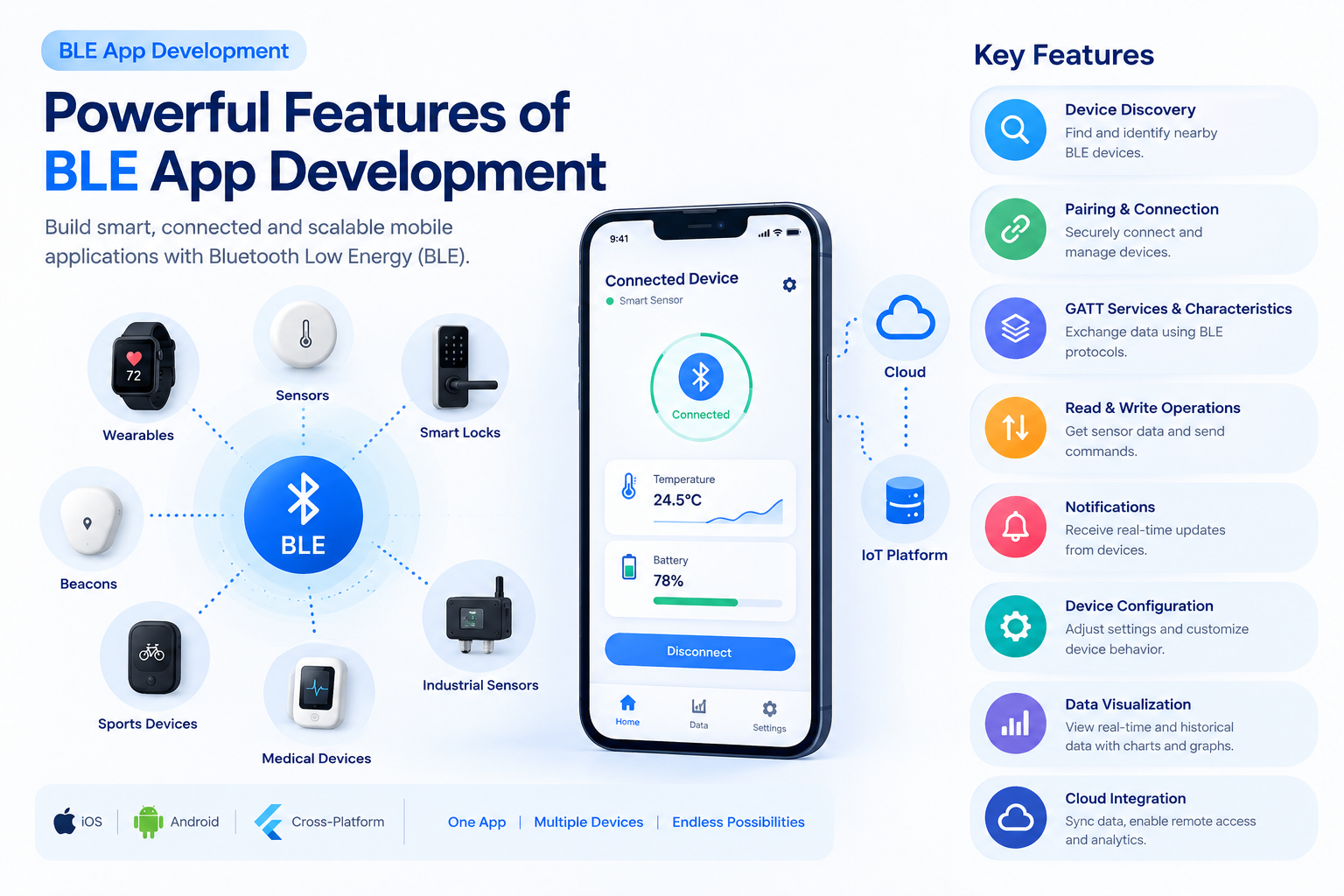
    Key Features of BLE App Development

    A professional BLE mobile application may include several important features.

    BLE Device Discovery

    The application can scan for nearby Bluetooth Low Energy devices and identify compatible hardware.

    Device Pairing and Connection

    Users can connect the mobile application with a BLE device and establish communication.

    GATT Services and Characteristics

    BLE applications commonly communicate through the Generic Attribute Profile (GATT).

    GATT services and characteristics define how information is organized and exchanged between the mobile application and BLE device.

    Read and Write Operations

    The application can read information from a device and write commands or configuration values to supported characteristics.

    Notifications

    BLE notifications can allow devices to send updated information to the application without requiring continuous manual requests.

    Device Configuration

    Applications can provide interfaces for configuring connected devices, changing settings, or updating operating parameters.

    Data Visualization

    Sensor information can be displayed through:

    • Charts
    • Graphs
    • Dashboards
    • Status indicators
    • Historical reports

    Cloud Synchronization

    BLE application data can be synchronized with backend systems for remote storage, analytics, and multi-device access.

    BLE App Development for iOS

    Developing BLE applications for iOS requires careful handling of Apple’s Bluetooth frameworks and platform-specific permissions.

    An iOS BLE application may support:

    • Device scanning
    • BLE connections
    • GATT communication
    • Background communication where supported
    • Notifications
    • Device configuration
    • Data synchronization

    Developers need to consider iOS permissions, background behavior, device compatibility, and Apple’s platform requirements during development.

    BLE App Development for Android

    Android provides extensive support for Bluetooth Low Energy applications.

    Android BLE apps can implement:

    • Device discovery
    • BLE scanning
    • Connection management
    • GATT communication
    • Characteristic read/write operations
    • Notifications
    • Device configuration
    • Data synchronization

    Android development also requires attention to Bluetooth permissions and differences between operating system versions.

    Cross-Platform BLE App Development

    Businesses that need applications for both iOS and Android may consider cross-platform development.

    Technologies such as Flutter and React Native can help teams build applications across multiple platforms while sharing part of the application codebase.

    However, BLE communication often requires platform-specific implementation or native integrations.

    The right development approach depends on:

    • Device complexity
    • BLE protocol requirements
    • Performance
    • Background communication
    • Development budget
    • Target platforms
    • Product roadmap

    BLE App Development Process

    Building a reliable BLE application requires more than creating a mobile interface.

    1. Product Requirement Analysis

    The development process begins with understanding the connected product.

    Important questions include:

    • What BLE device will the app communicate with?
    • What data needs to be exchanged?
    • How many devices can connect?
    • Does the app need cloud integration?
    • Is background connectivity required?
    • What security requirements apply?

    2. BLE Architecture Planning

    Developers define the communication architecture, including:

    • BLE services
    • Characteristics
    • Data formats
    • Connection behavior
    • Notifications
    • Error handling

    3. UI/UX Design

    The application interface should make device connection and management simple.

    Important screens may include:

    • Device discovery
    • Device connection
    • Device status
    • Settings
    • Sensor dashboard
    • Alerts
    • User profile

    4. BLE Integration

    Developers implement scanning, connection management, GATT communication, data processing, and device control.

    5. Backend and API Integration

    If the application needs cloud functionality, APIs can connect the mobile application with backend services.

    This can support:

    • User accounts
    • Data storage
    • Device management
    • Analytics
    • Remote monitoring
    • Notifications

    6. Testing

    BLE applications need extensive testing because wireless communication can behave differently depending on the device, environment, operating system, and hardware.

    Testing can include:

    • Connectivity testing
    • Range testing
    • Battery testing
    • Device compatibility
    • Connection recovery
    • Data accuracy
    • Security testing
    • iOS testing
    • Android testing

    BLE App Development Use Cases

    BLE applications are used across multiple industries.

    Healthcare Apps

    BLE applications can communicate with connected medical and health-monitoring devices.

    Potential applications include:

    • Health sensors
    • Patient monitoring
    • Medical equipment
    • Fitness monitoring
    • Wearable healthcare devices

    Fitness and Wearables

    BLE is widely used for connected fitness products.

    Applications can connect with:

    • Smartwatches
    • Fitness trackers
    • Heart-rate sensors
    • Cycling devices
    • Sports equipment

    Smart Home Applications

    BLE apps can provide control and configuration features for connected home devices.

    Examples include:

    • Smart locks
    • Sensors
    • Lighting systems
    • Access control devices
    • Smart appliances

    Industrial Applications

    BLE applications can connect with industrial sensors and equipment for monitoring and configuration.

    Potential uses include:

    • Equipment monitoring
    • Asset tracking
    • Sensor data collection
    • Maintenance systems
    • Industrial diagnostics

    Retail Applications

    BLE applications can be used with beacons, sensors, and connected retail devices.

    Possible applications include:

    • Indoor positioning
    • Proximity experiences
    • Asset tracking
    • Inventory monitoring
    • Customer engagement

    Logistics and Asset Tracking

    BLE trackers can provide information about the location or status of assets.

    Mobile applications can be used to configure trackers and display collected information.

    BLE App and IoT Integration

    BLE becomes even more powerful when combined with IoT technology.

    A mobile application can act as a bridge between BLE devices and cloud services.

    For example:

    BLE Sensor → Mobile App → API → Cloud → Web Dashboard

    Alternatively:

    BLE Sensor → BLE Gateway → Cloud → Mobile/Web App

    This architecture can allow businesses to monitor connected products remotely and analyze device data at scale.

    BLE App Security

    Security should be considered throughout the BLE application development lifecycle.

    Important security considerations include:

    • Secure device pairing
    • Authentication
    • Encrypted communication
    • Secure APIs
    • User authentication
    • Access control
    • Secure data storage
    • Firmware security
    • Secure device configuration

    Applications handling sensitive information may require additional security controls based on their industry and regulatory requirements.

    Common BLE App Development Challenges

    Connection Reliability

    Wireless connections can disconnect because of distance, interference, device movement, or operating-system behavior.

    Applications should therefore implement appropriate connection recovery and error handling.

    Device Compatibility

    Different BLE devices may implement services and characteristics differently.

    Testing against actual hardware is essential.

    Background Operation

    Mobile operating systems place restrictions on background Bluetooth operations.

    Applications that require background functionality need platform-specific planning.

    Battery Consumption

    Frequent scanning and communication can affect smartphone and device battery life.

    Developers need to optimize connection intervals, scanning behavior, and data transmission.

    Hardware-Software Integration

    The BLE application must correctly communicate with the firmware and hardware.

    Clear BLE specifications and testing procedures can reduce integration problems.

    How to Choose a BLE App Development Company

    Businesses planning a Bluetooth-enabled product should evaluate development teams based on their experience with both software and connected hardware.

    Look for experience in:

    • BLE mobile app development
    • Bluetooth Low Energy
    • iOS BLE development
    • Android BLE development
    • Cross-platform BLE apps
    • GATT/GAP
    • BLE firmware integration
    • IoT integration
    • Cloud APIs
    • BLE device testing
    • Connected product development

    A development partner should also understand the complete product lifecycle, from prototype and MVP development through testing, deployment, and ongoing improvements.

    Future of BLE App Development

    BLE applications are becoming increasingly connected to larger digital ecosystems.

    Future BLE applications are likely to combine Bluetooth connectivity with:

    • IoT platforms
    • Edge computing
    • AI-powered analytics
    • Cloud infrastructure
    • Real-time monitoring
    • Smart sensors
    • Digital twins
    • Predictive maintenance

    This means BLE apps can evolve from simple device-control applications into intelligent interfaces for connected products.

    Why Work With BLE App Developers?

    Developing a reliable Bluetooth application requires knowledge of mobile development, wireless communication, hardware integration, and backend technologies.

    A specialized BLE app development company can help businesses move from a connected-device concept to a working mobile application.

    BLEAppDevelopers can focus on areas such as:

    • Custom BLE mobile applications
    • iOS BLE app development
    • Android BLE app development
    • Cross-platform BLE applications
    • BLE device integration
    • BLE IoT applications
    • BLE gateway integration
    • Cloud and API integration
    • Connected device solutions

    Conclusion

    BLE app development provides businesses with a practical way to connect smartphones with smart devices, sensors, wearables, industrial equipment, and IoT products.

    From device discovery and GATT communication to cloud integration and real-time analytics, a well-designed BLE application can become an important part of a connected product ecosystem.

    As businesses continue developing smart products in 2026, combining BLE, mobile applications, IoT, cloud platforms, and intelligent analytics can create scalable connected experiences across multiple industries.

    Frequently Asked Questions

    What is BLE app development?
    BLE app development is the process of creating mobile applications that communicate with Bluetooth Low Energy devices.

    Can BLE apps be developed for both iOS and Android?
    Yes. BLE applications can be developed for iOS and Android, either as separate native applications or using suitable cross-platform technologies.

    What can a BLE mobile app do?
    A BLE app can discover devices, establish connections, read and write data, receive notifications, configure devices, display sensor information, and communicate with cloud platforms.

    Can BLE apps connect to IoT platforms?
    Yes. BLE applications can communicate with backend APIs and cloud platforms, allowing device data to be stored, analyzed, and monitored remotely.

    How much does BLE app development cost?
    Development cost depends on the number of platforms, BLE hardware, application complexity, cloud requirements, integrations, security requirements, and testing needs.

    What industries use BLE applications?
    BLE applications are used in healthcare, fitness, wearables, retail, smart homes, logistics, industrial IoT, asset tracking, and connected consumer products.

  • BLE App Development in 2026: Building Smarter Bluetooth Low Energy Applications

    Bluetooth Low Energy (BLE) has become an important technology for connecting smartphones, wearables, sensors, medical devices, industrial equipment, and smart products.

    Unlike traditional Bluetooth applications that often focus on continuous data transmission, BLE is designed for efficient communication with connected devices while minimizing power consumption.

    This makes BLE app development particularly useful for businesses building connected products and IoT ecosystems.

    From smartwatches and fitness trackers to industrial sensors and healthcare devices, BLE applications can connect physical products with mobile and cloud platforms.

    In 2026, businesses are increasingly combining BLE, IoT, mobile applications, cloud platforms, real-time data, and AI to create connected experiences.

    What Is BLE App Development?

    BLE app development involves creating mobile, web, or backend applications that communicate with Bluetooth Low Energy-enabled devices.

    A typical BLE ecosystem can include:

    • BLE-enabled hardware
    • Sensors
    • Smartphones
    • Mobile applications
    • Cloud platforms
    • APIs
    • Analytics dashboards
    • IoT platforms

    A mobile application can discover nearby BLE devices, establish connections, read characteristics, write data, subscribe to notifications, and display information to users.

    Why Businesses Choose Bluetooth Low Energy

    BLE offers several characteristics that make it suitable for connected products.

    Low Power Consumption

    BLE is designed for low-energy communication, making it useful for battery-powered devices such as:

    • Fitness trackers
    • Smart sensors
    • Wearables
    • Asset trackers
    • Smart home devices
    • Industrial monitoring devices

    Battery life can be an important consideration when designing connected hardware.

    Wireless Connectivity

    BLE eliminates the need for physical connections between compatible devices.

    A smartphone can communicate with nearby BLE hardware without requiring a traditional wired interface.

    Broad Device Ecosystems

    BLE is supported across major mobile platforms and a wide range of modern consumer and industrial hardware.

    This creates opportunities for businesses developing cross-platform connected-device applications.

    Popular BLE App Development Use Cases

    BLE technology can be applied across many industries.

    1. Wearable App Development

    Wearables are one of the most visible BLE use cases.

    BLE applications can connect smartphones with:

    • Smartwatches
    • Fitness trackers
    • Smart bands
    • Health monitoring devices
    • Sports equipment

    The application can receive device data and present it through a mobile interface.

    2. Healthcare and Medical Devices

    BLE can support communication between compatible medical or health-monitoring devices and mobile applications.

    Potential applications include:

    • Connected health devices
    • Patient monitoring
    • Fitness monitoring
    • Device configuration
    • Remote data collection

    Healthcare applications require additional consideration of privacy, security, regulatory requirements, and device-specific standards.

    3. Smart Home Applications

    BLE can be used for device discovery, configuration, control, and communication within smart-device ecosystems.

    Examples include:

    • Smart locks
    • Sensors
    • Lighting devices
    • Home automation controllers
    • Smart appliances

    BLE can also work alongside other wireless technologies within a broader IoT architecture.

    4. Industrial IoT

    Industrial businesses can use BLE-enabled sensors and devices for monitoring and data collection.

    Applications can include:

    • Equipment monitoring
    • Asset tracking
    • Environmental sensing
    • Machine data collection
    • Worker safety systems
    • Predictive maintenance workflows

    BLE can serve as one

  • AI-Powered BLE App Development in 2026: Building Smarter Connected Devices

    Bluetooth Low Energy (BLE) has become an important connectivity layer for wearables, smart sensors, healthcare devices, industrial equipment, smart locks, fitness products, and connected consumer electronics.

    But BLE applications are evolving beyond simply connecting a smartphone to a device.

    In 2026, businesses are combining BLE app development, artificial intelligence, IoT, cloud platforms, and edge computing to create connected products that can collect data, understand patterns, automate decisions, and deliver more personalized experiences.

    This combination of BLE and AI is opening new opportunities for businesses developing next-generation connected products.

    What Is AI-Powered BLE App Development?

    AI-powered BLE app development combines Bluetooth Low Energy communication with artificial intelligence capabilities.

    A traditional BLE application may:

    • Discover nearby devices
    • Establish connections
    • Read BLE characteristics
    • Write commands
    • Receive sensor notifications
    • Display device information

    An AI-powered BLE application can go further by analyzing the data received from connected devices.

    For example, a wearable could continuously collect movement information through BLE. An AI model could analyze those patterns and identify changes in activity, generate insights, or personalize recommendations.

    A typical architecture can look like:

    BLE Device → Mobile Application → AI Processing → Cloud Platform → Analytics & Automation

    Depending on the product, some AI processing can also happen directly on the device or smartphone.

    Why Combine BLE and AI?

    BLE is designed for efficient wireless communication and is widely used in battery-powered connected devices. The Bluetooth SIG continues to expand Bluetooth capabilities, including technologies such as Channel Sounding for more precise distance awareness and LE Audio for advanced Bluetooth audio applications.

    AI adds another layer of intelligence.

    Together, BLE and AI can help applications:

    • Analyze real-time sensor data
    • Detect unusual patterns
    • Personalize user experiences
    • Automate device workflows
    • Predict maintenance requirements
    • Improve asset monitoring
    • Generate intelligent recommendations
    • Reduce manual monitoring
    • Connect physical devices with digital services

    This makes BLE application development increasingly relevant to IoT and smart-product businesses.

    How AI Works With BLE Data

    A BLE device can collect information from sensors and transmit it to a mobile application or gateway.

    For example, an industrial sensor might provide:

    • Temperature
    • Vibration
    • Pressure
    • Motion
    • Battery level
    • Equipment status

    The BLE application can then send selected data to an AI or machine-learning pipeline.

    The system may identify patterns such as:

    Normal equipment behavior → unusual vibration → AI detects anomaly → application generates alert → maintenance team investigates

    This transforms BLE from a connectivity technology into part of an intelligent monitoring system.

    Top Use Cases for AI and BLE Applications

    1. Smart Wearables

    Wearables are one of the most natural applications for BLE.

    A smartphone can communicate with:

    • Fitness trackers
    • Smartwatches
    • Health sensors
    • Sports devices
    • Smart rings
    • Connected accessories

    AI can analyze the information received from these devices and generate personalized insights.

    For example, a fitness application could analyze movement patterns and provide recommendations based on permitted user data.

    2. Healthcare and Medical Devices

    BLE is widely applicable to connected healthcare products because many medical and monitoring devices need efficient wireless communication.

    Potential applications include:

    • Patient monitoring
    • Connected medical sensors
    • Remote device configuration
    • Fitness and wellness monitoring
    • Medical equipment diagnostics
    • Medication-related devices

    For regulated medical products, however, development also needs to account for applicable security, privacy, quality, and regulatory requirements.

    BLEAppDevelopers highlights regulatory-aware development for medical devices alongside BLE, firmware, mobile applications, cloud infrastructure, and real-hardware QA.

    3. Predictive Maintenance

    Industrial businesses can combine BLE sensors with AI to monitor equipment.

    Sensors can collect information about:

    • Vibration
    • Temperature
    • Pressure
    • Motor activity
    • Operating conditions

    AI models can analyze historical and real-time information to identify potential anomalies.

    Instead of waiting for equipment to fail, businesses can investigate unusual patterns earlier.

    4. Smart Home Applications

    BLE can connect smartphones with smart-home products such as:

    • Smart locks
    • Sensors
    • Lighting controllers
    • Access devices
    • Environmental sensors
    • Smart appliances

    AI can add automation and personalization.

    For example, a connected home system could learn permitted usage patterns and provide intelligent automation while still allowing users to control devices manually.

    5. Asset Tracking

    BLE-based tracking can help businesses monitor assets across facilities.

    Potential applications include:

    • Equipment tracking
    • Inventory monitoring
    • Warehouse assets
    • Tools and machinery
    • Hospital equipment
    • Retail assets

    AI can analyze movement patterns and help identify unusual asset activity.

    6. Automotive and Mobility

    BLE applications can support connected mobility experiences such as:

    • Digital keys
    • Vehicle access
    • Device pairing
    • In-vehicle accessories
    • Fleet equipment
    • Vehicle diagnostics

    Bluetooth Channel Sounding is particularly interesting for applications requiring more precise distance awareness. The Bluetooth SIG describes it as a secure fine-ranging capability designed to bring distance awareness to Bluetooth-connected devices.

    BLE + AI + IoT Architecture

    A scalable connected product can contain several layers.

    Layer 1: BLE Hardware

    The physical device contains sensors, a BLE chipset, firmware, and power management.

    Common hardware platforms can include Nordic nRF52/nRF53, ESP32, Silicon Labs, TI, and other BLE-capable chipsets.

    Layer 2: Mobile Application

    The mobile application can provide:

    • Device discovery
    • Pairing
    • Configuration
    • Data visualization
    • Device controls
    • Notifications
    • User accounts

    For iOS, developers commonly work with Apple’s Core Bluetooth framework.

    For Android, developers use Android’s Bluetooth APIs.

    Layer 3: Cloud Backend

    The application can synchronize relevant information with cloud infrastructure.

    Common requirements include:

    • APIs
    • Databases
    • Device management
    • Authentication
    • Analytics
    • Notifications
    • Remote monitoring

    Layer 4: AI and Analytics

    The AI layer can process accumulated data to provide:

    • Predictions
    • Recommendations
    • Anomaly detection
    • Classification
    • Automated insights
    • Intelligent alerts

    This creates a complete connected ecosystem rather than an isolated Bluetooth application.

    AI at the Edge vs Cloud AI

    One important architectural decision is where AI processing should happen.

    Edge AI

    Processing happens close to the device, such as on the BLE device, gateway, or smartphone.

    Advantages can include:

    • Lower latency
    • Reduced cloud communication
    • Faster local decisions
    • Better operation when connectivity is limited

    Cloud AI

    Data is sent to cloud infrastructure where more computationally intensive AI processing can occur.

    Advantages can include:

    • Greater computing resources
    • Centralized analytics
    • Model management
    • Large-scale data processing
    • Easier integration with enterprise systems

    Many products can use a hybrid architecture where immediate processing happens locally while larger analytics workloads run in the cloud.

    Secure BLE Communication Is Essential

    Connected devices can potentially handle sensitive information, making security an important part of BLE app development.

    A production BLE solution may require:

    • Secure pairing
    • Authentication
    • Encryption
    • Key management
    • Access control
    • Secure APIs
    • Protected cloud communication
    • Device authentication
    • Application-level security
    • Secure OTA firmware updates

    BLEAppDevelopers currently lists secure pairing and encryption, OTA firmware updates, and cloud integration as part of its connected-product capabilities.

    Security should be considered during architecture rather than added after development.

    OTA Firmware Updates for BLE Devices

    Connected products often need firmware improvements after they reach customers.

    A BLE application can support over-the-air firmware updates, allowing approved firmware packages to be transferred securely to compatible hardware.

    OTA updates can help manufacturers:

    • Fix bugs
    • Improve performance
    • Add features
    • Address security issues
    • Improve device compatibility

    For commercial products, the OTA process should include validation, secure transfer, version management, failure recovery, and appropriate rollback mechanisms.

    BLE App Development for iOS and Android

    A successful BLE product needs to account for platform-specific behavior.

    iOS BLE Development

    iOS BLE applications need to consider:

    • Core Bluetooth
    • Permission handling
    • Background behavior
    • Connection lifecycle
    • Service discovery
    • Characteristic management
    • Notifications
    • App lifecycle

    Android BLE Development

    Android BLE applications need to account for:

    • Bluetooth permissions
    • Runtime permission changes
    • Device discovery
    • GATT communication
    • Background restrictions
    • Android version differences
    • Manufacturer-specific behavior

    Testing across real devices is especially important because BLE behavior can vary across hardware and operating-system versions.

    Cross-Platform BLE App Development

    Businesses building both Android and iOS applications can consider cross-platform development.

    Frameworks such as Flutter and React Native can help share parts of the application codebase.

    However, BLE communication often requires careful native integration.

    A practical architecture may therefore be:

    Cross-Platform UI + Native BLE Layer + Cloud Backend + AI Services

    The appropriate approach depends on the hardware, performance requirements, background connectivity requirements, and application complexity.

    BLE + AI for Smart Products

    The combination of BLE and AI can be particularly useful for connected-product manufacturers.

    Potential products include:

    • Smart locks
    • Fitness trackers
    • Wearables
    • Medical devices
    • EV chargers
    • Industrial sensors
    • Smart-home devices
    • Connected retail products
    • Asset trackers
    • Sports equipment

    A product can use BLE for efficient communication while AI provides intelligence on top of the collected information.

    BLE App Development Process

    A professional BLE app development process should consider both software and hardware.

    Step 1: Define the Product

    Identify the target users, hardware, business workflow, and application requirements.

    Step 2: Design BLE Architecture

    Define:

    • BLE roles
    • Services
    • Characteristics
    • GATT structure
    • Data formats
    • Connection behavior
    • Security requirements

    Step 3: Select the AI Use Case

    Determine whether AI is required for:

    • Prediction
    • Classification
    • Recommendation
    • Anomaly detection
    • Automation
    • Personalization

    Step 4: Develop the Mobile Application

    Build the iOS and/or Android application and implement BLE communication.

    Step 5: Integrate Hardware and Firmware

    Validate communication between the application and real hardware.

    Step 6: Build Cloud and AI Infrastructure

    Where required, integrate APIs, databases, cloud services, analytics, and AI models.

    Step 7: Test With Real Devices

    Test:

    • Connectivity
    • Range
    • Battery usage
    • Connection recovery
    • Data accuracy
    • Security
    • OS compatibility
    • Different hardware versions

    Step 8: Deploy and Maintain

    Continue improving the application and connected device through software updates, firmware updates, monitoring, and analytics.

    What to Look for in a BLE App Development Company

    Choosing a development partner for a connected product requires more than general mobile-development experience.

    Look for experience with:

    • BLE protocol implementation
    • iOS BLE development
    • Android BLE development
    • Embedded firmware
    • GATT services
    • BLE device integration
    • OTA firmware updates
    • Secure pairing and encryption
    • Cloud integration
    • IoT platforms
    • AI and analytics
    • Real-hardware testing

    A development team that understands both the physical device and mobile application can identify connectivity and hardware-integration challenges earlier.

    The Future of BLE App Development

    BLE is continuing to evolve beyond basic short-range device communication.

    Bluetooth SIG’s current technology roadmap highlights capabilities such as Channel Sounding and LE Audio, including Auracast broadcast audio.

    At the same time, AI is creating opportunities to turn BLE-generated data into actionable insights.

    The future of connected products is therefore likely to involve several technologies working together:

    BLE + Embedded Systems + Mobile Apps + Cloud + AI + Analytics

    For businesses, this can mean moving from simple connected devices toward intelligent products that can monitor, learn from data, automate workflows, and deliver better user experiences.

    Build Your BLE Application With BLEAppDevelopers

    Building a successful connected product requires more than adding Bluetooth connectivity to a mobile application.

    It requires coordination between BLE protocol implementation, embedded firmware, mobile development, cloud infrastructure, security, testing, and product requirements.

    BLEAppDevelopers provides development capabilities covering embedded firmware, BLE protocols, native iOS and Android applications, cloud infrastructure, OTA firmware updates, secure pairing, and real-hardware QA.

    Whether you are developing a wearable, medical device, smart lock, fitness tracker, EV charger, industrial sensor, or another connected product, a carefully designed BLE architecture can provide the foundation for a scalable application.

    SEO Keyword Strategy

    Primary Keyword:
    BLE app development

    Secondary Keywords:
    BLE app developers, BLE application development, Bluetooth Low Energy app development, BLE development company, BLE mobile app development, iOS BLE development, Android BLE development, BLE IoT development, Bluetooth app development, custom BLE application, BLE device integration, BLE software development, BLE firmware development, BLE cloud integration, BLE IoT solutions, BLE development services.

    Trending/Supporting Keywords:
    AI-powered BLE applications, AI and BLE, edge AI, BLE IoT, smart connected devices, intelligent IoT applications, BLE automation, Bluetooth 5.4 development, Bluetooth Channel Sounding, connected device development, wearable app development, smart device app development.

    Suggested SEO Title

    AI-Powered BLE App Development in 2026: Smarter Connected Devices

    Meta Description

    Explore AI-powered BLE app development in 2026, from smart wearables and IoT devices to predictive maintenance, AI analytics, secure connectivity, and cloud integration.

    Suggested URL

    /blogs/ai-powered-ble-app-development-2026/

    Suggested Contextual Backlinks

    • BLE app development → BLEAppDevelopers.com
    • BLE IoT development → BLEIoT.com
    • IoT BLE solutions → IoTBLE.com
    • AI app development → AIAppDevelopers.ai
    • custom software development → Quartus Technology
    • custom POS software development → CustomPOS Developers
  • 10 Things Every BLE App Developer Hears Every Week — And Why They’re Funny

    Bluetooth Low Energy (BLE) sounds deceptively simple on paper.

    A mobile app scans for a device. The device broadcasts its signal. They connect, trade a few short data packets, and the user controls a smart product right from their phone.

    Except… the app can’t find the device.

    Welcome to the world of BLE app development, where radio waves, mobile operating system permissions, short packet limits, and hardware firmware quirks join forces to make developers question their career choices—at least until that sweet notification payload finally lands in the app console.

    Whether you are building connected medical wearables, smart home devices, asset trackers, or industrial sensors, if you develop BLE apps, you have definitely heard these 10 classic sentences.

    1. “It Connected Fine Yesterday”

    Few sentences bring more suspense to a BLE app developer than: “It was connecting perfectly yesterday.”

    The developer checks the app code. Perfect.

    Checks the GATT server logs. Clean.

    Toggles phone Bluetooth. Nothing.

    Restarts the app. Nothing.

    Restarts the hardware peripheral. Nothing.

    Then someone remembers they updated the phone’s OS overnight, or changed the peripheral’s advertising interval to save battery.

    Developer: “What changed since yesterday?”

    BLE Stack: “I’m taking a mental health day.”

    2. “Which Device Is Mine?”

    You tap “Scan” inside the mobile app.

    Expected:

    SmartLock_Pro_01

    Actual:

    Unknown Device

    Unknown Device

    0000180D-0000-1000-8000-00805F9B34FB

    A7:3F:91:2C:1E:04

    User: “Which one do I tap?”

    Developer: “The one with the strongest RSSI value… or trial and error.”

    Designing clean device discovery with friendly naming protocols, MAC filtering, and UUID mapping is half the battle in crowded BLE environments.

    3. “Why Does the App Need Location Permission Just for Bluetooth?”

    Every mobile user asks this. Every BLE developer sighs.

    User: “Why does your smart mug app need access to my location?”

    Developer: “Because on older Android versions, scanning for BLE beacons could technically be used to track your physical location.”

    User: “So you’re tracking me?”

    Developer: “No, I just want your coffee to stay at 60°C.”

    Handling OS-level permissions (BLUETOOTH_SCAN, BLUETOOTH_CONNECT, fine location) across different Android and iOS versions requires constant care and clear user onboarding screens.

    4. “We Need to Send a 50 MB Firmware Update Over BLE”

    Product Manager: “Can we push this new 50 Megabyte firmware file over Bluetooth?”

    Developer: “BLE is optimized for short-burst data packets, usually around 20 to 247 bytes per payload.”

    Product Manager: “So… that’s a yes?”

    Developer: “That means it will take 45 minutes, three retries, and the user holding their phone right next to the device without moving.”

    Over-the-Air (OTA) firmware updates over BLE are essential, but managing packet chunking, MTU negotiation (requestMtu), and packet loss recovery requires serious engineering.

    5. “It Disconnected When I Walked Into the Kitchen”

    Marketing: “Our device has a 30-meter range!”

    Developer: Walks 5 meters. Wall appears.

    Connection State: DISCONNECTED (Reason: 0x13 - Remote User Terminated / Signal Loss)

    Developer: “2.4 GHz radio waves really dislike concrete, water, microwave ovens, and human bodies.”

    Client: “Can you code around the wall?”

    Developer: “I can write auto-reconnect logic, but I can’t rewrite physics.”

    6. “The Data Isn’t Updating”

    Tester: “The sensor data on the app dashboard isn’t changing.”

    Developer: “Did you subscribe to the characteristic notifications?”

    Tester: “I’m polling it every 100 milliseconds.”

    Developer’s Inner Monologue: And that’s why the device battery died in 20 minutes.

    Using GATT Notifications or Indications (where the peripheral pushes data only when values change) instead of manual polling is the golden rule for saving battery life and keeping UI screens snappy.

    7. “Make it Connect Instantly in the Background”

    Client: “When the user walks near the door, the app should instantly unlock it in the background.”

    Developer: “iOS and Android severely throttle background Bluetooth scanning to prevent battery drain.”

    Client: “Can we override the phone’s operating system?”

    Developer: “Apple and Google usually win those arguments.”

    Balancing background execution limits, BLE advertising intervals, and power conservation demands smart architecture and sensible user expectations.

    8. “Just Works Pairing Is Fine, Right?”

    Team: “Let’s use ‘Just Works’ pairing so users don’t have to enter a PIN.”

    Security Lead: “We are transmitting healthcare sensor data.”

    Developer: “‘Just Works’ provides no protection against Man-in-the-Middle (MITM) attacks.”

    Team: “So what should we use?”

    Developer: “Passkey Entry, Numeric Comparison, or encrypted GATT payload characteristics.”

    Security in BLE apps isn’t an afterthought—it has to be designed into the GATT profiles and authentication flows right from day one.

    9. “Why Did Android Fail While iOS Worked?”

    Android App: GATT ERROR 133

    iOS App: Connected seamlessly.

    Developer: “Ah, the famous GATT 133 error on Android.”

    Client: “What does error 133 mean?”

    Developer: “It means Android’s Bluetooth stack tried its best, but decided it needed a moment of reflection.”

    Handling connection timeouts, queuing write requests sequentially, clearing GATT cache, and building resilient retry mechanisms are what turn fragile prototypes into reliable production apps.

    10. The Ultimate BLE Victory

    After days of debugging MTU sizes, permission handlers, auto-reconnect loops, and firmware updates:

    You open the app.

    Tap Connect.

    State: Connected

    Services Discovered: 0x180D

    Notification Received: [0x02, 0x4B, 0x1A]

    The live chart updates smoothly in real time.

    Developer: “It works! It’s alive!”

    Device disconnects.

    Developer: “…Let me grab another coffee.”

    What Makes a Great BLE Mobile Application?

    Behind the humorous edge cases lies a technical reality: building production-ready Bluetooth Low Energy mobile apps requires deep domain expertise in:

    • GATT Profile Architecture: Designing structured Services, Characteristics, and Descriptors.
    • Resilient Connection Logic: Graceful auto-reconnections, signal strength (RSSI) monitoring, and exponential backoff retries.
    • Cross-Platform Consistency: Managing the distinct Bluetooth stack behaviors of iOS (CoreBluetooth) and Android (BluetoothGatt).
    • Firmware & Hardware Alignment: Smooth OTA updates, MTU negotiation, and data packet optimization.
    • Security & Compliance: Encrypted characteristics, secure bonding, and permission compliance across modern OS versions.

    At BLEAppDevelopers, we specialize in bridging the gap between mobile applications and hardware peripherals. Whether you’re launching a wearable, an IoT sensor network, or a smart industrial device, we help you build fast, secure, and reliable BLE apps that stay connected when it matters most.

  • BLE App Development in 2026: Complete Guide to Building Bluetooth Low Energy Apps

    Bluetooth Low Energy (BLE) has become an important technology for mobile applications that need to communicate with connected devices.

    From fitness trackers and healthcare devices to smart locks, industrial sensors, wearables, and IoT products, BLE allows smartphones and tablets to communicate with nearby devices while supporting low-power wireless connectivity.

    In 2026, BLE app development is no longer limited to simple device pairing. Modern BLE applications can discover devices, connect to GATT services, exchange sensor data, configure hardware, monitor device status, support background workflows, and connect device information with cloud platforms.

    For businesses building connected products, choosing the right BLE app architecture is important for reliability, security, battery efficiency, and user experience.

    What Is BLE App Development?

    BLE app development is the process of creating mobile applications that communicate with Bluetooth Low Energy devices.

    A BLE application can act as a central device that discovers and communicates with BLE peripherals.

    For example:

    BLE Device → Smartphone App → Cloud Platform

    The BLE device could be a sensor, wearable, smart lock, medical device, industrial machine, or another connected product.

    The mobile application can then provide users with a way to:

    • Discover nearby devices
    • Connect to BLE devices
    • Read device data
    • Write commands
    • Receive notifications
    • Configure hardware
    • Monitor device status
    • Synchronize information with the cloud

    Why Businesses Need BLE Mobile Apps

    BLE provides an effective connection between physical products and mobile software.

    A company developing a connected product can use a BLE mobile application as the primary user interface for its hardware.

    For example, a smart-device company could allow users to:

    1. Open the application
    2. Search for nearby devices
    3. Select their device
    4. Establish a BLE connection
    5. Configure the device
    6. Monitor real-time information
    7. Synchronize information with the cloud

    This creates a complete hardware-plus-software product experience.

    Android BLE App Development

    Android provides APIs for discovering and communicating with BLE devices.

    A typical Android BLE application may need to handle:

    • Bluetooth availability
    • BLE scanning
    • Runtime permissions
    • Device discovery
    • GATT connection
    • Service discovery
    • Characteristic reads
    • Characteristic writes
    • Notifications
    • Connection failures
    • Reconnection

    Android documentation specifies Bluetooth permissions such as BLUETOOTH_SCAN, BLUETOOTH_CONNECT, and BLUETOOTH_ADVERTISE for apps targeting Android 12 or higher, depending on what the application does.

    Android applications can connect to a BLE device’s GATT server and use GATT operations to communicate with its services and characteristics.

    Android BLE Development Challenges

    Android BLE development can require careful handling of different device configurations and operating-system behavior.

    Developers should consider:

    • Permission management
    • Bluetooth state
    • Scan behavior
    • Connection lifecycle
    • GATT errors
    • Background behavior
    • Device compatibility
    • Reconnection logic
    • Data synchronization

    A reliable BLE application should not assume that every connection will remain active indefinitely.

    iOS BLE App Development

    Apple provides the Core Bluetooth framework for applications that communicate with Bluetooth Low Energy devices.

    An iOS BLE application can perform tasks such as:

    • Discovering peripherals
    • Connecting to devices
    • Discovering services
    • Discovering characteristics
    • Reading characteristic values
    • Writing data
    • Receiving notifications

    iOS BLE applications also require developers to consider application lifecycle and background execution behavior.

    For example, current Apple documentation describes background BLE behavior and changes introduced in newer iOS versions, making platform-specific testing important for production applications.

    Understanding BLE GATT

    One of the most important concepts in BLE app development is GATT, or Generic Attribute Profile.

    GATT defines how BLE devices organize and exchange application-level information through:

    • Services
    • Characteristics
    • Descriptors

    Bluetooth SIG documentation describes services as groups of characteristics and characteristics as individual pieces of state or data with defined properties.

    For example, a fitness device could expose:

    Heart Rate Service

    → Heart Rate Characteristic
    → Battery Characteristic
    → Device Information Characteristic

    The mobile application discovers these services and characteristics and communicates with the device accordingly.

    BLE Characteristics

    A characteristic can support different operations, including:

    • Read
    • Write
    • Notify
    • Indicate

    For example, a temperature sensor might expose a temperature characteristic that the application can read or subscribe to for updates.

    Notifications are particularly useful when the device needs to send new information to the application without requiring the application to repeatedly request it.

    BLE App Development Architecture

    A typical BLE mobile application can contain several layers.

    User Interface

    The UI provides screens for:

    • Device discovery
    • Connection status
    • Sensor information
    • Device configuration
    • Settings
    • User accounts
    • Alerts

    BLE Communication Layer

    This layer handles:

    • Scanning
    • Connections
    • GATT services
    • Characteristics
    • Read/write operations
    • Notifications
    • Reconnection

    Business Logic Layer

    This layer processes the information received from the BLE device.

    For example, raw sensor data can be converted into meaningful values for users.

    Cloud Integration

    The app can send selected device information to a cloud backend.

    A common architecture is:

    BLE Device → Mobile App → API → Cloud → Database

    This allows users and administrators to access information beyond the immediate BLE connection.

    BLE App Development Process

    A structured development process can reduce connectivity and compatibility problems.

    Step 1: Define the Product Requirements

    First identify:

    • What device will the application connect to?
    • What data will be exchanged?
    • How often will data be transmitted?
    • Is the device battery-powered?
    • Does the application need background connectivity?
    • Is cloud synchronization required?

    Step 2: Understand the BLE Protocol

    Developers need the device’s BLE specifications, including:

    • Service UUIDs
    • Characteristic UUIDs
    • Data formats
    • Read/write properties
    • Notification behavior
    • Authentication requirements

    Step 3: Design the GATT Communication

    The app should be designed around the actual GATT architecture of the hardware.

    Developers need to define how the app will:

    • Discover services
    • Discover characteristics
    • Read values
    • Write commands
    • Subscribe to notifications

    Step 4: Build the BLE Layer

    The BLE communication layer should manage:

    • Scanning
    • Device selection
    • Connection
    • Service discovery
    • Characteristic discovery
    • Data transfer
    • Disconnection
    • Reconnection

    Step 5: Build the Mobile UI

    The user interface should clearly communicate device status.

    For example:

    Searching → Device Found → Connecting → Connected → Data Syncing

    Clear connection states can make BLE applications easier to use.

    Step 6: Add Cloud Integration

    If required, the application can connect BLE data with a cloud platform.

    This may include:

    • User authentication
    • Device registration
    • Data storage
    • Analytics
    • Notifications
    • Remote monitoring

    Step 7: Test on Real Devices

    BLE applications should be tested on real smartphones and hardware.

    Testing should include:

    • Multiple Android devices
    • Multiple iPhone models
    • Different OS versions
    • Connection interruptions
    • Bluetooth disabled/enabled
    • Device going out of range
    • Reconnection
    • Background operation
    • Low battery conditions

    BLE App Use Cases

    BLE mobile applications are used across many industries.

    1. Wearable Applications

    BLE is widely used to connect mobile apps with wearable products.

    Examples include:

    • Fitness trackers
    • Smartwatches
    • Activity monitors
    • Heart-rate devices
    • Smart accessories

    The application can collect device information and present it to the user.

    2. Healthcare Applications

    BLE can connect healthcare-related devices to mobile applications.

    Potential use cases include:

    • Patient monitoring
    • Connected medical devices
    • Temperature monitoring
    • Fitness and wellness devices
    • Remote measurement systems

    Healthcare applications require appropriate privacy, security, reliability, and regulatory considerations.

    3. Smart Home Applications

    BLE apps can control or configure:

    • Smart locks
    • Sensors
    • Lighting products
    • Connected appliances
    • Security devices

    The smartphone can act as a local controller for the BLE device.

    4. Industrial Applications

    Industrial BLE applications can connect smartphones or tablets to equipment and sensors.

    Potential applications include:

    • Equipment configuration
    • Maintenance
    • Diagnostics
    • Sensor monitoring
    • Machine setup
    • Asset management

    5. Asset Tracking

    BLE tags and beacons can be integrated into asset-tracking applications.

    A mobile application can detect nearby devices and provide information about relevant assets.

    6. Retail Applications

    BLE applications can support:

    • Beacon-based experiences
    • Inventory-related workflows
    • Product identification
    • Store analytics
    • Device configuration

    BLE Beacon App Development

    BLE beacons periodically broadcast information that compatible devices can detect.

    A mobile application can use beacon information for:

    • Proximity detection
    • Indoor navigation
    • Location-aware experiences
    • Asset identification
    • Retail engagement

    Beacon applications need careful consideration of signal behavior, device compatibility, battery usage, and privacy.

    BLE App Security

    Security should be included from the beginning of the development process.

    Important areas include:

    • Device authentication
    • Secure pairing
    • Encryption
    • Access control
    • Secure API communication
    • Token management
    • Data protection
    • Secure firmware
    • Permission management

    Developers should also avoid assuming that proximity automatically means a device is trusted.

    A BLE application should validate devices and data according to the security requirements of the product.

    BLE Background Connectivity

    Background BLE functionality can be one of the most challenging parts of mobile BLE development.

    Mobile operating systems manage background applications differently from foreground applications.

    Therefore, developers need to design background functionality around the platform’s supported APIs and lifecycle rules.

    For iOS, Core Bluetooth provides the framework for BLE communication, while Apple documents specific background execution behavior.

    On Android, developers also need to consider permissions, lifecycle behavior, and the appropriate architecture for maintaining reliable device communication.

    BLE Connection Management

    A BLE connection can fail for many reasons.

    The device may:

    • Move out of range
    • Lose power
    • Disconnect
    • Restart
    • Become unavailable
    • Experience interference

    A production BLE application should therefore include appropriate connection-management logic.

    A common flow is:

    Connect → Monitor → Disconnect → Retry → Reconnect → Synchronize

    The exact strategy depends on the product requirements.

    BLE App Testing

    BLE testing should cover both software and hardware.

    Functional Testing

    Test:

    • Scanning
    • Device selection
    • Connection
    • Service discovery
    • Data reading
    • Data writing
    • Notifications
    • Disconnection

    Compatibility Testing

    Test different:

    • Smartphones
    • Operating-system versions
    • BLE chipsets
    • Device firmware versions

    Performance Testing

    Measure:

    • Connection time
    • Data-transfer reliability
    • Battery consumption
    • App responsiveness
    • Reconnection behavior

    Security Testing

    Test:

    • Unauthorized access
    • Authentication
    • Encryption
    • API security
    • Data handling

    Bluetooth SIG also recommends using appropriate development and testing tools when developing Bluetooth LE products and applications.

    BLE App Development Challenges

    Device Compatibility

    Different smartphones can behave differently with BLE connections.

    Testing across representative devices is therefore important.

    Connection Reliability

    BLE connections can be affected by:

    • Distance
    • Interference
    • Device state
    • Operating-system behavior
    • Hardware design

    Background Restrictions

    Mobile operating systems impose restrictions on background activity.

    Apps requiring continuous connectivity need architecture that works within those platform rules.

    Battery Consumption

    Scanning and continuous communication can increase battery usage.

    Developers should optimize:

    • Scan duration
    • Connection intervals
    • Data frequency
    • Notifications
    • Background activity

    Data Synchronization

    When a device stores data locally and the app synchronizes it later, developers need to handle duplicate data, missing data, timestamps, and interrupted transfers.

    BLE App Development Trends in 2026

    Bluetooth continues to evolve, with the Bluetooth SIG publishing new Core Specification updates and feature overviews, including Bluetooth Core 6.3 material in 2026.

    Several areas are relevant to BLE application development.

    BLE + IoT

    BLE apps increasingly serve as interfaces for connected IoT products.

    BLE + AI

    AI can analyze information collected from BLE-connected devices and generate insights or automate workflows.

    BLE + Cloud

    Cloud-connected BLE applications allow businesses to store, analyze, and monitor device data remotely.

    BLE Audio

    Bluetooth LE Audio continues to expand BLE-related application possibilities. Android provides built-in LE Audio support from Android 13, with use cases including audio sharing, broadcast audio, gaming, communications, and accessibility.

    Advanced Device Experiences

    As Bluetooth capabilities evolve, developers can build applications that provide richer device discovery, communication, monitoring, and location-related experiences.

    How Much Does BLE App Development Cost?

    The cost of developing a BLE application depends on the complexity of the product.

    Important cost factors include:

    • Android development
    • iOS development
    • BLE protocol complexity
    • Number of devices supported
    • Custom GATT implementation
    • Cloud backend
    • Admin dashboard
    • Authentication
    • Security
    • Firmware integration
    • Testing requirements
    • Background connectivity
    • Third-party integrations

    A simple BLE controller application can require significantly less development than a complete IoT platform with mobile applications, cloud infrastructure, device management, and analytics.

    Why Choose Custom BLE App Development?

    Custom development can be useful when a business has its own BLE hardware or requires functionality that generic Bluetooth applications cannot provide.

    A custom BLE application can be designed around:

    • Specific hardware
    • Custom GATT services
    • Proprietary data formats
    • Business workflows
    • Custom UI
    • Cloud infrastructure
    • Security requirements
    • Device-management requirements

    This allows the application and hardware to be developed as one connected product ecosystem.

    Conclusion

    BLE app development connects mobile applications with the growing ecosystem of connected devices.

    From wearables and healthcare equipment to industrial sensors, smart-home products, asset trackers, and IoT devices, BLE can provide an efficient wireless communication layer between hardware and mobile software.

    A successful BLE application requires more than implementing Bluetooth scanning. Developers need to understand GATT, services, characteristics, permissions, connection management, background behavior, security, battery optimization, cloud integration, and real-device testing.

    As BLE and mobile platforms continue to evolve in 2026, businesses can use custom BLE applications to create connected products that combine hardware, mobile software, cloud services, and intelligent data processing.

    Frequently Asked Questions

    What is BLE app development?

    BLE app development is the process of creating mobile applications that communicate with Bluetooth Low Energy devices.

    Can BLE apps be developed for both Android and iOS?

    Yes. Android provides Bluetooth APIs for BLE communication, while Apple’s Core Bluetooth framework supports BLE communication on Apple platforms.

    What is GATT in BLE?

    GATT, or Generic Attribute Profile, defines how BLE applications organize and exchange information through services, characteristics, and descriptors.

    Can a BLE app work with custom hardware?

    Yes. A BLE application can be developed specifically for custom hardware and its GATT services and characteristics.

    Can BLE apps connect to the cloud?

    Yes. A mobile application can receive information from a BLE device and synchronize that information with a cloud backend through an internet connection.

    How long does it take to build a BLE application?

    The development timeline depends on the BLE protocol, number of platforms, hardware complexity, cloud requirements, security, and testing requirements.


    Primary Keyword: BLE App Development

    Secondary Keywords:
    BLE App Development Company, Bluetooth Low Energy App Development, BLE Application Development, BLE Mobile App Development, Bluetooth App Development, BLE Android App Development, BLE iOS App Development, BLE Developers, Custom BLE App Development, BLE Application Development Services

    SEO Title:
    BLE App Development in 2026: Complete Guide to Building BLE Apps

    Meta Description:
    Learn about BLE app development in 2026, including Android and iOS BLE apps, GATT, device connectivity, security, testing, use cases, and development costs.

    Suggested URL Slug:
    /ble-app-development/

  • BLE App Development in 2026: Complete Guide to Building Bluetooth Low Energy Apps

    Bluetooth Low Energy (BLE) has become an important connectivity technology for modern mobile applications, IoT products, wearables, healthcare devices, industrial equipment, and smart consumer products.

    Unlike traditional Bluetooth applications that often focus on continuous data transfer, BLE is designed for efficient communication between devices while consuming relatively low power. This makes it suitable for products that need to operate for long periods using small batteries.

    In 2026, businesses are using BLE app development to connect smartphones and tablets with sensors, smart devices, medical equipment, fitness products, industrial machines, and connected products.

    For companies building a connected product, choosing the right BLE app development company can help transform a hardware concept into a reliable mobile and cloud-connected solution.

    What Is BLE App Development?

    BLE app development is the process of creating mobile or software applications that communicate with Bluetooth Low Energy devices.

    A BLE application can discover nearby devices, establish a connection, read device information, write commands, receive notifications, and exchange data.

    A typical BLE solution can include:

    • BLE-enabled hardware
    • Sensors
    • Firmware
    • Android application
    • iOS application
    • Cloud backend
    • APIs
    • Database
    • Web dashboard

    The exact architecture depends on the product and its business requirements.

    How Does Bluetooth Low Energy Work?

    BLE communication generally follows a client-server model.

    A BLE peripheral device advertises its availability. A smartphone or another central device can scan for nearby devices and establish a connection.

    After connecting, the application communicates with the device through GATT (Generic Attribute Profile).

    GATT organizes device data into:

    • Services
    • Characteristics
    • Descriptors

    For example, a wearable device could expose a heart-rate service with characteristics containing measurement data.

    The mobile application can subscribe to notifications and receive updated information from the BLE device.

    BLE App Architecture

    A typical BLE mobile application can follow this architecture:

    BLE Device → Bluetooth Connection → Mobile App → API → Cloud Platform → Web Dashboard

    Depending on the product, cloud connectivity may not be necessary.

    For example, a simple BLE configuration application may communicate directly between the smartphone and device.

    An enterprise IoT product may require:

    BLE Device → Mobile App/Gateway → Cloud → Database → Analytics Dashboard

    Key Features of BLE Applications

    A professional BLE application can include several important features.

    BLE Device Scanning

    The application scans for nearby BLE devices and identifies compatible hardware.

    Device information may include:

    • Device name
    • MAC-related identifiers where supported
    • Signal strength
    • Service UUID
    • Device status
    • Firmware version

    BLE Device Connection

    After discovering a compatible device, the application establishes a connection and manages the connection lifecycle.

    A reliable application should handle:

    • Connection failures
    • Disconnections
    • Reconnection
    • Timeout
    • Background behavior
    • Multiple devices

    Reading BLE Characteristics

    Applications can read information from BLE characteristics.

    Examples include:

    • Temperature
    • Battery level
    • Device status
    • Sensor readings
    • Configuration settings

    Writing Data to BLE Devices

    The application can send commands or configuration information to the device.

    For example:

    • Change device settings
    • Start or stop an operation
    • Configure thresholds
    • Update parameters
    • Control a connected product

    BLE Notifications

    BLE notifications allow devices to send updated information to a connected application without requiring the app to repeatedly request the data.

    This can be useful for:

    • Sensors
    • Fitness devices
    • Industrial monitoring
    • Medical equipment
    • Smart home products

    BLE App Development for Android

    Android BLE development requires careful handling of Bluetooth permissions, scanning, connections, GATT operations, and lifecycle behavior.

    A BLE Android application may provide:

    • Device scanning
    • Device pairing/connection workflows
    • Service discovery
    • Characteristic read/write
    • Notifications
    • Data visualization
    • Device configuration
    • Firmware update functionality

    Developers also need to account for differences between Android versions and device manufacturers.

    BLE App Development for iOS

    iOS applications can communicate with BLE peripherals using Apple’s Core Bluetooth framework.

    A typical iOS BLE application can:

    1. Scan for peripherals
    2. Identify supported services
    3. Connect to a peripheral
    4. Discover characteristics
    5. Read or write data
    6. Subscribe to notifications
    7. Handle connection changes

    iOS applications also need to follow Apple’s Bluetooth and background execution requirements.

    Cross-Platform BLE App Development

    Businesses that need both Android and iOS applications can consider cross-platform development.

    Depending on the project, technologies such as:

    • Flutter
    • React Native
    • Native Android
    • Native iOS

    can be considered.

    However, BLE functionality often requires platform-specific implementation.

    For comp