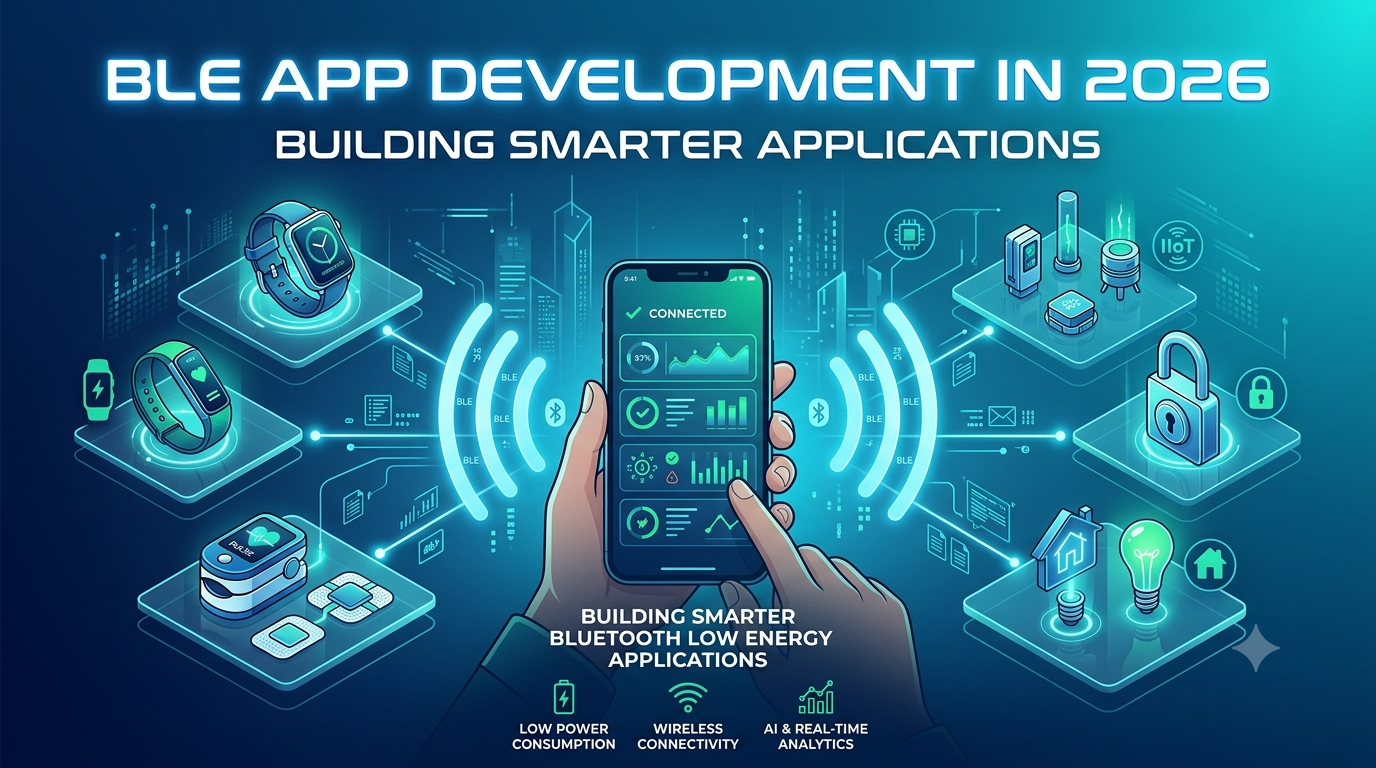
Bluetooth Low Energy (BLE) has become an important technology for connecting smartphones, wearables, sensors, medical devices, industrial equipment, and smart products.
Unlike traditional Bluetooth applications that often focus on continuous data transmission, BLE is designed for efficient communication with connected devices while minimizing power consumption.
This makes BLE app development particularly useful for businesses building connected products and IoT ecosystems.
From smartwatches and fitness trackers to industrial sensors and healthcare devices, BLE applications can connect physical products with mobile and cloud platforms.
In 2026, businesses are increasingly combining BLE, IoT, mobile applications, cloud platforms, real-time data, and AI to create connected experiences.
What Is BLE App Development?
BLE app development involves creating mobile, web, or backend applications that communicate with Bluetooth Low Energy-enabled devices.
A typical BLE ecosystem can include:
- BLE-enabled hardware
- Sensors
- Smartphones
- Mobile applications
- Cloud platforms
- APIs
- Analytics dashboards
- IoT platforms
A mobile application can discover nearby BLE devices, establish connections, read characteristics, write data, subscribe to notifications, and display information to users.
Why Businesses Choose Bluetooth Low Energy
BLE offers several characteristics that make it suitable for connected products.
Low Power Consumption
BLE is designed for low-energy communication, making it useful for battery-powered devices such as:
- Fitness trackers
- Smart sensors
- Wearables
- Asset trackers
- Smart home devices
- Industrial monitoring devices
Battery life can be an important consideration when designing connected hardware.
Wireless Connectivity
BLE eliminates the need for physical connections between compatible devices.
A smartphone can communicate with nearby BLE hardware without requiring a traditional wired interface.
Broad Device Ecosystems
BLE is supported across major mobile platforms and a wide range of modern consumer and industrial hardware.
This creates opportunities for businesses developing cross-platform connected-device applications.
Popular BLE App Development Use Cases
BLE technology can be applied across many industries.
1. Wearable App Development
Wearables are one of the most visible BLE use cases.
BLE applications can connect smartphones with:
- Smartwatches
- Fitness trackers
- Smart bands
- Health monitoring devices
- Sports equipment
The application can receive device data and present it through a mobile interface.
2. Healthcare and Medical Devices
BLE can support communication between compatible medical or health-monitoring devices and mobile applications.
Potential applications include:
- Connected health devices
- Patient monitoring
- Fitness monitoring
- Device configuration
- Remote data collection
Healthcare applications require additional consideration of privacy, security, regulatory requirements, and device-specific standards.
3. Smart Home Applications
BLE can be used for device discovery, configuration, control, and communication within smart-device ecosystems.
Examples include:
- Smart locks
- Sensors
- Lighting devices
- Home automation controllers
- Smart appliances
BLE can also work alongside other wireless technologies within a broader IoT architecture.
4. Industrial IoT
Industrial businesses can use BLE-enabled sensors and devices for monitoring and data collection.
Applications can include:
- Equipment monitoring
- Asset tracking
- Environmental sensing
- Machine data collection
- Worker safety systems
- Predictive maintenance workflows
BLE can serve as one