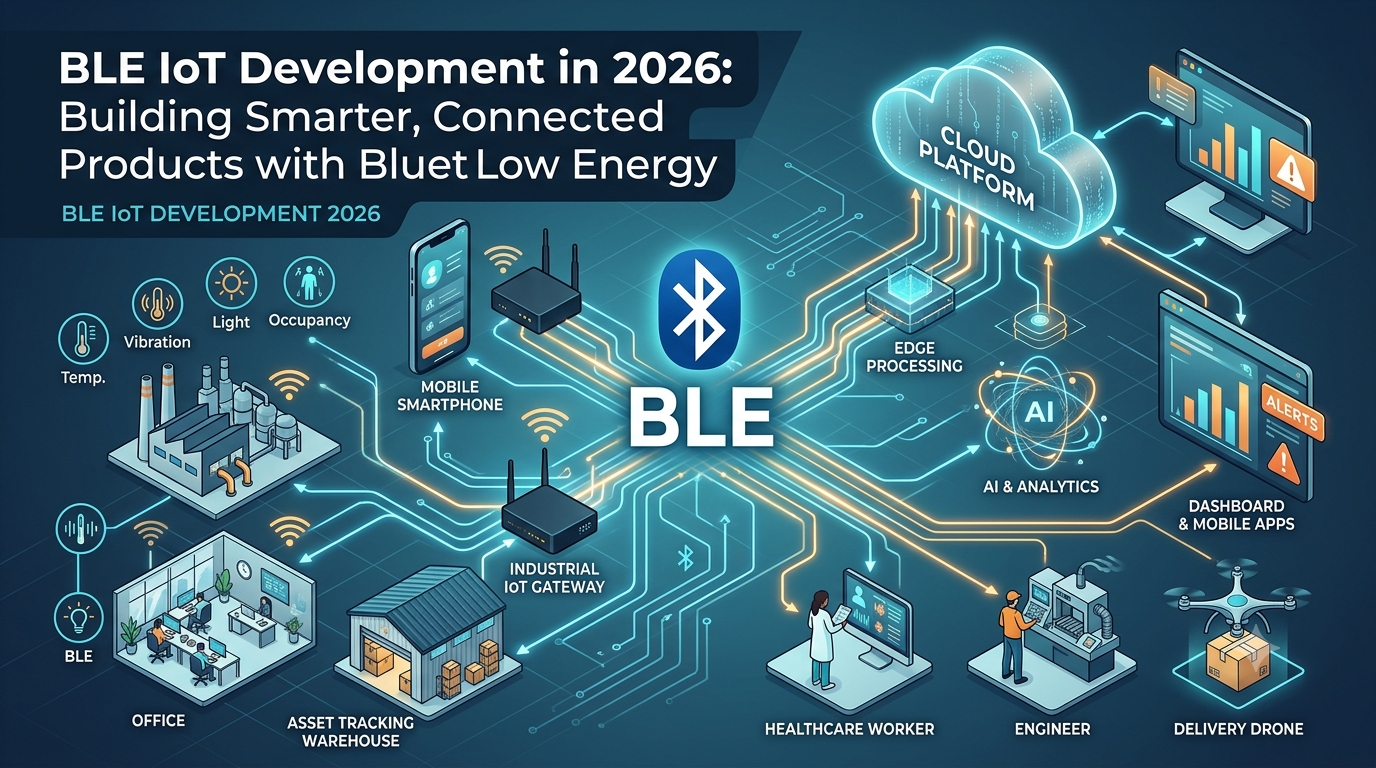
Bluetooth Low Energy (BLE) has become a critical connectivity technology for modern connected products. From smart wearables and healthcare devices to industrial sensors, asset trackers, smart home products, and retail solutions, BLE enables devices to communicate efficiently while maintaining low power consumption.
In 2026, BLE app development is moving beyond simple device connectivity. Businesses are increasingly combining BLE, mobile applications, IoT platforms, cloud services, AI, and real-time analytics to create intelligent connected-device ecosystems.
For companies planning a connected product, choosing an experienced BLE app development company can make a significant difference in application performance, security, scalability, and user experience.
What Is BLE App Development?
BLE app development is the process of building applications that communicate with Bluetooth Low Energy-enabled devices.
A modern BLE application can:
- Discover nearby BLE devices
- Establish and manage connections
- Read device information
- Write commands to connected hardware
- Receive real-time notifications
- Collect sensor data
- Monitor device status
- Configure connected products
- Synchronize information with cloud platforms
- Provide real-time alerts and analytics
A complete BLE solution can include hardware, firmware, mobile applications, APIs, cloud infrastructure, databases, and administrative dashboards.
The architecture depends on the product and its connectivity requirements.
Why BLE App Development Matters in 2026
BLE continues to be valuable because it combines wireless connectivity with efficient power usage.
It is particularly suitable for products that operate on batteries or require frequent communication with smartphones and other nearby devices.
Some of the major benefits include:
1. Low Power Consumption
BLE is designed for efficient wireless communication, making it suitable for battery-powered sensors, wearables, trackers, and smart devices.
2. Smartphone Connectivity
BLE support across modern mobile platforms allows businesses to connect physical products directly with iOS and Android applications.
3. Real-Time Device Communication
BLE applications can exchange information between mobile devices and connected hardware for monitoring, configuration, and control.
4. IoT Integration
BLE devices can connect with mobile gateways and cloud platforms, allowing businesses to create larger IoT ecosystems.
5. Flexible Use Cases
BLE can be used across healthcare, fitness, retail, logistics, automotive, industrial automation, smart homes, and consumer electronics.
How a BLE Application Works
A typical BLE communication flow looks like:
Scan → Discover → Connect → Service Discovery → Characteristic Discovery → Read/Write → Notifications
In many applications, the smartphone acts as the central, while the connected device acts as the peripheral.
BLE uses the Generic Attribute Profile (GATT) to organize device data into services and characteristics.
For example, a fitness application could connect to a wearable device, read sensor information, and display activity data in real time.
Top BLE App Development Trends in 2026
BLE + AI
One of the biggest opportunities is combining BLE-generated data with artificial intelligence.
Instead of simply collecting sensor information, AI can analyze device data and identify patterns.
For example:
- Predictive maintenance
- Personalized fitness recommendations
- Anomaly detection
- Smart device automation
- Predictive healthcare insights
- Intelligent customer experiences
This transforms a BLE application from a connectivity tool into an intelligent digital product.
Bluetooth Channel Sounding
Bluetooth technology is evolving toward more accurate distance awareness.
Bluetooth SIG introduced Bluetooth Channel Sounding to enable secure fine-ranging capabilities, creating opportunities for applications that need better distance awareness.
Potential applications include:
- Digital keys
- Asset tracking
- Indoor navigation
- Smart access control
- Device finding
- Location-aware experiences
- Industrial applications
BLE + IoT
BLE is increasingly being used as part of complete IoT architectures.
A typical solution can look like:
BLE Device → Mobile App/Gateway → Cloud → Database → Analytics → Business Dashboard
This architecture allows organizations to monitor connected devices and turn device data into actionable business insights.
BLE for Smart Devices
Smart locks, wearable devices, connected appliances, fitness equipment, medical sensors, and industrial products can use BLE applications for configuration, monitoring, and control.
BLE Mesh and Large Device Networks
BLE-based networking can also support environments containing many connected devices.
Potential applications include:
- Warehouses
- Retail stores
- Smart buildings
- Industrial facilities
- Healthcare environments
- Smart campuses
Bluetooth Core 5.4 introduced features such as Periodic Advertising with Responses (PAwR), supporting large-scale one-to-many communication scenarios.
BLE App Development for Android
Android BLE application development requires careful handling of scanning, permissions, connections, GATT operations, and device compatibility.
A BLE Android application can provide:
- Device discovery
- BLE pairing and connection
- Service discovery
- Characteristic read/write
- Notifications
- Device configuration
- Sensor monitoring
- Firmware update workflows
- Real-time data visualization
Android device fragmentation also means developers need to test applications across different devices and operating-system versions.
BLE App Development for iOS
Apple’s Core Bluetooth framework provides the foundation for communicating with BLE peripherals on iOS.
A typical iOS BLE application may:
- Scan for nearby peripherals
- Identify available services
- Connect to a BLE device
- Discover characteristics
- Read and write data
- Subscribe to notifications
- Handle connection changes
- Manage application lifecycle behavior
Background execution and Bluetooth permissions should be considered during architecture and testing.
Cross-Platform BLE App Development
Businesses developing both Android and iOS applications can consider cross-platform technologies such as:
- Flutter
- React Native
- Native Android
- Native iOS
However, BLE functionality frequently requires platform-specific handling.
A strong BLE development architecture should therefore balance code reuse with native Bluetooth capabilities.
Industries Using BLE Applications
Healthcare
BLE can connect medical sensors, monitoring equipment, wearable devices, and patient-monitoring products.
Fitness & Wearables
Fitness trackers, smartwatches, heart-rate monitors, cycling devices, and other wearable products can use BLE to transfer data to mobile applications.
Retail
BLE can support proximity experiences, indoor navigation, electronic shelf applications, customer engagement, and connected retail infrastructure.
Logistics & Asset Tracking
BLE-enabled tags and sensors can help businesses monitor assets, equipment, inventory, and movement.
Automotive
BLE can support digital keys, vehicle access, device connectivity, and personalized automotive experiences.
Industrial IoT
Factories can use BLE-connected sensors for equipment monitoring, environmental monitoring, predictive maintenance, and operational visibility.
Smart Homes
BLE applications can control and configure smart locks, sensors, lighting products, appliances, and other connected devices.
Key Features of a Modern BLE Application
A business-grade BLE application may include:
Device Management
Connect, disconnect, configure, rename, and monitor BLE devices.
Real-Time Data
Display sensor and device information immediately inside the application.
Push Notifications
Alert users when a device reports a particular event or condition.
Cloud Integration
Synchronize device information with cloud platforms and databases.
Analytics Dashboard
Convert BLE data into useful business and operational insights.
Secure Communication
Protect communication between mobile applications and connected hardware.
OTA Firmware Updates
Support firmware-management workflows where the product architecture requires them.
Multi-Device Support
Allow users to manage multiple BLE peripherals from a single application.
BLE App Security
Security should be considered from the beginning of BLE application development.
Important areas include:
- Secure pairing
- Authentication
- Encryption
- Secure data transmission
- API authentication
- Access control
- Secure cloud communication
- Device authorization
- Protection against unauthorized commands
For products handling sensitive business, personal, or healthcare information, BLE security should be combined with application-level and cloud-level security controls.
BLE App Development Process
A structured development process helps reduce connectivity problems and improves product reliability.
Step 1: Product Discovery
Understand the hardware, target users, business requirements, BLE profile, communication model, and expected data flow.
Step 2: BLE Architecture
Define the services, characteristics, communication protocols, connection strategy, and device-management requirements.
Step 3: UI/UX Design
Create a simple interface for device discovery, connection, configuration, monitoring, and data visualization.
Step 4: Mobile Development
Develop the Android and iOS applications based on the selected architecture.
Step 5: Hardware & Firmware Integration
Test communication between the application and actual BLE hardware rather than relying only on simulated environments.
Step 6: Cloud & API Integration
Connect the application with APIs, databases, dashboards, analytics platforms, and other business systems when required.
Step 7: Testing
Test:
- Different smartphones
- Different OS versions
- Multiple BLE devices
- Connection interruptions
- Background behavior
- Battery consumption
- Data accuracy
- Security
- Network conditions
Step 8: Deployment & Maintenance
After launch, continue monitoring performance and releasing application and firmware updates as required.
How to Choose a BLE App Development Company
Not every mobile development company has deep BLE expertise.
When selecting a BLE app development company, businesses should evaluate:
- BLE protocol experience
- Android BLE expertise
- iOS Core Bluetooth experience
- Hardware integration knowledge
- Firmware understanding
- IoT development experience
- Cloud and API integration
- BLE security knowledge
- Testing capabilities
- Post-launch support
A good development partner should understand the complete ecosystem—not just the mobile application.
Why Choose BLEAppDeveloper?
BLEAppDeveloper focuses on building customized Bluetooth Low Energy applications for connected products and IoT ecosystems.
Our development approach can support:
- Custom BLE mobile applications
- Android BLE development
- iOS BLE development
- Bluetooth device integration
- BLE IoT applications
- Wearable applications
- Smart device applications
- BLE data visualization
- Cloud and API integration
- Connected-product development
- Device monitoring solutions
The goal is to create BLE applications that are reliable, secure, scalable, and easy for end users to operate.
The Future of BLE App Development
BLE development is moving toward intelligent, context-aware, and highly connected experiences.
Future solutions will increasingly combine:
BLE + AI + IoT + Cloud + Edge Computing + Real-Time Analytics + Advanced Positioning
As Bluetooth technology continues to evolve, new capabilities around distance awareness, connected-device networking, and intelligent device interactions can create opportunities across consumer and enterprise markets. Bluetooth SIG’s 2026 industry outlook specifically identifies Channel Sounding and distance-aware experiences as important areas to watch.
Conclusion
BLE app development has become an important part of modern connected-product development.
From wearables and healthcare devices to industrial IoT, smart homes, retail, logistics, and automotive applications, BLE provides businesses with an efficient way to connect physical products with mobile and cloud-based experiences.
The most successful BLE applications are not built around connectivity alone. They combine reliable BLE communication, intuitive mobile UX, secure architecture, cloud integration, analytics, and intelligent automation.
If you are planning a connected product, working with an experienced BLE app development company can help turn your hardware concept into a scalable digital ecosystem.
SEO Details
SEO Title: BLE App Development Company in 2026 | BLEAppDeveloper
Meta Description: Build smarter connected products with BLE app development services. Explore Android, iOS, IoT, AI, wearable, and custom Bluetooth Low Energy app development.
Primary Keyword: BLE App Development Company
Secondary Keywords: BLE App Developers, BLE App Development Services, Bluetooth Low Energy App Development, Bluetooth App Development Company, BLE IoT Development, BLE Android App Development, BLE iOS App Development
Suggested URL: /blogs/ble-app-development-company-2026/