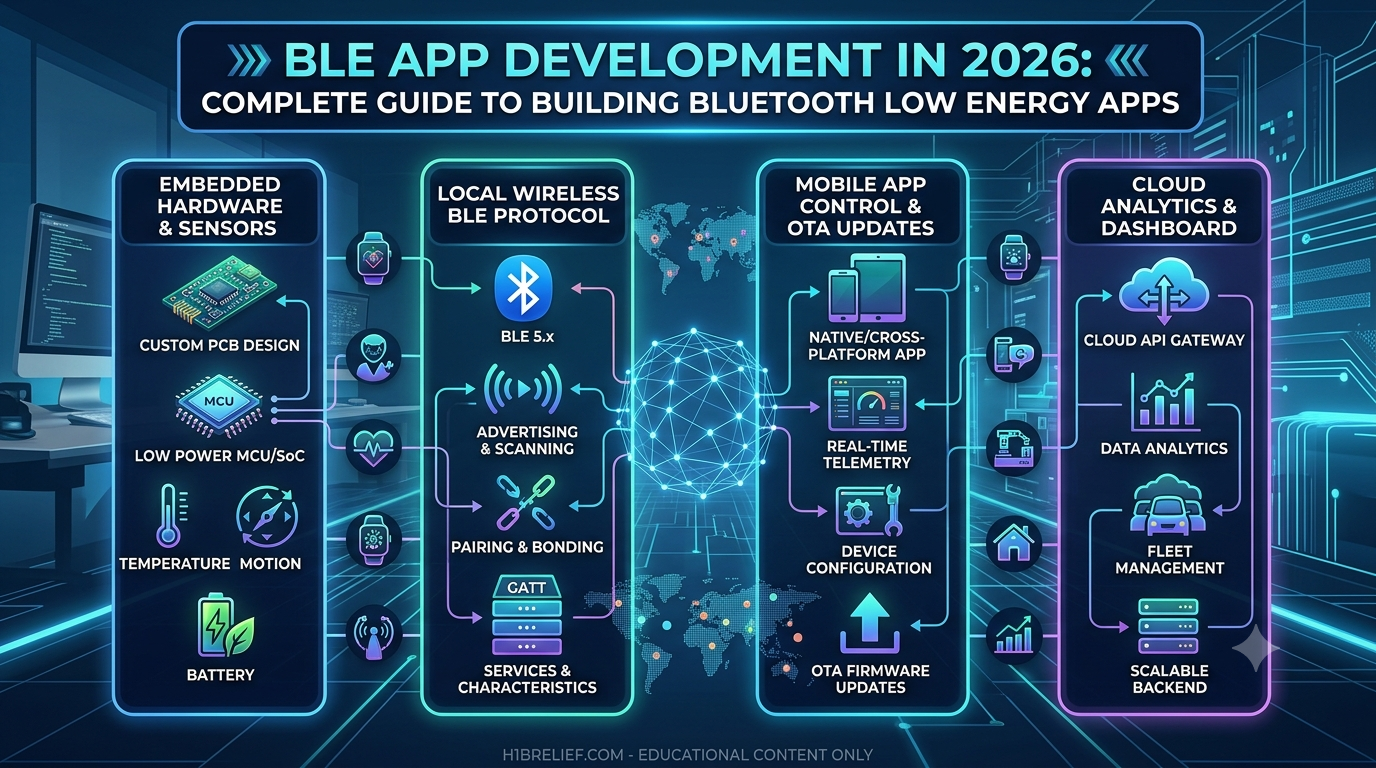
Bluetooth Low Energy (BLE) has become an important connectivity technology for modern mobile applications, IoT products, wearables, healthcare devices, industrial equipment, and smart consumer products.
Unlike traditional Bluetooth applications that often focus on continuous data transfer, BLE is designed for efficient communication between devices while consuming relatively low power. This makes it suitable for products that need to operate for long periods using small batteries.
In 2026, businesses are using BLE app development to connect smartphones and tablets with sensors, smart devices, medical equipment, fitness products, industrial machines, and connected products.
For companies building a connected product, choosing the right BLE app development company can help transform a hardware concept into a reliable mobile and cloud-connected solution.
What Is BLE App Development?
BLE app development is the process of creating mobile or software applications that communicate with Bluetooth Low Energy devices.
A BLE application can discover nearby devices, establish a connection, read device information, write commands, receive notifications, and exchange data.
A typical BLE solution can include:
- BLE-enabled hardware
- Sensors
- Firmware
- Android application
- iOS application
- Cloud backend
- APIs
- Database
- Web dashboard
The exact architecture depends on the product and its business requirements.
How Does Bluetooth Low Energy Work?
BLE communication generally follows a client-server model.
A BLE peripheral device advertises its availability. A smartphone or another central device can scan for nearby devices and establish a connection.
After connecting, the application communicates with the device through GATT (Generic Attribute Profile).
GATT organizes device data into:
- Services
- Characteristics
- Descriptors
For example, a wearable device could expose a heart-rate service with characteristics containing measurement data.
The mobile application can subscribe to notifications and receive updated information from the BLE device.
BLE App Architecture
A typical BLE mobile application can follow this architecture:
BLE Device → Bluetooth Connection → Mobile App → API → Cloud Platform → Web Dashboard
Depending on the product, cloud connectivity may not be necessary.
For example, a simple BLE configuration application may communicate directly between the smartphone and device.
An enterprise IoT product may require:
BLE Device → Mobile App/Gateway → Cloud → Database → Analytics Dashboard
Key Features of BLE Applications
A professional BLE application can include several important features.
BLE Device Scanning
The application scans for nearby BLE devices and identifies compatible hardware.
Device information may include:
- Device name
- MAC-related identifiers where supported
- Signal strength
- Service UUID
- Device status
- Firmware version
BLE Device Connection
After discovering a compatible device, the application establishes a connection and manages the connection lifecycle.
A reliable application should handle:
- Connection failures
- Disconnections
- Reconnection
- Timeout
- Background behavior
- Multiple devices
Reading BLE Characteristics
Applications can read information from BLE characteristics.
Examples include:
- Temperature
- Battery level
- Device status
- Sensor readings
- Configuration settings
Writing Data to BLE Devices
The application can send commands or configuration information to the device.
For example:
- Change device settings
- Start or stop an operation
- Configure thresholds
- Update parameters
- Control a connected product
BLE Notifications
BLE notifications allow devices to send updated information to a connected application without requiring the app to repeatedly request the data.
This can be useful for:
- Sensors
- Fitness devices
- Industrial monitoring
- Medical equipment
- Smart home products
BLE App Development for Android
Android BLE development requires careful handling of Bluetooth permissions, scanning, connections, GATT operations, and lifecycle behavior.
A BLE Android application may provide:
- Device scanning
- Device pairing/connection workflows
- Service discovery
- Characteristic read/write
- Notifications
- Data visualization
- Device configuration
- Firmware update functionality
Developers also need to account for differences between Android versions and device manufacturers.
BLE App Development for iOS
iOS applications can communicate with BLE peripherals using Apple’s Core Bluetooth framework.
A typical iOS BLE application can:
- Scan for peripherals
- Identify supported services
- Connect to a peripheral
- Discover characteristics
- Read or write data
- Subscribe to notifications
- Handle connection changes
iOS applications also need to follow Apple’s Bluetooth and background execution requirements.
Cross-Platform BLE App Development
Businesses that need both Android and iOS applications can consider cross-platform development.
Depending on the project, technologies such as:
- Flutter
- React Native
- Native Android
- Native iOS
can be considered.
However, BLE functionality often requires platform-specific implementation.
For comp