Bluetooth Low Energy has become an important technology for modern connected products.
From smartwatches and fitness trackers to healthcare devices, industrial sensors, smart home products, and retail technology, BLE allows mobile applications to communicate with nearby devices without relying on traditional wired connections.
As businesses continue building connected products, BLE app development is becoming an important part of the product development strategy.
What Is BLE App Development?
BLE app development involves creating mobile applications that communicate with Bluetooth Low Energy devices.
A BLE-enabled mobile app can:
- Discover nearby BLE devices
- Establish secure connections
- Read sensor data
- Write information to devices
- Monitor device status
- Send commands
- Configure connected hardware
- Synchronize data with cloud platforms
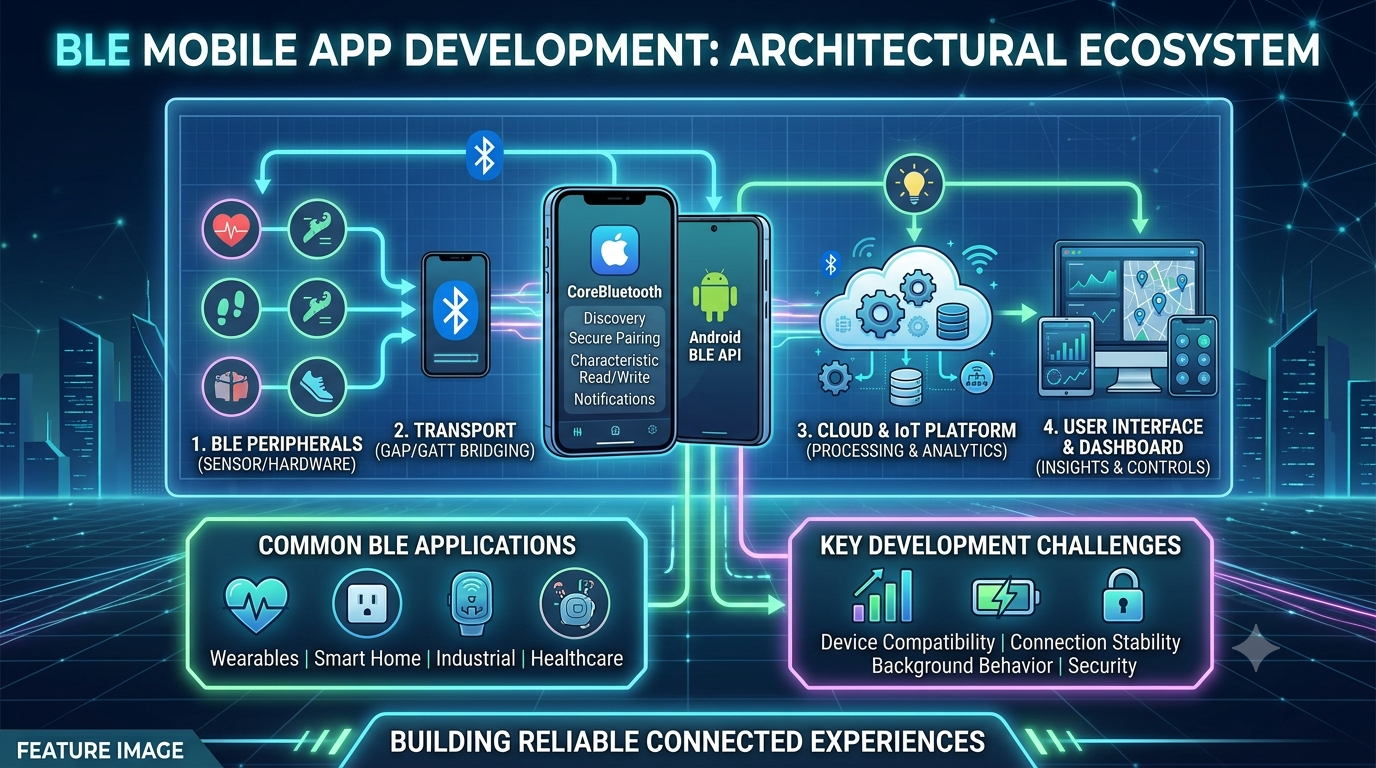
A typical BLE application ecosystem may include:
BLE Hardware → Mobile App → Cloud Platform → Web Dashboard
This combination allows physical products to interact with software and cloud-based services.
Why BLE Is Important for Mobile Applications
Traditional Bluetooth and BLE are not exactly the same.
BLE is designed around efficient, low-power communication, making it particularly suitable for devices that need to operate for extended periods on batteries.
For mobile application developers, BLE can enable communication with compact devices without requiring users to connect cables or use complicated interfaces.
This creates opportunities for businesses developing:
- Wearables
- Smart sensors
- Fitness devices
- Medical and wellness products
- IoT devices
- Industrial equipment
- Smart home products
1. BLE Apps for Wearable Devices
Wearables are one of the most common BLE application categories.
A smartwatch, fitness tracker, or other wearable can collect information from sensors and communicate it to a smartphone application.
The mobile app can then display the information in an easy-to-understand interface.
Possible features include:
- Activity tracking
- Device configuration
- Sensor monitoring
- Notifications
- Data synchronization
- Battery monitoring
BLE allows the wearable and smartphone to communicate efficiently without requiring a constant wired connection.
2. Healthcare and Medical Applications
BLE technology is also being used in connected healthcare and wellness products.
A BLE-enabled device can collect information and transfer it to a mobile application for visualization or further processing.
Potential applications include:
- Connected health monitors
- Wellness devices
- Patient monitoring
- Temperature sensors
- Fitness equipment
- Rehabilitation devices
Healthcare applications require additional attention to security, privacy, reliability, and applicable regulatory requirements.
3. BLE Apps for IoT Products
Many IoT products need a simple way for users to configure or control devices.
A mobile BLE application can act as the bridge between the user and the hardware.
For example, during initial setup, an app could:
Scan → Discover Device → Connect → Configure → Verify → Sync
After configuration, the device may communicate with a gateway or cloud platform for ongoing monitoring.
This makes BLE mobile apps particularly useful during device provisioning and local control.
4. Industrial BLE Applications
Industrial businesses are increasingly connecting machines, tools, sensors, and other equipment.
BLE apps can provide technicians and employees with direct access to nearby devices.
For example, a technician could use a mobile application to:
- Discover equipment
- Read sensor values
- Configure settings
- Check device status
- Troubleshoot equipment
- Update certain device parameters
This can reduce the need for dedicated hardware interfaces in some applications.
5. Smart Home Applications
Smart home products require simple user experiences.
A mobile application can use BLE to communicate with smart locks, sensors, lighting devices, and other connected products.
For example, a smart-device app might allow users to:
- Add new devices
- Configure devices
- Monitor status
- Change settings
- Control connected equipment
BLE can be especially useful during the device setup process.
BLE App Development for iOS and Android
Developing a BLE application requires understanding the Bluetooth frameworks available on each mobile platform.
iOS BLE Development
iOS applications commonly use Apple’s Core Bluetooth framework to communicate with BLE peripherals.
Developers need to manage:
- Bluetooth state
- Device discovery
- Services
- Characteristics
- Connections
- Notifications
- Read/write operations
- Permissions
Android BLE Development
Android provides APIs that allow applications to scan for and communicate with BLE devices.
Developers need to consider differences across Android versions and devices, including permissions, Bluetooth state management, background behavior, and connection handling.
Native vs Cross-Platform BLE Apps
Businesses often have to decide whether to build their BLE application using native technologies or a cross-platform framework.
Native Development
Native development can provide deeper platform-specific control.
It may be suitable when the application requires complex Bluetooth functionality or highly optimized platform behavior.
Cross-Platform Development
Frameworks such as React Native can help businesses share parts of their application code between iOS and Android.
This can potentially reduce development effort while maintaining applications for multiple platforms.
However, BLE functionality still requires careful testing because Bluetooth behavior can vary between operating systems and devices.
Common BLE App Development Challenges
BLE development can look simple from the outside, but reliable implementation requires careful engineering.
Common challenges include:
Device Compatibility
Different smartphones and BLE peripherals can behave differently.
Testing across relevant devices is important.
Connection Stability
Applications need to handle unexpected disconnections, reconnection attempts, and changing Bluetooth states.
Background Operation
Mobile operating systems place restrictions on background activities, so developers need to design BLE workflows carefully.
Data Reliability
Applications must correctly handle notifications, read/write operations, packets, and communication timing.
Security
Connected applications should use appropriate authentication, encryption, permissions, and secure communication practices.
How AI Could Improve BLE Applications
AI is increasingly being integrated into connected-device ecosystems.
A BLE application can collect device data and send it to an AI or analytics platform.
For example:
BLE Sensors → Mobile App → Cloud → AI Model → Insights
This could allow applications to identify patterns, detect anomalies, generate recommendations, or automate certain decisions.
The value of AI doesn’t come from simply adding an AI feature. It comes from turning device data into useful and actionable information.
Choosing the Right BLE App Development Partner
If you’re developing a BLE product, mobile development is only one part of the project.
A successful solution may require expertise in:
- BLE protocols
- Mobile application development
- Firmware
- Hardware integration
- Cloud APIs
- IoT architecture
- Security
- Testing
- Device certification requirements
Working with a development team that understands both mobile software and connected hardware can help reduce integration problems later in the project.
The Future of BLE App Development
BLE applications are evolving from simple device-control apps into complete connected-product platforms.
Future BLE applications are likely to combine:
BLE + Mobile Apps + IoT + Cloud + AI + Analytics
This will create opportunities for businesses to build smarter products that can communicate, collect information, and provide useful insights.
From wearable technology to industrial IoT, BLE app development will continue to play an important role in the connected-device ecosystem.
Conclusion
BLE has created new possibilities for mobile applications by allowing smartphones to communicate with a wide range of low-power connected devices.
For businesses developing smart products, a well-designed BLE mobile application can provide the interface between users and hardware while also connecting the product to cloud and IoT platforms.
The key isn’t simply creating an app that connects to Bluetooth.
The goal is to build a reliable connected experience that makes the hardware more useful, intelligent, and easy to operate.