Introduction
Bluetooth Low Energy (BLE) has become an important technology for businesses developing connected products and mobile applications. From smart wearables and healthcare devices to industrial sensors and connected consumer products, BLE enables devices to communicate efficiently while using very little power.
As businesses invest in IoT and connected technologies in 2026, BLE app development is becoming more sophisticated. Modern BLE applications are no longer limited to basic device connectivity. They can support real-time data exchange, remote monitoring, device configuration, automation, analytics, and cloud integration.
For companies planning a connected product, choosing the right BLE application architecture can have a major impact on performance, scalability, and user experience.
What Is BLE App Development?
BLE app development involves creating mobile or software applications that communicate with Bluetooth Low Energy-enabled devices.
A typical BLE ecosystem can include:
BLE Device → Mobile Application → API/Cloud Platform → Dashboard
The mobile application acts as an important communication layer between the user and the connected hardware.
Depending on the product, a BLE application may allow users to:
- Discover nearby devices
- Connect and disconnect devices
- Configure hardware
- Receive sensor data
- Control connected equipment
- Monitor device status
- Update settings
- Receive notifications
- Synchronize information with the cloud
Why BLE Is Important for Connected Products
BLE is designed for applications where low power consumption and efficient wireless communication are important.
Its advantages include:
- Low energy consumption
- Wireless connectivity
- Smartphone compatibility
- Fast device discovery
- Compact hardware requirements
- Flexible communication
- Support for connected-device ecosystems
These characteristics make BLE suitable for battery-powered devices that need to communicate with smartphones or gateways.
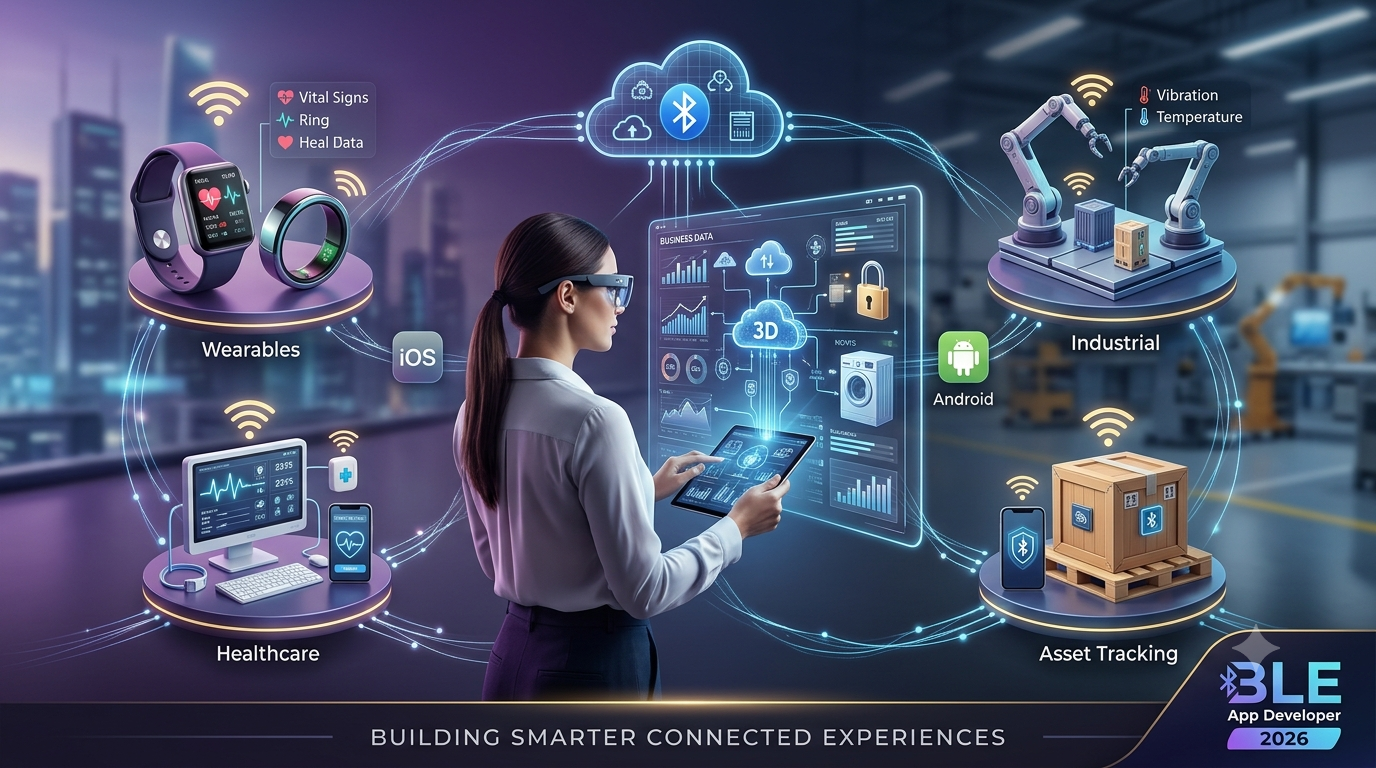
Top BLE App Development Use Cases
1. Wearable Applications
Fitness trackers, smartwatches, health devices, and other wearables frequently use BLE to communicate with smartphones.
A mobile application can collect information from the wearable and present it to users through dashboards, reports, and notifications.
2. Healthcare Applications
BLE can connect medical and healthcare devices with mobile applications.
Depending on the device and regulatory requirements, applications can support data collection, device configuration, monitoring, and communication with cloud-based systems.
Security, privacy, reliability, and applicable regulatory requirements are especially important for healthcare-related products.
3. Smart Home Applications
BLE can be used in smart locks, sensors, lighting systems, appliances, and other connected products.
A mobile application can allow users to discover devices, configure them, and control supported functions.
4. Industrial Applications
Industrial companies can use BLE-enabled sensors and devices to collect operational information.
Applications can provide information about:
- Equipment status
- Temperature
- Movement
- Location
- Battery levels
- Maintenance conditions
When combined with IoT platforms, this information can be transmitted to centralized systems for analysis.
5. Asset Tracking
BLE beacons and tags can help businesses track equipment, inventory, and other assets.
Mobile applications and gateways can collect BLE signals and connect them with backend platforms for tracking and reporting.
6. Retail Applications
Retail businesses can use BLE technology for proximity-based experiences, connected devices, inventory applications, and location-aware services.
BLE can also work alongside mobile applications to create personalized customer experiences.
BLE App Development for iOS and Android
A successful BLE application needs to account for the differences between mobile platforms.
iOS BLE Development
iOS applications can use Apple’s Core Bluetooth framework to communicate with supported BLE peripherals.
Developers need to consider Bluetooth permissions, background behavior, connection management, device discovery, and Apple’s platform requirements.
Android BLE Development
Android provides Bluetooth APIs that allow applications to scan for and communicate with BLE devices.
Android development requires careful handling of permissions, Bluetooth states, scanning behavior, connection lifecycle, and device compatibility.
Because Android devices vary significantly across manufacturers and operating-system versions, compatibility testing is particularly important.
BLE Communication Architecture
Understanding the BLE communication model is essential when designing an application.
A BLE peripheral typically exposes services containing characteristics. The mobile application can discover these services and interact with supported characteristics.
Common operations include:
- Reading characteristic values
- Writing values
- Receiving notifications
- Monitoring device status
- Managing connections
The application should also be designed to handle situations such as connection failures, signal interruptions, device unavailability, and unexpected disconnections.
BLE and IoT Integration
BLE becomes even more powerful when combined with IoT infrastructure.
A connected product can use BLE for local communication and cloud infrastructure for centralized data management.
For example:
Sensor → BLE → Smartphone/Gateway → API → Cloud → Analytics Dashboard
This architecture can enable businesses to collect information from connected devices and make it accessible across different systems.
Security in BLE App Development
Security should be considered throughout the development lifecycle.
Depending on the application, developers may need to address:
- Secure pairing
- Device authentication
- Encrypted communication
- Access control
- Secure API communication
- Data protection
- Authentication tokens
- Secure cloud storage
- Firmware security
The security architecture should be designed according to the sensitivity of the data and the requirements of the product.
BLE App Development Challenges
Although BLE offers significant advantages, developing a reliable BLE application can present several challenges.
Connection Management
BLE connections can be interrupted because of distance, interference, device conditions, or operating-system behavior.
The application should be able to reconnect gracefully and maintain a reliable user experience.
Device Compatibility
Different devices may implement BLE specifications differently.
Testing with actual hardware is therefore an important part of BLE application development.
Background Operation
Mobile operating systems impose restrictions on applications operating in the background.
BLE applications need to be designed carefully when continuous or background communication is required.
Data Synchronization
When BLE data needs to be synchronized with cloud platforms, developers must consider connectivity interruptions and duplicate or incomplete data.
A reliable synchronization strategy can help prevent data inconsistencies.
BLE App Development Process
A structured development approach can reduce technical problems and improve product quality.
Step 1: Understand the Hardware
The development team should first understand the BLE device, supported services, characteristics, communication protocol, and firmware behavior.
Step 2: Define the Application Architecture
The team determines how the mobile application, BLE device, APIs, cloud infrastructure, and other components will communicate.
Step 3: Design the User Experience
The application interface should make device discovery, connection, configuration, and monitoring easy for users.
Step 4: Develop BLE Communication
Developers implement scanning, pairing, connection management, service discovery, characteristic operations, and notifications.
Step 5: Integrate APIs and Cloud Services
If the product requires cloud functionality, BLE data can be synchronized with backend services and databases.
Step 6: Test With Real Devices
Testing should be performed with actual hardware across relevant smartphones and operating-system versions.
Step 7: Deploy and Maintain
After launch, applications may require updates for new operating-system versions, hardware revisions, security improvements, and additional product features.
Why Choose BLEAppDeveloper?
BLEAppDeveloper helps businesses develop applications for BLE-enabled products and connected-device ecosystems.
Development capabilities can include:
- BLE mobile application development
- iOS BLE development
- Android BLE development
- BLE device integration
- IoT application development
- BLE-to-cloud integration
- API development
- Connected product development
- BLE testing and optimization
- Custom device control applications
A development partner with experience across mobile applications, BLE communication, APIs, and IoT can help businesses create a more complete connected-product ecosystem.
The Future of BLE App Development
BLE will continue to play an important role in connected technology as businesses combine it with IoT, cloud platforms, edge computing, and artificial intelligence.
Future BLE applications are likely to focus increasingly on:
- Intelligent device management
- Real-time analytics
- Predictive maintenance
- Automated workflows
- Connected healthcare
- Smart industrial systems
- Advanced asset tracking
- AI-powered insights
The biggest opportunity is not simply connecting a device to a smartphone. It is using that connection to create useful, scalable, and intelligent digital experiences.
Conclusion
BLE app development has become an important part of modern connected-product development. From wearables and healthcare devices to industrial equipment and smart consumer products, BLE provides an efficient communication layer between hardware and software.
However, successful BLE applications require more than Bluetooth integration. They need reliable connection management, platform-specific development, security, device compatibility testing, scalable architecture, and—when required—cloud and IoT integration.
Businesses planning a connected product in 2026 can use BLE as a foundation for building smarter, more efficient, and more scalable digital experiences.
BLEAppDeveloper can help transform BLE product concepts into customized mobile and connected-device applications designed around specific business and hardware requirements.