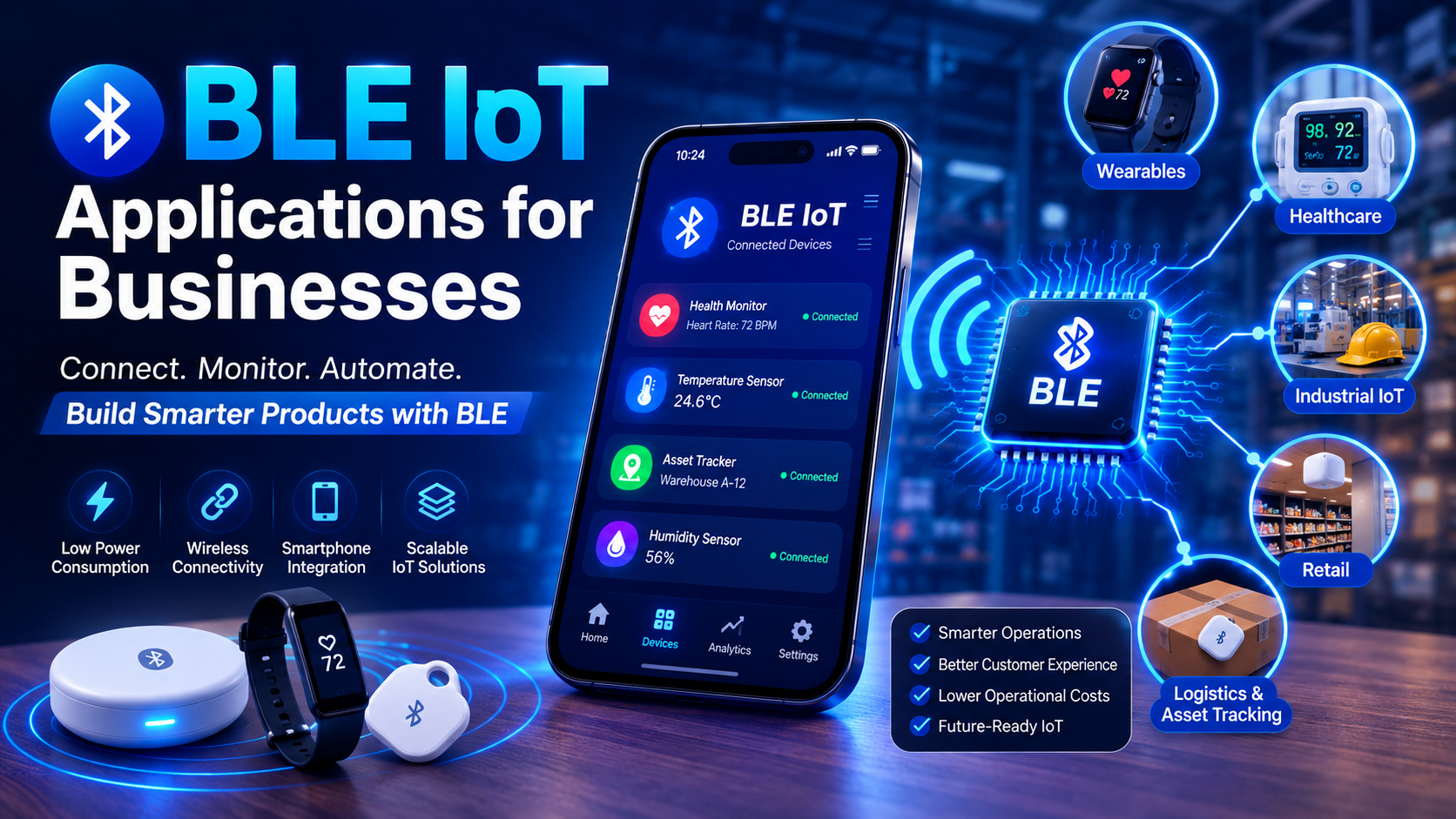
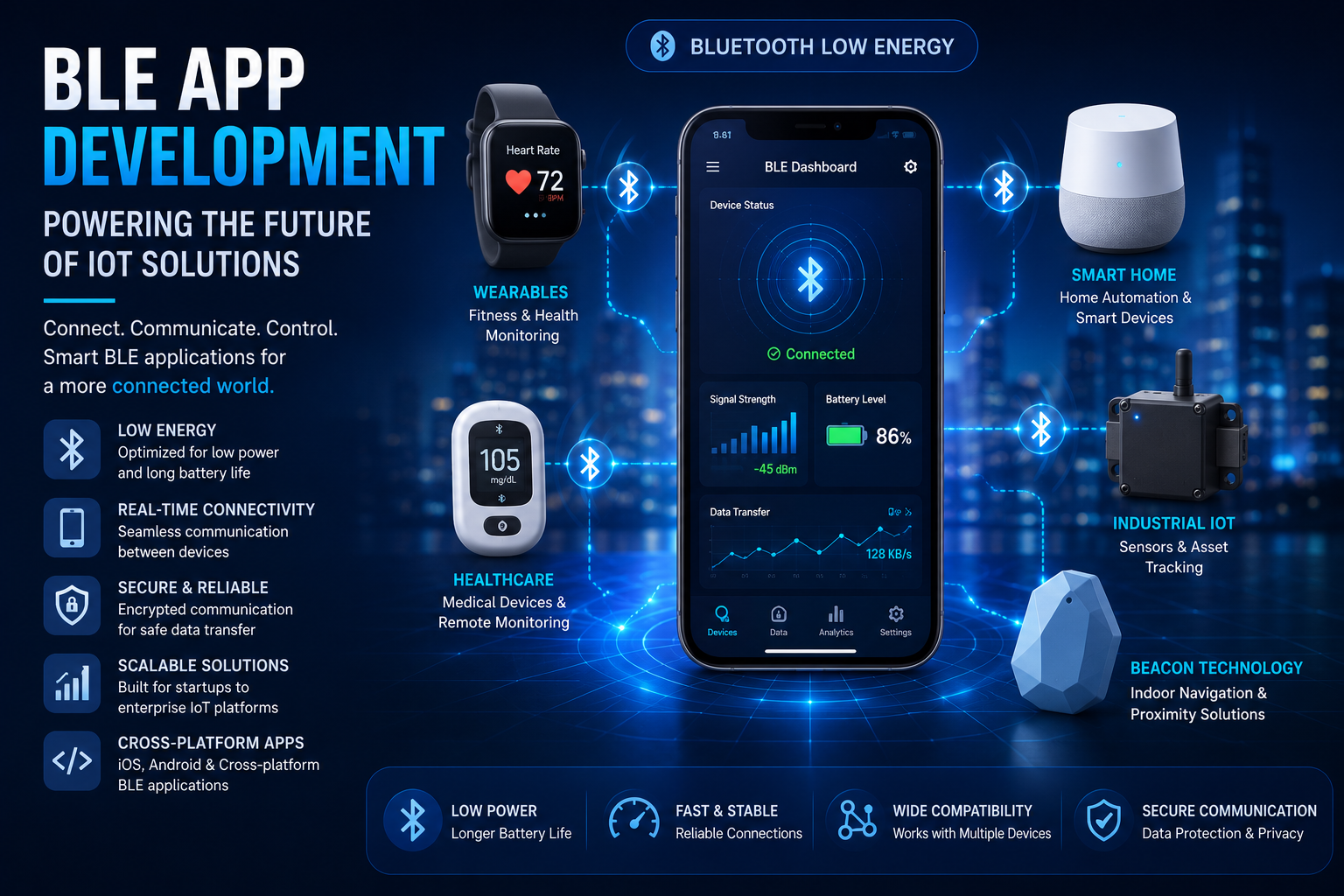
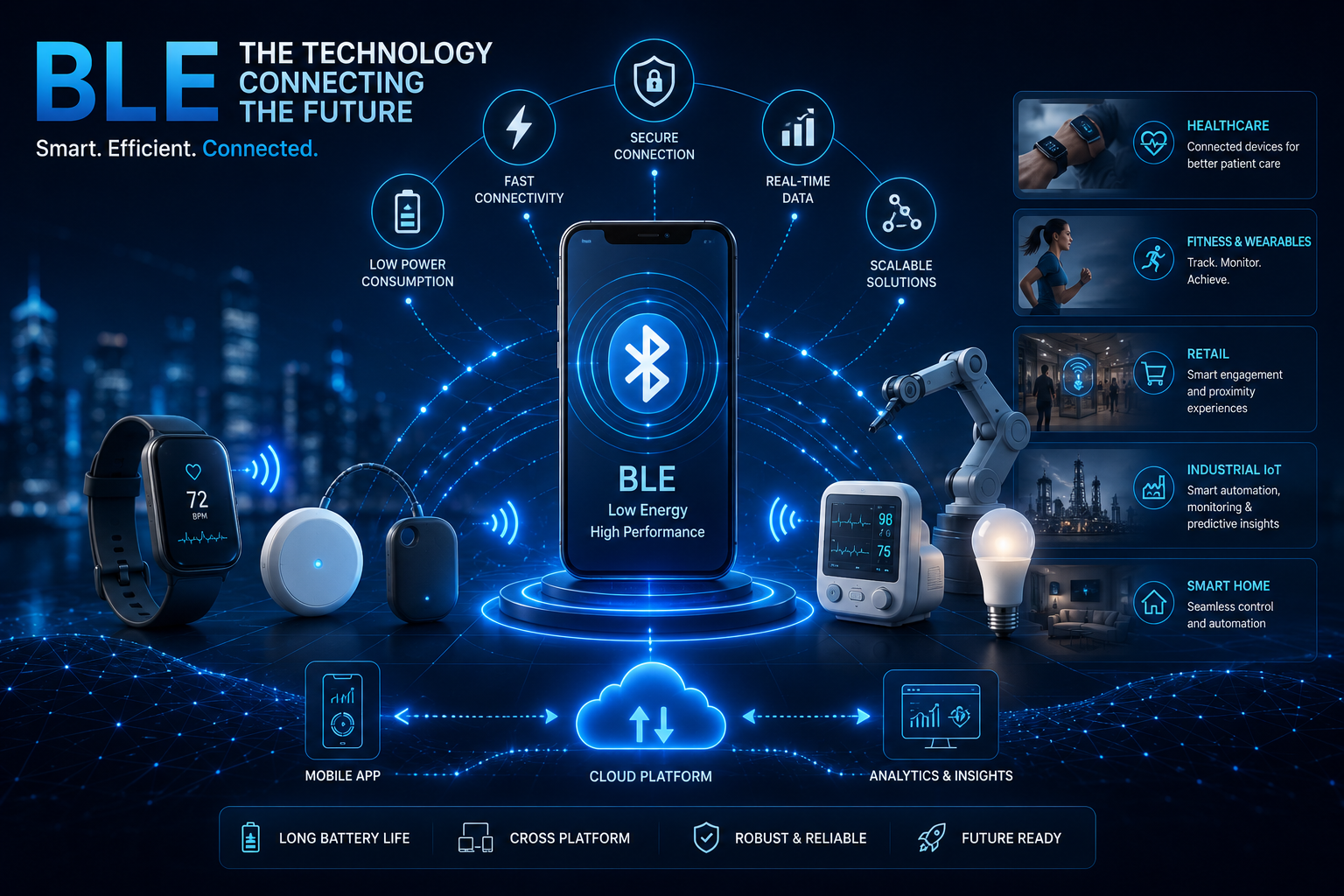
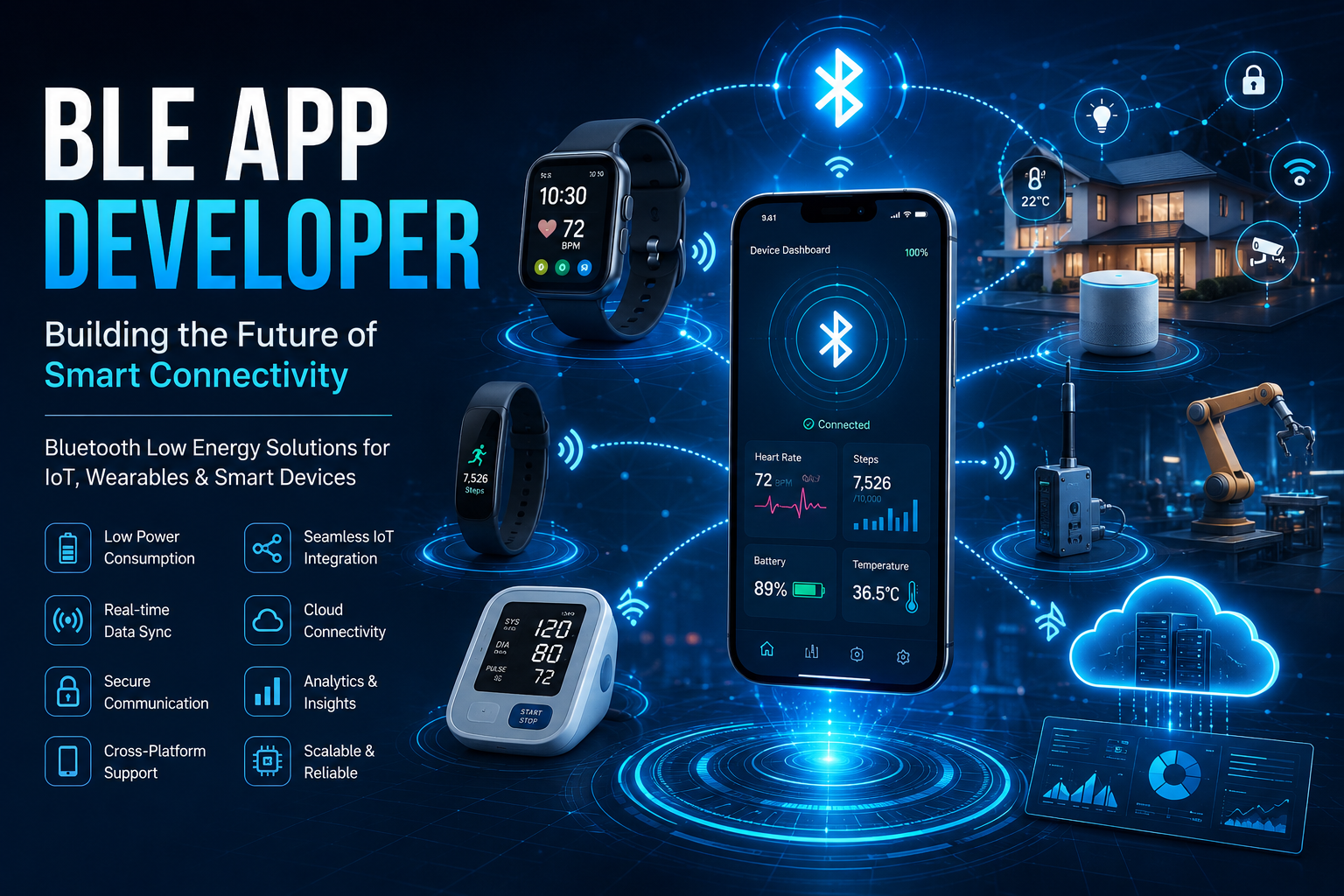
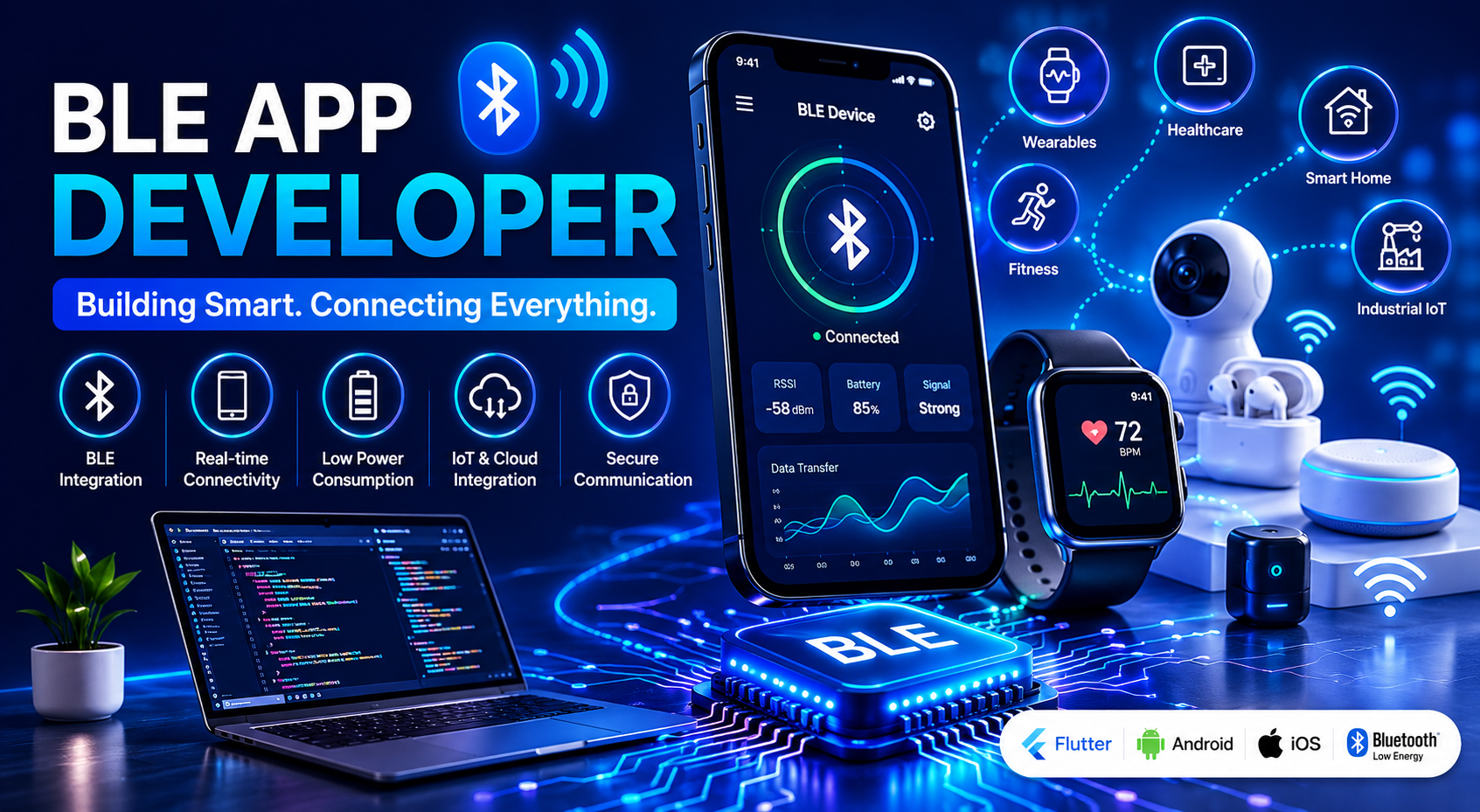
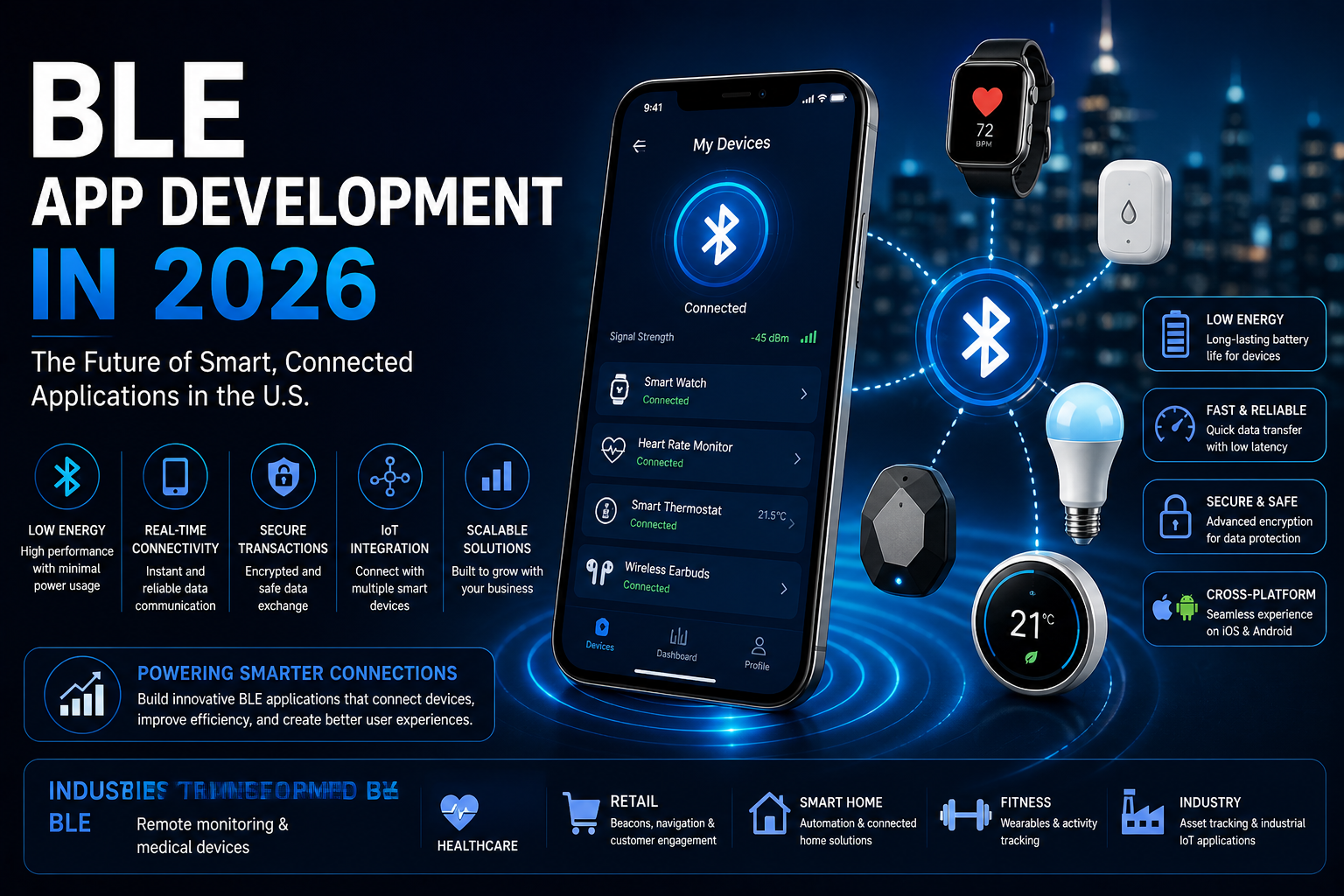
Bluetooth Low Energy (BLE) has evolved far beyond simple wireless connectivity between smartphones and accessories.
Today, businesses are using BLE IoT applications to connect sensors, devices, wearables, industrial equipment, healthcare products, retail systems, and smart-building infrastructure.
The reason is straightforward: BLE offers low power consumption, short-range wireless communication, broad smartphone support, and a flexible foundation for connected-device applications.
When BLE is combined with cloud platforms, mobile applications, edge computing, and IoT analytics, it can become an important part of a complete connected-product architecture.
A typical BLE IoT architecture can look like:
BLE Device → Mobile App / Gateway → Cloud Platform → Database → Analytics / Business System
This article explores how businesses are using Bluetooth Low Energy for IoT, the most important applications, technical architecture, development considerations, and how to build scalable BLE IoT solutions.
What Is BLE IoT?
BLE IoT refers to the use of Bluetooth Low Energy technology to connect physical devices, sensors, and equipment to applications and IoT platforms.
A BLE-enabled device can collect information such as:
Temperature
Humidity
Motion
Proximity
Battery status
Location-related data
Pressure
Heart rate
Equipment status
Environmental measurements
The device can then communicate this information through BLE.
Depending on the architecture, the BLE data can be processed by:
A smartphone
Tablet
Dedicated gateway
Edge device
Embedded controller
IoT gateway
The information can subsequently be transferred to a cloud platform for storage, processing, analytics, automation, or monitoring.
Why Businesses Are Using BLE for IoT
BLE is particularly useful when IoT devices need to communicate wirelessly while consuming minimal power.
Some of the key advantages include:
Low Power Consumption
BLE was designed for applications where battery efficiency matters.
This makes it suitable for sensors, trackers, wearables, and other battery-powered devices.
Smartphone Compatibility
Modern smartphones generally support BLE, making a smartphone a practical gateway for many connected-device applications.
Cost-Effective Hardware
BLE modules and chipsets are available across a wide range of embedded platforms.
This makes BLE attractive for startups as well as enterprise IoT deployments.
Wireless Connectivity
BLE eliminates the need for physical connections between compatible devices.
Flexible Communication
BLE supports different communication patterns depending on the product architecture, including advertising, scanning, connections, services, and characteristics.
Suitable for Small Data Transfers
Many IoT sensors transmit relatively small amounts of data.
BLE can be an effective communication technology for these scenarios.
How a BLE IoT System Works
A typical BLE IoT application involves several layers.
Layer 1: BLE Device
The physical device contains a BLE-capable chipset and one or more sensors.
For example:
Temperature Sensor → BLE Chip → Wireless Advertisement
The device may periodically broadcast information or establish a connection with another BLE device.
Layer 2: Mobile Application or Gateway
A mobile application can scan for nearby BLE devices and communicate with them.
The application can:
Discover devices
Connect to devices
Read characteristics
Write configuration values
Subscribe to notifications
Monitor signal strength
Process sensor data
Send data to the cloud
Alternatively, a dedicated IoT gateway can perform these functions.
Layer 3: Cloud Backend
The gateway or mobile application can send data to a backend through Wi-Fi, cellular connectivity, or another internet connection.
The backend can provide:
Data storage
Device management
Authentication
Analytics
Alerts
Reporting
APIs
User management
Layer 4: Business Application
The final layer transforms IoT data into something useful for the business.
For example:
Sensor Data → Analytics → Maintenance Alert
or:
BLE Device → Mobile App → Cloud → Customer Dashboard
This is where BLE IoT becomes a business solution rather than simply a connectivity feature.
Major BLE IoT Applications for Businesses
1. Healthcare and Medical Devices
BLE is widely suited to connected healthcare products where low-power communication and mobile connectivity are important.
Potential applications include:
Patient monitoring
Wearable health devices
Fitness equipment
Blood pressure devices
Temperature monitoring
Glucose-related devices
Medical equipment monitoring
A BLE-enabled healthcare device can transmit measurements to a mobile application, where authorized information can be displayed and processed.
A more advanced architecture can connect:
Medical Device → BLE → Mobile Gateway → Secure Cloud → Healthcare Dashboard
For healthcare applications, however, security, privacy, regulatory requirements, and data handling need to be considered from the beginning.
2. Industrial IoT
BLE can also be used in industrial environments for selected monitoring and asset-management scenarios.
Industrial BLE IoT applications can include:
Equipment monitoring
Asset tracking
Temperature monitoring
Predictive maintenance
Worker safety
Inventory monitoring
Machine-status monitoring
Environmental sensing
For example, a sensor attached to equipment can periodically transmit operating information.
The gateway collects the data and sends it to an industrial IoT platform.
This can help businesses move from reactive maintenance toward data-driven maintenance strategies.
3. Asset Tracking
Businesses often need to know where equipment, tools, inventory, or other assets are located.
BLE beacons and tags can provide a relatively practical way to build asset-monitoring systems.
Potential applications include:
Warehouse assets
Hospital equipment
Industrial tools
Retail inventory
Office equipment
Logistics assets
BLE-based tracking can use information such as:
Device identifier
RSSI
Gateway location
Beacon information
Timestamp
For more sophisticated location systems, BLE can be combined with technologies such as Bluetooth Direction Finding.
4. Smart Retail
BLE can create connected retail experiences.
Retail businesses can use BLE for:
Indoor proximity experiences
Product information
Customer engagement
Asset monitoring
Inventory-related applications
Store analytics
Smart shelves
For example, BLE beacons can transmit identifiers that a compatible application can detect.
A mobile application can then use that information to trigger an appropriate experience.
However, businesses should design these systems carefully around user consent and privacy.
5. Smart Buildings
BLE IoT technology can support connected-building applications.
Examples include:
Occupancy monitoring
Access systems
Indoor navigation
Environmental monitoring
Smart lighting
Asset tracking
Room management
A BLE-enabled system could collect information from sensors distributed throughout a building.
That data can then be combined with other building-management systems.
For example:
BLE Sensors + Cloud Platform + Building Management System
This architecture can provide a more connected view of building operations.
6. Wearable Technology
Wearables are one of the natural use cases for BLE.
Examples include:
Smartwatches
Fitness trackers
Health wearables
Industrial wearables
Safety devices
Location tags
Smart accessories
A mobile application can act as the bridge between the wearable and the cloud.
For example:
Wearable → BLE → Smartphone → Internet → Cloud
The application can synchronize data, configure the device, display information, and send updates back to the wearable.
7. Logistics and Supply Chain
BLE IoT can also contribute to logistics operations.
Potential use cases include:
Asset tracking
Cold-chain monitoring
Warehouse monitoring
Temperature tracking
Equipment tracking
Shipment monitoring
For example, a BLE temperature sensor attached to a shipment can periodically record environmental conditions.
A gateway can collect the information and send it to the cloud.
If the temperature exceeds a defined threshold, the backend can generate an alert.
8. Smart Agriculture
BLE sensors can be used in selected agricultural environments.
Potential applications include:
Temperature monitoring
Humidity sensing
Equipment monitoring
Greenhouse monitoring
Environmental data collection
BLE can be particularly useful where sensors need to operate on batteries for extended periods.
For large outdoor deployments, however, businesses should evaluate BLE alongside technologies such as LoRaWAN, cellular IoT, Wi-Fi, or other connectivity options.
The correct technology depends on:
Range
Data volume
Power requirements
Deployment environment
Infrastructure
Cost
9. Hospitality and Smart Hotels
Hotels can use BLE to create connected guest experiences.
Applications may include:
Mobile room access
Indoor navigation
Guest services
Asset tracking
Staff management
Smart-room controls
A smartphone can communicate with BLE-enabled locks or room devices.
The backend can then manage authentication and access permissions.
Security is particularly important for applications involving physical access.
10. Automotive and Mobility Applications
BLE can also be integrated into automotive and mobility ecosystems.
Potential applications include:
Digital keys
Vehicle accessories
Driver identification
Asset tracking
Fleet applications
Maintenance devices
A mobile application can communicate with a BLE-enabled vehicle component or accessory and exchange authorized information.
BLE Beacons in IoT Applications
BLE beacons are small devices that periodically broadcast Bluetooth packets.
They are useful for applications involving proximity and location awareness.
A typical architecture looks like:
Beacon → Smartphone → Application → Backend
Possible applications include:
Indoor navigation
Retail proximity
Museum experiences
Asset identification
Event management
Location-aware applications
The important distinction is that beacons generally broadcast information rather than functioning like traditional connected BLE peripherals.
BLE GATT: The Core of Many BLE Applications
Developers building BLE applications need to understand the Generic Attribute Profile (GATT).
GATT defines how data is organized and exchanged between BLE devices.
The basic structure includes:
Profile → Service → Characteristic → Value
For example:
Device
→ Battery Service
→ Battery Level Characteristic
→ Battery Percentage
Another device could expose a custom service:
Custom Service
→ Temperature Characteristic
→ Sensor Value
The mobile application can discover these services and characteristics and then perform operations such as:
Read
Write
Notify
Indicate
Understanding GATT is essential when developing reliable BLE applications.
BLE Advertising vs BLE Connections
BLE applications commonly use two different communication approaches.
Advertising
A BLE peripheral can periodically broadcast packets without establishing a connection.
This can be useful for:
Beacons
Discovery
Sensor broadcasts
Presence detection
Connected Communication
A central device can establish a BLE connection with a peripheral.
This can enable:
Reading characteristics
Writing commands
Receiving notifications
Device configuration
Data synchronization
The correct approach depends on the application’s requirements.
BLE IoT Mobile App Architecture
A modern BLE IoT mobile application may use an architecture such as:
BLE Device
↓
iOS / Android App
↓
BLE Service Layer
↓
Application Logic
↓
Cloud API
↓
IoT Backend
↓
Database + Analytics
This separation is important because BLE communication should not be tightly coupled to the application’s user interface.
A well-designed architecture can make the application easier to:
Test
Maintain
Extend
Debug
Scale
BLE App Development for iOS and Android
BLE development behaves differently across mobile platforms.
iOS BLE Development
Apple provides the Core Bluetooth framework for Bluetooth Low Energy communication.
Developers need to consider:
Bluetooth permissions
Background execution
Connection lifecycle
Service discovery
Notifications
State restoration
iOS-specific limitations
Android BLE Development
Android provides Bluetooth APIs for BLE communication.
Developers need to consider:
Bluetooth permissions
Android version differences
Scanning behavior
Connection lifecycle
Background restrictions
Manufacturer-specific behavior
BLE reliability
A cross-platform application can share significant application logic, but BLE implementations may still require platform-specific handling.
BLE IoT Security
Security should never be treated as an optional feature in BLE IoT development.
Potential security considerations include:
Device Authentication
How does the application know that it is communicating with the correct device?
Encryption
Sensitive communication should use appropriate security mechanisms.
Secure Pairing
The pairing mechanism should match the application’s security requirements.
Cloud Authentication
The backend should authenticate devices and applications before accepting data.
Access Control
Not every user should have access to every device.
Secure Firmware Updates
Connected devices may require secure OTA firmware-update mechanisms.
Data Protection
Sensitive information should be protected during transmission and storage.
A complete architecture therefore needs security across:
Device → BLE → Mobile/Gateway → API → Cloud → Database
BLE IoT Data Pipeline
A scalable BLE IoT system should consider how sensor data moves through the entire platform.
For example:
Sensor
↓
BLE Advertisement / GATT
↓
Mobile App / Gateway
↓
MQTT / HTTPS / API
↓
Cloud Backend
↓
Database
↓
Data Processing
↓
Dashboard / Alert / Automation
This architecture allows BLE to function as one part of a larger IoT ecosystem.
BLE + Cloud Integration
BLE itself is not an internet protocol.
This distinction is important.
BLE typically provides local wireless connectivity.
Cloud connectivity generally comes through another network connection.
For example:
BLE Device → Smartphone → Wi-Fi/5G → Cloud
or:
BLE Device → IoT Gateway → Ethernet/Wi-Fi/Cellular → Cloud
This gateway concept is fundamental to many BLE IoT deployments.
BLE + AI: The Next Step for Intelligent IoT
BLE can provide the data.
AI can provide intelligence.
This creates an interesting architecture:
BLE Sensors → IoT Platform → AI Models → Insights → Automated Actions
For example, industrial sensors could provide equipment data.
AI could analyze historical patterns and identify anomalies.
The system could then generate:
“Possible equipment failure detected.”
This combination can enable:
Predictive maintenance
Intelligent monitoring
Anomaly detection
Automated alerts
Personalized recommendations
Sensor-data classification
BLE therefore doesn’t need to work alone.
Its value can increase significantly when combined with cloud computing and AI.
BLE IoT Development Challenges
BLE is powerful, but developers need to account for several challenges.
Device Compatibility
Different manufacturers may implement BLE specifications differently.
Testing across real hardware is essential.
Connection Reliability
BLE connections can be affected by:
Distance
Interference
Device state
Operating-system behavior
Power management
Background Processing
Mobile operating systems impose restrictions on background execution.
This can affect BLE applications that need continuous communication.
Battery Consumption
Poorly designed scanning or connection strategies can increase power consumption.
Data Synchronization
Applications need to handle situations where connectivity is interrupted.
A robust system should support:
Local caching
Retry mechanisms
Queueing
Synchronization
Conflict handling
How to Build a BLE IoT Application
A practical BLE IoT development process can follow these stages.
Step 1: Define the Use Case
Start with the business problem.
What needs to be connected?
What information needs to be collected?
What action will the data enable?
Step 2: Select the BLE Hardware
Choose the appropriate:
BLE chipset
Sensor
Antenna
Power source
Firmware architecture
Step 3: Define the GATT Architecture
Design:
Services
Characteristics
Properties
Data formats
Notifications
Commands
Step 4: Develop Firmware
The embedded software needs to manage:
Sensor readings
BLE advertising
Connections
Data transmission
Power management
Security
Step 5: Develop the Mobile Application
The mobile application can provide:
Device discovery
Pairing
Configuration
Data visualization
Firmware updates
User management
Step 6: Develop the Backend
The cloud platform can provide:
APIs
Authentication
Device management
Data storage
Analytics
Notifications
Step 7: Test With Real Hardware
BLE applications should not be tested only with simulators.
Real-device testing is essential.
Test:
Different phones
Different OS versions
Different BLE peripherals
Range
Interference
Battery behavior
Connection recovery
Background behavior
Step 8: Monitor and Scale
After deployment, monitor:
Connection failures
Battery performance
Device errors
API failures
Data quality
User behavior
Then improve the platform based on real-world data.
BLE vs Wi-Fi for IoT
BLE and Wi-Fi serve different purposes.
Feature
BLE
Wi-Fi
Power consumption
Very low
Higher
Typical range
Short
Longer
Data throughput
Lower
Higher
Smartphone support
Excellent
Excellent
Battery devices
Excellent
Less suitable
Internet connection
Usually indirect
Direct
Small sensor data
Excellent
Often unnecessary
High-bandwidth data
Limited
Better
BLE is often a better choice for small, battery-powered sensors.
Wi-Fi can be more appropriate for applications requiring high data throughput or direct internet connectivity.
In some architectures, both technologies work together.
BLE vs Zigbee vs LoRaWAN
There is no single best wireless technology for every IoT project.
BLE
Best suited for:
Wearables
Smartphones
Short-range sensors
Accessories
Proximity applications
Zigbee
Often useful for:
Smart-home networks
Mesh networks
Low-power connected devices
LoRaWAN
Useful for:
Long-range sensor networks
Agriculture
Smart cities
Remote monitoring
The best choice depends on the application’s:
Range + Power + Data + Cost + Infrastructure
requirements.
How Much Does BLE IoT App Development Cost?
BLE IoT development costs vary significantly.
The total project cost depends on:
Hardware complexity
Firmware development
BLE protocol requirements
Mobile platforms
Number of devices
Cloud infrastructure
IoT backend
Security
Dashboard requirements
AI integration
Third-party APIs
Testing requirements
A simple BLE mobile application can be considerably less complex than an enterprise IoT platform involving thousands of connected devices.
A proper technical discovery process should therefore happen before estimating the complete project.
BLE IoT Trends Businesses Should Watch
Several developments are making BLE increasingly useful for connected products.
Bluetooth Direction Finding
Direction-finding capabilities can enable more precise positioning applications.
BLE Audio
Bluetooth LE Audio expands the potential of Bluetooth Low Energy for audio-related experiences.
Edge Processing
More IoT data can be processed closer to the device instead of sending everything to the cloud.
AI-Powered IoT
AI can transform BLE sensor data into predictions and automated decisions.
Connected Products
BLE is increasingly being incorporated into consumer and industrial products as a standard connectivity layer.
When Should a Business Choose BLE?
BLE is a strong candidate when an IoT application requires:
Low power consumption
Short-range communication
Smartphone connectivity
Small data transfers
Battery-powered devices
Wearable integration
Sensor connectivity
Local device configuration
BLE may not be ideal when the application requires:
Long-distance direct communication
High-bandwidth data
Continuous high-volume streaming
Large-scale outdoor coverage without gateways
In such cases, BLE can still be part of a hybrid architecture.
Why Choose a BLE App Development Partner?
Building a BLE IoT solution requires more than mobile development.
A successful project may involve:
Hardware + Firmware + BLE + Mobile + Cloud + IoT + Security + Analytics
A development team should understand how these layers interact.
An experienced BLE development partner can help with:
BLE mobile app development
iOS BLE development
Android BLE development
BLE firmware integration
BLE IoT architecture
BLE device integration
GATT implementation
BLE gateway development
Cloud integration
IoT dashboards
BLE security
Device management
The goal is to create a complete connected ecosystem rather than an isolated BLE feature.
How BLEAppDeveloper Can Help
At BLEAppDeveloper, businesses can build custom Bluetooth Low Energy applications designed around their specific connected-product requirements.
Development capabilities can include:
Custom BLE app development
iOS BLE applications
Android BLE applications
Cross-platform BLE applications
BLE IoT applications
BLE device integration
BLE beacon applications
BLE wearable applications
BLE sensor applications
BLE gateway solutions
BLE firmware integration
Cloud and IoT integration
BLE device configuration apps
BLE data monitoring applications
Whether you’re building a wearable, industrial sensor, smart device, healthcare product, or connected consumer product, the BLE architecture should be designed around the actual hardware and business requirements.
Frequently Asked Questions
What are BLE IoT applications?
BLE IoT applications use Bluetooth Low Energy to connect sensors, devices, wearables, equipment, or other physical products with mobile applications, gateways, cloud platforms, or business systems.
Is BLE good for IoT?
Yes. BLE is particularly useful for low-power, short-range IoT applications involving sensors, wearables, asset tracking, smart devices, and smartphone connectivity.
Can BLE connect directly to the cloud?
BLE itself does not normally provide direct internet connectivity. A smartphone, gateway, or another connected device can act as the bridge between BLE and the cloud.
Can BLE be used with iOS and Android?
Yes. BLE is supported on both major mobile platforms. iOS applications can use Core Bluetooth, while Android provides its own BLE APIs.
What is GATT in BLE?
GATT, or Generic Attribute Profile, defines how BLE data is organized and exchanged through services and characteristics.
Can BLE be used for asset tracking?
Yes. BLE beacons and tags can be used for proximity and asset-monitoring applications. More advanced location requirements can use additional Bluetooth positioning capabilities.
Can BLE work with AI?
Yes. BLE can provide sensor and device data to an AI or analytics platform. AI can then be used for anomaly detection, predictive maintenance, classification, personalization, and other intelligent applications.
How much does BLE app development cost?
The cost depends on hardware, firmware, mobile platforms, backend requirements, device complexity, security, integrations, and testing. A technical assessment is recommended before preparing a project estimate.
Is BLE better than Wi-Fi for IoT?
It depends on the use case. BLE is generally better suited to low-power, short-range, small-data applications, while Wi-Fi is better for higher-bandwidth applications and direct network connectivity.
Conclusion
BLE has become an important connectivity technology for modern IoT products.
Its combination of low power consumption, smartphone compatibility, flexible communication, and relatively low hardware requirements makes it suitable for a wide range of connected-product applications.
But the real value of BLE doesn’t come from connectivity alone.
The strongest BLE IoT solutions combine:
BLE Devices + Mobile Apps + Cloud + IoT Platforms + Analytics + Security
And increasingly:
BLE + AI
For businesses developing connected products, the opportunity is to transform raw sensor data into useful information, automated workflows, and better customer experiences.
Whether you’re developing a wearable, healthcare device, industrial sensor, smart product, asset-tracking system, or connected consumer application, a well-designed BLE architecture can provide the foundation for a scalable IoT ecosystem.
Have a BLE or IoT product idea? Start with the hardware, communication requirements, and business workflow—and design the mobile and cloud architecture around them.
Talk to BLEAppDeveloper about building your custom BLE IoT application.
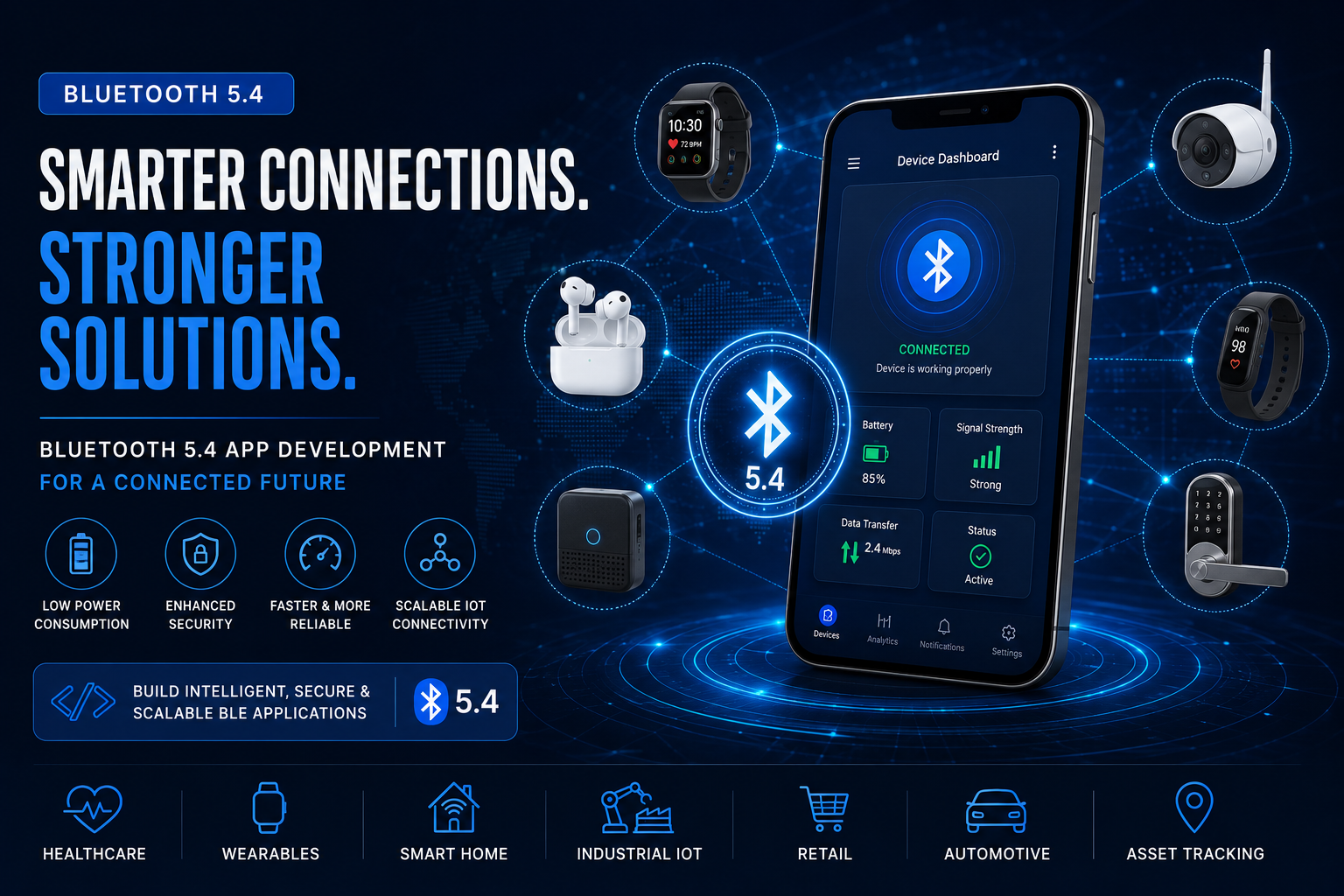
Bluetooth technology continues to evolve, enabling businesses to build highly connected, intelligent, and energy-efficient applications. With the introduction of Bluetooth 5.4, developers can create applications that deliver improved reliability, lower power consumption, enhanced security, and better support for large-scale connected ecosystems.
From wearable devices and healthcare equipment to industrial IoT, smart homes, and retail solutions, Bluetooth 5.4 is becoming the preferred wireless technology for next-generation applications.
At BLE App Developer, we specialize in building secure, scalable, and high-performance Bluetooth Low Energy (BLE) applications tailored to modern business requirements.
What Is Bluetooth 5.4?
Bluetooth 5.4 is the latest evolution of Bluetooth Low Energy technology, introducing enhancements that improve communication efficiency, device synchronization, and energy management.
It is designed for applications requiring:
Reliable wireless communication
Low power consumption
Secure device connectivity
Large-scale IoT deployments
Intelligent automation
Real-time data exchange
These capabilities make Bluetooth 5.4 ideal for enterprise-grade connected solutions.
Key Features of Bluetooth 5.4
Improved Energy Efficiency
Bluetooth 5.4 further reduces power consumption, allowing battery-powered devices to operate for extended periods.
Benefits include:
Longer battery life
Reduced maintenance
Lower operational costs
Improved user experience
This is especially valuable for wearables, sensors, and medical devices.
Enhanced Device Communication
Bluetooth 5.4 introduces improvements that enable more reliable communication between multiple connected devices.
Applications benefit from:
Stable connections
Reduced interference
Faster synchronization
Better scalability
Improved Security
Modern Bluetooth applications require enterprise-grade security.
Bluetooth 5.4 supports:
Strong encryption
Secure authentication
Protected data transmission
Device identity verification
Secure pairing mechanisms
These features help protect sensitive business and user data.
Better Support for Large IoT Networks
Businesses deploying hundreds or thousands of connected devices require scalable communication infrastructure.
Bluetooth 5.4 supports:
Smart buildings
Industrial automation
Healthcare networks
Retail ecosystems
Smart city infrastructure
without compromising performance.
Industries Benefiting from Bluetooth 5.4 App Development
Healthcare
Bluetooth applications enable:
Patient monitoring
Medical device connectivity
Remote health tracking
Wearable integration
Smart diagnostics
Wearables
Bluetooth powers:
Fitness trackers
Smartwatches
Health monitoring devices
Sports equipment
Lifestyle applications
Smart Homes
Connected devices include:
Smart locks
Lighting systems
Thermostats
Security sensors
Voice assistants
Industrial IoT
Manufacturers leverage Bluetooth for:
Equipment monitoring
Predictive maintenance
Worker safety
Asset tracking
Environmental sensors
Retail
Retail businesses implement Bluetooth solutions for:
Digital payments
Indoor navigation
Customer engagement
Smart shelves
Inventory management
Automotive
Bluetooth applications support:
Digital keys
Vehicle diagnostics
Infotainment systems
Driver assistance
Connected mobility
Essential Features of Enterprise BLE Applications
A modern Bluetooth application should include:
Secure Device Pairing
Real-Time Data Synchronization
Offline Data Storage
OTA Firmware Updates
Cloud Integration
Mobile App Support
Multi-Device Connectivity
Analytics Dashboard
API Integration
Role-Based Access Control
These features ensure scalability, maintainability, and enterprise-grade performance.
Why Businesses Are Choosing Bluetooth 5.4
Compared to previous Bluetooth versions, Bluetooth 5.4 offers:
Improved battery efficiency
Better communication reliability
Stronger security
Enhanced scalability
Reduced latency
Improved support for IoT ecosystems
Greater network stability
These advantages make Bluetooth 5.4 an excellent choice for future-ready applications.
Technologies Behind Bluetooth 5.4 Applications
Enterprise BLE solutions combine:
Bluetooth 5.4
Mobile Applications
IoT Devices
Cloud Computing
Artificial Intelligence
Machine Learning
Edge Computing
Secure APIs
Analytics Platforms
Device Management Systems
Together, these technologies create intelligent connected ecosystems capable of supporting millions of interactions.
Why Choose BLE App Developer?
At BLE App Developer, we build enterprise-grade Bluetooth applications that connect devices securely and efficiently across industries.
Our expertise includes:
Bluetooth 5.4 App Development
BLE Mobile Applications
Custom Firmware Development
IoT Device Integration
Wearable App Development
Healthcare BLE Solutions
Asset Tracking Systems
Cloud Connectivity
OTA Firmware Updates
Long-Term Support & Maintenance
Our experienced engineers help businesses transform ideas into reliable, scalable, and high-performance Bluetooth applications.
The Future of Bluetooth App Development
Bluetooth technology continues to evolve alongside AI and IoT.
Future innovations include:
AI-powered device intelligence
Predictive IoT maintenance
Digital twins
Edge AI processing
Context-aware automation
Smart healthcare ecosystems
Autonomous industrial monitoring
Integration with Matter-enabled smart environments
Businesses investing in Bluetooth 5.4 today will be well-positioned to take advantage of tomorrow’s connected technologies.
Conclusion
Bluetooth 5.4 represents a major step forward in wireless connectivity. Its improved efficiency, stronger security, lower power consumption, and enhanced scalability make it the ideal foundation for modern connected applications.
Whether you’re building wearable technology, healthcare solutions, smart home products, industrial IoT platforms, or enterprise mobility applications, Bluetooth 5.4 enables secure and intelligent communication at scale.
Ready to build your next Bluetooth-enabled application? Partner with BLE App Developer to develop innovative, secure, and scalable BLE solutions that drive digital transformation and business growth.
Frequently Asked Questions (FAQs)
What is Bluetooth 5.4?
Bluetooth 5.4 is the latest version of Bluetooth Low Energy technology, offering improved power efficiency, security, scalability, and communication reliability for connected devices.
Which industries use Bluetooth 5.4 applications?
Healthcare, wearables, smart homes, retail, manufacturing, logistics, automotive, and industrial IoT are among the industries benefiting from Bluetooth 5.4.
Why is Bluetooth 5.4 better for IoT?
Bluetooth 5.4 provides lower power consumption, reliable connectivity, stronger security, and improved support for large-scale connected device networks.
Can Bluetooth 5.4 apps integrate with cloud platforms?
Yes. Modern BLE applications can securely integrate with cloud services, enterprise APIs, analytics platforms, and IoT management systems.
Does BLE App Developer provide custom Bluetooth solutions?
Yes. BLE App Developer offers end-to-end Bluetooth 5.4 app development, firmware development, IoT integration, cloud connectivity, testing, deployment, and ongoing support for businesses across multiple industries.
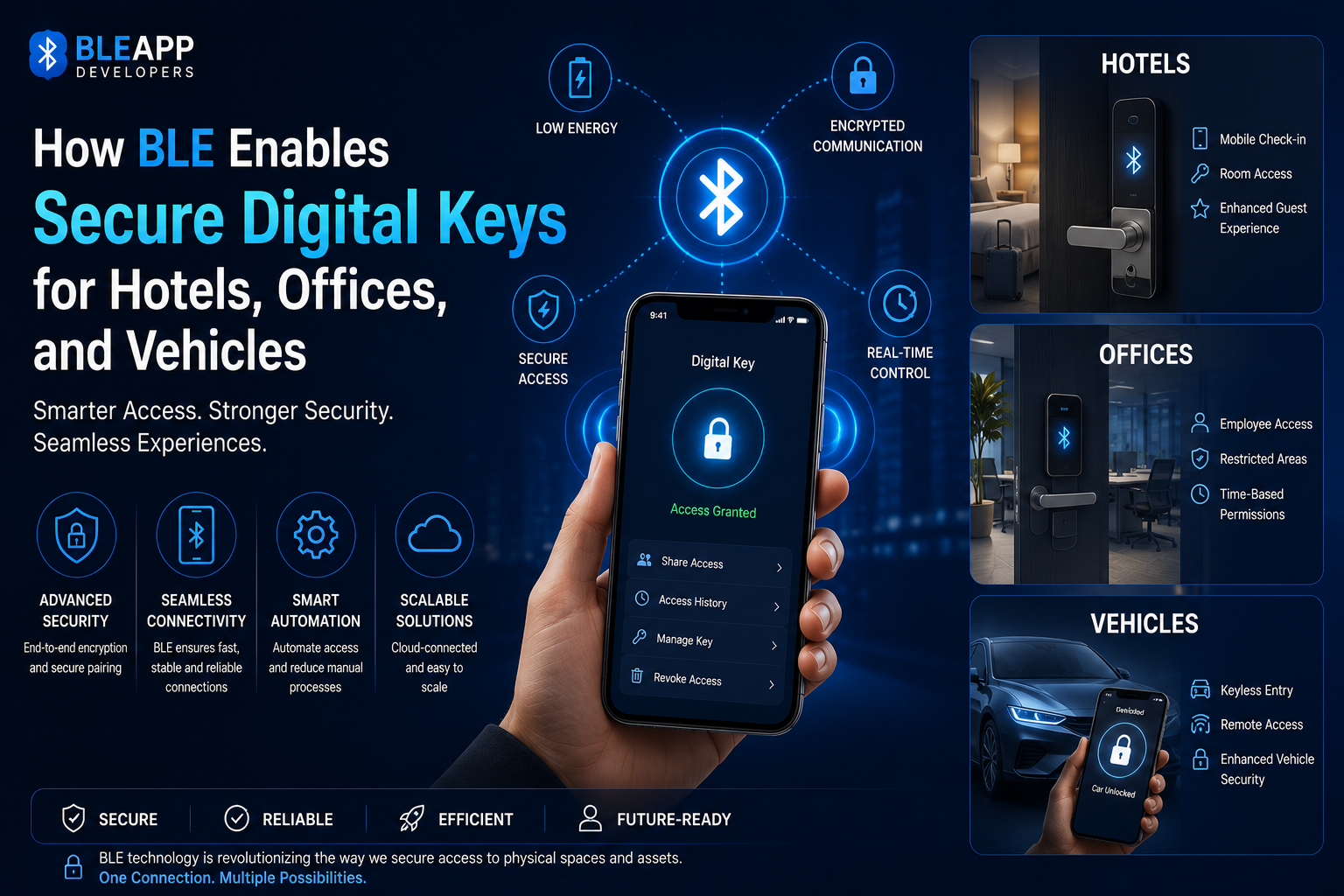
The way people access hotels, offices, and vehicles is rapidly evolving. Traditional physical keys and access cards are being replaced by secure, smartphone-based digital keys that offer greater convenience, flexibility, and security. At the heart of this transformation is Bluetooth Low Energy (BLE), a wireless technology designed for reliable, low-power communication between devices.
BLE-powered digital keys enable users to unlock doors, access workspaces, or start vehicles with a smartphone or wearable device. For businesses, this technology simplifies access management, reduces operational costs, and enhances the overall user experience.
In this guide, we’ll explore how BLE digital keys work, why they’re secure, their real-world applications, and why businesses are increasingly adopting BLE-enabled access systems.
What Are BLE Digital Keys?
A BLE digital key is a virtual credential securely stored on a smartphone, smartwatch, or other compatible device. Instead of carrying physical keys or RFID cards, users authenticate themselves through a mobile application that communicates with nearby BLE-enabled locks or access systems.
When an authorized user approaches a compatible lock, the mobile device securely exchanges encrypted information with the lock. Once authentication is complete, the door, vehicle, or gate unlocks automatically or with a simple tap inside the app.
Unlike traditional Bluetooth, BLE is specifically designed to consume minimal battery power while maintaining fast and secure communication.
How BLE Digital Keys Work
A BLE digital key system consists of several components working together.
1. Mobile Application
The mobile app stores encrypted digital credentials and manages user authentication. It also allows users to receive, revoke, or update digital keys remotely.
2. BLE-Enabled Smart Lock
The smart lock continuously advertises its availability using Bluetooth Low Energy while consuming very little power.
3. Secure Authentication
When the smartphone comes within range, encrypted authentication takes place between the app and the lock. Access is granted only if the credentials are verified successfully.
4. Cloud Access Management
Cloud platforms allow administrators to:
Create temporary digital keys
Grant or revoke permissions instantly
Track access history
Manage multiple locations from one dashboard
Configure user roles and schedules
This centralized management significantly improves operational efficiency.
Why BLE Is Ideal for Digital Key Solutions
Bluetooth Low Energy offers several advantages over traditional access methods.
Low Power Consumption
BLE devices operate for months or even years on a single battery, making them ideal for smart locks installed in hotels, office buildings, apartments, and parking facilities.
Fast Connection
BLE establishes connections quickly, allowing users to unlock doors within seconds without noticeable delays.
Smartphone Compatibility
Nearly every modern Android and iOS smartphone supports Bluetooth Low Energy, eliminating the need for specialized hardware.
Contactless Access
Users simply approach the lock with their phone or smartwatch, creating a seamless and hygienic access experience.
Scalable Infrastructure
Organizations can deploy BLE access systems across a single building or multiple locations while managing everything centrally.
Security Features of BLE Digital Keys
Security is the most important consideration when replacing physical keys. Modern BLE access systems incorporate multiple layers of protection.
End-to-End Encryption
All communication between the mobile device and lock is encrypted, making it extremely difficult for attackers to intercept useful information.
Dynamic Authentication
Instead of relying on static codes, modern systems use rotating encryption keys and challenge-response authentication to prevent replay attacks.
Secure Credential Storage
Digital keys are securely stored using hardware-backed security features available on modern smartphones.
Time-Limited Access
Administrators can issue temporary digital keys for:
Hotel guests
Delivery personnel
Contractors
Maintenance teams
Event attendees
Access automatically expires at the specified time.
Remote Revocation
Lost smartphones no longer require changing physical locks. Administrators can revoke access immediately through the management platform.
Multi-Factor Authentication
Many systems combine BLE authentication with:
PIN verification
Biometrics
Face recognition
Fingerprint authentication
This provides additional protection for sensitive areas.
BLE Digital Keys in Hotels
The hospitality industry has been one of the earliest adopters of BLE digital keys.
Guests can:
Skip the front desk
Check in online
Receive room keys instantly
Unlock rooms using smartphones
Extend stays remotely
Hotel operators benefit from:
Reduced plastic key card costs
Faster guest check-in
Improved guest satisfaction
Better security monitoring
Simplified room access management
Digital keys also reduce the number of lost or demagnetized room cards.
BLE Access Control for Offices
Modern workplaces increasingly rely on flexible access control systems.
BLE digital keys help organizations:
Manage employee access remotely
Restrict entry to secure departments
Enable visitor management
Support hybrid work environments
Monitor building occupancy
Generate access reports
Employees enjoy frictionless entry without carrying multiple access cards.
BLE Digital Keys for Vehicles
Automotive manufacturers are integrating BLE into connected vehicle ecosystems.
BLE digital keys allow users to:
Unlock vehicles
Lock doors remotely
Start compatible vehicles
Share temporary access
Grant family or employee permissions
Fleet operators can securely manage vehicle access without exchanging physical keys.
This technology is particularly valuable for:
Rental companies
Corporate fleets
Car-sharing platforms
Logistics providers
Additional Industries Using BLE Digital Keys
BLE-powered access systems are expanding into numerous sectors.
Residential Communities
Residents can securely access:
Apartments
Gates
Elevators
Clubhouses
Parking garages
Healthcare Facilities
Hospitals use BLE access to secure:
Patient areas
Laboratories
Medicine storage
Staff-only zones
Educational Institutions
Universities can manage access for:
Students
Faculty
Dormitories
Libraries
Research labs
Warehouses and Logistics
BLE simplifies access management across large facilities while maintaining detailed audit logs.
Business Benefits of BLE Digital Keys
Organizations implementing BLE access systems experience several operational advantages.
Lower Operational Costs
Digital credentials eliminate recurring expenses associated with replacing lost keys and printing access cards.
Better User Experience
Contactless entry reduces waiting times and improves convenience for employees, guests, and customers.
Cloud-based dashboards simplify user management across multiple locations.
Future-Ready Infrastructure
BLE systems integrate easily with:
Smart buildings
IoT devices
Visitor management platforms
Identity management systems
Facility automation solutions
Challenges to Consider
Although BLE digital keys offer significant advantages, businesses should plan for:
Device compatibility testing
Secure mobile app development
User education
Battery management for smart locks
Compliance with privacy and security regulations
Reliable cloud infrastructure
Working with experienced BLE developers helps address these challenges effectively.
Why Choose BLE App Developers?
At BLE App Developers, we specialize in building secure, scalable, and user-friendly Bluetooth Low Energy solutions for businesses across industries. Our expertise includes:
Custom BLE mobile app development
Smart lock integration
Secure digital key implementation
IoT device connectivity
Cloud-based access management
BLE firmware integration
Cross-platform Android and iOS applications
Enterprise-grade security solutions
Whether you’re developing a smart hotel platform, office access control system, or connected vehicle solution, our team delivers reliable BLE applications tailored to your business needs.
Conclusion
Bluetooth Low Energy has become the foundation of modern digital access systems, offering a secure and convenient alternative to physical keys. From hotels and corporate offices to connected vehicles and smart residential communities, BLE digital keys improve security, streamline operations, and create seamless user experiences.
As demand for contactless and intelligent access continues to grow, investing in BLE-powered digital key solutions can help businesses stay competitive while delivering greater convenience and control.
If you’re planning to build a secure digital key solution, BLE App Developers can help you design, develop, and deploy a customized BLE application that meets your security, scalability, and business goals.
Frequently Asked Questions
1. What is a BLE digital key?
A BLE digital key is a secure virtual credential stored on a smartphone or wearable device that allows users to unlock compatible doors, vehicles, or access systems using Bluetooth Low Energy.
2. Are BLE digital keys secure?
Yes. Modern BLE digital key systems use encryption, secure credential storage, dynamic authentication, and optional multi-factor authentication to protect against unauthorized access.
3. Which industries benefit most from BLE digital keys?
Hotels, offices, healthcare facilities, residential communities, educational institutions, logistics companies, and automotive businesses all benefit from BLE-based digital access solutions.
4. Can digital keys be revoked remotely?
Yes. Administrators can instantly revoke or modify user permissions through a centralized cloud-based management system.
5. Why choose BLE over traditional Bluetooth?
BLE consumes significantly less power, offers faster connections for access control, supports modern smartphones, and is specifically optimized for IoT and smart access applications.
Bluetooth Low Energy (BLE) technology has become one of the most important communication technologies powering modern IoT applications. From smart healthcare devices and wearable technology to industrial sensors and smart home solutions, BLE enables seamless wireless connectivity with low power consumption.
In 2026, businesses are increasingly investing in BLE-powered applications to connect devices, collect real-time data, and deliver smarter digital experiences.
BLEAppDevelopers helps businesses build advanced Bluetooth Low Energy applications that connect mobile devices, sensors, and smart hardware through secure and reliable communication solutions.
What Is BLE App Development?
BLE app development focuses on creating mobile and web applications that communicate with Bluetooth Low Energy-enabled devices.
Unlike traditional Bluetooth technology, BLE is designed for:
Low power consumption
Continuous device communication
Faster data exchange
Longer battery life
Cost-effective IoT solutions
BLE applications allow smartphones and tablets to interact with smart devices without requiring internet connectivity.
Why Businesses Are Choosing BLE Technology in 2026
1. Growing Demand for IoT Connected Devices
The Internet of Things ecosystem is expanding rapidly.
Businesses are using BLE technology for:
Smart wearables
Healthcare monitoring devices
Industrial sensors
Smart home systems
Asset tracking solutions
Retail technology
BLE provides a simple and efficient way to connect physical devices with digital applications.
2. Low Power Consumption for Smart Devices
Battery life is a major challenge for connected devices.
BLE technology allows devices to operate for months or even years using small batteries.
Popular BLE-powered products include:
Fitness trackers
Smart watches
Medical sensors
Smart locks
Environmental monitoring devices
3. Real-Time Data Communication
BLE applications enable instant communication between devices and mobile applications.
Businesses can collect:
Sensor data
Device status information
User activity
Location-based insights
Performance metrics
This helps companies make better decisions using real-time information.
Industries Using BLE App Development Solutions
Healthcare & Medical Technology
BLE has transformed healthcare applications by enabling remote patient monitoring.
Examples:
Smart medical devices
Heart monitoring systems
Glucose monitoring devices
Healthcare wearables
BLE apps allow doctors and patients to access important health information quickly.
Fitness & Wearable Technology
Fitness companies use BLE applications to connect:
Smart watches
Fitness trackers
Exercise equipment
Health monitoring devices
Users can track performance, activity levels, and health goals through mobile applications.
Smart Home Solutions
BLE technology powers modern smart home products such as:
Smart locks
Lighting systems
Temperature sensors
Security devices
Users can control connected devices directly from smartphones.
Retail & Enterprise Solutions
Businesses use BLE applications for:
Inventory tracking
Customer engagement
Smart POS systems
Beacon-based marketing
Asset monitoring
Key Features of a Successful BLE Mobile Application
Device Discovery & Pairing
A professional BLE application should provide:
Fast device scanning
Secure pairing
Automatic reconnection
Multiple device support
Real-Time Data Monitoring
BLE apps should display device information through:
Live dashboards
Graphs
Reports
Notifications
Secure BLE Communication
Security is essential for connected devices.
BLE applications should include:
Data encryption
Secure authentication
Protected communication channels
Cross-Platform Development
Modern BLE apps should support:
iOS applications
Android applications
Cross-platform frameworks
This helps businesses reach more users efficiently.
BLE App Development Process
Step 1: Understanding Business Requirements
Developers analyze:
Device specifications
User requirements
Data flow
Connectivity needs
Step 2: BLE Architecture Planning
The development team creates:
Communication protocols
Data structures
Device interaction models
Step 3: Mobile App Development
The application is developed with:
User-friendly interfaces
Device management features
Real-time communication
Step 4: Testing & Optimization
Testing includes:
Device compatibility
Connection stability
Security testing
Performance optimization
Why Choose BLEAppDevelopers?
BLEAppDevelopers specializes in creating custom Bluetooth Low Energy solutions for businesses worldwide.
Our expertise includes:
✔ Custom BLE mobile applications ✔ IoT device connectivity ✔ Wearable app development ✔ Bluetooth communication solutions ✔ Android & iOS BLE applications ✔ Smart device integration ✔ Real-time monitoring applications
Future of BLE Application Development
The future of BLE technology will continue to grow with advancements in:
IoT ecosystems
Smart healthcare
Wearable devices
Artificial intelligence
Edge computing
Connected enterprise solutions
Businesses that adopt BLE solutions today can create smarter, faster, and more efficient products.
Conclusion
Bluetooth Low Energy technology is changing how businesses connect devices and deliver digital experiences. From healthcare and fitness to industrial automation and smart homes, BLE applications are becoming an essential part of modern IoT solutions.
BLEAppDevelopers helps companies transform innovative ideas into powerful BLE-powered applications with secure connectivity, scalable architecture, and user-focused design.
Build your next connected product with expert BLE app developers and bring your IoT vision to life.
SEO Meta Title:
BLE App Development Company | Custom Bluetooth Low Energy Solutions
SEO Meta Description:
Looking for BLE app developers? Discover how BLE application development helps businesses build IoT, wearable, healthcare, and smart device solutions in 2026.
Suggested Feature Image:
A futuristic BLE IoT ecosystem showing smartphone connected with smartwatch, sensors, smart home devices, and industrial equipment with Bluetooth wireless signals.
BLE in 2026: The Technology Powering the Next Generation of Smart Connected Devices
The world is becoming increasingly connected.
From smartwatches and fitness trackers to healthcare devices, industrial sensors, smart homes, and asset tracking systems, businesses are relying on seamless wireless communication to deliver better experiences and smarter operations.
At the center of this transformation is Bluetooth Low Energy (BLE)—a technology designed for fast, secure, and energy-efficient device connectivity.
As organizations continue investing in IoT ecosystems, BLE has become one of the most important technologies shaping the future of connected products.
What is Bluetooth Low Energy (BLE)?
Bluetooth Low Energy (BLE) is a wireless communication technology that enables devices to exchange data while consuming minimal power.
Unlike traditional Bluetooth, BLE is specifically designed for:
Low energy consumption
Fast device discovery
Reliable connectivity
Long battery life
Real-time data exchange
This makes it ideal for battery-powered smart devices that need to remain connected for months or even years.
Why BLE Is Growing Faster Than Ever
Businesses are adopting BLE because modern consumers expect connected experiences.
Whether it’s:
Smart healthcare monitoring
Fitness tracking
Retail proximity marketing
Industrial automation
Smart home control
Asset tracking systems
BLE provides the foundation for secure and efficient communication between devices.
The Rise of IoT and Connected Ecosystems
The Internet of Things (IoT) continues to expand across industries.
A single connected ecosystem may include:
Mobile applications
Wearable devices
Sensors
Smart equipment
Cloud platforms
Analytics dashboards
BLE serves as the communication bridge that enables these devices to interact seamlessly.
Without reliable BLE connectivity, smart ecosystems cannot function effectively.
Key Benefits of BLE Technology
Ultra-Low Power Consumption
One of BLE’s biggest advantages is energy efficiency.
Devices can operate for extended periods using small batteries, making BLE perfect for:
Wearables
Medical devices
Tracking devices
Smart sensors
Longer battery life means lower maintenance costs and better user experiences.
Fast and Reliable Connectivity
Users expect devices to connect instantly.
BLE enables:
✅ Quick pairing
✅ Stable communication
✅ Reduced latency
✅ Improved performance
This ensures a smooth experience across connected devices and applications.
Real-Time Data Transfer
Many industries depend on immediate access to information.
BLE allows devices to transmit:
Health metrics
Environmental data
Equipment status
Location information
User activity data
in real time, helping businesses make faster decisions.
Enhanced User Experiences
Connected products succeed when they feel effortless.
BLE enables:
Automatic device pairing
Background synchronization
Smart notifications
Personalized interactions
The result is a seamless experience that users appreciate.
Industries Being Transformed by BLE
Healthcare
BLE powers:
Remote patient monitoring
Smart medical devices
Health tracking wearables
Connected healthcare platforms
Healthcare providers gain access to critical patient data in real time.
Fitness & Wearables
Fitness applications use BLE to connect:
Smartwatches
Heart-rate monitors
Activity trackers
Smart fitness equipment
This allows users to track health and performance effortlessly.
Retail
Retailers leverage BLE for:
Customer engagement
Indoor navigation
Proximity marketing
Smart loyalty programs
This helps create personalized shopping experiences.
Industrial Automation
BLE supports:
Equipment monitoring
Predictive maintenance
Asset tracking
Workforce safety systems
Industrial organizations use connected devices to improve efficiency and reduce downtime.
Smart Homes
From smart locks to lighting systems, BLE enables convenient and secure device communication within modern homes.
Why BLE App Development Matters
Building a BLE-enabled application requires more than standard mobile development.
Developers must understand:
Device communication protocols
Connection stability
Data synchronization
Security implementation
Cross-platform compatibility
Battery optimization
Poor BLE implementation often results in:
Frequent disconnections
Slow performance
Data loss
Poor user experiences
Professional BLE app development ensures reliable device communication and long-term scalability.
The Future of BLE Technology
As smart devices continue to grow in popularity, BLE will become even more important.
Emerging trends include:
AI-powered connected devices
Smart healthcare ecosystems
Advanced wearable technology
Industrial IoT expansion
Smart city infrastructure
Real-time asset intelligence
Organizations that invest in BLE-powered solutions today will be better positioned for the connected future.
Why Businesses Choose BLE App Developer
At BLE App Developer, we specialize in building powerful Bluetooth Low Energy applications that connect devices, users, and businesses.
Our expertise includes:
✔ BLE Mobile App Development
✔ IoT Application Development
✔ Wearable Device Integration
✔ Healthcare Connectivity Solutions
✔ Industrial IoT Systems
✔ Smart Device Ecosystems
✔ Cross-Platform BLE Applications
We help businesses transform innovative ideas into reliable connected experiences.
Final Thoughts
The future is connected.
Bluetooth Low Energy is no longer just a wireless technology—it is the foundation of modern digital ecosystems.
From healthcare and retail to industrial automation and smart homes, BLE is enabling businesses to create smarter products, improve customer experiences, and unlock new opportunities for growth.
Ready to build the next generation of connected solutions?
BLE App Developer helps businesses create secure, scalable, and high-performance BLE applications designed for the future of IoT. 🚀
In a world where smart devices are becoming an essential part of everyday life, Bluetooth Low Energy (BLE) technology is driving a new era of connectivity. From healthcare wearables and fitness trackers to smart homes, industrial automation, and retail solutions, BLE enables devices to communicate efficiently while consuming minimal power. As businesses continue to invest in connected technologies, the demand for experienced BLE App Developers has never been higher. BLE remains one of the most important wireless technologies for IoT ecosystems, location-based services, wearables, and enterprise automation.
What Is BLE (Bluetooth Low Energy)?
Bluetooth Low Energy (BLE) is a wireless communication technology designed for low-power, short-range data transmission. Unlike traditional Bluetooth, BLE focuses on energy efficiency, making it ideal for battery-powered devices that need continuous connectivity. BLE supports fast pairing, real-time data exchange, and seamless integration with mobile and web applications.
Key Benefits of BLE Technology
Ultra-low power consumption
Fast and reliable connectivity
Real-time data transfer
Cross-platform support (iOS & Android)
Cost-effective deployment
Enhanced user experiences
Scalable IoT integration
These advantages make BLE the preferred communication protocol for modern connected devices.
Why Businesses Need a BLE App Developer
Developing a successful BLE application requires much more than simply connecting a device to a smartphone. A skilled BLE App Developer understands hardware communication, device protocols, mobile architecture, security, and user experience.
A professional BLE developer helps businesses:
1. Build Reliable Device Connectivity
Ensuring stable communication between devices and applications is critical. BLE developers optimize scanning, pairing, bonding, and data transmission processes for maximum reliability.
2. Improve Battery Efficiency
One of BLE’s biggest strengths is low energy consumption. Developers fine-tune communication intervals, data packets, and background operations to maximize battery life.
3. Create Secure Communication Channels
Modern BLE applications require:
Secure pairing
Device authentication
Encrypted communication
Protection against unauthorized access
Security has become a major priority for BLE applications across healthcare, finance, and enterprise environments.
4. Deliver Cross-Platform Experiences
Businesses often require applications that work seamlessly across:
iOS
Android
Tablets
Embedded systems
Cloud platforms
BLE developers ensure compatibility across multiple operating systems and hardware environments.
Industries Benefiting from BLE App Development
Healthcare & Medical Devices
BLE powers:
Remote patient monitoring
Smart medical devices
Glucose monitoring systems
Heart rate trackers
Connected healthcare solutions
Healthcare providers use BLE-enabled applications to improve patient care while reducing operational costs.
Wearables & Fitness
Popular BLE-powered devices include:
Smartwatches
Fitness bands
Activity trackers
Sports monitoring devices
BLE ensures long battery life and real-time synchronization between devices and mobile applications.
Retail & Smart POS
Retail businesses leverage BLE for:
Contactless payments
Customer engagement
Inventory tracking
Beacon marketing
Smart POS systems
BLE technology enhances customer experiences while streamlining operations.
Industrial IoT
BLE applications support:
Asset tracking
Equipment monitoring
Predictive maintenance
Worker safety systems
Smart factory automation
Industrial organizations use BLE to improve productivity and reduce downtime.
Smart Homes
BLE enables:
Smart lighting
Security systems
Smart locks
Connected appliances
Home automation platforms
Users gain convenient control over their environments through intuitive mobile applications.
Top BLE App Development Trends in 2026
BLE + AI Integration
Artificial Intelligence is transforming BLE-powered applications by enabling:
Predictive automation
Personalized experiences
Smart notifications
Context-aware interactions
Businesses are increasingly combining AI and BLE to create intelligent user experiences.
BLE Mesh Networking
BLE Mesh technology allows large numbers of devices to communicate efficiently across extensive environments such as:
Hospitals
Warehouses
Retail chains
Smart campuses
This creates highly scalable IoT ecosystems without requiring centralized infrastructure.
Enhanced Security Standards
As connected devices become more widespread, organizations are prioritizing:
End-to-end encryption
Secure device authentication
Privacy-focused communication
Security-first BLE development is becoming a competitive necessity.
Essential Features of a Successful BLE Application
A modern BLE application should include:
✅ Device Discovery & Pairing
✅ Real-Time Data Synchronization
✅ Secure Communication Protocols
✅ Cloud Integration
✅ Offline Data Storage
✅ Push Notifications
✅ Cross-Platform Support
✅ Analytics & Reporting
These features help businesses deliver seamless and scalable connected experiences.
Why Choose Professional BLE App Development?
Working with experienced BLE App Developers provides:
Faster development cycles
Reduced technical risks
Better performance optimization
Stronger security im
Protection against unauthorized access
Security has become a major priority for BLE applications across healthcare, finance, and enterprise environments.
4. Deliver Cross-Platform Experiences
Businesses often require applications that work seamlessly across:
iOS
Android
Tablets
Embedded systems
Cloud platforms
BLE developers ensure compatibility across multiple operating systems and hardware environments.
Industries Benefiting from BLE App Development
Healthcare & Medical Devices
BLE powers:
Remote patient monitoring
Smart medical devices
Glucose monitoring systems
Heart rate trackers
Connected healthcare solutions
Healthcare providers use BLE-enabled applications to improve patient care while reducing operational costs.
Wearables & Fitness
Popular BLE-powered devices include:
Smartwatches
Fitness bands
Activity trackers
Sports monitoring devices
BLE ensures long battery life and real-time synchronization between devices and mobile applications.
Retail & Smart POS
Retail businesses leverage BLE for:
Contactless payments
Customer engagement
Inventory tracking
Beacon marketing
Smart POS systems
BLE technology enhances customer experiences while streamlining operations.
Industrial IoT
BLE applications support:
Asset tracking
Equipment monitoring
Predictive maintenance
Worker safety systems
Smart factory automation
Industrial organizations use BLE to improve productivity and reduce downtime.
Smart Homes
BLE enables:
Smart lighting
Security systems
Smart locks
Connected appliances
Home automation platforms
Users gain convenient control over their environments through intuitive mobile applications.
Top BLE App Development Trends in 2026
BLE + AI Integration
Artificial Intelligence is transforming BLE-powered applications by enabling:
Predictive automation
Personalized experiences
Smart notifications
Context-aware interactions
Businesses are increasingly combining AI and BLE to create intelligent user experiences.
BLE Mesh Networking
BLE Mesh technology allows large numbers of devices to communicate efficiently across extensive environments such as:
Hospitals
Warehouses
Retail chains
Smart campuses
This creates highly scalable IoT ecosystems without requiring centralized infrastructure.
Enhanced Security Standards
As connected devices become more widespread, organizations are prioritizing:
End-to-end encryption
Secure device authentication
Privacy-focused communication
Security-first BLE development is becoming a competitive necessity.
Essential Features of a Successful BLE Application
✅ Device Discovery & Pairing
✅ Real-Time Data Synchronization
✅ Secure Communication Protocols
✅ Cloud Integration
✅ Offline Data Storage
✅ Push Notifications
✅ Cross-Platform Support
✅ Analytics & Reporting
These features help businesses deliver seamless and scalable connected experiences.
Why Choose Professional BLE App Development?
Working with experienced BLE App Developers provides:
Faster development cycles
Reduced technical risks
Better performance optimization
Stronger security implementation
Future-ready architecture
Scalable IoT integration
Whether you’re launching a wearable product, a healthcare solution, a smart retail platform, or an industrial IoT system, expert BLE development can significantly accelerate success.
Final Thoughts
Bluetooth Low Energy is no longer just a communication protocol—it’s the foundation of modern connected ecosystems. As businesses continue to embrace IoT, automation, and smart technologies, BLE App Developers play a crucial role in building secure, scalable, and high-performance applications.
Organizations that invest in professional BLE app development today are positioning themselves to lead tomorrow’s connected world. From wearables and healthcare to retail and industrial automation, BLE technology is enabling smarter experiences, greater efficiency, and limitless innovation.
Meta Title: BLE App Developer: Smart Bluetooth Low Energy Solutions in 2026
Meta Description: Discover how BLE App Developers create secure, scalable, and energy-efficient Bluetooth Low Energy applications for IoT, healthcare, retail, wearables, and smart business solutions in 2026.
As smart devices continue transforming industries worldwide, businesses are increasingly adopting Bluetooth Low Energy (BLE) technology to create faster, smarter, and more energy-efficient digital experiences.
From healthcare wearables and fitness trackers to smart homes, industrial automation, and IoT ecosystems — BLE is now powering the future of connected technology.
But building reliable BLE-enabled applications requires specialized expertise.
That’s where a professional BLE App Developer becomes critical.
🚀 What is BLE (Bluetooth Low Energy)?
Bluetooth Low Energy (BLE) is a wireless communication technology designed for:
Low power consumption
Fast data transmission
Long battery life
Real-time connectivity
Efficient device communication
Unlike traditional Bluetooth, BLE is optimized for devices that continuously exchange small amounts of data while consuming minimal energy.
This makes BLE ideal for:
Smartwatches
Fitness bands
Medical devices
IoT sensors
Smart locks
POS hardware
Industrial equipment
Smart home systems
🌟 Why BLE Technology Is Growing Rapidly
In 2026, businesses are rapidly investing in IoT and connected devices.
According to industry trends, BLE technology is becoming the backbone of modern wireless ecosystems because it offers:
Better battery efficiency
Faster pairing
Stable device communication
Cost-effective connectivity
Cross-platform compatibility
As demand for smart products increases, businesses need experienced BLE app developers who understand both hardware communication and software architecture.
📱 What Does a BLE App Developer Do?
A BLE App Developer specializes in building applications that communicate with Bluetooth-enabled devices.
Their responsibilities include:
BLE device integration
Real-time data synchronization
Sensor communication
Device pairing & connectivity
Firmware communication
Cross-platform mobile development
Performance optimization
Security implementation
They ensure that apps can communicate smoothly with connected devices while maintaining stability, speed, and low battery usage.
🔥 Industries Using BLE Applications
BLE technology is now used across multiple industries.
🏥 Healthcare
Patient monitoring systems
Smart medical devices
Heart rate monitors
Glucose monitoring systems
🏋️ Fitness & Wearables
Smartwatches
Fitness trackers
Health analytics apps
🏠 Smart Homes
Smart lighting
Smart locks
Home automation systems
Security devices
🏭 Industrial Automation
Asset tracking
Smart sensors
Machine monitoring
Predictive maintenance systems
🛒 Retail & POS Systems
Smart payment terminals
BLE-enabled POS hardware
Beacon-based marketing
Contactless customer engagement
⚡ Key Skills Every BLE App Developer Should Have
A skilled BLE developer must understand both software and hardware ecosystems.
Essential Technical Skills:
Bluetooth GATT Protocol
BLE Device Pairing
iOS BLE Development
Android BLE APIs
Flutter BLE Integration
React Native BLE
IoT Communication
Firmware Interaction
Real-Time Data Handling
Cloud Connectivity
They must also know how to optimize BLE performance to reduce:
Connection drops
Battery drain
Data latency
Device instability
☁️ BLE + IoT = The Future
The combination of BLE and IoT is reshaping digital infrastructure globally.
Modern businesses are using BLE applications for:
Smart automation
Real-time tracking
Remote monitoring
AI-driven analytics
Connected ecosystems
This integration allows companies to build intelligent systems capable of collecting and processing live device data efficiently.
🔐 Security Is Critical in BLE Applications
Security remains one of the biggest concerns in BLE development.
Professional BLE developers implement:
Encrypted communication
Secure authentication
Device authorization
Data protection protocols
Secure firmware communication
This is especially important in industries like healthcare, fintech, and enterprise IoT systems.
📊 Challenges in BLE App Development
BLE development is highly technical and comes with multiple challenges, including:
Device compatibility issues
Background connectivity limitations
Cross-platform synchronization
Signal interference
Battery optimization
Real-time performance handling
An experienced BLE App Developer understands how to solve these issues efficiently while delivering stable applications.
🌍 Why Businesses Need BLE Experts in 2026
As connected devices become more common, businesses need developers who can build scalable BLE ecosystems.
Hiring a BLE specialist helps businesses:
Launch products faster
Improve device reliability
Reduce development errors
Enhance customer experiences
Create scalable IoT solutions
From startups building smart wearables to enterprises developing industrial automation systems, BLE expertise is now a major competitive advantage.
🔮 The Future of BLE Technology
BLE is expected to play a massive role in the future of:
Smart cities
AI-powered IoT systems
Healthcare automation
Retail technology
Industrial intelligence
Connected transportation
Businesses that invest in BLE-enabled products today are positioning themselves for long-term digital growth.
✨ Final Thoughts
Bluetooth Low Energy technology is revolutionizing how devices communicate in the modern digital world.
Whether it’s healthcare, fitness, smart homes, retail, or industrial automation, BLE applications are becoming essential for connected ecosystems.
A skilled BLE App Developer helps businesses build secure, scalable, and high-performance applications that power the next generation of smart technology.
In 2026, connectivity is everything. From smart homes to healthcare devices and retail automation, Bluetooth Low Energy (BLE) is powering the next generation of mobile and IoT applications.
BLE app development is becoming essential for businesses looking to build fast, energy-efficient, and real-time connected solutions. At QuartusTech, we help U.S. businesses create powerful BLE-enabled mobile and web applications that deliver seamless device communication.
🔍 What is BLE App Development?
BLE (Bluetooth Low Energy) is a wireless communication technology designed for short-range data exchange with minimal power consumption.
BLE app development involves creating applications that connect and interact with BLE-enabled devices such as:
Smartwatches & fitness trackers
Medical devices
Smart home systems
Retail beacons
Industrial IoT devices
📊 Why BLE is Growing Rapidly in the U.S.
1. Rise of IoT Devices
Millions of connected devices rely on BLE for communication.
2. Low Power Consumption
BLE devices can run for months or even years on small batteries.
3. Real-Time Communication
BLE enables instant data transfer between devices and apps.
4. Cost-Effective Implementation
Lower hardware and operational costs make BLE ideal for startups and enterprises.
📱 Key Features of BLE Applications
Device discovery and pairing
Secure data transmission
Real-time notifications
Background connectivity
Cross-platform compatibility (iOS & Android)
🏥 BLE Use Cases Across Industries
Healthcare
Remote patient monitoring
Wearable health devices
Smart medical equipment
Retail
Beacon-based marketing
Indoor navigation
Customer engagement tracking
Fitness & Lifestyle
Activity tracking apps
Smart gym equipment
Smart Homes
Lighting control
Smart locks
IoT automation
Industrial & Logistics
Asset tracking
Equipment monitoring
Warehouse automation
⚙️ Technologies Used in BLE App Development
Bluetooth GATT protocol
iOS Core Bluetooth framework
Android BLE APIs
Cloud integration (AWS, Firebase)
IoT platforms
🔐 Security in BLE Applications
Security is critical in BLE development. Key measures include:
Data encryption
Secure pairing methods
Authentication protocols
Firmware security updates
QuartusTech ensures all BLE apps meet high security standards for U.S. businesses.
💡 Benefits of BLE App Development
Low energy consumption
Fast and reliable connectivity
Scalable IoT integration
Improved user experience
Cost efficiency
🏆 Why Choose QuartusTech for BLE App Development?
QuartusTech provides end-to-end BLE development services:
Custom BLE mobile app development
IoT device integration
Cross-platform solutions
UI/UX optimization
Ongoing support and maintenance
We build scalable and future-ready BLE solutions tailored to your business needs.
🔮 Future Trends in BLE Technology (2026)
BLE Mesh networks
Smart cities integration
Advanced wearable technology
AI-powered IoT devices
Contactless automation systems
❓ Frequently Asked Questions (FAQ)
1. What is BLE used for in mobile apps?
BLE is used to connect mobile apps with smart devices like wearables, sensors, and IoT systems.
2. Is BLE better than classic Bluetooth?
Yes, BLE consumes significantly less power and is ideal for IoT and continuous connectivity.
3. How much does BLE app development cost in the U.S.?
Costs vary based on complexity, but basic apps can start from a few thousand dollars, while advanced solutions can go much higher.
4. Is BLE secure for sensitive data?
Yes, with proper encryption and authentication, BLE can securely transmit sensitive data.
5. Can QuartusTech integrate BLE with existing apps?
Absolutely. QuartusTech can upgrade your existing app with BLE functionality seamlessly.
Bluetooth Low Energy (BLE) is a wireless communication technology designed for low power consumption and short-range data exchange. Unlike classic Bluetooth, BLE is optimized for devices that need to run for long periods on minimal battery—such as wearables, IoT devices, and smart sensors.
BLE app development involves creating mobile or web applications that communicate with BLE-enabled hardware devices.
🌐 Why BLE App Development is Growing Rapidly
In 2026, BLE technology is powering innovation across multiple industries. Here’s why demand is increasing:
🔋 Ultra-low power consumption
📡 Fast and stable connectivity
📲 Seamless integration with smartphones
🌍 Ideal for IoT ecosystems
From fitness trackers to industrial automation, BLE is everywhere.
💡 Key Features of BLE Applications
A well-built BLE app includes:
🔗 Device Discovery & Pairing
Apps scan and connect to nearby BLE devices.
📊 Real-Time Data Sync
Transfer health data, sensor readings, or machine stats instantly.
🔒 Secure Communication
Encryption ensures safe data exchange.
⚙️ Background Processing
Apps can collect data even when running in the background.
🏭 Top Use Cases of BLE App Development
🏥 Healthcare & Wearables
Heart rate monitors
Fitness bands
Smart medical devices
🏠 Smart Home Automation
Smart locks
Lighting systems
Thermostats
🛍️ Retail & POS Systems
Contactless payments
Beacon-based marketing
Customer tracking
🏭 Industrial IoT
Asset tracking
Equipment monitoring
Predictive maintenance
⚙️ BLE App Development Process
1️⃣ Requirement Analysis
Understand device specifications and use cases.
2️⃣ UI/UX Design
Create user-friendly interfaces for seamless control.
3️⃣ Development
Integrate BLE APIs (Android & iOS).
4️⃣ Testing
Ensure stable connectivity and performance.
5️⃣ Deployment & Maintenance
Launch and continuously optimize the app.
🧠 Challenges in BLE Development
BLE development is powerful—but not simple:
❗ Device compatibility issues
📶 Signal interference
🔋 Battery optimization
🔄 Connection stability
That’s why expert developers are essential.
🏆 Why Choose Professional BLE App Developers?
Working with experienced developers ensures:
✔️ Reliable device connectivity
✔️ Faster development time
✔️ Secure and scalable apps
✔️ Better user experience
🔥 Why Choose BleAppDevelopers?
At BleAppDevelopers, we specialize in building high-performance BLE solutions tailored for your business.
🌟 Our Expertise:
Custom BLE Mobile Apps
IoT Integration
POS & Smart Device Connectivity
Cross-platform Development
We help businesses turn ideas into powerful connected solutions.
📈 Future of BLE Technology
BLE is evolving rapidly with advancements in:
🚀 IoT ecosystems
🤖 AI-powered devices
📡 Smart cities
🏥 Remote healthcare
The future is wireless—and BLE is leading the way.
📢 Final Thoughts
BLE app development is no longer optional—it’s essential for businesses looking to stay competitive in a connected world.
Whether you’re building a wearable device, smart POS system, or IoT solution, investing in BLE technology will give you a strong edge in 2026 and beyond.