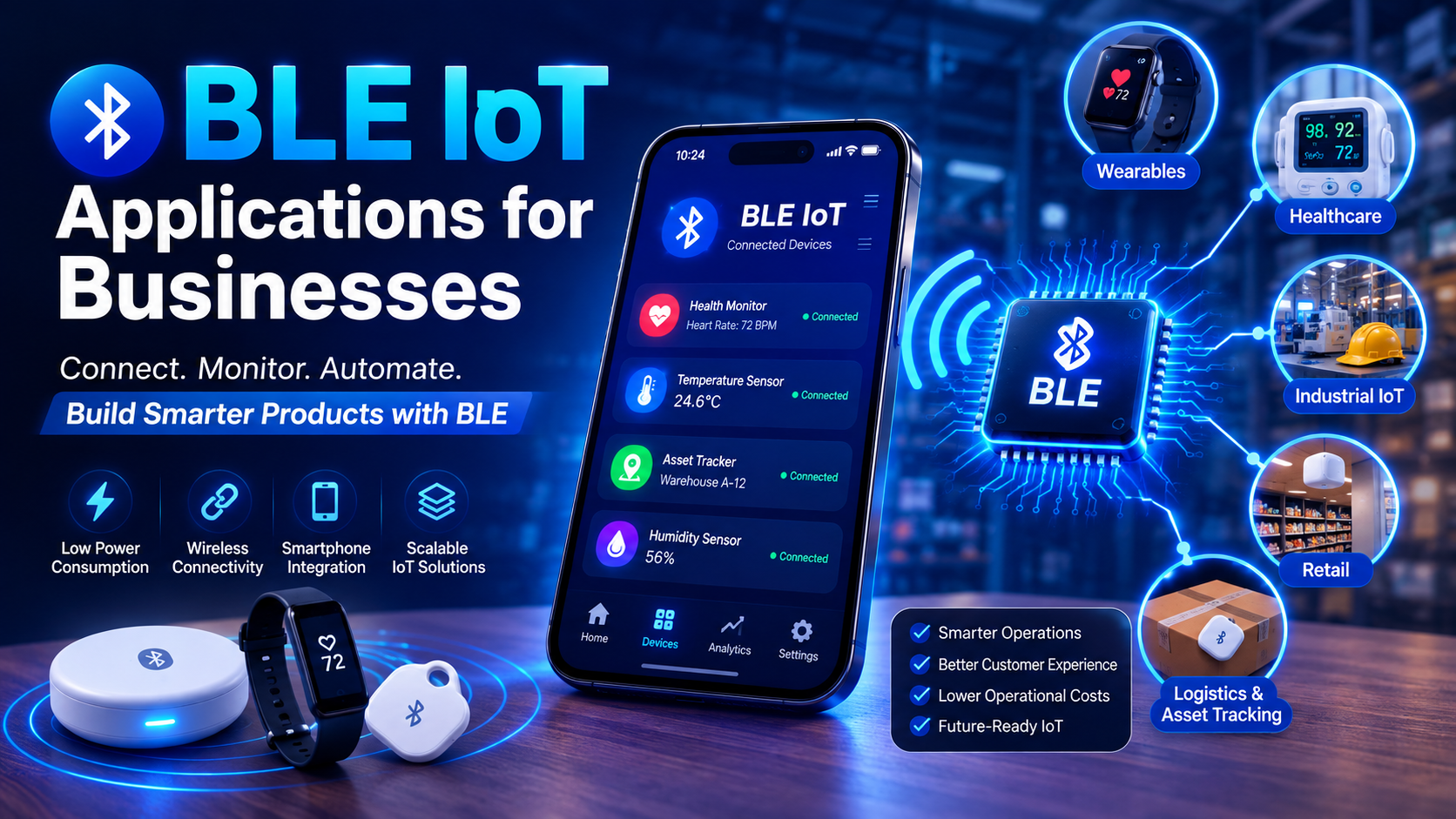
Bluetooth Low Energy (BLE) has become an important connectivity technology for modern mobile applications, IoT products, wearables, healthcare devices, smart home products, industrial equipment, and connected consumer products.
Unlike traditional Bluetooth, BLE is designed for applications where devices need to communicate while maintaining relatively low power consumption.
This makes BLE particularly useful for battery-powered products that need to exchange information with smartphones, tablets, gateways, or other connected systems.
However, successful BLE app development involves much more than connecting a mobile phone to a Bluetooth device.
A production-ready BLE application may require device discovery, pairing, GATT communication, background connectivity, firmware integration, data synchronization, cloud APIs, security, device management, and a carefully designed mobile user experience.
What Is BLE App Development?
BLE app development is the process of creating mobile or software applications that communicate with Bluetooth Low Energy devices.
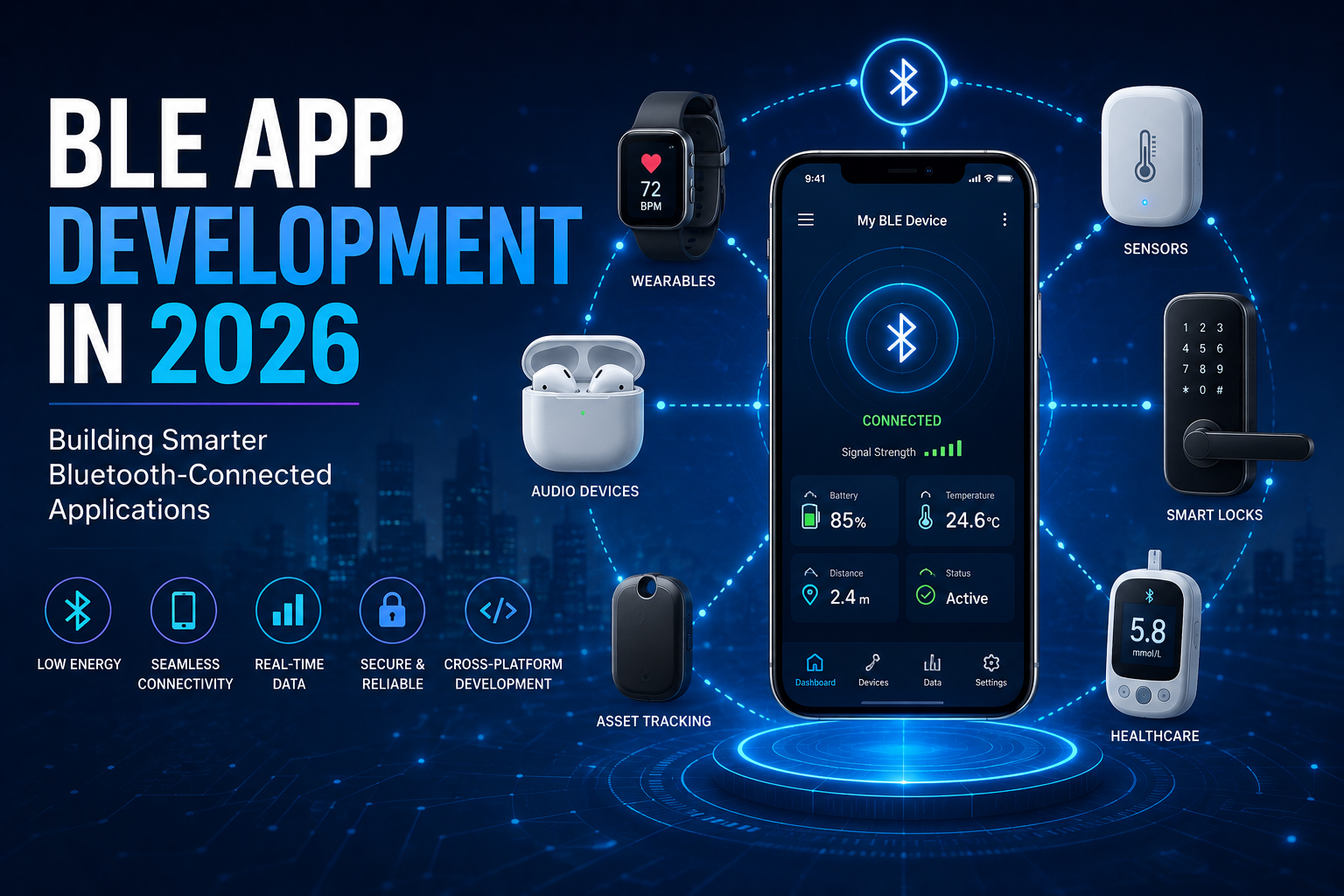
A BLE application can communicate with:
- Sensors
- Fitness trackers
- Smartwatches
- Medical devices
- Industrial equipment
- Beacons
- Smart locks
- Wearable devices
- Smart home products
- Asset trackers
- Connected consumer electronics
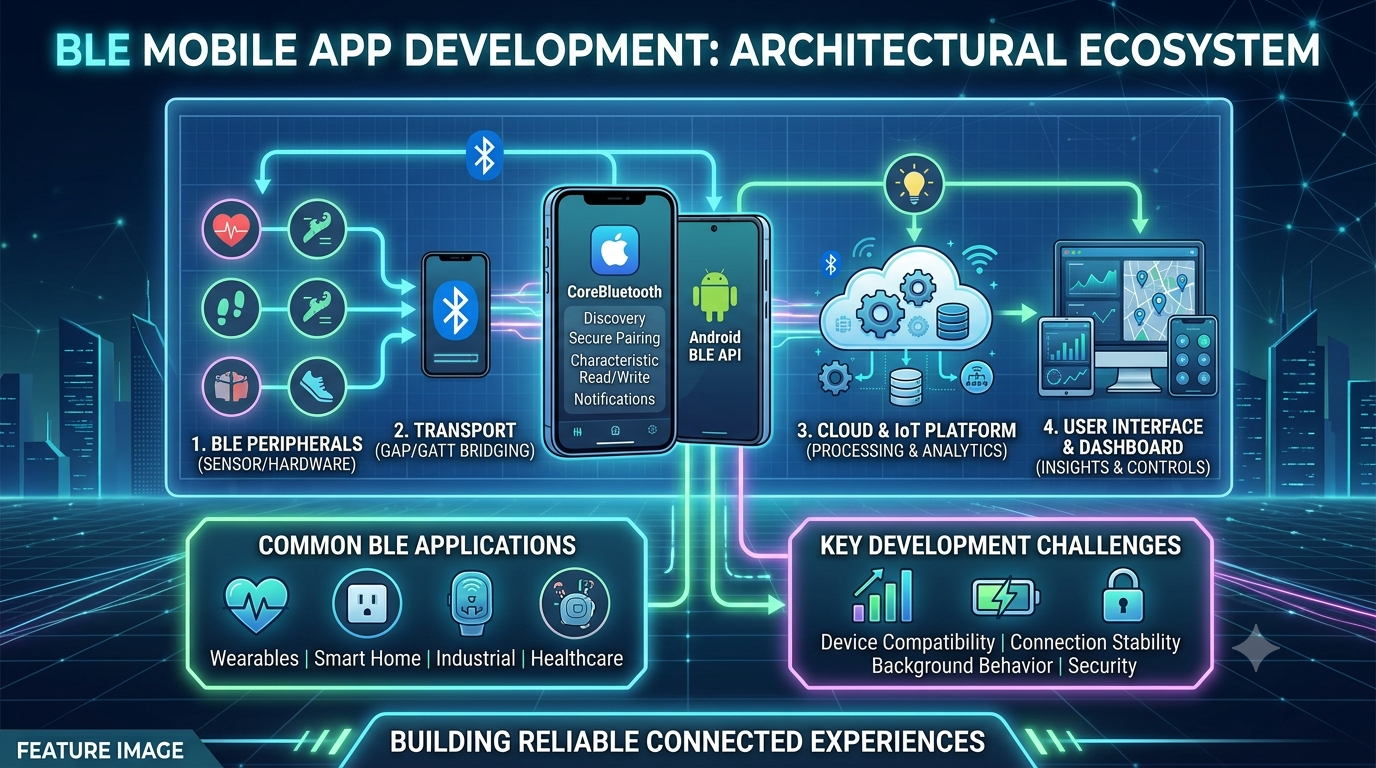
A typical BLE ecosystem may look like:
BLE Device → Bluetooth Connection → Mobile Application → Backend API → Cloud Platform
Depending on the product, the mobile application may also control the BLE device.
For example:
Mobile App → BLE Command → Connected Device → Sensor Data → Mobile App
This two-way communication allows applications to monitor and control connected products.
How Does Bluetooth Low Energy Work?
BLE uses a client-server communication model based around the Generic Attribute Profile (GATT).
A BLE device typically exposes services and characteristics.
BLE Services
A service groups related functionality.
For example, a smart fitness device might provide:
- Heart-rate service
- Battery service
- Device information service
- Activity service
BLE Characteristics
Characteristics contain data or provide a way to interact with a BLE device.
A characteristic can be used to:
- Read data
- Write data
- Receive notifications
- Receive indications
For example:
Service → Temperature Characteristic → Sensor Reading
The mobile application can discover the available services and characteristics and then communicate with the device according to its BLE protocol.
BLE App Development for iOS and Android
BLE applications are commonly developed for both major mobile platforms.
BLE App Development for iOS
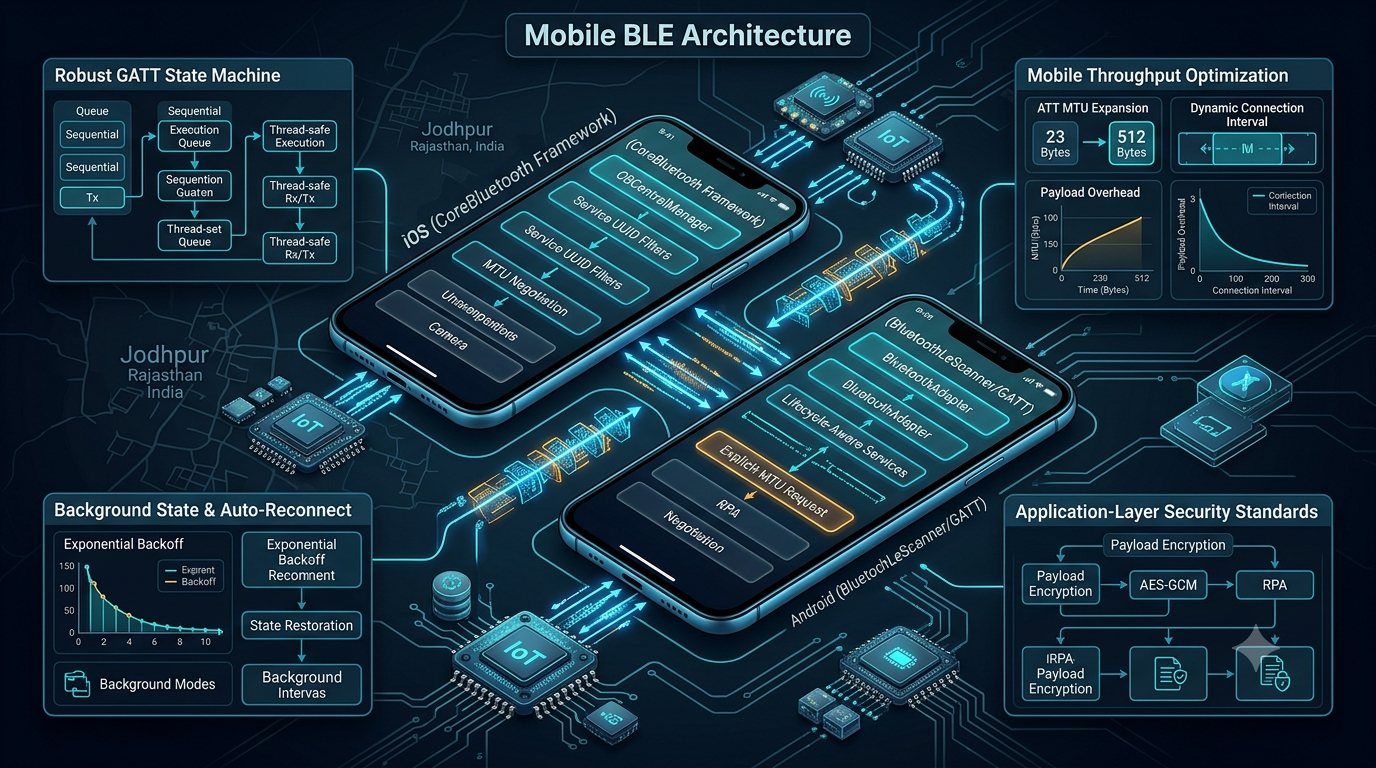
iOS applications can use Apple’s Core Bluetooth framework to communicate with BLE peripherals.
Typical functionality includes:
- Scanning for BLE devices
- Connecting to peripherals
- Discovering services
- Discovering characteristics
- Reading characteristics
- Writing values
- Receiving notifications
- Managing connection states
The application must also account for Apple’s permissions and background execution rules.
BLE App Development for Android
Android provides Bluetooth APIs for BLE communication.
An Android BLE application may need to handle:
- Bluetooth permissions
- Device scanning
- GATT connections
- Service discovery
- Characteristic reads
- Characteristic writes
- Notifications
- Connection management
Android versions and device manufacturers can introduce differences that should be considered during testing.
BLE Device Integration
One of the most important parts of BLE application development is understanding the device’s communication protocol.
The mobile application needs to know:
- Device advertising behavior
- Service UUIDs
- Characteristic UUIDs
- Data formats
- Commands
- Response formats
- Notification behavior
- Connection requirements
- Authentication mechanisms
For a custom BLE product, the firmware and mobile application should be designed together whenever possible.
This helps ensure that the hardware, firmware, and mobile application use a consistent communication protocol.
BLE GATT Architecture
GATT provides the structure through which BLE devices expose their data and functionality.
A simplified architecture is:
BLE Peripheral
→ Service
→ Characteristic
→ Descriptor
The mobile application acts as a GATT client and communicates with the BLE peripheral.
For example:
Device Information Service
- Manufacturer Name
- Model Number
- Firmware Version
Battery Service
- Battery Level
Custom Service
- Device Status
- Configuration
- Sensor Data
- Control Commands
Custom BLE services are particularly useful when developing proprietary connected products.
BLE Data Communication
BLE applications may use several communication operations.
Read
The application requests information from a characteristic.
Example:
App → Read Battery Level → BLE Device → 85%
Write
The application sends a value or command to the BLE device.
Example:
App → Write Command → BLE Device → Change Operating Mode
Notify
The BLE device sends updated information to the application when the value changes.
Example:
Temperature Changes → BLE Device → Notification → Mobile App
Indicate
Indications provide a mechanism for acknowledged updates between the BLE device and client.
The communication method should be selected according to the application’s requirements.
BLE App Development for IoT
BLE is frequently used as part of larger IoT architectures.
For example:
BLE Sensors → Mobile App/Gateway → Cloud → Web Dashboard
BLE can provide short-range communication while the gateway or smartphone provides internet connectivity.
This architecture can be useful for:
- Industrial sensors
- Smart buildings
- Asset tracking
- Healthcare devices
- Wearables
- Retail systems
- Connected equipment
BLE can therefore serve as the local connectivity layer within a broader IoT platform.
BLE Gateway Development
A gateway can connect BLE devices to cloud infrastructure.
For example:
Multiple BLE Sensors → Gateway → Internet → Cloud Platform
The gateway can:
- Scan for BLE devices
- Connect to multiple peripherals
- Collect sensor data
- Process information locally
- Authenticate devices
- Forward data to APIs
- Store data temporarily during connectivity problems
This can be particularly useful in industrial and commercial environments where many BLE devices need centralized monitoring.
BLE and Mobile Applications
The mobile application can provide a user-friendly interface for connected hardware.
A BLE application may allow users to:
- Discover devices
- Connect devices
- Configure settings
- Monitor sensor data
- Control hardware
- Update device configuration
- View historical information
- Receive alerts
- Manage multiple devices
For consumer products, the mobile app may become the primary interface between the customer and the physical product.
BLE Firmware Integration
A BLE mobile application cannot work independently of the device firmware.
The firmware determines:
- BLE advertising
- Services
- Characteristics
- Data formats
- Commands
- Connection behavior
- Security mechanisms
- Power management
The mobile application must implement the corresponding communication protocol.
For example:
Mobile App Command
SET_MODE:01
↓
BLE Characteristic
↓
Firmware
↓
Device Changes Operating Mode
A clearly documented BLE protocol can make development and long-term maintenance easier.
BLE Security
Security should be considered from the beginning of BLE application development.
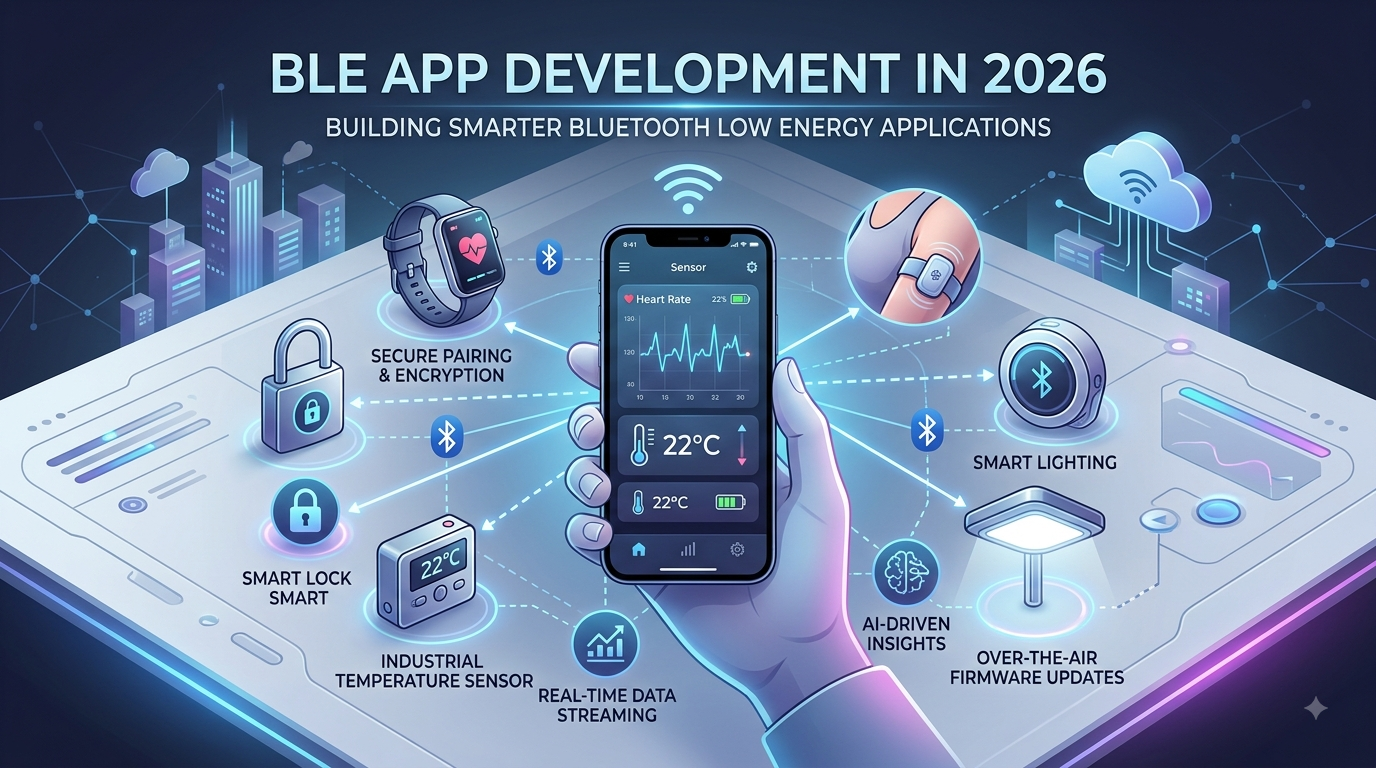
Depending on the product, security measures may include:
- Device authentication
- Secure pairing
- Encrypted communication
- Application authentication
- Access control
- Secure firmware updates
- Secure cloud APIs
- Device identity management
Developers should also consider what happens if an unauthorized device attempts to connect.
For products controlling physical equipment, weak BLE security could potentially allow unauthorized commands to reach the device.
BLE Background Connectivity
Some applications need to communicate with BLE devices while the application is not actively visible.
Examples include:
- Fitness trackers
- Healthcare devices
- Smart home products
- Location systems
- Background sensor monitoring
Background BLE behavior differs between operating systems and depends on platform policies.
Therefore, background connectivity should be treated as an architectural requirement rather than something added at the end of development.
BLE and Cloud Integration
BLE applications can connect local devices with cloud platforms.
A typical architecture can be:
BLE Device → Mobile App → REST API → Cloud Database → Web Dashboard
The cloud platform can provide:
- User accounts
- Device management
- Data storage
- Analytics
- Notifications
- Remote configuration
- Device history
- Reporting
This allows businesses to turn a local BLE product into a connected software ecosystem.
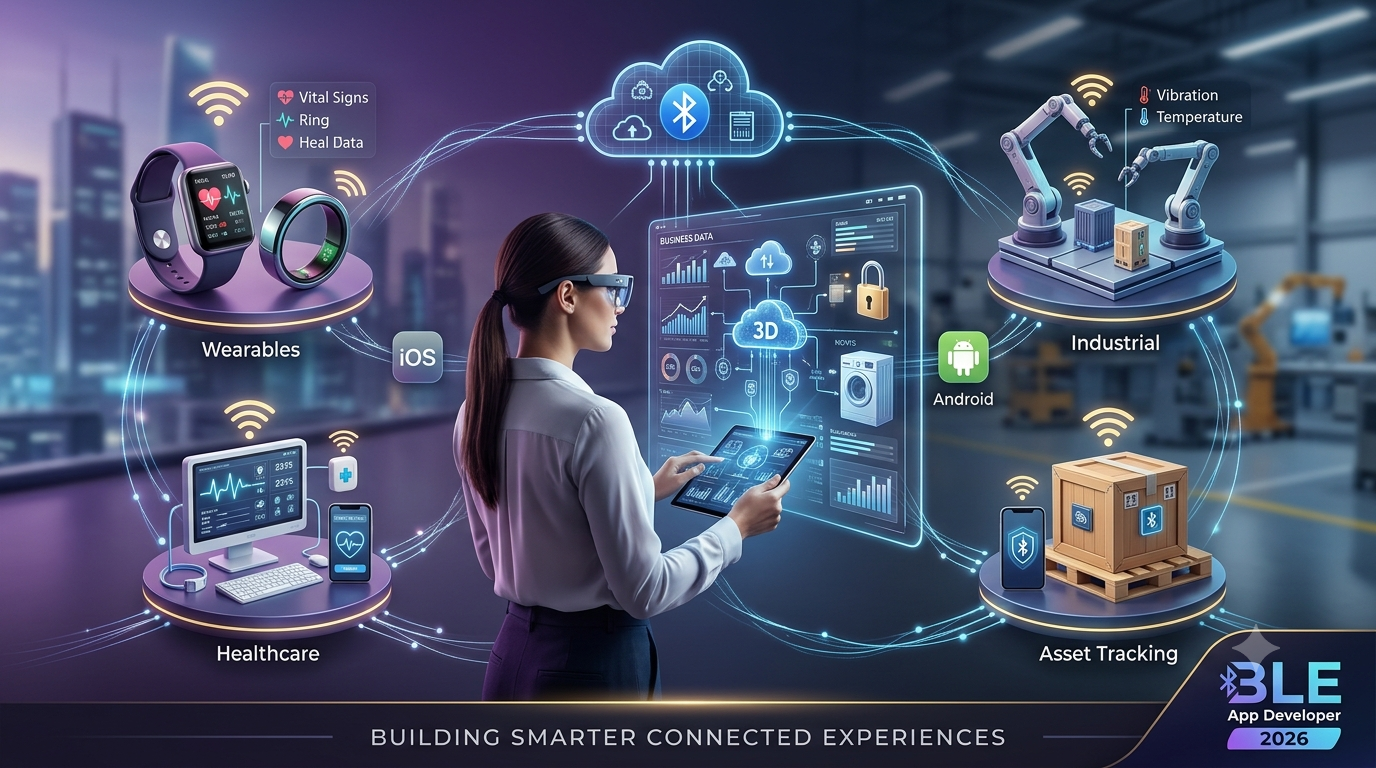
BLE App Development Use Cases
BLE technology can support applications across many industries.
Healthcare
BLE can connect:
- Wearable health devices
- Patient monitoring devices
- Fitness equipment
- Medical sensors
- Connected diagnostic products
Healthcare applications require careful consideration of privacy, security, reliability, and regulatory requirements.
Fitness and Wearables
BLE is widely suited to battery-powered wearable products.
Applications can include:
- Fitness trackers
- Smartwatches
- Heart-rate devices
- Cycling sensors
- Sports equipment
- Activity monitors
Smart Home
BLE can support device configuration and local communication for:
- Smart locks
- Sensors
- Lighting products
- Home appliances
- Security devices
Industrial IoT
Industrial BLE applications can connect:
- Equipment sensors
- Machine-monitoring devices
- Asset trackers
- Environmental sensors
- Maintenance tools
Retail
BLE can support:
- Beacons
- Asset tracking
- Inventory systems
- Smart retail devices
- Customer engagement systems
Automotive
BLE applications can be used for certain connected vehicle and accessory experiences, depending on the product architecture.
Common BLE Development Challenges
BLE development can present challenges that are not usually found in conventional mobile applications.
Device Compatibility
Different phones and operating-system versions can behave differently.
Testing should therefore include multiple devices.
Connection Reliability
BLE connections can be affected by:
- Distance
- Interference
- Device state
- Radio environment
- Operating-system restrictions
- Power management
The application should gracefully handle connection failures and reconnection attempts.
Data Synchronization
Applications need a strategy for handling data when a BLE connection is interrupted.
For example:
Device Offline → Local Data Storage → Reconnection → Data Synchronization
Battery Consumption
Continuous scanning or communication can consume significant battery power.
Developers should optimize:
- Scan intervals
- Connection intervals
- Data frequency
- Notifications
- Background operations
Firmware Compatibility
A mobile application may need to communicate with multiple firmware versions.
Version management and backward compatibility should therefore be considered.
BLE Firmware Over-the-Air Updates
Connected products may require firmware updates after deployment.
A BLE application can sometimes act as the communication channel for firmware updates.
A simplified process is:
Firmware File → Mobile App → BLE Transfer → Device → Firmware Verification → Update
Firmware update systems need careful design because interrupted or invalid updates can affect device availability.
For production systems, developers should consider:
- Update authentication
- Firmware integrity
- Version management
- Recovery mechanisms
- Interrupted transfers
- Rollback strategies
BLE App Development Process
A structured development process can reduce technical risks.
Step 1: Define the Product
Identify:
- Device type
- Target users
- Mobile platforms
- Required BLE functions
- Data requirements
- Cloud requirements
Step 2: Define the BLE Protocol
Document:
- Services
- Characteristics
- UUIDs
- Commands
- Data formats
- Error responses
- Authentication
Step 3: Develop a Proof of Concept
Test the fundamental communication between the mobile application and BLE device.
Step 4: Develop the Mobile Application
Implement:
- Scanning
- Pairing/connection
- Service discovery
- Data communication
- Device control
- Error handling
Step 5: Integrate Cloud Services
Add backend APIs, user accounts, data storage, analytics, and dashboards where required.
Step 6: Test Real Devices
Test across:
- iOS devices
- Android devices
- BLE hardware versions
- Different operating-system versions
- Different physical environments
Step 7: Launch and Maintain
Continue supporting:
- OS updates
- Firmware updates
- Security improvements
- Bug fixes
- Device compatibility
- Backend improvements
How to Choose a BLE App Development Company
Businesses planning a connected product should evaluate the development team’s experience across both software and hardware communication.
Consider the following areas.
BLE Experience
Ask whether the team has worked with real BLE devices and custom GATT protocols.
Mobile Development
Check experience with both iOS and Android BLE applications if cross-platform support is required.
Firmware Knowledge
For custom hardware, firmware knowledge can make integration significantly easier.
IoT Experience
If the BLE product will connect to cloud infrastructure, look for experience with IoT platforms, gateways, APIs, and device management.
Security
Ask how the development team handles BLE authentication, secure communication, APIs, and device security.
Testing
BLE products need testing on real hardware rather than only simulators.
Long-Term Support
Connected products may require ongoing firmware, mobile application, backend, and security updates.
Future of BLE App Development
BLE is becoming part of increasingly sophisticated connected-product ecosystems.
Future BLE applications may combine:
- BLE
- Edge computing
- IoT cloud platforms
- AI analytics
- Digital twins
- Wearable technology
- Smart sensors
- Real-time monitoring
- Device automation
Instead of using BLE simply to transfer data between two devices, businesses can use BLE as one layer within a larger connected ecosystem.
For example:
BLE Sensor → Mobile/Gateway → Cloud → AI Analytics → Automated Action
This architecture can transform raw device data into useful business intelligence.
Conclusion
BLE app development is an important part of the modern connected-device ecosystem.
A successful BLE application requires more than Bluetooth connectivity. Developers need to consider GATT architecture, device protocols, mobile operating systems, firmware, sec