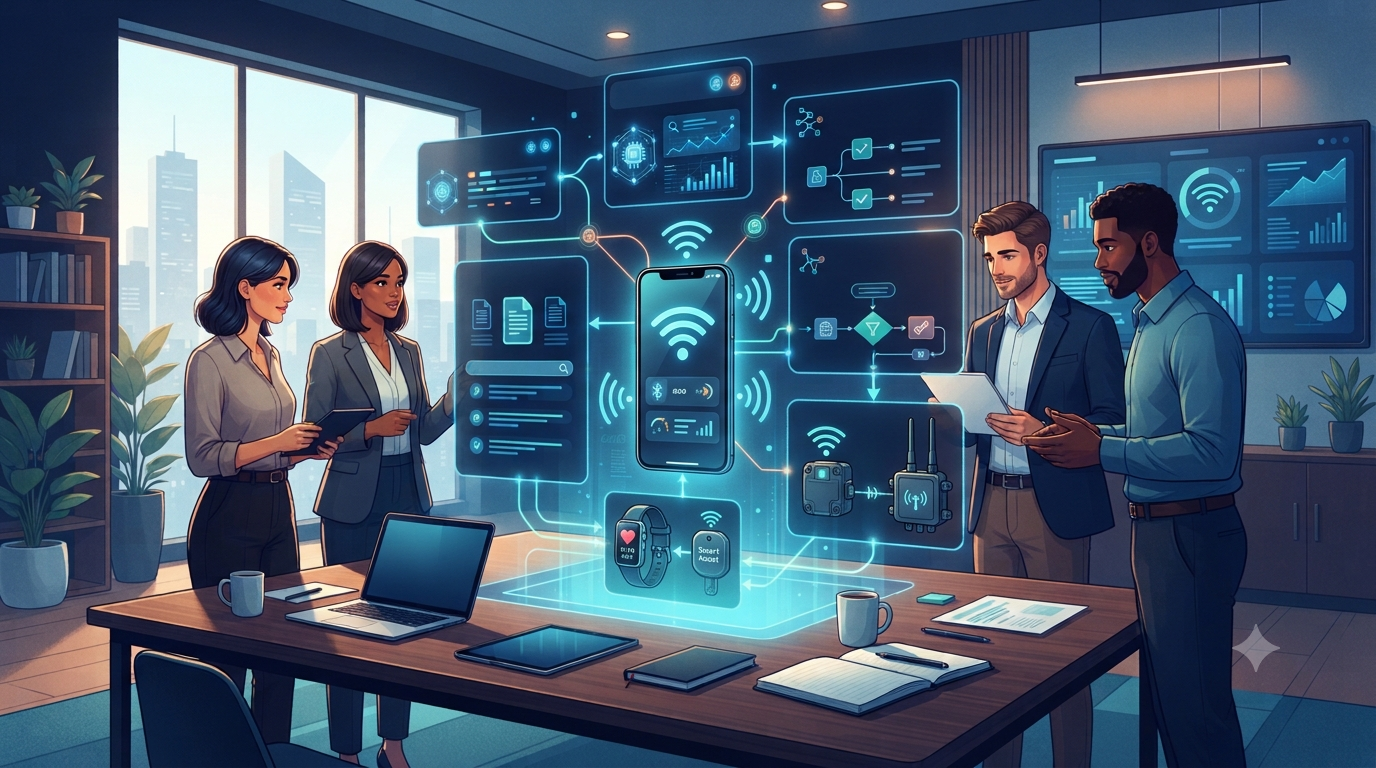
Bluetooth Low Energy (BLE) has become an important technology for connecting smartphones with wearables, smart devices, industrial sensors, healthcare equipment, and connected products. Its ability to exchange information while consuming relatively little power makes it a practical choice for applications that depend on wireless communication and battery-powered hardware.
In 2026, BLE application development is evolving beyond basic device pairing and data exchange. Businesses are exploring more intelligent mobile experiences through precise location awareness, connected asset tracking, real-time sensor monitoring, and AI-powered device insights.
For companies developing connected products, a well-designed BLE application can provide the software layer that connects hardware, users, and business systems.
This article explores the latest BLE developments, important application use cases, and the key considerations for building reliable Bluetooth Low Energy applications.
What Is Bluetooth Low Energy App Development?
Bluetooth Low Energy app development is the process of creating mobile or software applications that communicate with BLE-enabled devices.
These applications typically connect to nearby hardware, exchange data, display device information, and allow users to control connected products.
A BLE application may include:
- Device discovery and scanning.
- Bluetooth pairing and connection management.
- Data exchange through GATT services and characteristics.
- Real-time sensor monitoring.
- Device configuration and control.
- Notifications and alerts.
- Firmware updates.
- Cloud and backend integration.
BLE applications are commonly developed for Android and iOS platforms. Depending on the product requirements, they may also work with gateways, embedded systems, and web-based management platforms.
7 Bluetooth Low Energy App Development Trends in 2026
1. Smarter Asset Tracking and Location Awareness
Asset tracking is one of the important applications of Bluetooth technology.
Businesses can use BLE-enabled tags, sensors, and mobile applications to monitor the location and movement of equipment, inventory, tools, and other valuable assets.
BLE applications can support:
- Indoor asset tracking.
- Warehouse inventory visibility.
- Equipment monitoring.
- Proximity-based notifications.
- Staff and equipment location awareness.
- Smart retail experiences.
Bluetooth Channel Sounding is an important development in this area. It enables secure and more precise distance measurement between compatible devices, creating opportunities for improved proximity and location-aware applications.
For developers, the challenge is to combine supported Bluetooth capabilities with suitable hardware, operating-system APIs, and application logic.
2. AI-Powered Wearable Applications
Wearable technology is creating new opportunities for BLE application development.
Smartwatches, fitness trackers, smart rings, and connected health devices use wireless communication to transfer information to mobile applications.
When combined with AI and analytics, these applications can provide more useful insights from collected device data.
Potential features include:
- Activity and fitness tracking.
- Sleep data visualization.
- Personalized wellness insights.
- Sensor-based alerts.
- Device performance monitoring.
- Historical data analysis.
For example, a fitness application could collect information from a compatible wearable and use analytics to present activity trends and personalized recommendations.
Applications handling health-related information should also implement appropriate privacy, security, and regulatory safeguards.
3. Low-Latency Bluetooth Communication
Responsiveness is important for applications that depend on frequent device communication.
Bluetooth Shorter Connection Intervals, introduced in Bluetooth Core 6.2, reduce the minimum connection interval to support more responsive interactions in compatible implementations.
This can create opportunities for applications involving:
- Wireless controllers.
- Interactive accessories.
- Responsive input devices.
- Real-time sensor communication.
- Specialized industrial equipment.
Developers should evaluate connection intervals, power consumption, hardware capabilities, and operating-system support before implementing latency-sensitive functionality.
4. Bluetooth Core 7.0 and Higher Data Throughput
Bluetooth technology continues to evolve to support increasingly demanding wireless applications.
In November 2026, the Bluetooth SIG published its Bluetooth Core 7.0 feature overview. The update describes enhancements involving Bluetooth High Data Throughput, isochronous transport, and security mechanisms.
Bluetooth High Data Throughput introduces a new LE physical layer with a maximum bit rate of 7.5 Mbps, alongside improvements intended to support more efficient and reliable wireless data transfer.
These developments could expand opportunities for future connected products that need higher data capacity.
However, application developers should not assume that every new specification feature is automatically available through Android or iOS APIs. Actual support depends on device hardware, Bluetooth stack implementation, operating-system versions, and exposed developer interfaces.
5. Smart Home and Industrial BLE Applications
BLE is being used across residential, commercial, and industrial environments.
In smart homes, mobile applications can communicate with connected lights, locks, sensors, and other compatible devices.
In industrial environments, BLE-enabled applications can support:
- Equipment condition monitoring.
- Temperature and humidity tracking.
- Machine sensor readings.
- Maintenance notifications.
- Asset identification.
- Wireless device configuration.
Developers can also combine BLE with cloud platforms and dashboards to provide centralized monitoring across multiple devices or locations.
6. Better Device Security and Privacy
Security is a fundamental requirement for any application that communicates with connected hardware.
A BLE application may handle device credentials, user information, sensor readings, and operational data. Weak security practices can expose both the application and the connected product to unnecessary risks.
Important development practices include:
- Secure pairing and bonding where appropriate.
- Authentication and authorization.
- Encrypted communication.
- Secure credential storage.
- Protected backend APIs.
- Firmware update verification.
- Permission management.
- Regular security testing.
Developers should select the right security model for the product rather than relying on a single Bluetooth feature to protect the complete application ecosystem.
7. Cross-Platform BLE Application Development
Many businesses want their connected products to work across both Android and iOS devices.
Cross-platform development can help reduce duplicated application work, but BLE functionality requires careful platform-specific implementation and testing.
Key considerations include:
- Bluetooth permissions.
- Background connection behavior.
- Device discovery.
- Connection recovery.
- Data transfer reliability.
- Operating-system restrictions.
- Hardware compatibility.
A successful cross-platform BLE application should provide a consistent user experience while respecting the technical differences between mobile platforms.
Essential Features of a Successful BLE Mobile Application
A reliable BLE application needs more than a connect button. Its features should support the complete device interaction experience.
1. Device Discovery
The application should scan for nearby compatible BLE devices and display useful identification information.
2. Secure Device Connection
Users should be able to establish and manage connections with compatible hardware through an appropriate security process.
3. GATT Service Integration
The application should discover supported GATT services and characteristics to read, write, and receive notifications from connected devices.
4. Real-Time Data Monitoring
Sensor readings and device information should be displayed in a clear interface with appropriate updates and error handling.
5. Device Configuration
Users may need to change settings, update operating parameters, or manage connected hardware through the application.
6. Notifications and Alerts
Applications can provide notifications when connected devices report important events or reach predefined conditions.
7. Cloud Integration
Backend integration can support user accounts, historical data, analytics, reporting, and device management across multiple locations.
How to Develop a Reliable Bluetooth Low Energy Application
Building a BLE application requires coordination between mobile software, hardware, firmware, and backend systems.
A structured development process can help reduce connectivity issues and improve the overall product experience.
Step 1: Understand the Device Requirements
Identify the BLE hardware, supported Bluetooth capabilities, sensor requirements, expected communication range, and target mobile platforms.
Step 2: Define the Application Architecture
Plan the communication flow between the mobile application, BLE device, firmware, gateway, and cloud platform.
Step 3: Design the User Experience
Create simple screens for device discovery, connection status, data monitoring, configuration, and notifications.
Step 4: Implement BLE Communication
Develop scanning, connection management, GATT service discovery, characteristic operations, and notification handling.
Step 5: Integrate Backend Services
Add cloud connectivity, user authentication, device records, data storage, and analytics wherever required.
Step 6: Test on Real Devices
Test across different smartphone models, operating-system versions, and BLE hardware configurations.
Evaluate connection stability, reconnection behavior, background operation, battery usage, and data accuracy.
Step 7: Deploy and Maintain
Release the application, monitor performance, address compatibility issues, and provide updates as the connected product evolves.
Common Challenges in BLE App Development
Although BLE offers many advantages, developers must address several technical challenges.
| Challenge | Development Consideration |
|---|---|
| Unstable connections | Implement reconnection and connection-state management |
| Device compatibility | Test with different hardware and mobile platforms |
| Battery consumption | Optimize scanning and connection intervals |
| Background operation | Follow Android and iOS background execution rules |
| Data synchronization | Handle interrupted transfers and duplicate data |
| Security | Use suitable authentication and encryption mechanisms |
| Firmware compatibility | Coordinate mobile app and device firmware versions |
Planning for these challenges early can make a BLE application more reliable in real-world environments.
Why Choose a Specialized BLE App Development Company?
Developing a Bluetooth-enabled application requires experience with wireless communication protocols, mobile operating systems, device firmware, and hardware integration.
A specialized development team can help businesses:
- Build custom Android and iOS BLE applications.
- Integrate Bluetooth-enabled sensors and devices.
- Develop GATT-based communication workflows.
- Create wearable and healthcare applications.
- Build industrial monitoring applications.
- Implement asset tracking functionality.
- Integrate BLE applications with cloud platforms.
- Test connectivity and device compatibility.
The right development approach depends on the connected product, its users, and the environment in which it will operate.
Final Thoughts
Bluetooth Low Energy continues to create opportunities for businesses developing connected devices and mobile applications. From wearable technology and smart home products to industrial monitoring and asset tracking, BLE provides an energy-efficient foundation for wireless communication.
With Bluetooth technology evolving through improved ranging, lower-latency communication, and higher data throughput, developers have new opportunities to create more capable connected products.
However, successful BLE application development still depends on strong architecture, reliable device integration, secure communication, and extensive real-world testing.
Planning to build a Bluetooth-enabled application? BLEAppDeveloper can help transform your connected product idea into a functional mobile solution through custom BLE app development, device integration, and Bluetooth connectivity expertise.
Frequently Asked Questions
1. What is a BLE application?
A BLE application is a mobile or software application that communicates with Bluetooth Low Energy devices to exchange information, monitor sensors, configure hardware, or control connected products.
2. Can BLE applications work on both Android and iOS?
Yes. BLE applications can be developed for Android and iOS. Cross-platform solutions are also possible, although certain Bluetooth features and background behaviors require platform-specific implementation.
3. What industries use Bluetooth Low Energy applications?
Healthcare, fitness, manufacturing, retail, logistics, automotive, smart homes, and asset management are among the industries that use BLE applications.
4. What is GATT in BLE development?
GATT stands for Generic Attribute Profile. It defines how BLE devices organize and exchange data through services and characteristics.
5. Can a BLE application work without an internet connection?
Yes. BLE communication between a mobile device and a nearby compatible device can work without internet access. Internet connectivity is only needed for features such as cloud synchronization or remote data access.
6. How much does BLE app development cost?
The cost depends on application complexity, hardware integration, supported platforms, backend requirements, security features, and testing needs.
7. How long does it take to develop a BLE application?
A basic BLE application may take several weeks, while a complex solution involving custom hardware, firmware, cloud services, and advanced features may require several months.
SEO Metadata
- Meta Title: Bluetooth Low Energy App Development | BLE App Solutions
- Meta Description: Explore Bluetooth Low Energy app development, BLE connectivity, wearable apps, asset tracking, industrial monitoring, and custom Bluetooth solutions.
- URL Slug:
bluetooth-low-energy-app-development-2026 - Focus Keyword: Bluetooth Low Energy App Development
- Secondary Keywords: BLE App Development, BLE Mobile App Development, Bluetooth App Development, BLE Application Development Company, Bluetooth Low Energy Developers, BLE Device Integration, Custom BLE Apps
- Suggested Internal Links: BLE IoT Development, Bluetooth Low Energy Solutions, IoT Application Development, Wearable App Development, Connected Device Development