Bluetooth Low Energy (BLE) has become an important connectivity technology for modern applications that need reliable short-range communication with connected devices.
From wearable technology and healthcare devices to smart locks, industrial sensors, fitness products, asset tracking systems, and IoT solutions, BLE enables mobile applications to communicate with physical devices without requiring traditional wired connections.
As connected products continue to grow in 2026, businesses are investing in BLE app development to create mobile applications that can discover, connect, control, monitor, and exchange data with BLE-enabled devices.
What Is BLE App Development?
BLE app development involves creating mobile applications that communicate with Bluetooth Low Energy devices.
A BLE application can allow users to:
- Discover nearby devices
- Connect to BLE peripherals
- Read sensor data
- Send commands
- Configure devices
- Monitor device status
- Receive notifications
- Synchronize data
- Manage connected products
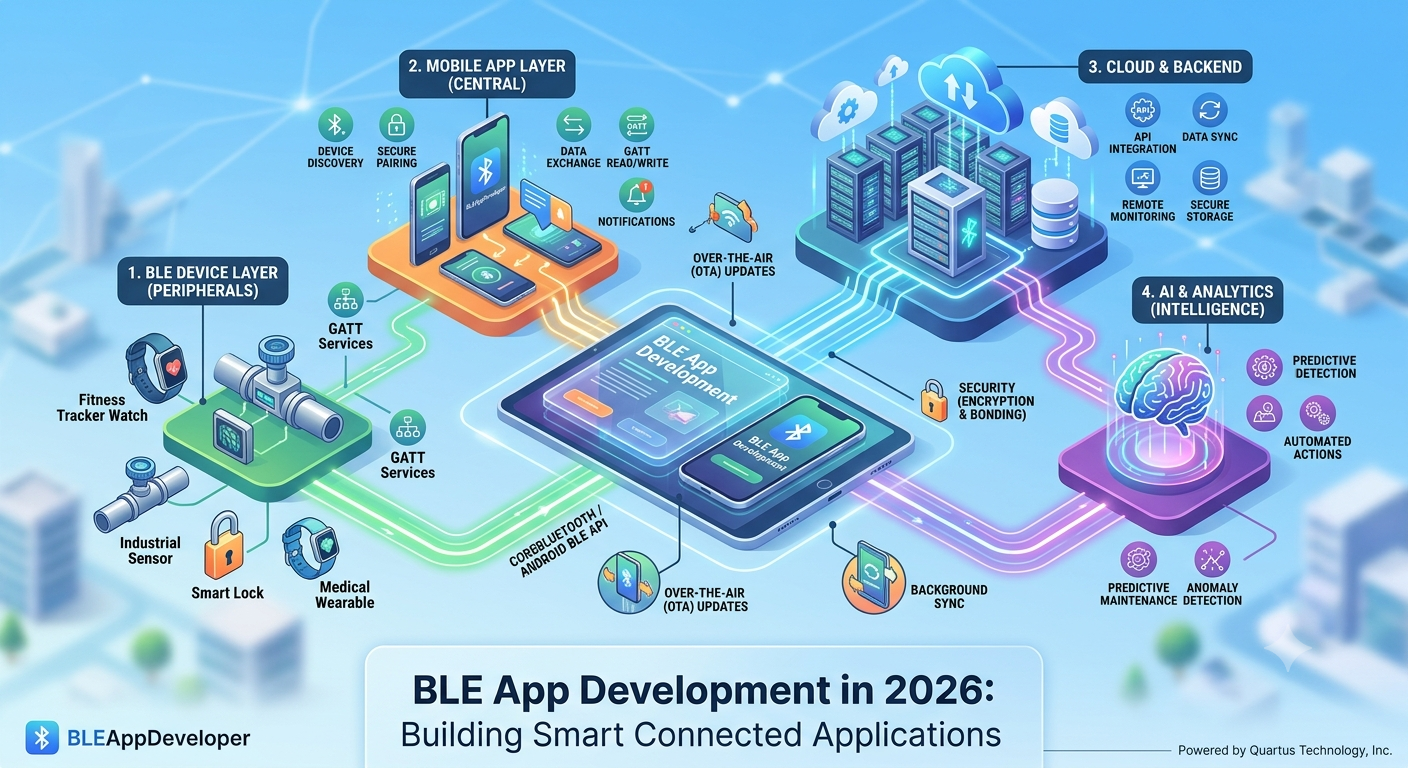
A typical BLE application ecosystem looks like:
BLE Device → Mobile Application → Backend/Cloud → Dashboard
The exact architecture depends on the product and its business requirements.
Why Businesses Are Choosing BLE in 2026
BLE is particularly useful for connected products that need efficient wireless communication.
Compared with traditional connectivity approaches, BLE can be attractive for applications where devices need:
- Low power consumption
- Short-range communication
- Smartphone connectivity
- Compact hardware
- Battery-powered operation
- Sensor data transmission
This makes BLE suitable for a wide range of consumer and enterprise products.
Top BLE App Development Use Cases
1. Wearable Applications
Fitness trackers, smartwatches, health devices, and other wearables frequently communicate with smartphones.
BLE applications can collect information from wearable devices and display it through mobile dashboards.
Possible features include:
- Activity tracking
- Device monitoring
- Sensor readings
- Exercise data
- Notifications
- Device configuration
2. Healthcare Applications
BLE can connect compatible medical and wellness devices with mobile applications.
Potential use cases include:
- Patient monitoring
- Fitness monitoring
- Connected thermometers
- Rehabilitation devices
- Blood pressure monitoring
- Wearable health devices
Healthcare applications require strong attention to security, privacy, reliability, and applicable regulatory requirements.
3. Smart Home Applications
BLE can also support smart-home products.
Examples include:
- Smart locks
- Sensors
- Lighting controls
- Access systems
- Smart appliances
- Security devices
A mobile application can provide users with a convenient interface for discovering and controlling compatible devices.
4. Industrial Applications
Industrial businesses are increasingly adopting connected sensors and equipment.
BLE applications can support:
- Equipment monitoring
- Asset tracking
- Maintenance workflows
- Environmental sensors
- Inventory monitoring
- Worker safety solutions
A mobile BLE application can give field workers direct access to connected equipment.
5. Retail and Proximity Applications
BLE beacons and connected devices can support proximity-based experiences.
Businesses can explore applications such as:
- Indoor navigation
- Proximity notifications
- Asset tracking
- Smart retail
- Customer engagement
- Location-aware experiences
How BLE Communication Works
A BLE system generally involves two roles:
Central: Usually a smartphone, tablet, or gateway.
Peripheral: A BLE-enabled device that provides services and characteristics.
The mobile application can discover the peripheral and establish a connection.
After connection, the application can interact with the device through defined BLE services and characteristics.
For example:
Mobile App → BLE Characteristic → Device Command
or:
BLE Sensor → Characteristic → Mobile App → Data Display
Understanding this communication model is essential when designing a reliable BLE application.
Important Features of a BLE Application
Device Discovery
Users can scan for nearby BLE devices and identify compatible products.
Device Pairing
The application can establish secure communication with supported devices.
Data Reading
Applications can retrieve information from BLE characteristics.
Data Writing
Apps can send commands or configuration values to compatible devices.
Notifications
BLE notifications can allow devices to send updated information to applications without requiring constant polling.
Device Management
Users can manage multiple connected devices from one application.
Firmware Updates
For compatible products, BLE applications can support appropriate firmware-update workflows.
Cloud Synchronization
Device information can be synchronized with a backend or cloud platform for storage and analytics.
BLE App Development for Android and iOS
Businesses often need BLE applications across both major mobile platforms.
Android BLE Development
Android provides Bluetooth APIs that allow applications to scan for devices, connect to peripherals, discover services, and exchange data.
Developers need to account for Android permissions, operating-system versions, device manufacturers, background behavior, and connection management.
iOS BLE Development
Apple’s Core Bluetooth framework allows iOS applications to communicate with BLE peripherals.
iOS BLE development requires careful handling of permissions, background operation, connection states, and Apple’s platform-specific requirements.
A successful BLE application should provide a consistent experience while respecting the technical differences between Android and iOS.
BLE + IoT: A Powerful Combination
BLE becomes even more useful when connected to an IoT platform.
A typical architecture can be:
BLE Device → Mobile/Gateway → API → Cloud → Analytics
This allows businesses to collect device data and make it available through centralized systems.
IoT integration can provide:
- Device monitoring
- Data storage
- Remote analytics
- User management
- Notifications
- Reporting
- Device lifecycle management
BLE + AI for Smarter Applications
Artificial intelligence is creating new opportunities for BLE-enabled products.
BLE devices can collect data while AI systems analyze that information to identify patterns and generate insights.
For example:
BLE Sensor → Data → AI Analysis → Insight → Action
Potential applications include:
- Predictive maintenance
- Anomaly detection
- Personalized recommendations
- Device behavior analysis
- Usage forecasting
- Intelligent alerts
AI should be introduced where it provides measurable value to the product or business.
BLE Application Security
Security is an important consideration when developing applications that communicate with physical devices.
A BLE application may need to address:
- Secure pairing
- Device authentication
- Encryption
- Access control
- Secure APIs
- User authentication
- Data protection
- Firmware security
- Secure device updates
Security should be considered during architecture and development rather than added after the product is completed.
Challenges in BLE App Development
BLE development can involve several technical challenges.
Connection Management
Wireless connections can be affected by distance, interference, operating-system behavior, and device conditions.
Battery Optimization
Frequent scanning and communication can increase battery consumption if not designed carefully.
Device Compatibility
Different smartphones and BLE hardware can behave differently.
Background Operation
Android and iOS impose platform-specific restrictions around background Bluetooth operations.
Firmware Compatibility
Mobile applications need to remain compatible with supported hardware and firmware versions.
Scalability
A product designed for a few devices may need a different architecture when supporting thousands or millions of connected devices.
How to Develop a BLE Application
A structured development process can help reduce technical problems.
Step 1: Define the Use Case
Identify what the BLE device does and what users need to accomplish through the app.
Step 2: Define BLE Requirements
Document:
- Services
- Characteristics
- Data formats
- Commands
- Connection behavior
- Security requirements
Step 3: Select the Technology Stack
Choose the appropriate native or cross-platform mobile development approach based on the product requirements.
Step 4: Develop the BLE Layer
Build device scanning, connection management, service discovery, data exchange, and error handling.
Step 5: Build the User Interface
Create a simple interface for device setup, monitoring, configuration, and control.
Step 6: Integrate the Backend
Connect the application with APIs, databases, cloud services, and analytics where required.
Step 7: Test With Real Hardware
BLE applications should be tested across different:
- Smartphones
- OS versions
- BLE devices
- Firmware versions
- Physical environments
- Connection conditions
Why Choose Custom BLE App Development?
Generic Bluetooth applications may be sufficient for basic device testing, but commercial products often require a customized user experience.
Custom BLE application development can provide control over:
- Device communication
- User experience
- Hardware integration
- Security
- Cloud connectivity
- Analytics
- Firmware updates
- Device management
- Business workflows
This makes custom development particularly valuable for companies creating their own connected products.
What Does BLE App Development Cost?
The cost of a BLE application depends on the complexity of the product.
Factors that can affect development cost include:
- Number of platforms
- BLE communication complexity
- Number of devices
- UI/UX requirements
- Hardware integration
- Firmware requirements
- Cloud backend
- API integrations
- Security requirements
- Analytics
- Admin dashboards
- Testing requirements
A simple BLE controller can require significantly less development effort than a complete IoT ecosystem with cloud infrastructure and thousands of connected devices.
The Future of BLE Applications
BLE development is moving toward more connected and intelligent applications.
The combination of:
BLE + Mobile + IoT + Cloud + AI + Edge Computing
can create powerful connected-product ecosystems.
As businesses continue developing smart devices, BLE applications will remain an important interface between users and physical products.
Final Thoughts
BLE app development is no longer limited to basic Bluetooth connectivity.
Modern BLE applications can connect physical devices with mobile apps, cloud platforms, IoT systems, analytics, and AI-powered services.
For businesses developing wearables, healthcare devices, smart-home products, industrial equipment, asset trackers, or connected consumer products, choosing the right BLE architecture can have a major impact on reliability, security, scalability, and user experience.
A well-designed BLE application provides more than connectivity—it creates a digital interface for the physical product.
Looking to build a BLE-powered mobile application?
BLEAppDeveloper helps businesses develop custom Bluetooth Low Energy applications for Android, iOS, IoT devices, wearables, industrial products, healthcare technology, smart-home solutions, and connected products.