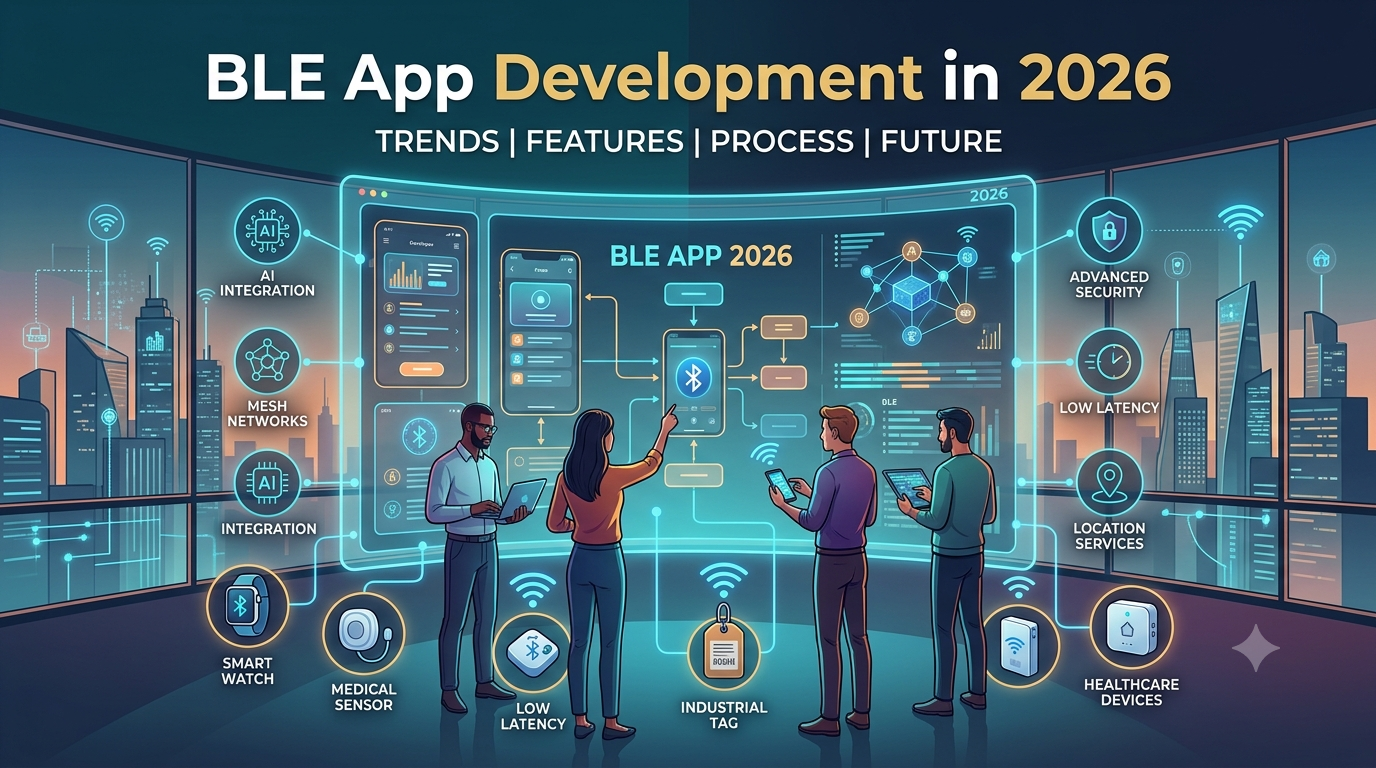
Bluetooth Low Energy has become an important connectivity technology for modern mobile applications. From smartwatches and fitness trackers to healthcare devices, industrial sensors, smart home products, and asset tracking systems, BLE enables smartphones and connected devices to communicate efficiently.
In 2026, BLE app development is moving beyond basic device connectivity. Developers are building applications that combine Bluetooth Low Energy, IoT, cloud platforms, AI, real-time analytics, and intelligent automation.
For businesses developing connected products, a well-designed BLE mobile application can become the bridge between the physical device and the digital ecosystem.
What Is BLE App Development?
BLE app development involves creating mobile applications that communicate with Bluetooth Low Energy devices.
A typical BLE application can:
- Discover nearby BLE devices
- Connect and disconnect devices
- Read sensor data
- Write commands to devices
- Monitor device status
- Configure connected hardware
- Transfer data
- Synchronize information with the cloud
- Display real-time device information
The application can be developed for Android, iOS, or both platforms depending on the product requirements.
A typical architecture looks like:
BLE Device → Mobile App → API/Cloud → Dashboard/Analytics
Why BLE App Development Is Trending in 2026
Connected devices are becoming part of everyday life.
Businesses are developing products that need smartphones to communicate with physical devices without relying on traditional wired connections.
BLE provides an efficient solution for many of these use cases because it is designed for low-power wireless communication.
Popular applications include:
- Wearables
- Smart healthcare devices
- Fitness equipment
- Smart home devices
- Industrial sensors
- Asset tracking
- Retail technology
- Automotive accessories
- Consumer electronics
Top BLE App Development Trends in 2026
1. AI-Powered BLE Applications
AI is becoming an important layer in connected-device applications.
Instead of simply showing sensor readings, BLE apps can use AI and analytics to interpret device data.
For example:
BLE Sensor → Mobile App → Cloud → AI → Intelligent Recommendation
AI-powered BLE applications can support:
- Predictive insights
- Anomaly detection
- Personalized recommendations
- Device performance analysis
- User behavior analysis
- Predictive maintenance
- Automated alerts
This moves BLE applications from simple control interfaces toward intelligent applications.
2. BLE + IoT Integration
BLE apps are increasingly becoming part of larger IoT ecosystems.
A mobile app can act as a bridge between BLE hardware and a cloud platform.
For example:
BLE Device → Smartphone → Internet → Cloud → Web Dashboard
This architecture allows businesses to monitor connected devices remotely and analyze their data.
3. BLE 5.x Development
Modern BLE development can take advantage of capabilities available across the Bluetooth 5.x family, depending on the hardware and use case.
Developers can build applications around requirements involving:
- Range
- Data throughput
- Broadcasting
- Device discovery
- Reliability
- Location-related functionality
Choosing compatible hardware and designing the correct BLE communication architecture is essential for achieving the expected application performance.
4. BLE Wearable App Development
Wearables remain one of the most popular BLE application categories.
BLE apps can connect smartphones with:
- Smartwatches
- Fitness bands
- Health trackers
- Smart rings
- Sports devices
- Specialized wearable sensors
Applications can collect information such as activity, movement, device status, and other supported sensor measurements.
5. Healthcare BLE Apps
BLE is widely useful for connected healthcare and wellness products.
A healthcare BLE app can communicate with compatible devices and present information to users or authorized systems.
Potential applications include:
- Health monitoring
- Fitness monitoring
- Rehabilitation
- Remote device configuration
- Connected medical equipment
- Wellness applications
Healthcare applications require additional attention to security, privacy, reliability, and applicable regulations.
6. BLE Asset Tracking Apps
Businesses can use BLE-enabled mobile applications to interact with asset tags and tracking systems.
For example, an application can help employees:
- Discover nearby assets
- Identify devices
- Configure BLE tags
- Record asset information
- Monitor proximity
- Update asset status
For larger deployments, the mobile app can communicate with cloud-based asset management systems.
7. BLE Indoor Positioning
BLE technology can support location and proximity-based applications.
Potential use cases include:
- Indoor navigation
- Retail proximity
- Warehouse management
- Hospital asset tracking
- Smart buildings
- Event applications
- Location-based experiences
BLE beacons and other Bluetooth-based technologies can help applications understand proximity or approximate device location.
8. Cross-Platform BLE App Development
Businesses increasingly want applications for both Android and iOS without unnecessarily maintaining completely separate development projects.
Depending on the requirements, cross-platform technologies can help reduce development time and simplify application maintenance.
However, BLE applications require careful handling of:
- Bluetooth permissions
- Background behavior
- Device discovery
- Connection management
- OS-specific Bluetooth APIs
- Battery optimization
For complex BLE applications, the development approach should be selected based on the hardware and communication requirements rather than simply choosing a framework because it is popular.
Essential Features of a BLE Mobile App
A professional BLE application can include:
Device Discovery
Scan for nearby Bluetooth Low Energy devices.
Device Pairing
Allow users to securely connect supported devices.
Device Management
Add, remove, rename, or configure connected devices.
Data Reading
Retrieve information from BLE characteristics.
Data Writing
Send commands or configuration values to connected devices.
Real-Time Monitoring
Display live device and sensor information.
Notifications
Alert users when specific conditions occur.
Cloud Synchronization
Send device data to a backend or IoT platform.
Firmware Updates
Support appropriate device firmware update workflows.
User Accounts
Provide authentication and personalized device management.
Analytics
Display historical and real-time device data.
BLE App Development for Android and iOS
BLE development is different across mobile platforms.
Android BLE Development
Android applications can use the platform’s Bluetooth APIs to:
- Scan devices
- Connect to peripherals
- Discover services
- Read characteristics
- Write characteristics
- Subscribe to notifications
Developers also need to handle modern Android Bluetooth permissions and different device behaviors.
iOS BLE Development
iOS applications commonly use Apple’s Core Bluetooth framework for BLE communication.
Applications can:
- Discover peripherals
- Connect to devices
- Discover services
- Read characteristics
- Write data
- Monitor notifications
Background execution and Bluetooth behavior need to be carefully considered when designing the application.
BLE App Development Architecture
A scalable BLE application can contain multiple layers.
Hardware Layer
BLE sensors, wearables, tags, or connected devices.
BLE Communication Layer
Handles scanning, pairing, connections, services, characteristics, notifications, and data transfer.
Mobile Application Layer
Provides the user interface and device management functionality.
Backend Layer
Handles authentication, APIs, data storage, device information, and business logic.
Cloud Layer
Stores and processes connected-device data.
Analytics & AI Layer
Analyzes information and generates insights.
This architecture can be represented as:
BLE Hardware → Mobile App → API → Cloud → Analytics/AI
BLE App Security
Security should be considered throughout BLE app development.
Important areas include:
- Secure pairing
- Authentication
- Encryption
- Secure data transfer
- Device identity
- API security
- User authentication
- Access control
- Secure firmware updates
- Cloud security
Developers should also avoid trusting device data blindly and should validate data received from connected hardware.
How to Develop a BLE App
Step 1: Define the Product
Identify the connected device, target users, supported platforms, and business requirements.
Step 2: Understand the BLE Protocol
Define:
- Services
- Characteristics
- UUIDs
- Read/write operations
- Notifications
- Data formats
- Connection requirements
Step 3: Design the UX
Create a simple experience for:
- Device discovery
- Pairing
- Setup
- Monitoring
- Configuration
- Notifications
Step 4: Develop the BLE Layer
Implement scanning, connection management, service discovery, data reading, writing, and notifications.
Step 5: Build the Mobile App
Develop the Android, iOS, or cross-platform application.
Step 6: Connect the Backend
Add APIs, authentication, cloud storage, user management, and analytics where required.
Step 7: Test With Real Hardware
BLE applications should be tested with actual devices.
Testing should cover:
- Connection reliability
- Range
- Reconnection
- Background behavior
- Battery consumption
- Multiple devices
- Different smartphones
- Data accuracy
Step 8: Deploy and Maintain
After launch, continue improving the application, firmware compatibility, security, and device support.
Industries Using BLE Apps
Healthcare
Connected health and wellness devices.
Fitness
Wearables, gym equipment, and sports sensors.
Retail
Beacons, proximity marketing, and smart retail solutions.
Manufacturing
Equipment monitoring and industrial sensors.
Logistics
Asset tracking and warehouse applications.
Smart Home
Connected locks, sensors, lighting, and appliances.
Automotive
Connected accessories and proximity applications.
Consumer Electronics
Smart devices and Bluetooth-enabled products.
BLE App Development Challenges
Building a BLE application is different from developing a standard mobile application.
Common challenges include:
Device Compatibility
Different BLE devices can behave differently even when they follow the same standard.
Connection Stability
Applications need to handle connection drops and automatic reconnection.
Background Restrictions
Android and iOS impose restrictions that can affect BLE behavior in the background.
Battery Consumption
Poorly designed scanning and communication can increase battery usage.
Data Synchronization
Mobile apps need reliable synchronization between device data and cloud systems.
Hardware Dependencies
The mobile application often depends on firmware and hardware behavior.
This is why BLE development requires coordination between hardware, firmware, mobile, backend, and cloud teams.
How Much Does BLE App Development Cost?
The cost of a BLE application depends on the complexity of the product.
Factors include:
- Android development
- iOS development
- Cross-platform requirements
- Number of BLE devices
- BLE protocol complexity
- UI/UX requirements
- Backend development
- Cloud integration
- AI and analytics
- Admin dashboard
- Security requirements
- Firmware integration
- Testing requirements
A simple BLE controller app can be significantly different in scope from a complete IoT platform with multiple devices, cloud services, and analytics.
Future of BLE App Development
The future of BLE applications is moving toward intelligent connected experiences.
The next generation of BLE apps will increasingly combine:
Bluetooth Low Energy + IoT + AI + Cloud + Edge Computing + Analytics
Instead of simply connecting to a device, applications will increasingly understand device data and help users make decisions.
For businesses developing connected products, this creates opportunities to build applications that are not only communication tools but complete digital platforms.
Build Your BLE Application With BLEAppDeveloper
A successful BLE application requires more than a Bluetooth connection.
It requires a well-designed combination of BLE communication, mobile development, hardware integration, backend APIs, cloud services, security, and user experience.
Whether you are developing a wearable, healthcare device, fitness product, smart home device, industrial sensor, asset tracking solution, or connected consumer product, the right BLE architecture can help turn your hardware into a scalable digital product.
BLEAppDeveloper helps businesses develop BLE-enabled mobile applications designed to communicate with connected products and IoT ecosystems.
SEO Keywords
- BLE app development
- BLE app development company
- Bluetooth app development
- Bluetooth Low Energy app development
- BLE mobile app development
- BLE Android app development
- BLE iOS app development
- BLE application development
- Bluetooth application development
- BLE software development
- BLE developer
- BLE developers
- BLE wearable app development
- BLE IoT app development
- BLE healthcare app development
- BLE asset tracking app
- BLE device management app
- BLE firmware integration
- Bluetooth IoT app development
- BLE app development services
- custom BLE app development
- BLE app development 2026
- Bluetooth app development company
- IoT mobile app development