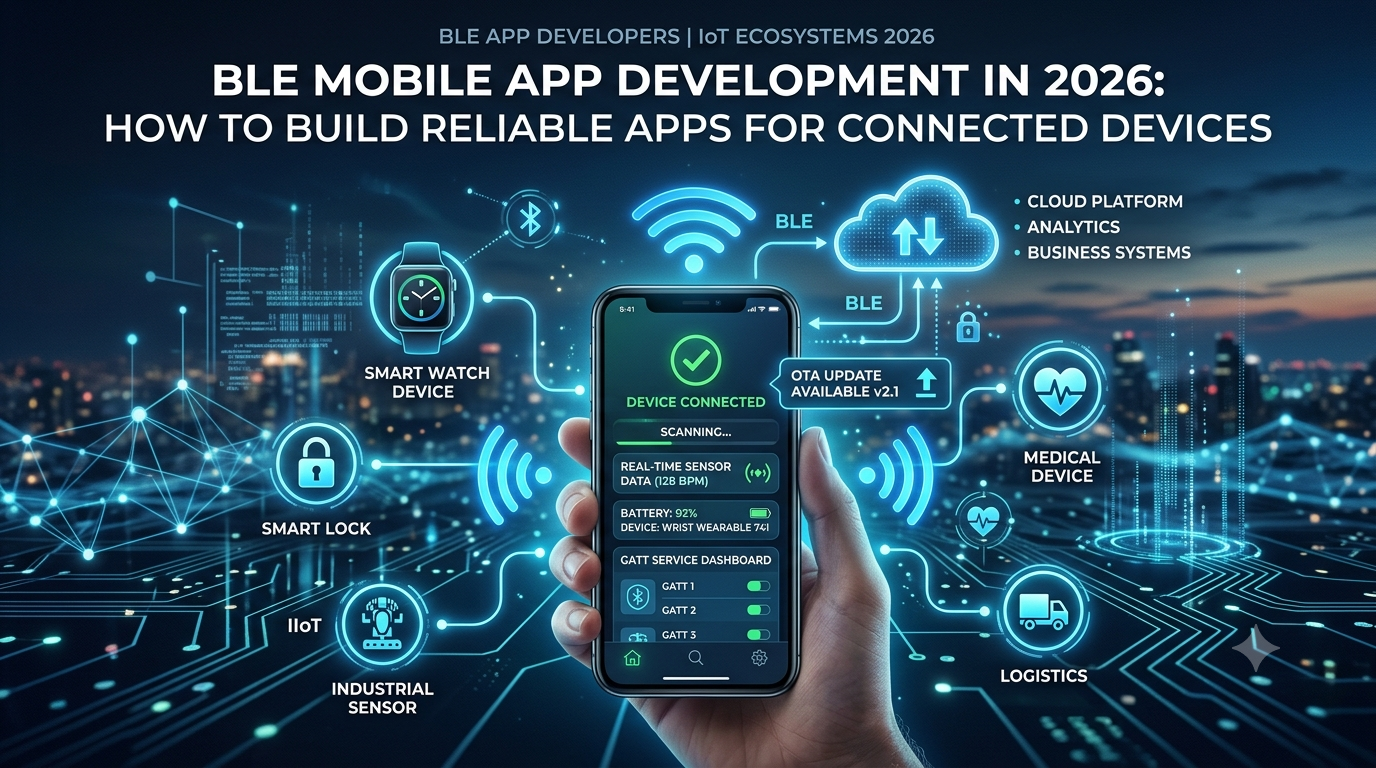
Bluetooth Low Energy (BLE) has become an important connectivity layer for modern connected products. From smart wearables and healthcare devices to industrial sensors, smart locks, asset trackers, and consumer electronics, BLE allows mobile applications to communicate with nearby hardware while supporting efficient wireless communication.
In 2026, BLE mobile app development is moving beyond simple device pairing. Businesses are building complete connected ecosystems that combine BLE hardware, mobile applications, cloud platforms, analytics, automation, and firmware updates.
For companies launching a connected product, the challenge is not simply making an app connect to Bluetooth. The real goal is creating a reliable, secure, scalable, and easy-to-use BLE application.
What Is BLE Mobile App Development?
BLE mobile app development is the process of creating mobile applications that communicate with Bluetooth Low Energy-enabled devices.
A typical BLE ecosystem may include:
BLE Device → Mobile App → Cloud Platform → Analytics → Business System
The mobile application can discover nearby devices, establish connections, read and write data, receive notifications, configure hardware, monitor device status, and synchronize information with cloud services.
Apple provides the Core Bluetooth framework for applications communicating with Bluetooth Low Energy devices, including support for central and peripheral roles.
Why BLE Apps Are Important in 2026
Connected products increasingly need a mobile interface that makes hardware useful and manageable for customers.
BLE applications can help businesses provide:
- Wireless device configuration
- Real-time sensor monitoring
- Device control
- User authentication
- Firmware updates
- Remote diagnostics
- Data synchronization
- Push notifications
- Cloud connectivity
- Device management
BLE is particularly useful when a product needs short-range wireless communication and efficient power usage.
At the same time, the Bluetooth ecosystem continues to evolve. Bluetooth SIG is developing technologies such as Bluetooth High Data Throughput and Channel Sounding, expanding possibilities for future connected-device applications.
How a BLE Mobile App Works
A typical BLE application follows a structured communication process:
1. Device Discovery
The application scans for nearby BLE peripherals and identifies compatible devices.
For example, a fitness application may search for a specific wearable based on its advertised information.
2. Connection
Once the correct device is identified, the application establishes a BLE connection.
3. Service Discovery
The app discovers the device’s available services and characteristics.
These characteristics define the data that the application can read, write, or subscribe to.
4. Data Exchange
The application can then:
- Read sensor values
- Send commands
- Write configuration settings
- Subscribe to notifications
- Monitor device status
5. Cloud Synchronization
For products requiring centralized data, information collected through BLE can be synchronized with a cloud backend.
This allows businesses to create dashboards, analytics systems, remote monitoring platforms, and device-management solutions.
Key Features of a Modern BLE Application
Device Scanning and Discovery
A good BLE application should make device discovery simple for users.
Instead of forcing users through complicated Bluetooth settings, the application can provide a guided connection experience.
Secure Pairing and Authentication
Security should be considered from the beginning of development.
Depending on the product, a BLE solution may require:
- Secure pairing
- Authentication
- Encryption
- Device authorization
- User authentication
- Secure API communication
- Access control
Security requirements should be designed according to the product, hardware, operating system, and data being transmitted.
Real-Time Notifications
BLE applications can subscribe to characteristic updates so that users receive new device information without repeatedly requesting it.
This can be useful for:
- Temperature sensors
- Fitness devices
- Industrial equipment
- Medical monitoring devices
- Smart locks
- Asset trackers
Background Connectivity
Some connected products need BLE communication even when the user is not actively looking at the application.
This is one of the more challenging areas of BLE iOS app development and BLE Android app development because mobile operating systems manage background execution and radio usage differently.
Apple’s current Core Bluetooth documentation includes specific background behavior and, in iOS 26 and later, additional capabilities associated with Live Activities and Bluetooth workflows.
Therefore, developers should design background connectivity according to the actual product requirements rather than assuming that BLE scanning or communication will behave identically in foreground and background modes.
BLE Android App Development vs. BLE iOS App Development
Businesses building a BLE mobile application often need both Android and iOS versions.
However, the BLE implementation should not simply be copied from one platform to another.
Android BLE Development
Android BLE applications need to account for:
- Bluetooth permissions
- Device discovery
- Connection management
- GATT communication
- Connection failures
- Android version differences
- Battery optimization
iOS BLE Development
iOS applications commonly use Apple’s Core Bluetooth framework.
Developers need to consider:
- Central and peripheral roles
- Permission handling
- Background execution
- Connection restoration
- GATT services and characteristics
- iOS lifecycle behavior
Apple’s documentation specifically describes Core Bluetooth support for discovering, connecting to, and interacting with BLE peripherals.
Custom BLE App Development for Connected Products
A generic Bluetooth application may work for simple use cases, but commercial products often require custom BLE app development.
A custom application can be designed around the exact:
- Hardware architecture
- BLE services
- GATT profile
- User workflow
- Security model
- Firmware
- Cloud architecture
- Business requirements
For example, a smart-lock company may require a BLE application that supports user authentication, device provisioning, remote configuration, access history, and secure unlock commands.
A healthcare device may instead require sensor data collection, notifications, cloud synchronization, and device-status monitoring.
The BLE communication layer needs to be designed around each product’s requirements.
BLE App Development for IoT
BLE is also an important component of many IoT ecosystems.
A BLE IoT architecture can look like:
Sensor → BLE → Smartphone/Gateway → Cloud → Dashboard
This model can be used for:
- Industrial monitoring
- Smart buildings
- Healthcare devices
- Asset tracking
- Retail systems
- Environmental sensors
- Wearables
- Smart-home products
The mobile application can act as a gateway between the physical device and the cloud platform.
OTA Firmware Updates
Connected products often need firmware updates after deployment.
A BLE application can support an OTA firmware update workflow, allowing compatible firmware to be transferred to a device wirelessly.
A production OTA system should consider:
- Firmware authentication
- Integrity verification
- Version management
- Update recovery
- Battery level
- Connection stability
- Rollback strategies
This can reduce the need for physical access to deployed devices.
BLE App Testing: What Developers Should Check
BLE applications require more than standard mobile-app testing.
A comprehensive testing strategy should include:
Connectivity Testing
Test connection, disconnection, reconnection, and unexpected connection loss.
Device Compatibility Testing
Test different phones, operating-system versions, and supported BLE hardware.
GATT Testing
Verify services, characteristics, read/write operations, notifications, and data formats.
Background Testing
Test how the application behaves when the screen is locked, the app is minimized, or the operating system changes its execution state.
Battery Testing
Measure the impact of scanning, connections, notifications, and background communication.
Security Testing
Test authentication, authorization, encrypted communication, and protection against unauthorized device access.
Real-World Testing
BLE performance can change because of physical environments, interference, distance, device orientation, and hardware differences.
Testing should therefore include real devices rather than relying entirely on simulators.
Common BLE App Development Challenges
Unstable Connections
BLE connections can fail because of distance, interference, device limitations, or operating-system behavior.
Applications should have intelligent reconnection and error-handling mechanisms.
Battery Drain
Excessive scanning and unnecessary communication can reduce battery efficiency.
Developers should optimize scan frequency, connection intervals, notifications, and background activity.
Platform Differences
Android and iOS do not always behave identically.
A successful cross-platform strategy should account for native BLE behavior where necessary.
Hardware Compatibility
The mobile application and firmware must follow a clearly defined communication contract.
Poorly defined GATT services or inconsistent data formats can create problems during development and testing.
Background Restrictions
Background BLE behavior requires careful platform-specific design. Apple’s documentation, for example, explains that Bluetooth activity in the background is subject to specific execution rules and system constraints.
BLE App Development Process
A professional BLE application development project can follow these stages:
Step 1: Product Discovery
Understand the hardware, target users, connectivity requirements, and business objectives.
Step 2: BLE Architecture
Define the BLE roles, services, characteristics, communication flow, security requirements, and data model.
Step 3: UI/UX Design
Create an intuitive interface for device discovery, connection, configuration, monitoring, and control.
Step 4: Mobile Development
Develop the Android and iOS application using the appropriate native or cross-platform approach.
Step 5: Hardware Integration
Connect the application with the actual BLE hardware and firmware.
Step 6: Backend Integration
Connect device data with APIs, cloud services, dashboards, analytics, and business systems where required.
Step 7: Testing
Perform connectivity, performance, security, compatibility, battery, and real-device testing.
Step 8: Deployment and Support
Launch the application and continue with monitoring, bug fixes, firmware compatibility, security updates, and new features.
Native or Cross-Platform BLE Development?
Businesses often ask whether they should build their BLE application using native development or a cross-platform framework.
Cross-platform technologies can reduce duplicated development work, but BLE functionality may still require platform-specific native implementations.
The right choice depends on:
- BLE complexity
- Hardware requirements
- Performance expectations
- Background functionality
- Development timeline
- Target platforms
- Long-term maintenance
For advanced BLE products, architecture should be decided based on technical requirements rather than simply choosing a framework because it is popular.
Industries Using BLE Mobile Applications
BLE app development can support a wide range of industries.
Healthcare
Connected medical and wellness devices can transfer sensor information to mobile applications.
Fitness & Wearables
Fitness trackers, smartwatches, sports equipment, and health-focused wearables can use BLE for smartphone connectivity.
Smart Home
Smart locks, sensors, lighting systems, and other devices can use mobile apps as their control interface.
Industrial IoT
BLE applications can connect workers and technicians with industrial sensors, equipment, and monitoring systems.
Retail
BLE can support proximity experiences, connected devices, inventory workflows, and smart retail environments.
Logistics
BLE-enabled tags and sensors can help businesses monitor assets and collect operational data.
Automotive
Connected accessories, vehicle-related devices, digital keys, and monitoring solutions can incorporate BLE technology.
Choosing a BLE App Development Company
When selecting a BLE app development company, businesses should look beyond basic mobile development experience.
Evaluate whether the development team understands:
- Bluetooth Low Energy
- GATT and BLE profiles
- Mobile BLE APIs
- Embedded systems
- Firmware integration
- Cloud and IoT architecture
- Security
- OTA updates
- Real-device testing
A team that understands both software and connected hardware can help reduce integration problems later in the product lifecycle.
Why Choose BLE App Developers?
BLEAppDevelopers focuses on end-to-end BLE application development, including mobile applications, hardware integration, firmware, cloud connectivity, OTA updates, and connected-device solutions.
The development approach can support products requiring:
- Custom BLE mobile apps
- Android BLE applications
- iOS BLE applications
- Cross-platform BLE solutions
- BLE device integration
- Embedded firmware integration
- Cloud and IoT connectivity
- Device management
- OTA firmware updates
The Future of BLE Mobile App Development
BLE development is continuing to expand beyond basic device communication.
Emerging capabilities such as Bluetooth Channel Sounding and High Data Throughput are creating opportunities for new connected-device experiences. Bluetooth SIG describes High Data Throughput as an effort to increase Bluetooth LE data rates while also addressing energy efficiency and connection reliability.
As connected products become more intelligent, BLE applications are likely to work increasingly closely with:
- AI
- Edge computing
- Cloud platforms
- Real-time analytics
- Smart sensors
- Digital twins
- Location and ranging technologies
- Automated device management
The result is a shift from simply connecting devices to creating complete digital experiences around physical products.
Conclusion
BLE mobile app development in 2026 is about much more than connecting a smartphone to a Bluetooth device.
A successful BLE application needs reliable connectivity, efficient communication, security, intuitive UX, hardware compatibility, platform-specific optimization, and a scalable architecture.
Whether you are developing a wearable, healthcare device, smart lock, industrial sensor, asset tracker, or IoT product, the right BLE app developers can help turn connected hardware into a practical digital product.
If you are planning a new connected-device project, custom Bluetooth Low Energy app development can provide the foundation for a reliable mobile-to-device experience.