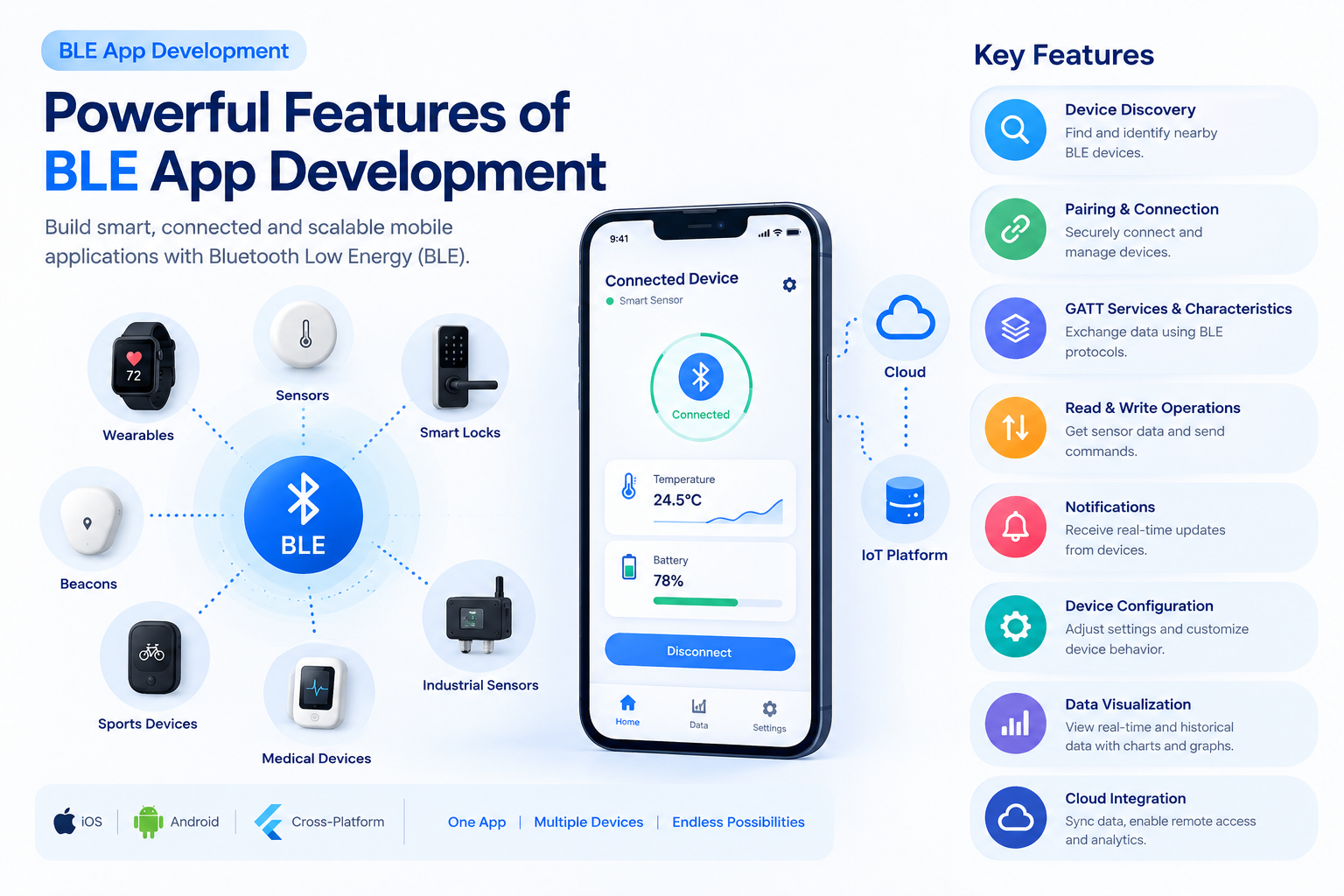
Bluetooth Low Energy (BLE) has become a key technology for connecting smartphones with smart devices, sensors, wearables, healthcare equipment, industrial products, and IoT systems.
As connected products continue to grow, businesses are investing in BLE app development to create mobile applications that can discover, connect, monitor, configure, and control Bluetooth-enabled devices.
A modern BLE application can do much more than simply connect two devices. It can become the user interface for an entire connected product ecosystem, combining BLE connectivity, mobile applications, cloud platforms, APIs, analytics, and IoT services.
What Is BLE App Development?
BLE app development is the process of building mobile applications that communicate with Bluetooth Low Energy devices.
A BLE-enabled mobile application can:
- Discover nearby BLE devices
- Scan Bluetooth signals
- Connect and disconnect devices
- Read sensor data
- Write commands to devices
- Monitor device status
- Configure connected hardware
- Display real-time information
- Send alerts and notifications
- Synchronize data with cloud platforms
BLE applications can be developed for iOS, Android, or cross-platform environments, depending on the product requirements.
Why Businesses Are Investing in BLE Applications
BLE provides a practical way to connect physical products with smartphones.
Businesses can use BLE applications to create connected experiences without requiring users to interact directly with complicated hardware interfaces.
Common advantages include:
Low-Power Connectivity
BLE is designed for applications where devices need efficient wireless communication and long battery life.
This makes it suitable for wearable devices, sensors, trackers, and portable products.
Smartphone Compatibility
Modern smartphones support Bluetooth Low Energy, allowing applications to communicate directly with many BLE-enabled products.
Real-Time Device Interaction
A mobile application can receive information from connected hardware and send commands back to the device.
Flexible Product Development
BLE can support a wide variety of products, from simple sensors to sophisticated IoT ecosystems.
IoT Integration
BLE applications can work as part of a larger IoT architecture by transferring device data to cloud platforms and backend systems.
How BLE Mobile Apps Work
A typical BLE application follows a communication process:
BLE Device → Bluetooth Connection → Mobile App → API/Cloud → Dashboard
The exact architecture depends on the product.
For example, a fitness device may collect health and activity information and send it to a smartphone. The application can display the data to the user and synchronize selected information with a cloud platform.
An industrial application may connect to multiple sensors and send collected data to a centralized monitoring system.
Key Features of BLE App Development
A professional BLE mobile application may include several important features.
BLE Device Discovery
The application can scan for nearby Bluetooth Low Energy devices and identify compatible hardware.
Device Pairing and Connection
Users can connect the mobile application with a BLE device and establish communication.
GATT Services and Characteristics
BLE applications commonly communicate through the Generic Attribute Profile (GATT).
GATT services and characteristics define how information is organized and exchanged between the mobile application and BLE device.
Read and Write Operations
The application can read information from a device and write commands or configuration values to supported characteristics.
Notifications
BLE notifications can allow devices to send updated information to the application without requiring continuous manual requests.
Device Configuration
Applications can provide interfaces for configuring connected devices, changing settings, or updating operating parameters.
Data Visualization
Sensor information can be displayed through:
- Charts
- Graphs
- Dashboards
- Status indicators
- Historical reports
Cloud Synchronization
BLE application data can be synchronized with backend systems for remote storage, analytics, and multi-device access.
BLE App Development for iOS
Developing BLE applications for iOS requires careful handling of Apple’s Bluetooth frameworks and platform-specific permissions.
An iOS BLE application may support:
- Device scanning
- BLE connections
- GATT communication
- Background communication where supported
- Notifications
- Device configuration
- Data synchronization
Developers need to consider iOS permissions, background behavior, device compatibility, and Apple’s platform requirements during development.
BLE App Development for Android
Android provides extensive support for Bluetooth Low Energy applications.
Android BLE apps can implement:
- Device discovery
- BLE scanning
- Connection management
- GATT communication
- Characteristic read/write operations
- Notifications
- Device configuration
- Data synchronization
Android development also requires attention to Bluetooth permissions and differences between operating system versions.
Cross-Platform BLE App Development
Businesses that need applications for both iOS and Android may consider cross-platform development.
Technologies such as Flutter and React Native can help teams build applications across multiple platforms while sharing part of the application codebase.
However, BLE communication often requires platform-specific implementation or native integrations.
The right development approach depends on:
- Device complexity
- BLE protocol requirements
- Performance
- Background communication
- Development budget
- Target platforms
- Product roadmap
BLE App Development Process
Building a reliable BLE application requires more than creating a mobile interface.
1. Product Requirement Analysis
The development process begins with understanding the connected product.
Important questions include:
- What BLE device will the app communicate with?
- What data needs to be exchanged?
- How many devices can connect?
- Does the app need cloud integration?
- Is background connectivity required?
- What security requirements apply?
2. BLE Architecture Planning
Developers define the communication architecture, including:
- BLE services
- Characteristics
- Data formats
- Connection behavior
- Notifications
- Error handling
3. UI/UX Design
The application interface should make device connection and management simple.
Important screens may include:
- Device discovery
- Device connection
- Device status
- Settings
- Sensor dashboard
- Alerts
- User profile
4. BLE Integration
Developers implement scanning, connection management, GATT communication, data processing, and device control.
5. Backend and API Integration
If the application needs cloud functionality, APIs can connect the mobile application with backend services.
This can support:
- User accounts
- Data storage
- Device management
- Analytics
- Remote monitoring
- Notifications
6. Testing
BLE applications need extensive testing because wireless communication can behave differently depending on the device, environment, operating system, and hardware.
Testing can include:
- Connectivity testing
- Range testing
- Battery testing
- Device compatibility
- Connection recovery
- Data accuracy
- Security testing
- iOS testing
- Android testing
BLE App Development Use Cases
BLE applications are used across multiple industries.
Healthcare Apps
BLE applications can communicate with connected medical and health-monitoring devices.
Potential applications include:
- Health sensors
- Patient monitoring
- Medical equipment
- Fitness monitoring
- Wearable healthcare devices
Fitness and Wearables
BLE is widely used for connected fitness products.
Applications can connect with:
- Smartwatches
- Fitness trackers
- Heart-rate sensors
- Cycling devices
- Sports equipment
Smart Home Applications
BLE apps can provide control and configuration features for connected home devices.
Examples include:
- Smart locks
- Sensors
- Lighting systems
- Access control devices
- Smart appliances
Industrial Applications
BLE applications can connect with industrial sensors and equipment for monitoring and configuration.
Potential uses include:
- Equipment monitoring
- Asset tracking
- Sensor data collection
- Maintenance systems
- Industrial diagnostics
Retail Applications
BLE applications can be used with beacons, sensors, and connected retail devices.
Possible applications include:
- Indoor positioning
- Proximity experiences
- Asset tracking
- Inventory monitoring
- Customer engagement
Logistics and Asset Tracking
BLE trackers can provide information about the location or status of assets.
Mobile applications can be used to configure trackers and display collected information.
BLE App and IoT Integration
BLE becomes even more powerful when combined with IoT technology.
A mobile application can act as a bridge between BLE devices and cloud services.
For example:
BLE Sensor → Mobile App → API → Cloud → Web Dashboard
Alternatively:
BLE Sensor → BLE Gateway → Cloud → Mobile/Web App
This architecture can allow businesses to monitor connected products remotely and analyze device data at scale.
BLE App Security
Security should be considered throughout the BLE application development lifecycle.
Important security considerations include:
- Secure device pairing
- Authentication
- Encrypted communication
- Secure APIs
- User authentication
- Access control
- Secure data storage
- Firmware security
- Secure device configuration
Applications handling sensitive information may require additional security controls based on their industry and regulatory requirements.
Common BLE App Development Challenges
Connection Reliability
Wireless connections can disconnect because of distance, interference, device movement, or operating-system behavior.
Applications should therefore implement appropriate connection recovery and error handling.
Device Compatibility
Different BLE devices may implement services and characteristics differently.
Testing against actual hardware is essential.
Background Operation
Mobile operating systems place restrictions on background Bluetooth operations.
Applications that require background functionality need platform-specific planning.
Battery Consumption
Frequent scanning and communication can affect smartphone and device battery life.
Developers need to optimize connection intervals, scanning behavior, and data transmission.
Hardware-Software Integration
The BLE application must correctly communicate with the firmware and hardware.
Clear BLE specifications and testing procedures can reduce integration problems.
How to Choose a BLE App Development Company
Businesses planning a Bluetooth-enabled product should evaluate development teams based on their experience with both software and connected hardware.
Look for experience in:
- BLE mobile app development
- Bluetooth Low Energy
- iOS BLE development
- Android BLE development
- Cross-platform BLE apps
- GATT/GAP
- BLE firmware integration
- IoT integration
- Cloud APIs
- BLE device testing
- Connected product development
A development partner should also understand the complete product lifecycle, from prototype and MVP development through testing, deployment, and ongoing improvements.
Future of BLE App Development
BLE applications are becoming increasingly connected to larger digital ecosystems.
Future BLE applications are likely to combine Bluetooth connectivity with:
- IoT platforms
- Edge computing
- AI-powered analytics
- Cloud infrastructure
- Real-time monitoring
- Smart sensors
- Digital twins
- Predictive maintenance
This means BLE apps can evolve from simple device-control applications into intelligent interfaces for connected products.
Why Work With BLE App Developers?
Developing a reliable Bluetooth application requires knowledge of mobile development, wireless communication, hardware integration, and backend technologies.
A specialized BLE app development company can help businesses move from a connected-device concept to a working mobile application.
BLEAppDevelopers can focus on areas such as:
- Custom BLE mobile applications
- iOS BLE app development
- Android BLE app development
- Cross-platform BLE applications
- BLE device integration
- BLE IoT applications
- BLE gateway integration
- Cloud and API integration
- Connected device solutions
Conclusion
BLE app development provides businesses with a practical way to connect smartphones with smart devices, sensors, wearables, industrial equipment, and IoT products.
From device discovery and GATT communication to cloud integration and real-time analytics, a well-designed BLE application can become an important part of a connected product ecosystem.
As businesses continue developing smart products in 2026, combining BLE, mobile applications, IoT, cloud platforms, and intelligent analytics can create scalable connected experiences across multiple industries.
Frequently Asked Questions
What is BLE app development?
BLE app development is the process of creating mobile applications that communicate with Bluetooth Low Energy devices.
Can BLE apps be developed for both iOS and Android?
Yes. BLE applications can be developed for iOS and Android, either as separate native applications or using suitable cross-platform technologies.
What can a BLE mobile app do?
A BLE app can discover devices, establish connections, read and write data, receive notifications, configure devices, display sensor information, and communicate with cloud platforms.
Can BLE apps connect to IoT platforms?
Yes. BLE applications can communicate with backend APIs and cloud platforms, allowing device data to be stored, analyzed, and monitored remotely.
How much does BLE app development cost?
Development cost depends on the number of platforms, BLE hardware, application complexity, cloud requirements, integrations, security requirements, and testing needs.
What industries use BLE applications?
BLE applications are used in healthcare, fitness, wearables, retail, smart homes, logistics, industrial IoT, asset tracking, and connected consumer products.