Bluetooth Low Energy (BLE) has become an important connectivity layer for wearables, smart sensors, healthcare devices, industrial equipment, smart locks, fitness products, and connected consumer electronics.
But BLE applications are evolving beyond simply connecting a smartphone to a device.
In 2026, businesses are combining BLE app development, artificial intelligence, IoT, cloud platforms, and edge computing to create connected products that can collect data, understand patterns, automate decisions, and deliver more personalized experiences.
This combination of BLE and AI is opening new opportunities for businesses developing next-generation connected products.
What Is AI-Powered BLE App Development?
AI-powered BLE app development combines Bluetooth Low Energy communication with artificial intelligence capabilities.
A traditional BLE application may:
- Discover nearby devices
- Establish connections
- Read BLE characteristics
- Write commands
- Receive sensor notifications
- Display device information
An AI-powered BLE application can go further by analyzing the data received from connected devices.
For example, a wearable could continuously collect movement information through BLE. An AI model could analyze those patterns and identify changes in activity, generate insights, or personalize recommendations.
A typical architecture can look like:
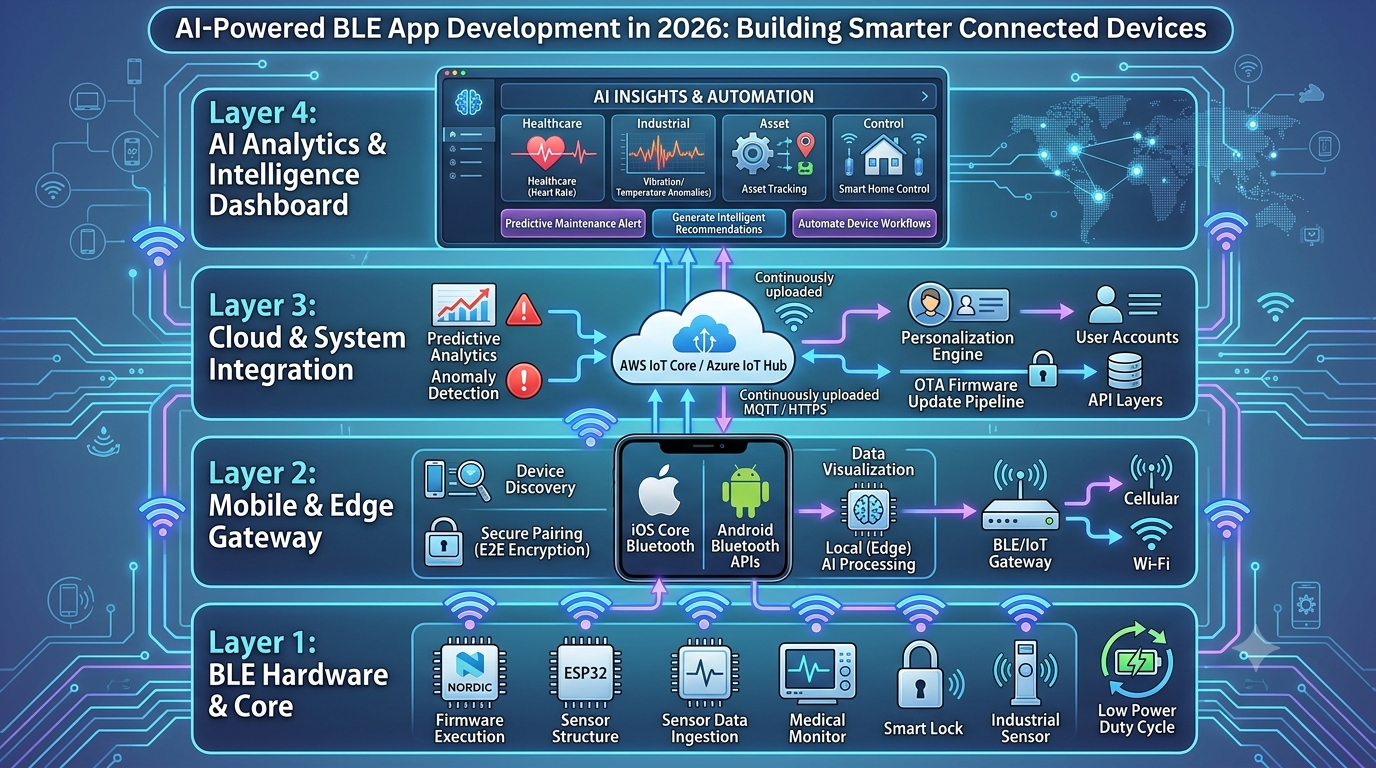
BLE Device → Mobile Application → AI Processing → Cloud Platform → Analytics & Automation
Depending on the product, some AI processing can also happen directly on the device or smartphone.
Why Combine BLE and AI?
BLE is designed for efficient wireless communication and is widely used in battery-powered connected devices. The Bluetooth SIG continues to expand Bluetooth capabilities, including technologies such as Channel Sounding for more precise distance awareness and LE Audio for advanced Bluetooth audio applications.
AI adds another layer of intelligence.
Together, BLE and AI can help applications:
- Analyze real-time sensor data
- Detect unusual patterns
- Personalize user experiences
- Automate device workflows
- Predict maintenance requirements
- Improve asset monitoring
- Generate intelligent recommendations
- Reduce manual monitoring
- Connect physical devices with digital services
This makes BLE application development increasingly relevant to IoT and smart-product businesses.
How AI Works With BLE Data
A BLE device can collect information from sensors and transmit it to a mobile application or gateway.
For example, an industrial sensor might provide:
- Temperature
- Vibration
- Pressure
- Motion
- Battery level
- Equipment status
The BLE application can then send selected data to an AI or machine-learning pipeline.
The system may identify patterns such as:
Normal equipment behavior → unusual vibration → AI detects anomaly → application generates alert → maintenance team investigates
This transforms BLE from a connectivity technology into part of an intelligent monitoring system.
Top Use Cases for AI and BLE Applications
1. Smart Wearables
Wearables are one of the most natural applications for BLE.
A smartphone can communicate with:
- Fitness trackers
- Smartwatches
- Health sensors
- Sports devices
- Smart rings
- Connected accessories
AI can analyze the information received from these devices and generate personalized insights.
For example, a fitness application could analyze movement patterns and provide recommendations based on permitted user data.
2. Healthcare and Medical Devices
BLE is widely applicable to connected healthcare products because many medical and monitoring devices need efficient wireless communication.
Potential applications include:
- Patient monitoring
- Connected medical sensors
- Remote device configuration
- Fitness and wellness monitoring
- Medical equipment diagnostics
- Medication-related devices
For regulated medical products, however, development also needs to account for applicable security, privacy, quality, and regulatory requirements.
BLEAppDevelopers highlights regulatory-aware development for medical devices alongside BLE, firmware, mobile applications, cloud infrastructure, and real-hardware QA.
3. Predictive Maintenance
Industrial businesses can combine BLE sensors with AI to monitor equipment.
Sensors can collect information about:
- Vibration
- Temperature
- Pressure
- Motor activity
- Operating conditions
AI models can analyze historical and real-time information to identify potential anomalies.
Instead of waiting for equipment to fail, businesses can investigate unusual patterns earlier.
4. Smart Home Applications
BLE can connect smartphones with smart-home products such as:
- Smart locks
- Sensors
- Lighting controllers
- Access devices
- Environmental sensors
- Smart appliances
AI can add automation and personalization.
For example, a connected home system could learn permitted usage patterns and provide intelligent automation while still allowing users to control devices manually.
5. Asset Tracking
BLE-based tracking can help businesses monitor assets across facilities.
Potential applications include:
- Equipment tracking
- Inventory monitoring
- Warehouse assets
- Tools and machinery
- Hospital equipment
- Retail assets
AI can analyze movement patterns and help identify unusual asset activity.
6. Automotive and Mobility
BLE applications can support connected mobility experiences such as:
- Digital keys
- Vehicle access
- Device pairing
- In-vehicle accessories
- Fleet equipment
- Vehicle diagnostics
Bluetooth Channel Sounding is particularly interesting for applications requiring more precise distance awareness. The Bluetooth SIG describes it as a secure fine-ranging capability designed to bring distance awareness to Bluetooth-connected devices.
BLE + AI + IoT Architecture
A scalable connected product can contain several layers.
Layer 1: BLE Hardware
The physical device contains sensors, a BLE chipset, firmware, and power management.
Common hardware platforms can include Nordic nRF52/nRF53, ESP32, Silicon Labs, TI, and other BLE-capable chipsets.
Layer 2: Mobile Application
The mobile application can provide:
- Device discovery
- Pairing
- Configuration
- Data visualization
- Device controls
- Notifications
- User accounts
For iOS, developers commonly work with Apple’s Core Bluetooth framework.
For Android, developers use Android’s Bluetooth APIs.
Layer 3: Cloud Backend
The application can synchronize relevant information with cloud infrastructure.
Common requirements include:
- APIs
- Databases
- Device management
- Authentication
- Analytics
- Notifications
- Remote monitoring
Layer 4: AI and Analytics
The AI layer can process accumulated data to provide:
- Predictions
- Recommendations
- Anomaly detection
- Classification
- Automated insights
- Intelligent alerts
This creates a complete connected ecosystem rather than an isolated Bluetooth application.
AI at the Edge vs Cloud AI
One important architectural decision is where AI processing should happen.
Edge AI
Processing happens close to the device, such as on the BLE device, gateway, or smartphone.
Advantages can include:
- Lower latency
- Reduced cloud communication
- Faster local decisions
- Better operation when connectivity is limited
Cloud AI
Data is sent to cloud infrastructure where more computationally intensive AI processing can occur.
Advantages can include:
- Greater computing resources
- Centralized analytics
- Model management
- Large-scale data processing
- Easier integration with enterprise systems
Many products can use a hybrid architecture where immediate processing happens locally while larger analytics workloads run in the cloud.
Secure BLE Communication Is Essential
Connected devices can potentially handle sensitive information, making security an important part of BLE app development.
A production BLE solution may require:
- Secure pairing
- Authentication
- Encryption
- Key management
- Access control
- Secure APIs
- Protected cloud communication
- Device authentication
- Application-level security
- Secure OTA firmware updates
BLEAppDevelopers currently lists secure pairing and encryption, OTA firmware updates, and cloud integration as part of its connected-product capabilities.
Security should be considered during architecture rather than added after development.
OTA Firmware Updates for BLE Devices
Connected products often need firmware improvements after they reach customers.
A BLE application can support over-the-air firmware updates, allowing approved firmware packages to be transferred securely to compatible hardware.
OTA updates can help manufacturers:
- Fix bugs
- Improve performance
- Add features
- Address security issues
- Improve device compatibility
For commercial products, the OTA process should include validation, secure transfer, version management, failure recovery, and appropriate rollback mechanisms.
BLE App Development for iOS and Android
A successful BLE product needs to account for platform-specific behavior.
iOS BLE Development
iOS BLE applications need to consider:
- Core Bluetooth
- Permission handling
- Background behavior
- Connection lifecycle
- Service discovery
- Characteristic management
- Notifications
- App lifecycle
Android BLE Development
Android BLE applications need to account for:
- Bluetooth permissions
- Runtime permission changes
- Device discovery
- GATT communication
- Background restrictions
- Android version differences
- Manufacturer-specific behavior
Testing across real devices is especially important because BLE behavior can vary across hardware and operating-system versions.
Cross-Platform BLE App Development
Businesses building both Android and iOS applications can consider cross-platform development.
Frameworks such as Flutter and React Native can help share parts of the application codebase.
However, BLE communication often requires careful native integration.
A practical architecture may therefore be:
Cross-Platform UI + Native BLE Layer + Cloud Backend + AI Services
The appropriate approach depends on the hardware, performance requirements, background connectivity requirements, and application complexity.
BLE + AI for Smart Products
The combination of BLE and AI can be particularly useful for connected-product manufacturers.
Potential products include:
- Smart locks
- Fitness trackers
- Wearables
- Medical devices
- EV chargers
- Industrial sensors
- Smart-home devices
- Connected retail products
- Asset trackers
- Sports equipment
A product can use BLE for efficient communication while AI provides intelligence on top of the collected information.
BLE App Development Process
A professional BLE app development process should consider both software and hardware.
Step 1: Define the Product
Identify the target users, hardware, business workflow, and application requirements.
Step 2: Design BLE Architecture
Define:
- BLE roles
- Services
- Characteristics
- GATT structure
- Data formats
- Connection behavior
- Security requirements
Step 3: Select the AI Use Case
Determine whether AI is required for:
- Prediction
- Classification
- Recommendation
- Anomaly detection
- Automation
- Personalization
Step 4: Develop the Mobile Application
Build the iOS and/or Android application and implement BLE communication.
Step 5: Integrate Hardware and Firmware
Validate communication between the application and real hardware.
Step 6: Build Cloud and AI Infrastructure
Where required, integrate APIs, databases, cloud services, analytics, and AI models.
Step 7: Test With Real Devices
Test:
- Connectivity
- Range
- Battery usage
- Connection recovery
- Data accuracy
- Security
- OS compatibility
- Different hardware versions
Step 8: Deploy and Maintain
Continue improving the application and connected device through software updates, firmware updates, monitoring, and analytics.
What to Look for in a BLE App Development Company
Choosing a development partner for a connected product requires more than general mobile-development experience.
Look for experience with:
- BLE protocol implementation
- iOS BLE development
- Android BLE development
- Embedded firmware
- GATT services
- BLE device integration
- OTA firmware updates
- Secure pairing and encryption
- Cloud integration
- IoT platforms
- AI and analytics
- Real-hardware testing
A development team that understands both the physical device and mobile application can identify connectivity and hardware-integration challenges earlier.
The Future of BLE App Development
BLE is continuing to evolve beyond basic short-range device communication.
Bluetooth SIG’s current technology roadmap highlights capabilities such as Channel Sounding and LE Audio, including Auracast broadcast audio.
At the same time, AI is creating opportunities to turn BLE-generated data into actionable insights.
The future of connected products is therefore likely to involve several technologies working together:
BLE + Embedded Systems + Mobile Apps + Cloud + AI + Analytics
For businesses, this can mean moving from simple connected devices toward intelligent products that can monitor, learn from data, automate workflows, and deliver better user experiences.
Build Your BLE Application With BLEAppDevelopers
Building a successful connected product requires more than adding Bluetooth connectivity to a mobile application.
It requires coordination between BLE protocol implementation, embedded firmware, mobile development, cloud infrastructure, security, testing, and product requirements.
BLEAppDevelopers provides development capabilities covering embedded firmware, BLE protocols, native iOS and Android applications, cloud infrastructure, OTA firmware updates, secure pairing, and real-hardware QA.
Whether you are developing a wearable, medical device, smart lock, fitness tracker, EV charger, industrial sensor, or another connected product, a carefully designed BLE architecture can provide the foundation for a scalable application.
SEO Keyword Strategy
Primary Keyword:
BLE app development
Secondary Keywords:
BLE app developers, BLE application development, Bluetooth Low Energy app development, BLE development company, BLE mobile app development, iOS BLE development, Android BLE development, BLE IoT development, Bluetooth app development, custom BLE application, BLE device integration, BLE software development, BLE firmware development, BLE cloud integration, BLE IoT solutions, BLE development services.
Trending/Supporting Keywords:
AI-powered BLE applications, AI and BLE, edge AI, BLE IoT, smart connected devices, intelligent IoT applications, BLE automation, Bluetooth 5.4 development, Bluetooth Channel Sounding, connected device development, wearable app development, smart device app development.
Suggested SEO Title
AI-Powered BLE App Development in 2026: Smarter Connected Devices
Meta Description
Explore AI-powered BLE app development in 2026, from smart wearables and IoT devices to predictive maintenance, AI analytics, secure connectivity, and cloud integration.
Suggested URL
/blogs/ai-powered-ble-app-development-2026/
Suggested Contextual Backlinks
- BLE app development → BLEAppDevelopers.com
- BLE IoT development → BLEIoT.com
- IoT BLE solutions → IoTBLE.com
- AI app development → AIAppDevelopers.ai
- custom software development → Quartus Technology
- custom POS software development → CustomPOS Developers