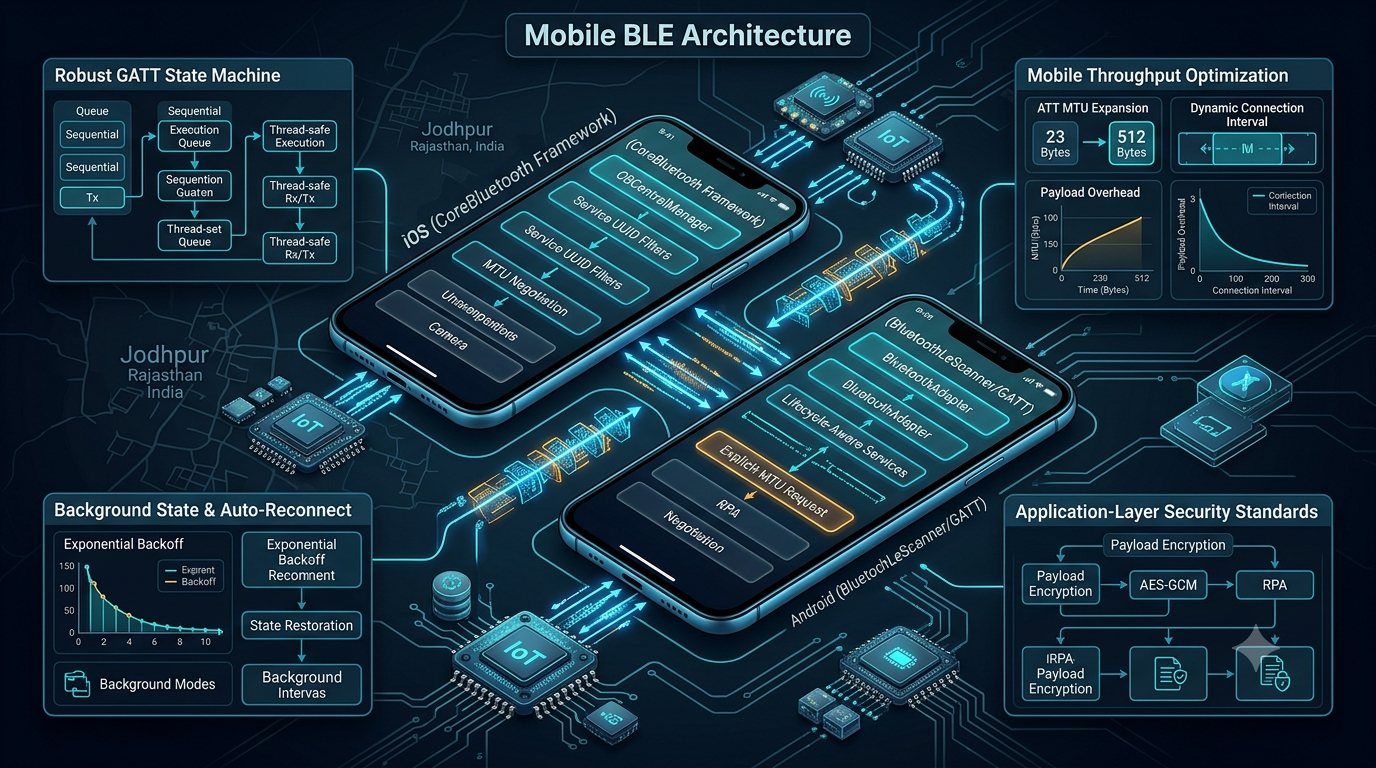
Integrating physical hardware peripherals with native mobile applications requires bridging two radically different execution environments: the constrained, deterministic world of embedded microcontrollers and the high-level, lifecycle-managed environment of iOS and Android OS.
For the modern BLE App Developer (bleappdeveloper), delivering resilient connected-product experiences demands mastering GATT state machines, throughput negotiation, OS background execution modes, and fault-tolerant reconnection logic.
The Cross-Platform BLE Engineering Framework
Mobile OS vendors enforce strict abstraction layers over Bluetooth radios. Building production apps requires handling distinct stack behaviors between Apple CoreBluetooth and Android BluetoothLeScanner/GATT drivers.
| Engineering Domain | iOS (CoreBluetooth) | Android (Android.Bluetooth) | Production Best Practice |
|---|---|---|---|
| Central State Lifecycle | CBCentralManager state restoration keys. | BluetoothAdapter & lifecycle-aware foreground services. | Handle OS-level state changes gracefully without losing background subscriptions. |
| Device Discovery | Service UUID filtering via scanForPeripherals. | ScanFilter with ScanSettings.SCAN_MODE_LOW_LATENCY. | Always filter by target Service UUIDs to preserve mobile battery and radio performance. |
| MTU & Throughput | Auto-negotiates max MTU (up to 185–512 bytes). | Explicit request via gatt.requestMtu(512). | Right-size ATT MTU immediately post-connection to maximize data packet payload size. |
| Connection Parameters | Minimum interval constrained to ~15ms by iOS. | Supports short intervals down to 7.5ms. | Dynamically adjust connection intervals: low latency for data transfers, high interval for idle. |
| Permissions Framework | NSBluetoothAlwaysUsageDescription. | BLUETOOTH_SCAN, BLUETOOTH_CONNECT, fine location. | Request runtime permissions with clear fallback UI states when Bluetooth is disabled. |
Core Engineering Patterns for BLE Mobile Apps
1. Robust GATT Connection State Machine
A common failure point in mobile-BLE applications is assuming a linear connection flow. Peripheral connections drop due to radio interference, range variations, or unexpected OS thread suspension.
- Sequential Execution Queues: Native BLE stacks do not support concurrent operations. Implement thread-safe queues (e.g., ReactiveX, Kotlin Coroutines, or Swift Actor patterns) to ensure GATT operations (
read,write,notify) run sequentially. - Service & Characteristic Discovery Caching: Avoid redundant service discovery calls on re-connection. Cache GATT characteristic handles to reduce connection setup time and save battery power.
- Indication vs. Notification Strategy: Favor
NOTIFYoverINDICATEfor continuous telemetry streams to avoid waiting for application-layer acknowledgments over the air, reservingINDICATEstrictly for critical state changes.
┌─────────────────────────────────────────────────────────────┐
│                 GATT STATE MACHINE EXECUTION                │
├─────────────────────────────────────────────────────────────┤
│ Disconnected ──> Scanning (UUID Filtered)                   │
│                       │                                     │
│                       ▼                                     │
│ Connecting ──> MTU Negotiation (Request 512 Bytes)          │
│                       │                                     │
│                       ▼                                     │
│ Discover Services ──> Subscribe to Notifications (CCC)      │
│                       │                                     │
│                       ▼                                     │
│ Connected State <─── Ready for Data Queue (Rx/Tx)           │
└─────────────────────────────────────────────────────────────┘
2. Mobile Throughput Optimization
Achieving maximum throughput (e.g., during Over-the-Air firmware updates or high-frequency sensor streams) requires tuning three key parameters:
- ATT MTU Expansion: Default BLE ATT MTU is only 23 bytes (leaving 20 bytes for actual payload). Expanding the MTU to 512 bytes reduces packet framing overhead by up to 80%.
- Connection Interval Negotiation: Requesting a 15ms connection interval increases packet bursts per second from the central device.
- Write Without Response (
WRITE_NO_RESPONSE): Offload high-volume data pushes to unacknowledged write commands, handling packet integrity checks at the application protocol layer instead of waiting for a GATT layer ACK every cycle.
3. Background Execution & Auto-Reconnection Strategy
Mobile operating systems aggressively kill background apps or suspend radio polling to extend smartphone battery life.
- iOS Background Modes: Declare
bluetooth-centralbackground execution modes and supply restoration identifiers (CBCentralManagerOptionRestoreIdentifierKey) so iOS can re-instantiate your manager state upon background event triggers. - Android Foreground Services: Wrap active BLE sessions in a persistent Android Foreground Service bound to an active OS notification to protect the connection thread from memory management kills.
- Exponential Backoff Reconnection: Implement auto-reconnect loops that scale attempt intervals exponentially (1s,2s,4s,8s,16s…) to prevent radio saturation when the physical hardware is out of range.
Application-Layer Security Standards
Wireless security cannot rely solely on basic BLE pairing or “Just Works” passkeys. Modern BLE mobile architectures enforce multi-layered security:
- App-Layer Payload Encryption: Encrypt sensitive telemetry payloads with AES-GCM or ChaCha20-Poly1305 at the application layer before writing data to GATT characteristics.
- Challenge-Response Authentication: Exchange ephemeral session tokens over secure channels upon initial connection before unlocking control characteristics.
- Resolvable Private Addresses (RPA): Enforce MAC address rotation on the peripheral hardware to protect user privacy against physical location tracking.
Modern Development Pipelines for BLE Mobile Systems
Building reliable BLE applications requires pairing clean native mobile code with physical hardware testing pipelines. By combining structured GATT queues, dynamic connection parameter tuning, robust background state restoration, and robust encryption, BLE app developers build seamless mobile-to-hardware ecosystems that perform predictably in real-world environments.