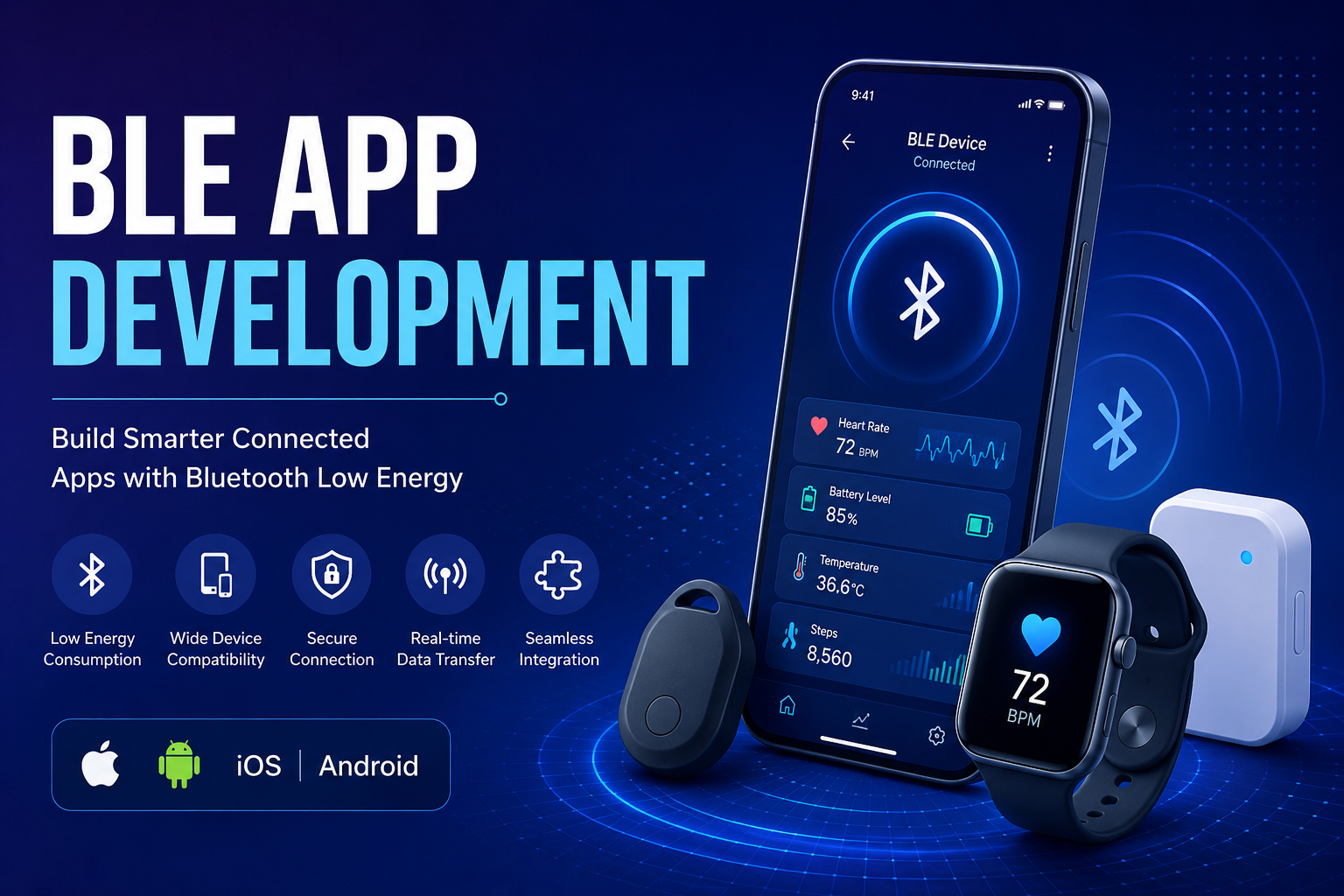
Bluetooth Low Energy (BLE) has become an important connectivity technology for modern mobile and connected-device applications. From wearable technology and healthcare devices to smart retail, asset tracking, fitness products, and industrial equipment, BLE enables applications to communicate with nearby devices while maintaining efficient power consumption.
In 2026, BLE app development is evolving beyond basic device connectivity. Businesses are building complete ecosystems where BLE devices, mobile applications, cloud platforms, IoT systems, and AI-powered services work together.
For companies developing connected products, choosing the right BLE architecture and development approach can have a major impact on performance, reliability, security, and user experience.
What Is BLE App Development?
BLE app development involves creating mobile applications that communicate with Bluetooth Low Energy-enabled devices.
A BLE application can:
- Discover nearby devices
- Connect to BLE peripherals
- Read device data
- Write commands to devices
- Subscribe to notifications
- Monitor sensor information
- Synchronize data with cloud platforms
- Control connected hardware
BLE applications can be developed for platforms such as iOS and Android, with the architecture selected according to the product’s requirements.
Why BLE Is Important in 2026
BLE offers several advantages for connected applications.
Low Power Consumption
BLE is designed for efficient wireless communication, making it particularly useful for battery-powered devices.
Smartphone Compatibility
Modern smartphones support BLE, allowing businesses to create applications that communicate directly with compatible devices.
Flexible Connectivity
BLE can support sensors, wearables, trackers, smart devices, medical equipment, and many other connected products.
Cost Efficiency
BLE hardware can provide an economical connectivity option for many consumer and business applications.
Real-Time Communication
Applications can receive information from BLE devices and respond to device events in real time.
How a BLE Application Works
A typical BLE application involves two major components:
Central: Usually a smartphone or tablet.
Peripheral: A BLE-enabled device such as a sensor, wearable, tracker, or smart accessory.
The basic communication process is:
Scan → Discover Device → Connect → Discover Services → Discover Characteristics → Read/Write Data → Receive Notifications
For example, a fitness application may connect to a wearable device and receive activity or sensor information through BLE characteristics.
BLE Services and Characteristics
BLE communication is generally organized around services and characteristics.
A service groups related functionality.
Characteristics contain the actual data or control points exchanged between the application and the device.
For example, a smart temperature sensor could provide:
- Device information service
- Battery service
- Temperature service
- Temperature characteristic
The mobile application communicates with the appropriate characteristics to read information or send commands.
Understanding this structure is essential for reliable BLE application development.
Major BLE App Development Use Cases
1. Wearable Applications
Wearables are one of the most common BLE use cases.
BLE can connect smartphones with:
- Smartwatches
- Fitness trackers
- Smart bands
- Health monitors
- Sports devices
Applications can synchronize activity, health, and device information.
2. Healthcare Applications
BLE can connect mobile applications with compatible healthcare devices.
Potential applications include:
- Blood pressure monitors
- Glucose-related devices
- Pulse monitoring
- Patient monitoring
- Fitness and wellness devices
- Connected medical equipment
Healthcare applications require additional attention to privacy, security, reliability, and applicable regulatory requirements.
3. Asset Tracking
BLE-enabled tags can communicate with smartphones or gateways to support asset-monitoring applications.
Businesses can use BLE for:
- Equipment tracking
- Inventory visibility
- Warehouse monitoring
- Hospital equipment management
- Logistics
- Industrial assets
4. Smart Retail
BLE applications can support proximity-based retail experiences.
Examples include:
- Beacon-based engagement
- Indoor navigation
- Product identification
- Store analytics
- Customer notifications
- Smart checkout experiences
5. Smart Home Applications
BLE can be used to connect smartphones with smart devices such as:
- Locks
- Sensors
- Lighting controllers
- Home accessories
- Security devices
The application can allow users to monitor and control connected devices.
6. Industrial Applications
BLE can help connect sensors and industrial equipment to mobile applications.
Potential applications include:
- Machine monitoring
- Equipment configuration
- Sensor data collection
- Maintenance applications
- Industrial diagnostics
BLE App Development for iOS and Android
Developing a BLE application for iOS and Android requires understanding the differences between the platforms.
iOS BLE Development
Apple provides Bluetooth functionality through its Core Bluetooth framework.
Developers need to consider:
- Bluetooth permissions
- Background execution
- Connection management
- Service discovery
- Characteristic handling
- App lifecycle behavior
Android BLE Development
Android provides Bluetooth APIs for discovering and communicating with BLE devices.
Important considerations include:
- Bluetooth permissions
- Android version compatibility
- Device discovery
- Runtime permissions
- Connection management
- Background behavior
A cross-platform application can also be developed when the product requirements are suitable for a shared codebase.
BLE and Mobile App Architecture
A scalable BLE application should separate Bluetooth communication from the user interface.
A typical architecture can include:
BLE Layer → Communication Layer → Business Logic → Application UI → Cloud/API Layer
This separation can make the application easier to test, maintain, and expand.
For example, the BLE communication layer can handle device connections while the business logic determines how the collected information should be processed.
BLE and IoT Integration
BLE applications can become part of larger IoT ecosystems.
A smartphone or BLE gateway can collect information from nearby devices and send it to a cloud platform.
The architecture may look like:
BLE Device → Mobile App/Gateway → API → IoT Cloud → Dashboard
This enables businesses to manage connected devices remotely and analyze information collected from multiple locations.
BLE + AI: The Next Step
Artificial Intelligence can add intelligence to BLE-connected applications.
For example, a BLE-enabled industrial sensor may continuously collect equipment data.
The application can transmit that data to a cloud platform where AI analyzes it to identify unusual patterns.
AI-powered BLE applications can support:
- Predictive maintenance
- Anomaly detection
- Intelligent recommendations
- Automated alerts
- User behavior analysis
- Predictive analytics
The combination of BLE + IoT + AI can transform a simple connected device into a more intelligent business solution.
BLE App Security
Security should be considered from the beginning of development.
Important security measures can include:
- Secure device pairing
- Authentication
- Encryption
- Secure APIs
- Access control
- Secure cloud communication
- Protection of sensitive device data
- Secure firmware-update mechanisms
Applications handling health, financial, personal, or business-sensitive data may require additional security and compliance controls.
Common BLE Development Challenges
Device Compatibility
BLE implementations can differ between devices and manufacturers.
Testing with actual target hardware is essential.
Connection Drops
BLE connections can be interrupted because of distance, interference, device state, or operating-system behavior.
Applications should implement reliable reconnection strategies.
Background Restrictions
Mobile operating systems can restrict background activity.
Developers need to design BLE communication according to platform-specific limitations.
Battery Consumption
Poorly optimized scanning and communication can increase battery usage.
BLE operations should be carefully optimized.
Hardware Variations
Different firmware versions and BLE chipsets can behave differently.
A structured testing strategy is therefore important.
How to Build a Successful BLE Application
Step 1: Define the Product Requirements
Identify what the application needs to do and which BLE devices it needs to support.
Step 2: Understand the BLE Specification
Document:
- Services
- Characteristics
- UUIDs
- Data formats
- Commands
- Notification behavior
Step 3: Select the Development Approach
Choose between native iOS/Android development or an appropriate cross-platform approach.
Step 4: Build the BLE Communication Layer
Implement:
- Scanning
- Connection
- Service discovery
- Characteristic operations
- Notifications
- Reconnection
Step 5: Build the Application
Create the user interface and business logic around the BLE functionality.
Step 6: Integrate Cloud Services
If required, connect the application with APIs, databases, analytics, and IoT platforms.
Step 7: Test With Real Hardware
Testing should cover different devices, operating-system versions, connection distances, battery conditions, and real-world environments.
Benefits of Working With an Experienced BLE App Development Team
BLE development combines mobile development with wireless communication and hardware integration.
An experienced team can help businesses with:
- BLE architecture
- Mobile app development
- Hardware integration
- IoT connectivity
- Cloud integration
- API development
- Security
- Cross-platform development
- Testing and optimization
This can reduce development risks and help create a more reliable connected product.
Why Choose BLE App Developer?
BLE App Developer focuses on creating applications and connected solutions involving Bluetooth Low Energy, mobile applications, IoT, and smart devices.
Businesses can use BLE development expertise to build solutions for:
- Wearables
- Healthcare
- Fitness
- Retail
- Asset tracking
- Smart home
- Industrial applications
- Consumer electronics
- IoT products
A complete BLE development strategy can cover the mobile application, device communication, backend services, cloud integration, and ongoing product improvements.
Future of BLE App Development
BLE is likely to remain an important connectivity technology as businesses continue developing connected products.
The future will increasingly involve applications that combine:
BLE + IoT + AI + Cloud + Mobile
This combination can enable applications that not only connect devices but also collect information, analyze data, automate actions, and deliver intelligent user experiences.
As connected-device adoption grows, businesses will need BLE applications that are secure, scalable, battery-efficient, and capable of working across increasingly complex ecosystems.
Conclusion
BLE app development has become an important part of the connected technology ecosystem in 2026.
From wearable technology and healthcare to industrial IoT and smart retail, BLE allows businesses to create applications that communicate efficiently with nearby devices.
However, successful BLE development requires more than establishing a Bluetooth connection. Device compatibility, architecture, security, battery optimization, platform limitations, cloud integration, and real-world testing all need to be considered.
BLE App Developer helps businesses turn connected-device ideas into reliable BLE mobile applications and scalable IoT solutions.
Suggested SEO Keywords
Primary Keywords:
BLE app development, BLE app developer, Bluetooth Low Energy app development, BLE development
Secondary Keywords:
BLE mobile app development, Bluetooth app development, BLE iOS development, BLE Android development, BLE IoT development, BLE integration, Bluetooth Low Energy developers, wearable app development, connected device app development
Suggested Meta Title
BLE App Development in 2026 | Bluetooth Low Energy Solutions
Suggested Meta Description
Learn how BLE app development is transforming wearables, healthcare, IoT, retail, and smart devices in 2026. Explore BLE architecture, benefits, security, challenges, and development best practices.