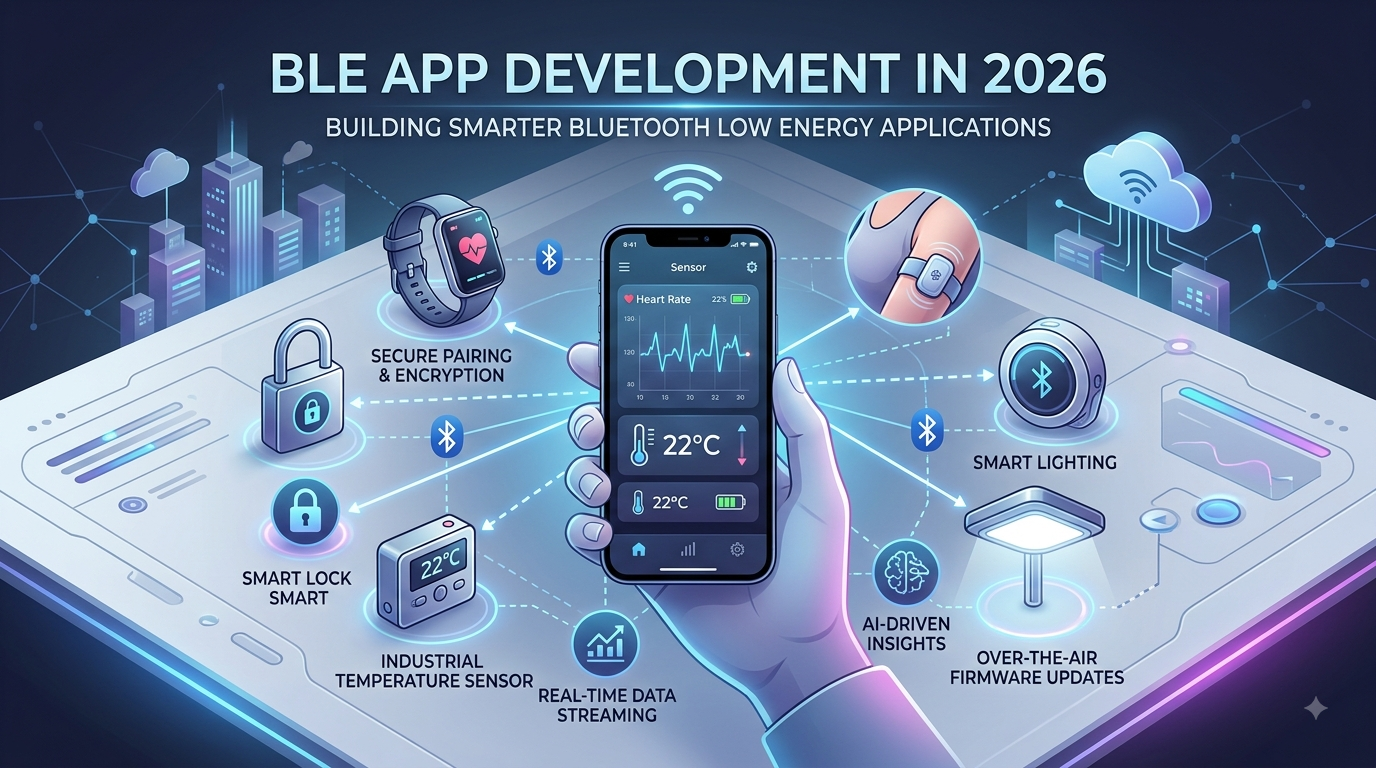
Bluetooth Low Energy (BLE) has become an important technology for connecting smartphones, smart devices, sensors, wearables, and IoT products. In 2026, BLE app development is moving beyond basic device pairing toward intelligent, secure, and highly connected applications.
BLE’s low power requirements make it especially useful for battery-powered devices such as fitness trackers, healthcare sensors, smart locks, industrial sensors, and connected consumer products. Modern mobile platforms also provide built-in BLE support for discovering nearby devices, accessing services, and exchanging data.
For businesses building connected products, a well-designed BLE application can become the bridge between physical hardware and digital experiences.
What Is BLE App Development?
BLE app development involves creating mobile or software applications that communicate with Bluetooth Low Energy-enabled devices.
A BLE application can:
- Discover nearby devices
- Connect and disconnect from devices
- Read device information
- Exchange sensor data
- Send commands to hardware
- Monitor device status
- Synchronize data with cloud platforms
- Provide real-time notifications
Unlike traditional Bluetooth applications, BLE solutions are optimized for low-power communication and are well suited to devices that need long battery life.
Why BLE App Development Matters in 2026
BLE is being used across healthcare, retail, smart homes, fitness, logistics, automotive, and industrial IoT.
The technology is particularly valuable when businesses need reliable short-range communication without placing a heavy power burden on connected hardware.
Current Bluetooth industry developments are also expanding possibilities around device ranging and spatial awareness, including Bluetooth Channel Sounding, which is designed to provide more accurate distance awareness between connected devices.
Key Features of a Modern BLE Application
1. Device Discovery and Pairing
A BLE app should be able to scan for compatible devices and establish a reliable connection.
The application can identify devices based on their advertising information and then connect to the appropriate hardware.
2. Real-Time Data Communication
BLE applications can receive information from sensors and connected devices in real time.
Examples include:
- Heart-rate data
- Temperature readings
- Motion information
- Battery status
- Equipment status
- Location-related information
This makes BLE particularly useful for monitoring and automation applications.
3. Secure Device Communication
Security should be included from the beginning of BLE application development.
Depending on the use case, developers may need to implement:
- Secure pairing
- Authentication
- Encryption
- Access control
- Secure APIs
- Application-layer protection
Android documentation specifically notes that applications handling sensitive BLE data should implement application-layer security to protect that information.
4. Background Connectivity
Many BLE products need to continue communicating with devices while the user is not actively interacting with the application.
Developers therefore need to carefully manage:
- Background execution
- Connection states
- Notifications
- OS restrictions
- Battery consumption
The implementation can differ significantly between iOS and Android.
5. Firmware and OTA Updates
Some connected products require firmware updates after deployment.
A BLE application can be designed to support secure over-the-air firmware updates, allowing manufacturers to improve device functionality without requiring customers to physically access the hardware.
Major BLE App Development Use Cases
Healthcare and Medical Devices
BLE is widely suited to low-power health and wellness devices.
Applications can support:
- Remote monitoring
- Fitness tracking
- Wearable devices
- Connected medical equipment
- Patient-related monitoring systems
For medical applications, developers must also consider the additional security, privacy, regulatory, and reliability requirements of the specific product.
Smart Wearables
Smartwatches, fitness trackers, sports sensors, and other wearables rely heavily on efficient wireless communication.
BLE allows these devices to exchange information with smartphones while conserving battery power.
Smart Home Applications
BLE applications can control and monitor connected home devices such as:
- Smart locks
- Sensors
- Lighting
- Temperature devices
- Security equipment
- Connected appliances
A mobile application can provide users with a central interface for interacting with these devices.
Industrial IoT
Industrial businesses can use BLE-enabled sensors to monitor equipment and operational conditions.
Potential applications include:
- Asset tracking
- Equipment monitoring
- Predictive maintenance
- Worker safety
- Environmental monitoring
- Warehouse operations
BLE Mesh can also support larger connected environments where many devices need to communicate across an area.
Retail and Proximity Applications
BLE beacons and connected devices can support:
- Indoor navigation
- Proximity notifications
- Customer engagement
- Store analytics
- Location-aware experiences
Retail businesses can combine BLE data with mobile applications and analytics platforms to create more personalized experiences.
Automotive Applications
BLE can support several automotive experiences, including device connectivity, digital keys, access systems, and personalized interactions.
Bluetooth’s continued development around ranging and distance awareness could create additional opportunities for secure and context-aware automotive experiences.
BLE App Development for iOS and Android
Cross-platform BLE development requires careful consideration because the operating systems handle Bluetooth communication differently.
iOS BLE Development
Apple’s Core Bluetooth framework provides the foundation for communicating with BLE peripherals on iOS applications.
Developers need to consider:
- Bluetooth permissions
- Background behavior
- Connection management
- Service discovery
- Data handling
- App lifecycle
Android BLE Development
Android provides APIs that allow applications to discover nearby BLE devices, query services, and exchange information.
Android development also requires attention to permissions, device fragmentation, background restrictions, and different hardware implementations.
BLE and IoT Integration
BLE applications become even more powerful when integrated with IoT platforms.
A typical architecture can look like:
BLE Device → Mobile App/Gateway → Cloud Platform → Database → Analytics Dashboard
This architecture allows businesses to collect device information and transform it into useful operational data.
Cloud integration can provide:
- Centralized device management
- Remote monitoring
- Data storage
- Analytics
- Alerts
- Reporting
- Multi-device management
BLE and AI
Artificial intelligence is creating new opportunities for BLE applications.
Instead of simply displaying sensor data, AI can analyze device information to identify patterns and generate useful insights.
Potential applications include:
- Predictive maintenance
- Personalized fitness recommendations
- Smart alerts
- Anomaly detection
- Usage prediction
- Automated device behavior
The combination of BLE, IoT, and AI can transform a connected product into an intelligent system.
BLE App Development Challenges
Developing a reliable BLE application requires more than implementing basic Bluetooth APIs.
Common challenges include:
Device Compatibility
Different hardware manufacturers can implement BLE services and characteristics differently.
Connection Reliability
Real-world environments may introduce interference, signal loss, or unexpected disconnects.
Battery Optimization
Poor scanning and connection strategies can unnecessarily consume device or smartphone battery.
Background Restrictions
iOS and Android impose different restrictions on background processing and Bluetooth activity.
Security
Applications handling sensitive information need appropriate security controls beyond simply establishing a BLE connection.
Testing
BLE applications should be tested with different phones, operating-system versions, hardware devices, signal conditions, and connection scenarios.
BLE App Development Process
A professional BLE development process generally includes the following stages.
Step 1: Requirement Analysis
Define the hardware, communication requirements, target platforms, user workflows, and business objectives.
Step 2: BLE Architecture
Identify services, characteristics, communication patterns, device roles, and security requirements.
Step 3: UI/UX Design
Create a simple interface for device setup, monitoring, controls, and data visualization.
Step 4: Mobile Development
Develop the iOS and/or Android application and integrate the required BLE functionality.
Step 5: Hardware Integration
Connect the application with the target BLE hardware and validate communication.
Step 6: Testing
Test connectivity, performance, battery usage, security, device compatibility, and real-world scenarios.
Step 7: Cloud and API Integration
If required, connect the BLE application to cloud services, databases, analytics, and business systems.
Step 8: Deployment and Maintenance
Launch the application and continue improving it through software updates, firmware updates, monitoring, and optimization.
How to Choose a BLE App Development Partner
Businesses should evaluate a development partner based on technical BLE experience rather than general mobile development skills alone.
Important areas include:
- BLE protocol knowledge
- iOS and Android experience
- Hardware integration
- IoT development
- Firmware understanding
- Security
- Cloud integration
- BLE testing
- Post-launch support
A strong development partner should understand both the mobile application and the physical device ecosystem.
The Future of BLE App Development
BLE development is moving toward smarter and more context-aware connected experiences.
Future applications will increasingly combine:
- BLE
- AI
- IoT
- Edge computing
- Cloud platforms
- Advanced positioning
- Smart sensors
- Real-time analytics
Bluetooth Channel Sounding is one example of how the ecosystem is evolving toward more precise distance awareness, potentially opening new possibilities for location and proximity-based applications.
Conclusion
BLE app development is becoming an important part of the connected-device ecosystem in 2026. Its low-power characteristics, mobile compatibility, and broad range of applications make it suitable for everything from wearables and healthcare devices to smart homes, retail systems, and industrial IoT.
For businesses developing a connected product, the right BLE architecture can improve reliability, battery efficiency, security, and user experience.
A successful BLE application should therefore be designed as part of the complete product ecosystem—connecting hardware, mobile applications, cloud platforms, and intelligent data services.
Suggested SEO Keywords: BLE app development, BLE app developer, Bluetooth Low Energy app development, BLE mobile app development, Bluetooth app development, BLE IoT development, BLE software development, BLE application development, iOS BLE development, Android BLE development, custom BLE app development