Introduction
Imagine a smart sensor that detects unusual machine vibrations before equipment fails, a wearable that recognizes changes in activity patterns, or a smart lock that identifies suspicious connection attempts. These applications demonstrate how Bluetooth Low Energy (BLE) can do more than connect devices—it can help businesses build smarter, data-driven products.
In 2026, BLE app development is evolving through the integration of Internet of Things (IoT), artificial intelligence (AI), cloud computing, and real-time analytics. Businesses are moving beyond basic Bluetooth connectivity toward applications that monitor device behavior, identify unusual patterns, and automate everyday operations.
For companies building connected products, the opportunity is clear: the next generation of BLE applications will focus not just on connectivity, but on what connected devices can learn from data.
What Is BLE App Development?
Bluetooth Low Energy app development involves building software that communicates with BLE-enabled hardware using energy-efficient wireless connections.
A BLE application can connect smartphones or tablets to sensors, wearables, smart locks, industrial equipment, medical devices, and other connected products.
Common capabilities include:
- Discovering and connecting to nearby BLE devices.
- Collecting real-time sensor data.
- Sending commands to compatible hardware.
- Monitoring device status and battery levels.
- Synchronizing information with cloud platforms.
- Supporting alerts, diagnostics, and device configuration.
- Enabling secure firmware updates where supported.
Unlike applications designed primarily for continuous, high-bandwidth media streaming, BLE applications are particularly useful for short-range communication with devices that need to conserve battery power.
1. From Connected Devices to Predictive Devices
Traditional BLE applications often display readings or let users control connected hardware. A more advanced approach combines BLE data collection with analytics to identify patterns and flag potential problems.
For example, consider a BLE-enabled industrial sensor attached to a machine.
The application could collect temperature and vibration readings, compare them against expected operating ranges, and flag unusual changes for inspection. With suitable historical data and a validated analytical model, it could also estimate the likelihood of equipment problems.
Potential applications include:
- Predictive maintenance for industrial equipment.
- Abnormal temperature detection in connected devices.
- Battery-performance monitoring.
- Wearable activity pattern analysis.
- Early warnings for sensor malfunctions.
AI does not automatically make a device predictive. Reliable results depend on sensor quality, sufficient data, appropriate models, and testing in real operating conditions.
2. BLE + AI: Turning Sensor Data Into Useful Insights
BLE provides a communication channel; AI can help interpret the information collected through that channel.
A connected product might use the following architecture:
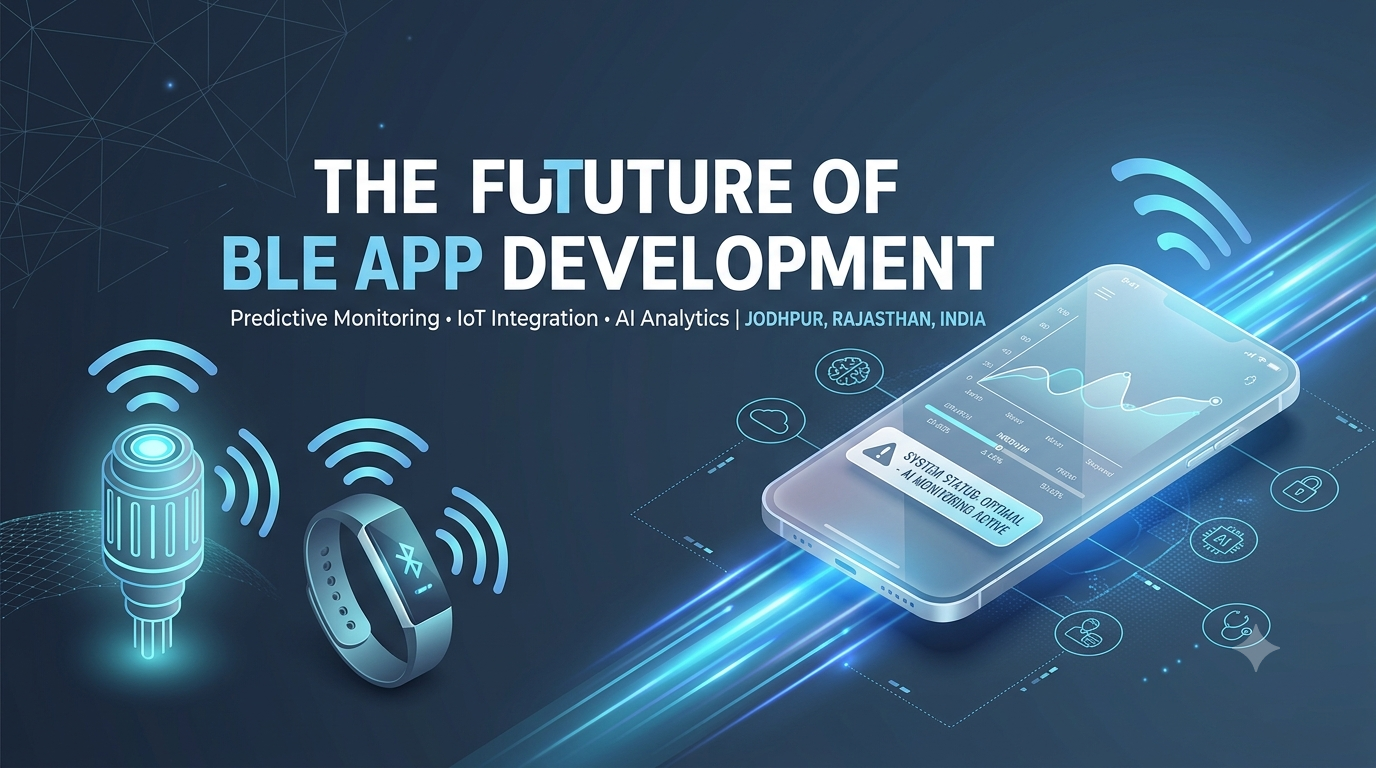
BLE Sensor → Mobile Application → Data Processing → AI Analytics → Actionable Alert
For example, a warehouse may deploy BLE sensors to monitor equipment temperature. The mobile application collects readings and sends selected data to an analytics platform. The platform identifies unusual patterns and notifies the maintenance team.
This combination can support:
- Anomaly detection.
- Intelligent notifications.
- Usage-pattern analysis.
- Predictive maintenance.
- Automated reporting.
- Personalized device experiences.
For privacy-sensitive applications, developers should carefully decide which data is processed locally and which information needs to be sent to the cloud.
3. Five Industries That Can Benefit From Smarter BLE Applications
Healthcare and Wearable Technology
BLE connects compatible wearable and medical devices to mobile applications for data collection, device configuration, and monitoring.
Depending on the product, applications may display heart-rate measurements, activity information, temperature readings, or other sensor data. Healthcare products require appropriate safeguards for privacy, reliability, and applicable regulatory requirements.
Industrial IoT and Manufacturing
Factories can use BLE-enabled sensors to monitor equipment, track assets, and collect operational data.
Applications can help technicians view readings, receive alerts, access diagnostic information, and synchronize maintenance records.
Smart Homes and Building Automation
BLE applications can support smart locks, lighting controls, environmental sensors, and other connected devices.
Developers can implement authorized device access, proximity-based interactions, configuration tools, and integration with broader automation systems.
Retail and Asset Tracking
BLE beacons and compatible tracking devices can help businesses understand proximity, monitor assets, and deliver location-aware experiences.
Retail applications may support indoor navigation, inventory workflows, and contextual notifications, subject to device capabilities and user permissions.
Automotive and Smart Access
BLE can support digital access experiences, device configuration, and communication between smartphones and compatible vehicle systems.
Secure authentication, connection reliability, and hardware compatibility are particularly important when developing access-control applications.
4. The Real Challenge: Making BLE Work Outside the Laboratory
A prototype may connect perfectly during a demonstration but behave differently in everyday environments. Successful BLE app development requires attention to the full hardware-software interaction.
Connection Reliability
Signal interference, distance, device state, and hardware differences can interrupt connections. Applications should handle disconnections gracefully and reconnect when appropriate.
iOS and Android Compatibility
Bluetooth permissions, background execution, scanning behavior, and operating-system restrictions differ between platforms. These differences must be considered during architecture and testing.
Battery Optimization
Frequent scanning and unnecessary communication can drain a phone or connected device’s battery. Developers should optimize scan intervals, connection behavior, and data transmission.
Data Synchronization
Applications must account for temporary connection loss, incomplete readings, duplicate events, and offline operation where required.
Security and Authentication
Sensitive applications may require secure pairing, encryption, user authentication, device authorization, and protected cloud APIs. Security should be part of the initial design rather than a last-minute addition.
5. Essential Features to Include in a Modern BLE App
Before beginning development, businesses should identify the capabilities their product actually needs.
A well-planned BLE application may include:
- Device discovery: Find compatible devices and identify the correct hardware.
- Reliable connectivity: Manage connection states and recovery after interruptions.
- Real-time monitoring: Display sensor readings and device status.
- Secure communication: Protect sensitive information and restrict unauthorized access.
- Battery management: Reduce unnecessary scanning and data exchange.
- Cloud integration: Synchronize data and support centralized monitoring.
- Device diagnostics: Help users or technicians investigate connection and hardware issues.
- Firmware updates: Support secure over-the-air updates when the device architecture allows them.
- Analytics dashboards: Present meaningful trends and operational insights.
The best feature set depends on the product, target users, hardware capabilities, and business goals.
6. How to Build a BLE Application: A Practical Roadmap
A structured development process reduces integration problems and helps businesses validate product requirements early.
Step 1: Define the product requirements
Identify the target devices, required Bluetooth services, data types, user workflows, and expected operating conditions.
Step 2: Validate the hardware
Test the BLE module, firmware, supported characteristics, connection behavior, and communication range.
Step 3: Design the application architecture
Choose the appropriate native or cross-platform approach for iOS and Android, based on performance, compatibility, and maintenance requirements.
Step 4: Develop connectivity features
Implement device scanning, connection management, service discovery, data exchange, notifications, and error handling.
Step 5: Integrate cloud services if needed
Add secure APIs, databases, dashboards, analytics, or remote device-management capabilities where required.
Step 6: Test with real devices
Test different phone models, operating-system versions, signal conditions, battery levels, disconnections, and recovery scenarios.
Step 7: Deploy and maintain
Release the application, monitor performance, resolve compatibility issues, and plan ongoing app and firmware updates.
7. How to Choose the Right BLE App Development Company
Choosing a development partner requires more than checking its general mobile application portfolio. BLE products involve hardware protocols, operating-system behavior, and real-world connectivity challenges.
Evaluate potential development partners based on their experience with:
- Bluetooth Low Energy protocols and GATT services.
- iOS and Android Bluetooth APIs.
- Hardware and firmware integration.
- IoT platforms and cloud services.
- Secure device communication.
- Connection and battery optimization.
- Testing across physical devices.
- Long-term maintenance and product updates.
Ask how the team plans to test your specific hardware, handle unexpected disconnections, protect device data, and support future firmware changes.
At BLEAppDevelopers, the goal is to help businesses turn connected-device concepts into practical BLE applications designed around their hardware, users, and operational requirements.
Frequently Asked Questions
What is the difference between BLE and traditional Bluetooth?
BLE is optimized for energy-efficient communication, making it suitable for sensors, wearables, and connected devices that exchange relatively small amounts of data. Traditional Bluetooth is commonly associated with applications such as continuous audio streaming.
Can a BLE app work on both iOS and Android?
Yes. BLE applications can support both platforms, but developers must account for differences in permissions, background execution, Bluetooth APIs, and device compatibility.
Can BLE applications use artificial intelligence?
Yes. BLE applications can collect sensor data that is analyzed using AI or machine-learning models. Depending on the architecture, processing can happen on the device, in the mobile application, or in the cloud.
How much does BLE app development cost?
The cost depends on hardware complexity, supported platforms, firmware requirements, security, cloud integration, testing, and ongoing maintenance. A simple device-control application generally requires less work than a connected product with multiple sensors and advanced analytics.
How long does it take to develop a BLE app?
The timeline depends on the number of features, hardware readiness, platform requirements, and testing complexity. A prototype may take considerably less time than a production-ready application requiring extensive device compatibility and security testing.
Conclusion
The future of BLE app development is about building connected products that deliver measurable value—not simply establishing a Bluetooth connection.
By combining reliable connectivity with IoT integration, thoughtful analytics, and appropriate AI capabilities, businesses can create applications that improve monitoring, automate workflows, and make connected devices more useful.
Whether you are developing a wearable, industrial sensor, smart access system, or connected consumer product, a strong BLE architecture is essential for reliability, security, and scalability.
Looking to develop a custom BLE application? Visit BLEAppDevelopers to explore Bluetooth Low Energy app development solutions tailored to your connected product.
Suggested URL slug: ble-app-development-predictive-connected-devices
Meta title: BLE App Development in 2026: Smarter Connected Devices
Meta description: Discover how BLE app development combines Bluetooth Low Energy, IoT, and AI to build smarter connected devices, predictive monitoring, and secure mobile applications.
Primary keyword: BLE app development
Secondary keywords: BLE app developers, Bluetooth Low Energy app development, custom BLE application development, BLE IoT integration, AI-powered BLE applications, iOS and Android BLE development.