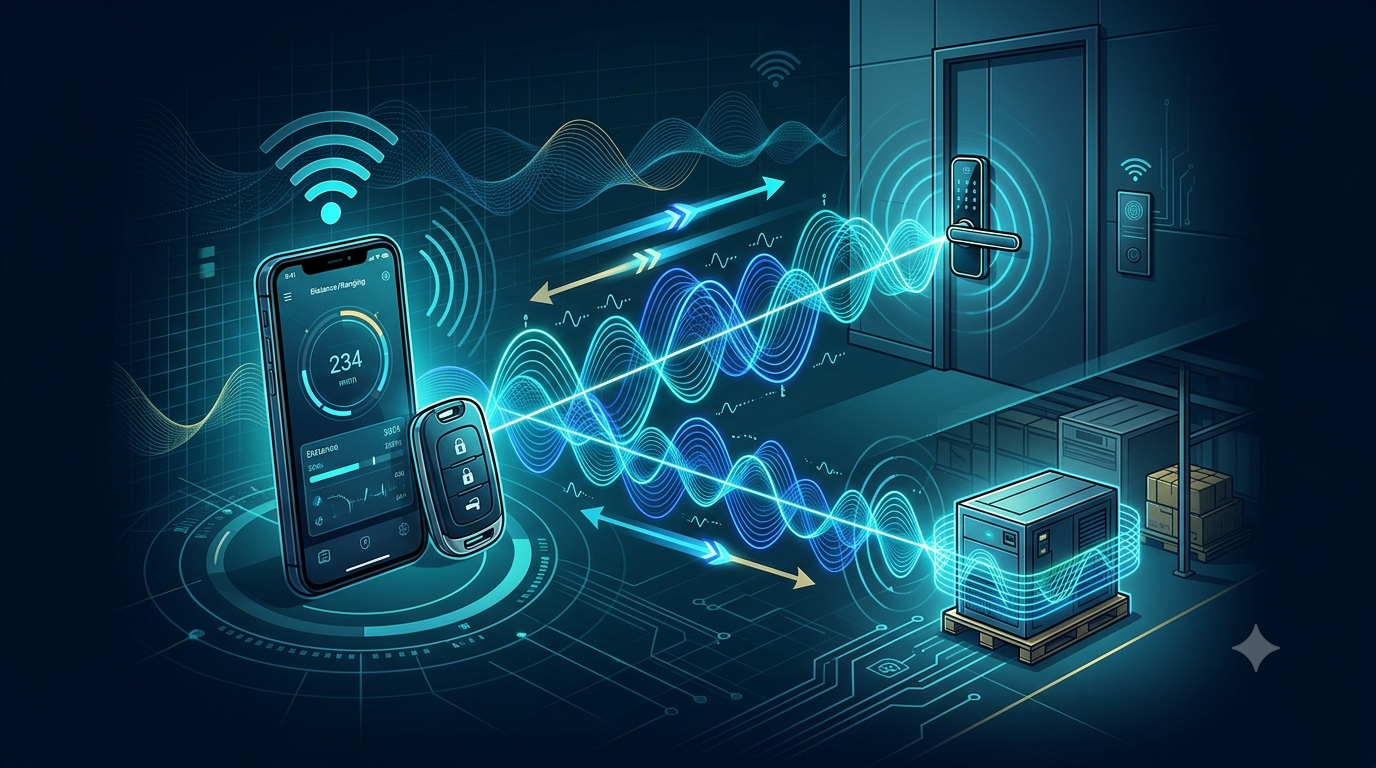
Bluetooth Low Energy (BLE) has become an essential technology for connecting smartphones with smart devices, wearables, industrial sensors, and IoT products. Traditionally, BLE applications have used signal strength to estimate how close a device might be. However, signal strength can fluctuate because of walls, interference, device orientation, and surrounding objects.
Bluetooth LE Channel Sounding introduces a different approach to distance measurement. It enables supported Bluetooth devices to estimate distance more accurately using radio-frequency measurements.
For businesses developing connected products, this technology creates new opportunities in digital keys, asset tracking, smart access systems, and proximity-based mobile applications.
What Is Bluetooth LE Channel Sounding?
Bluetooth LE Channel Sounding is a Bluetooth technology designed to measure the distance between two compatible devices.
Unlike traditional proximity detection, which often relies on Received Signal Strength Indicator (RSSI), Channel Sounding uses techniques including:
- Phase-Based Ranging (PBR): Uses the phase of radio signals across multiple frequencies to help estimate distance.
- Round-Trip Timing (RTT): Measures the time taken for signals to travel between devices and return.
These techniques can provide more reliable distance estimates than RSSI-based proximity alone, depending on the environment and implementation.
Bluetooth SIG has highlighted Channel Sounding as an important development for applications involving secure distance awareness and connected-device experiences. BLE App Developers+1
Why Channel Sounding Matters for BLE App Development
Traditional BLE applications can identify nearby devices, exchange information, and estimate proximity. However, knowing that a device is nearby does not always tell an application how far away it actually is.
For example, a smart access application might detect a digital key but still need a better way to determine whether the user is standing directly beside the door or several meters away.
Channel Sounding can help address this challenge.
Potential benefits include:
- More precise distance estimation between compatible devices.
- Better proximity-based user experiences.
- Additional security options for supported access-control systems.
- Improved asset-finding experiences.
- New possibilities for location-aware applications.
Actual performance depends on hardware support, device implementation, radio conditions, and software design.
5 Applications of Bluetooth LE Channel Sounding
1. Smart Digital Keys
Digital keys allow users to unlock compatible doors using smartphones or other connected devices.
Channel Sounding can help a system evaluate the distance between a mobile device and a smart lock.
Possible applications include:
- Smart home door locks
- Automotive digital keys
- Office access systems
- Hotel room access
- Secure equipment cabinets
Developers can integrate distance-aware logic into mobile applications to support a more controlled access experience.
2. Smart Asset Tracking
Businesses often need to locate equipment, tools, and valuable assets across warehouses, offices, and industrial facilities.
Traditional BLE tracking can identify nearby tags, but signal strength alone may not provide dependable distance information.
Channel Sounding could support more precise finding experiences when compatible hardware is deployed.
For example, an asset-tracking application could help an employee locate a tagged device inside a facility.
3. Retail and Indoor Navigation
Retail businesses can use connected devices to improve customer experiences and operational visibility.
Potential applications include:
- Finding products inside large stores
- Locating shopping carts
- Managing connected equipment
- Supporting proximity-based interactions
- Improving indoor navigation experiences
Channel Sounding may complement existing beacon and positioning technologies rather than replace every indoor-location system.
4. Industrial Equipment Monitoring
Factories and warehouses use connected sensors, tools, and machines that need to be monitored and managed.
BLE applications incorporating distance-aware capabilities could support equipment identification, proximity alerts, and workflow improvements.
For example, an application could help workers identify the approximate distance to a compatible tagged tool or machine.
5. Connected Consumer Products
Consumer electronics manufacturers can explore Channel Sounding for products that need more intelligent proximity interactions.
Examples include:
- Smart accessories
- Connected home products
- Wireless device management
- Personal item finders
- Smart storage systems
These experiences depend on compatible hardware and supported operating-system capabilities.
Channel Sounding vs. Traditional BLE RSSI
Both technologies can help applications understand device proximity, but they work differently.
| Feature | Traditional BLE RSSI | BLE Channel Sounding |
|---|---|---|
| Measurement approach | Signal strength | Radio phase and timing measurements |
| Distance estimation | Approximate | Designed for more accurate ranging |
| Environmental sensitivity | Can be highly affected by obstacles | Also affected by radio conditions, but uses different measurement techniques |
| Hardware support | Widely available in BLE devices | Requires compatible hardware |
| Common applications | Device discovery and proximity | Distance-aware experiences and ranging |
RSSI remains useful for many BLE applications. Channel Sounding is an additional option when a product requires more dependable distance measurement.
How to Integrate Channel Sounding into a BLE Mobile Application
Building an application around Channel Sounding requires coordination between hardware, firmware, Bluetooth communication, and mobile software.
Step 1: Define the Product Requirements
Start by identifying the problem the application needs to solve.
For example:
- Does the application need to estimate distance?
- Will it control a smart lock?
- Does it need to locate tagged assets?
- Should it trigger alerts when a device approaches or moves away?
Clear requirements help determine the appropriate hardware and software architecture.
Step 2: Select Compatible BLE Hardware
Not every Bluetooth-enabled device supports Channel Sounding.
The hardware must support the relevant Bluetooth capabilities, and both communicating devices need compatible implementations.
Developers should confirm chipset, firmware, and platform support before starting integration.
Step 3: Plan the BLE Communication Architecture
The application architecture may include:
- BLE device discovery
- Device identification
- Secure connection establishment
- Channel Sounding procedures
- Measurement processing
- Distance estimation
- Application-level decision logic
Step 4: Develop the Mobile Application
The mobile application provides the interface for users to interact with connected devices.
Depending on the product, it may include:
- Device discovery and registration
- Connection status
- Distance information
- Proximity notifications
- Device configuration
- User authentication
- Activity history
Step 5: Implement Security
Distance measurement should not be treated as complete authentication.
For applications involving digital keys or physical access, developers should combine appropriate ranging capabilities with authentication, authorization, secure pairing, and access-control policies.
Step 6: Test on Real Devices
Testing should include different device positions, orientations, distances, and environmental conditions.
Developers should also evaluate:
- Measurement consistency
- Connection reliability
- Battery consumption
- Hardware compatibility
- Interference
- Security behavior
- Mobile operating-system limitations
Challenges Businesses Should Consider
Although Channel Sounding offers new possibilities, businesses should evaluate several technical considerations before adopting it.
Hardware compatibility: Existing BLE devices may not support Channel Sounding. Product hardware may need to be updated.
Mobile platform support: Availability depends on the phone’s hardware, operating system, and exposed APIs.
Environmental conditions: Radio signals can be affected by physical surroundings, so real-world validation is essential.
Security architecture: Ranging should be integrated into a broader security design, particularly for access-control applications.
Battery performance: Developers need to balance measurement frequency, communication requirements, and power consumption.
Planning these factors early can help reduce development risks and improve product reliability.
Why Choose Professional BLE App Developers?
Channel Sounding-based products require more than standard mobile application development. Businesses need a development team that understands Bluetooth communication, hardware integration, firmware behavior, and mobile operating systems.
BLEAppDevelopers can help businesses plan and develop custom Bluetooth Low Energy applications involving:
- Android BLE app development
- iOS BLE app development
- Bluetooth device integration
- BLE GATT communication
- Smart device connectivity
- BLE asset tracking applications
- Proximity-based mobile applications
- IoT and cloud integration
- BLE application testing and optimization
A well-planned development process helps connect hardware capabilities with practical business requirements.
The Future of BLE Distance-Aware Applications
Bluetooth technology is continuing to expand beyond basic wireless communication. Channel Sounding, High Data Throughput, and other developments are creating opportunities for more advanced connected-device experiences. BLE App Developers+1
As compatible hardware becomes more widely adopted, developers may be able to build new applications for smart access, asset tracking, industrial operations, and connected consumer products.
For businesses planning their next IoT product, understanding these capabilities can help identify valuable opportunities for innovation.
Conclusion
Bluetooth LE Channel Sounding represents an important development for applications that need more accurate distance awareness between compatible devices.
From smart digital keys and asset tracking to industrial equipment and connected consumer products, it creates new possibilities for BLE mobile application development.
However, successful implementation requires compatible hardware, suitable firmware, secure communication, and thorough real-device testing.
Planning a Bluetooth-enabled product? Contact BLEAppDevelopers to explore custom BLE mobile application development and hardware integration solutions.
Frequently Asked Questions
1. What is Bluetooth LE Channel Sounding?
Bluetooth LE Channel Sounding is a technology that allows compatible Bluetooth devices to estimate the distance between them using radio-frequency measurement techniques.
2. How is Channel Sounding different from RSSI?
RSSI estimates proximity using received signal strength. Channel Sounding uses phase-based and timing-based measurements to provide a more accurate ranging approach.
3. Does every BLE device support Channel Sounding?
No. Both devices need compatible hardware and software implementations that support the feature.
4. Can Channel Sounding be used for digital keys?
Yes. It can support distance-aware digital key experiences when integrated with compatible hardware and appropriate security mechanisms.
5. Is Channel Sounding useful for asset tracking?
It can support more precise finding experiences for compatible tagged assets, depending on the deployment and hardware.
6. Can businesses build custom Channel Sounding applications?
Yes. Businesses can develop custom mobile applications around supported Bluetooth hardware, firmware, and platform capabilities.
7. Why is professional BLE development important?
Professional BLE developers can help with hardware compatibility, communication protocols, mobile integration, security, testing, and application performance.