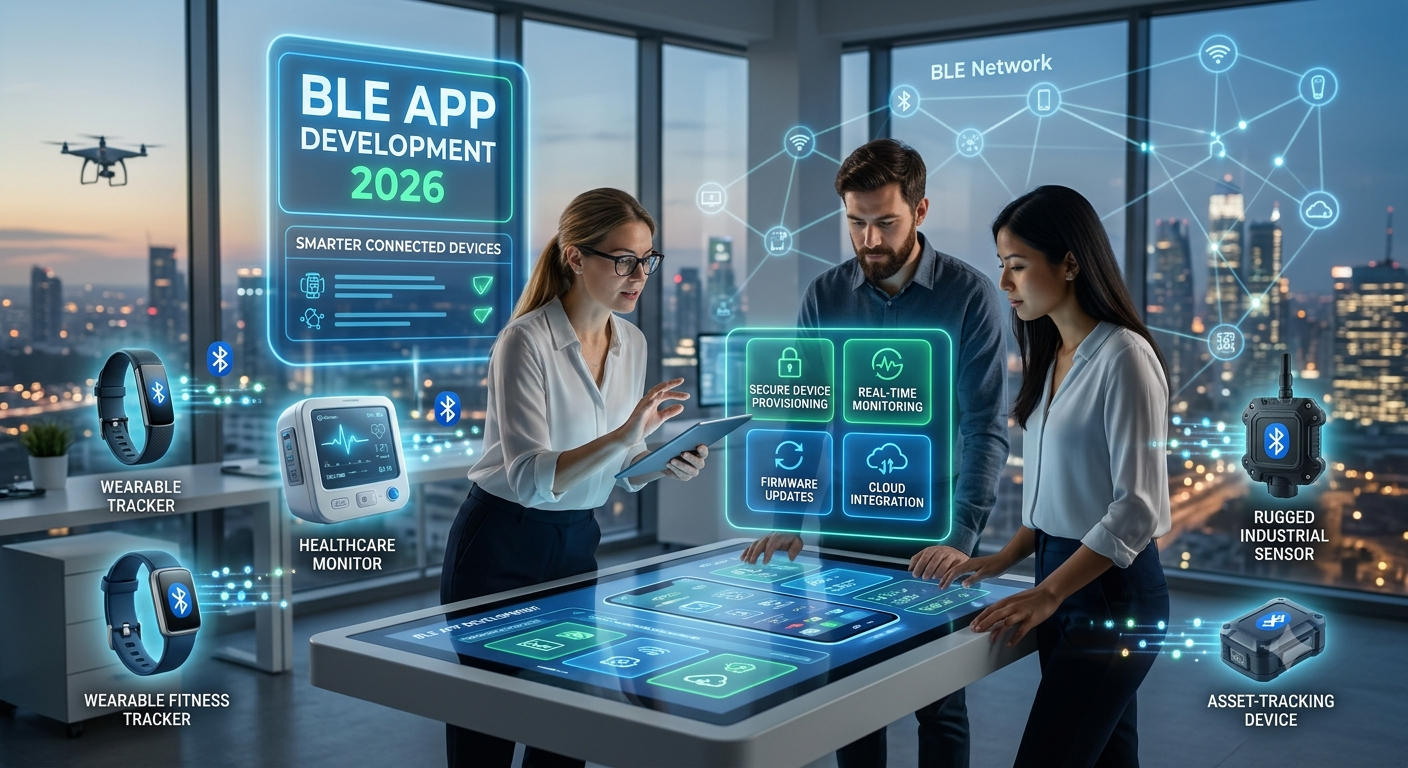
Bluetooth Low Energy (BLE) is becoming an essential technology for businesses building smart, connected products. From wearable devices and healthcare equipment to industrial sensors and asset-tracking systems, BLE enables mobile applications to communicate with nearby devices while supporting energy-efficient wireless connectivity.
In 2026, BLE app development is evolving beyond basic device pairing. Businesses increasingly need secure device provisioning, real-time sensor monitoring, reliable mobile connectivity, firmware updates, and integration with cloud platforms.
For companies planning a new connected product, working with experienced BLE app developers can help transform a hardware concept into a practical, scalable, and user-friendly application.
What Is BLE App Development?
BLE app development involves creating mobile applications that communicate with Bluetooth Low Energy-enabled devices. These applications can discover nearby peripherals, establish connections, exchange data, configure device settings, and display information collected by sensors.
Unlike traditional Bluetooth applications designed for use cases such as continuous audio streaming, BLE is particularly suitable for devices that transmit relatively small amounts of data and need to conserve battery power.
A typical BLE mobile application may include:
- Bluetooth device discovery and pairing
- Sensor data collection and visualization
- Device configuration and remote controls
- Real-time notifications and alerts
- Secure device authentication
- Firmware update workflows
- Cloud synchronization and reporting
- Multiple-device management
The exact features depend on the product’s purpose, hardware capabilities, and target users.
1. Latest BLE App Development Trends in 2026
The BLE ecosystem continues to evolve as businesses look for more accurate device interactions, better energy efficiency, and smarter connected experiences.
Bluetooth Channel Sounding and Precise Ranging
Bluetooth Channel Sounding supports standardized distance-measurement techniques using compatible devices. It can enable more precise ranging than approaches that rely only on received signal strength.
Potential applications include digital keys, item finding, access control, and industrial asset visibility.
Developers should confirm hardware, operating-system, and Bluetooth-stack support before incorporating Channel Sounding into an application.