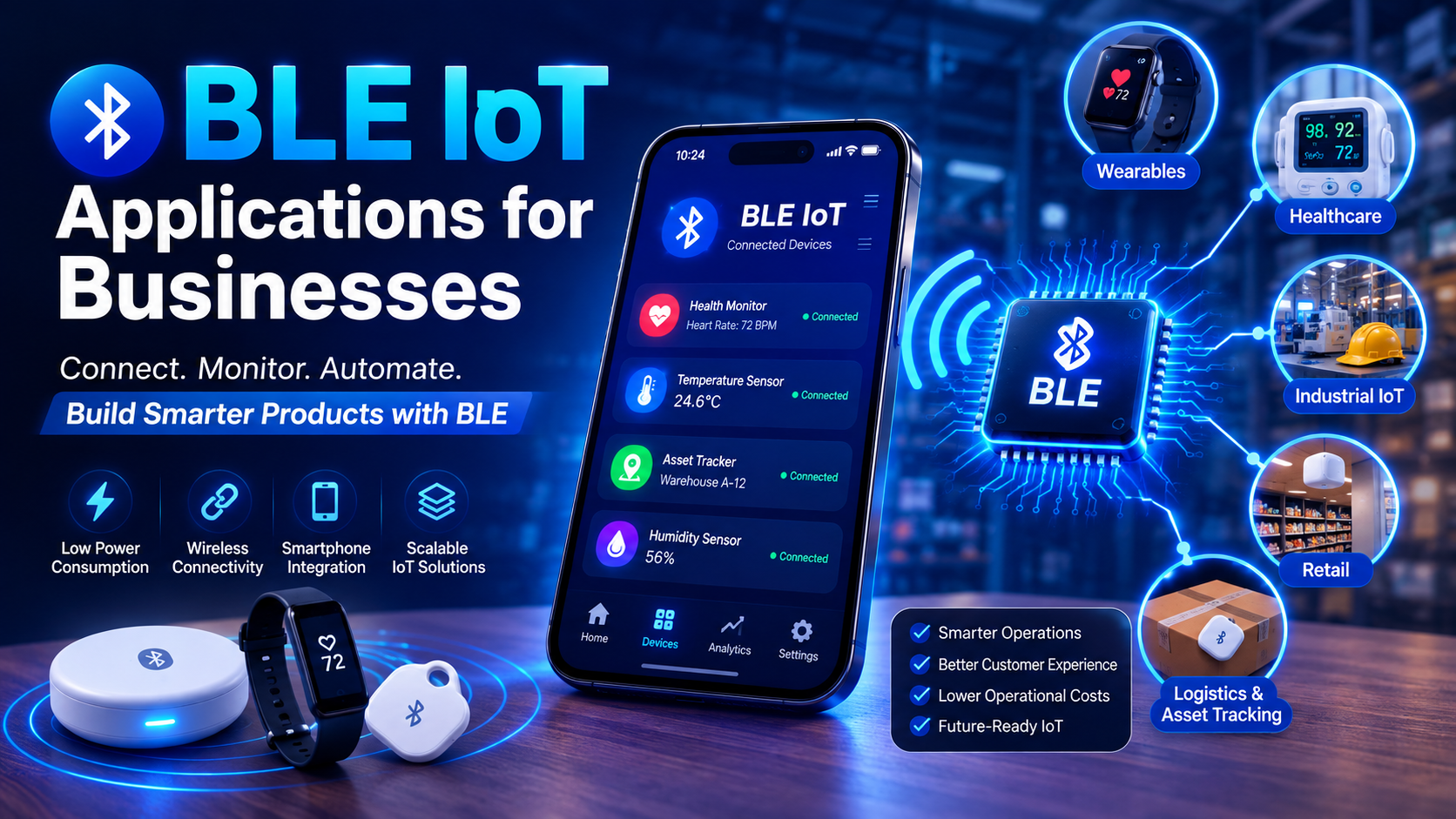
Bluetooth Low Energy (BLE) has evolved far beyond simple wireless connectivity between smartphones and accessories.
Today, businesses are using BLE IoT applications to connect sensors, devices, wearables, industrial equipment, healthcare products, retail systems, and smart-building infrastructure.
The reason is straightforward: BLE offers low power consumption, short-range wireless communication, broad smartphone support, and a flexible foundation for connected-device applications.
When BLE is combined with cloud platforms, mobile applications, edge computing, and IoT analytics, it can become an important part of a complete connected-product architecture.
A typical BLE IoT architecture can look like:
BLE Device → Mobile App / Gateway → Cloud Platform → Database → Analytics / Business System
This article explores how businesses are using Bluetooth Low Energy for IoT, the most important applications, technical architecture, development considerations, and how to build scalable BLE IoT solutions.
What Is BLE IoT?
BLE IoT refers to the use of Bluetooth Low Energy technology to connect physical devices, sensors, and equipment to applications and IoT platforms.
A BLE-enabled device can collect information such as:
- Temperature
- Humidity
- Motion
- Proximity
- Battery status
- Location-related data
- Pressure
- Heart rate
- Equipment status
- Environmental measurements
The device can then communicate this information through BLE.
Depending on the architecture, the BLE data can be processed by:
- A smartphone
- Tablet
- Dedicated gateway
- Edge device
- Embedded controller
- IoT gateway
The information can subsequently be transferred to a cloud platform for storage, processing, analytics, automation, or monitoring.
Why Businesses Are Using BLE for IoT
BLE is particularly useful when IoT devices need to communicate wirelessly while consuming minimal power.
Some of the key advantages include:
Low Power Consumption
BLE was designed for applications where battery efficiency matters.
This makes it suitable for sensors, trackers, wearables, and other battery-powered devices.
Smartphone Compatibility
Modern smartphones generally support BLE, making a smartphone a practical gateway for many connected-device applications.
Cost-Effective Hardware
BLE modules and chipsets are available across a wide range of embedded platforms.
This makes BLE attractive for startups as well as enterprise IoT deployments.
Wireless Connectivity
BLE eliminates the need for physical connections between compatible devices.
Flexible Communication
BLE supports different communication patterns depending on the product architecture, including advertising, scanning, connections, services, and characteristics.
Suitable for Small Data Transfers
Many IoT sensors transmit relatively small amounts of data.
BLE can be an effective communication technology for these scenarios.
How a BLE IoT System Works
A typical BLE IoT application involves several layers.
Layer 1: BLE Device
The physical device contains a BLE-capable chipset and one or more sensors.
For example:
Temperature Sensor → BLE Chip → Wireless Advertisement
The device may periodically broadcast information or establish a connection with another BLE device.
Layer 2: Mobile Application or Gateway
A mobile application can scan for nearby BLE devices and communicate with them.
The application can:
- Discover devices
- Connect to devices
- Read characteristics
- Write configuration values
- Subscribe to notifications
- Monitor signal strength
- Process sensor data
- Send data to the cloud
Alternatively, a dedicated IoT gateway can perform these functions.
Layer 3: Cloud Backend
The gateway or mobile application can send data to a backend through Wi-Fi, cellular connectivity, or another internet connection.
The backend can provide:
- Data storage
- Device management
- Authentication
- Analytics
- Alerts
- Reporting
- APIs
- User management
Layer 4: Business Application
The final layer transforms IoT data into something useful for the business.
For example:
Sensor Data → Analytics → Maintenance Alert
or:
BLE Device → Mobile App → Cloud → Customer Dashboard
This is where BLE IoT becomes a business solution rather than simply a connectivity feature.
Major BLE IoT Applications for Businesses
1. Healthcare and Medical Devices
BLE is widely suited to connected healthcare products where low-power communication and mobile connectivity are important.
Potential applications include:
- Patient monitoring
- Wearable health devices
- Fitness equipment
- Blood pressure devices
- Temperature monitoring
- Glucose-related devices
- Medical equipment monitoring
A BLE-enabled healthcare device can transmit measurements to a mobile application, where authorized information can be displayed and processed.
A more advanced architecture can connect:
Medical Device → BLE → Mobile Gateway → Secure Cloud → Healthcare Dashboard
For healthcare applications, however, security, privacy, regulatory requirements, and data handling need to be considered from the beginning.
2. Industrial IoT
BLE can also be used in industrial environments for selected monitoring and asset-management scenarios.
Industrial BLE IoT applications can include:
- Equipment monitoring
- Asset tracking
- Temperature monitoring
- Predictive maintenance
- Worker safety
- Inventory monitoring
- Machine-status monitoring
- Environmental sensing
For example, a sensor attached to equipment can periodically transmit operating information.
The gateway collects the data and sends it to an industrial IoT platform.
The platform can then identify unusual patterns.
A simplified workflow is:
BLE Sensor → Gateway → Cloud → Analytics → Maintenance Alert
This can help businesses move from reactive maintenance toward data-driven maintenance strategies.
3. Asset Tracking
Businesses often need to know where equipment, tools, inventory, or other assets are located.
BLE beacons and tags can provide a relatively practical way to build asset-monitoring systems.
Potential applications include:
- Warehouse assets
- Hospital equipment
- Industrial tools
- Retail inventory
- Office equipment
- Logistics assets
BLE-based tracking can use information such as:
- Device identifier
- RSSI
- Gateway location
- Beacon information
- Timestamp
For more sophisticated location systems, BLE can be combined with technologies such as Bluetooth Direction Finding.
4. Smart Retail
BLE can create connected retail experiences.
Retail businesses can use BLE for:
- Indoor proximity experiences
- Product information
- Customer engagement
- Asset monitoring
- Inventory-related applications
- Store analytics
- Smart shelves
For example, BLE beacons can transmit identifiers that a compatible application can detect.
A mobile application can then use that information to trigger an appropriate experience.
However, businesses should design these systems carefully around user consent and privacy.
5. Smart Buildings
BLE IoT technology can support connected-building applications.
Examples include:
- Occupancy monitoring
- Access systems
- Indoor navigation
- Environmental monitoring
- Smart lighting
- Asset tracking
- Room management
A BLE-enabled system could collect information from sensors distributed throughout a building.
That data can then be combined with other building-management systems.
For example:
BLE Sensors + Cloud Platform + Building Management System
This architecture can provide a more connected view of building operations.
6. Wearable Technology
Wearables are one of the natural use cases for BLE.
Examples include:
- Smartwatches
- Fitness trackers
- Health wearables
- Industrial wearables
- Safety devices
- Location tags
- Smart accessories
A mobile application can act as the bridge between the wearable and the cloud.
For example:
Wearable → BLE → Smartphone → Internet → Cloud
The application can synchronize data, configure the device, display information, and send updates back to the wearable.
7. Logistics and Supply Chain
BLE IoT can also contribute to logistics operations.
Potential use cases include:
- Asset tracking
- Cold-chain monitoring
- Warehouse monitoring
- Temperature tracking
- Equipment tracking
- Shipment monitoring
For example, a BLE temperature sensor attached to a shipment can periodically record environmental conditions.
A gateway can collect the information and send it to the cloud.
If the temperature exceeds a defined threshold, the backend can generate an alert.
8. Smart Agriculture
BLE sensors can be used in selected agricultural environments.
Potential applications include:
- Temperature monitoring
- Humidity sensing
- Equipment monitoring
- Greenhouse monitoring
- Environmental data collection
BLE can be particularly useful where sensors need to operate on batteries for extended periods.
For large outdoor deployments, however, businesses should evaluate BLE alongside technologies such as LoRaWAN, cellular IoT, Wi-Fi, or other connectivity options.
The correct technology depends on:
- Range
- Data volume
- Power requirements
- Deployment environment
- Infrastructure
- Cost
9. Hospitality and Smart Hotels
Hotels can use BLE to create connected guest experiences.
Applications may include:
- Mobile room access
- Indoor navigation
- Guest services
- Asset tracking
- Staff management
- Smart-room controls
A smartphone can communicate with BLE-enabled locks or room devices.
The backend can then manage authentication and access permissions.
Security is particularly important for applications involving physical access.
10. Automotive and Mobility Applications
BLE can also be integrated into automotive and mobility ecosystems.
Potential applications include:
- Digital keys
- Vehicle accessories
- Driver identification
- Asset tracking
- Fleet applications
- Maintenance devices
A mobile application can communicate with a BLE-enabled vehicle component or accessory and exchange authorized information.
BLE Beacons in IoT Applications
BLE beacons are small devices that periodically broadcast Bluetooth packets.
They are useful for applications involving proximity and location awareness.
A typical architecture looks like:
Beacon → Smartphone → Application → Backend
Possible applications include:
- Indoor navigation
- Retail proximity
- Museum experiences
- Asset identification
- Event management
- Location-aware applications
The important distinction is that beacons generally broadcast information rather than functioning like traditional connected BLE peripherals.
BLE GATT: The Core of Many BLE Applications
Developers building BLE applications need to understand the Generic Attribute Profile (GATT).
GATT defines how data is organized and exchanged between BLE devices.
The basic structure includes:
Profile → Service → Characteristic → Value
For example:
Device
→ Battery Service
→ Battery Level Characteristic
→ Battery Percentage
Another device could expose a custom service:
Custom Service
→ Temperature Characteristic
→ Sensor Value
The mobile application can discover these services and characteristics and then perform operations such as:
- Read
- Write
- Notify
- Indicate
Understanding GATT is essential when developing reliable BLE applications.
BLE Advertising vs BLE Connections
BLE applications commonly use two different communication approaches.
Advertising
A BLE peripheral can periodically broadcast packets without establishing a connection.
This can be useful for:
- Beacons
- Discovery
- Sensor broadcasts
- Presence detection
Connected Communication
A central device can establish a BLE connection with a peripheral.
This can enable:
- Reading characteristics
- Writing commands
- Receiving notifications
- Device configuration
- Data synchronization
The correct approach depends on the application’s requirements.
BLE IoT Mobile App Architecture
A modern BLE IoT mobile application may use an architecture such as:
BLE Device
↓
iOS / Android App
↓
BLE Service Layer
↓
Application Logic
↓
Cloud API
↓
IoT Backend
↓
Database + Analytics
This separation is important because BLE communication should not be tightly coupled to the application’s user interface.
A well-designed architecture can make the application easier to:
- Test
- Maintain
- Extend
- Debug
- Scale
BLE App Development for iOS and Android
BLE development behaves differently across mobile platforms.
iOS BLE Development
Apple provides the Core Bluetooth framework for Bluetooth Low Energy communication.
Developers need to consider:
- Bluetooth permissions
- Background execution
- Connection lifecycle
- Service discovery
- Notifications
- State restoration
- iOS-specific limitations
Android BLE Development
Android provides Bluetooth APIs for BLE communication.
Developers need to consider:
- Bluetooth permissions
- Android version differences
- Scanning behavior
- Connection lifecycle
- Background restrictions
- Manufacturer-specific behavior
- BLE reliability
A cross-platform application can share significant application logic, but BLE implementations may still require platform-specific handling.
BLE IoT Security
Security should never be treated as an optional feature in BLE IoT development.
Potential security considerations include:
Device Authentication
How does the application know that it is communicating with the correct device?
Encryption
Sensitive communication should use appropriate security mechanisms.
Secure Pairing
The pairing mechanism should match the application’s security requirements.
Cloud Authentication
The backend should authenticate devices and applications before accepting data.
Access Control
Not every user should have access to every device.
Secure Firmware Updates
Connected devices may require secure OTA firmware-update mechanisms.
Data Protection
Sensitive information should be protected during transmission and storage.
A complete architecture therefore needs security across:
Device → BLE → Mobile/Gateway → API → Cloud → Database
BLE IoT Data Pipeline
A scalable BLE IoT system should consider how sensor data moves through the entire platform.
For example:
Sensor
↓
BLE Advertisement / GATT
↓
Mobile App / Gateway
↓
MQTT / HTTPS / API
↓
Cloud Backend
↓
Database
↓
Data Processing
↓
Dashboard / Alert / Automation
This architecture allows BLE to function as one part of a larger IoT ecosystem.
BLE + Cloud Integration
BLE itself is not an internet protocol.
This distinction is important.
BLE typically provides local wireless connectivity.
Cloud connectivity generally comes through another network connection.
For example:
BLE Device → Smartphone → Wi-Fi/5G → Cloud
or:
BLE Device → IoT Gateway → Ethernet/Wi-Fi/Cellular → Cloud
This gateway concept is fundamental to many BLE IoT deployments.
BLE + AI: The Next Step for Intelligent IoT
BLE can provide the data.
AI can provide intelligence.
This creates an interesting architecture:
BLE Sensors → IoT Platform → AI Models → Insights → Automated Actions
For example, industrial sensors could provide equipment data.
AI could analyze historical patterns and identify anomalies.
The system could then generate:
“Possible equipment failure detected.”
This combination can enable:
- Predictive maintenance
- Intelligent monitoring
- Anomaly detection
- Automated alerts
- Personalized recommendations
- Sensor-data classification
BLE therefore doesn’t need to work alone.
Its value can increase significantly when combined with cloud computing and AI.
BLE IoT Development Challenges
BLE is powerful, but developers need to account for several challenges.
Device Compatibility
Different manufacturers may implement BLE specifications differently.
Testing across real hardware is essential.
Connection Reliability
BLE connections can be affected by:
- Distance
- Interference
- Device state
- Operating-system behavior
- Power management
Background Processing
Mobile operating systems impose restrictions on background execution.
This can affect BLE applications that need continuous communication.
Battery Consumption
Poorly designed scanning or connection strategies can increase power consumption.
Data Synchronization
Applications need to handle situations where connectivity is interrupted.
A robust system should support:
- Local caching
- Retry mechanisms
- Queueing
- Synchronization
- Conflict handling
How to Build a BLE IoT Application
A practical BLE IoT development process can follow these stages.
Step 1: Define the Use Case
Start with the business problem.
What needs to be connected?
What information needs to be collected?
What action will the data enable?
Step 2: Select the BLE Hardware
Choose the appropriate:
- BLE chipset
- Sensor
- Antenna
- Power source
- Firmware architecture
Step 3: Define the GATT Architecture
Design:
- Services
- Characteristics
- Properties
- Data formats
- Notifications
- Commands
Step 4: Develop Firmware
The embedded software needs to manage:
- Sensor readings
- BLE advertising
- Connections
- Data transmission
- Power management
- Security
Step 5: Develop the Mobile Application
The mobile application can provide:
- Device discovery
- Pairing
- Configuration
- Data visualization
- Firmware updates
- User management
Step 6: Develop the Backend
The cloud platform can provide:
- APIs
- Authentication
- Device management
- Data storage
- Analytics
- Notifications
Step 7: Test With Real Hardware
BLE applications should not be tested only with simulators.
Real-device testing is essential.
Test:
- Different phones
- Different OS versions
- Different BLE peripherals
- Range
- Interference
- Battery behavior
- Connection recovery
- Background behavior
Step 8: Monitor and Scale
After deployment, monitor:
- Connection failures
- Battery performance
- Device errors
- API failures
- Data quality
- User behavior
Then improve the platform based on real-world data.
BLE vs Wi-Fi for IoT
BLE and Wi-Fi serve different purposes.
| Feature | BLE | Wi-Fi |
|---|---|---|
| Power consumption | Very low | Higher |
| Typical range | Short | Longer |
| Data throughput | Lower | Higher |
| Smartphone support | Excellent | Excellent |
| Battery devices | Excellent | Less suitable |
| Internet connection | Usually indirect | Direct |
| Small sensor data | Excellent | Often unnecessary |
| High-bandwidth data | Limited | Better |
BLE is often a better choice for small, battery-powered sensors.
Wi-Fi can be more appropriate for applications requiring high data throughput or direct internet connectivity.
In some architectures, both technologies work together.
BLE vs Zigbee vs LoRaWAN
There is no single best wireless technology for every IoT project.
BLE
Best suited for:
- Wearables
- Smartphones
- Short-range sensors
- Accessories
- Proximity applications
Zigbee
Often useful for:
- Smart-home networks
- Mesh networks
- Low-power connected devices
LoRaWAN
Useful for:
- Long-range sensor networks
- Agriculture
- Smart cities
- Remote monitoring
The best choice depends on the application’s:
Range + Power + Data + Cost + Infrastructure
requirements.
How Much Does BLE IoT App Development Cost?
BLE IoT development costs vary significantly.
The total project cost depends on:
- Hardware complexity
- Firmware development
- BLE protocol requirements
- Mobile platforms
- Number of devices
- Cloud infrastructure
- IoT backend
- Security
- Dashboard requirements
- AI integration
- Third-party APIs
- Testing requirements
A simple BLE mobile application can be considerably less complex than an enterprise IoT platform involving thousands of connected devices.
A proper technical discovery process should therefore happen before estimating the complete project.
BLE IoT Trends Businesses Should Watch
Several developments are making BLE increasingly useful for connected products.
Bluetooth Direction Finding
Direction-finding capabilities can enable more precise positioning applications.
BLE Audio
Bluetooth LE Audio expands the potential of Bluetooth Low Energy for audio-related experiences.
Edge Processing
More IoT data can be processed closer to the device instead of sending everything to the cloud.
AI-Powered IoT
AI can transform BLE sensor data into predictions and automated decisions.
Connected Products
BLE is increasingly being incorporated into consumer and industrial products as a standard connectivity layer.
When Should a Business Choose BLE?
BLE is a strong candidate when an IoT application requires:
- Low power consumption
- Short-range communication
- Smartphone connectivity
- Small data transfers
- Battery-powered devices
- Wearable integration
- Sensor connectivity
- Local device configuration
BLE may not be ideal when the application requires:
- Long-distance direct communication
- High-bandwidth data
- Continuous high-volume streaming
- Large-scale outdoor coverage without gateways
In such cases, BLE can still be part of a hybrid architecture.
Why Choose a BLE App Development Partner?
Building a BLE IoT solution requires more than mobile development.
A successful project may involve:
Hardware + Firmware + BLE + Mobile + Cloud + IoT + Security + Analytics
A development team should understand how these layers interact.
An experienced BLE development partner can help with:
- BLE mobile app development
- iOS BLE development
- Android BLE development
- BLE firmware integration
- BLE IoT architecture
- BLE device integration
- GATT implementation
- BLE gateway development
- Cloud integration
- IoT dashboards
- BLE security
- Device management
The goal is to create a complete connected ecosystem rather than an isolated BLE feature.
How BLEAppDeveloper Can Help
At BLEAppDeveloper, businesses can build custom Bluetooth Low Energy applications designed around their specific connected-product requirements.
Development capabilities can include:
- Custom BLE app development
- iOS BLE applications
- Android BLE applications
- Cross-platform BLE applications
- BLE IoT applications
- BLE device integration
- BLE beacon applications
- BLE wearable applications
- BLE sensor applications
- BLE gateway solutions
- BLE firmware integration
- Cloud and IoT integration
- BLE device configuration apps
- BLE data monitoring applications
Whether you’re building a wearable, industrial sensor, smart device, healthcare product, or connected consumer product, the BLE architecture should be designed around the actual hardware and business requirements.
Frequently Asked Questions
What are BLE IoT applications?
BLE IoT applications use Bluetooth Low Energy to connect sensors, devices, wearables, equipment, or other physical products with mobile applications, gateways, cloud platforms, or business systems.
Is BLE good for IoT?
Yes. BLE is particularly useful for low-power, short-range IoT applications involving sensors, wearables, asset tracking, smart devices, and smartphone connectivity.
Can BLE connect directly to the cloud?
BLE itself does not normally provide direct internet connectivity. A smartphone, gateway, or another connected device can act as the bridge between BLE and the cloud.
Can BLE be used with iOS and Android?
Yes. BLE is supported on both major mobile platforms. iOS applications can use Core Bluetooth, while Android provides its own BLE APIs.
What is GATT in BLE?
GATT, or Generic Attribute Profile, defines how BLE data is organized and exchanged through services and characteristics.
Can BLE be used for asset tracking?
Yes. BLE beacons and tags can be used for proximity and asset-monitoring applications. More advanced location requirements can use additional Bluetooth positioning capabilities.
Can BLE work with AI?
Yes. BLE can provide sensor and device data to an AI or analytics platform. AI can then be used for anomaly detection, predictive maintenance, classification, personalization, and other intelligent applications.
How much does BLE app development cost?
The cost depends on hardware, firmware, mobile platforms, backend requirements, device complexity, security, integrations, and testing. A technical assessment is recommended before preparing a project estimate.
Is BLE better than Wi-Fi for IoT?
It depends on the use case. BLE is generally better suited to low-power, short-range, small-data applications, while Wi-Fi is better for higher-bandwidth applications and direct network connectivity.
Conclusion
BLE has become an important connectivity technology for modern IoT products.
Its combination of low power consumption, smartphone compatibility, flexible communication, and relatively low hardware requirements makes it suitable for a wide range of connected-product applications.
But the real value of BLE doesn’t come from connectivity alone.
The strongest BLE IoT solutions combine:
BLE Devices + Mobile Apps + Cloud + IoT Platforms + Analytics + Security
And increasingly:
BLE + AI
For businesses developing connected products, the opportunity is to transform raw sensor data into useful information, automated workflows, and better customer experiences.
Whether you’re developing a wearable, healthcare device, industrial sensor, smart product, asset-tracking system, or connected consumer application, a well-designed BLE architecture can provide the foundation for a scalable IoT ecosystem.
Have a BLE or IoT product idea? Start with the hardware, communication requirements, and business workflow—and design the mobile and cloud architecture around them.
Talk to BLEAppDeveloper about building your custom BLE IoT application.